Producing a semen sample on demand can feel awkward, especially in an unfamiliar collection room. Wanting your partner there is common. The details matter because some kinds of help are compatible with semen analysis, while saliva, regular lubricant, body fluids, and an unapproved condom can affect the sample. A simple plan can make collection more comfortable without compromising the result.
Can your partner help with a sperm sample?
Usually, yes. Your partner can provide emotional support and may help with manual stimulation if the performing lab permits them in the collection room. Use clean, dry hands and ejaculate directly into the sterile collection cup supplied or approved by the lab.
Avoid oral sex, saliva, regular lubricant, lotion, oil, vaginal or anal contact, and ordinary condoms during collection. If you want to collect during intercourse, arrange a laboratory-approved, non-spermicidal collection condom in advance. Withdrawal into a cup is not a reliable collection method.
The lab decides whether a partner may enter the room, whether you can collect at home, and who may deliver the sample. When you order through Hera, we coordinate the physician-signed lab requisition. The selected lab's collection and identity rules still apply.
Which kinds of partner help are suitable?
| Type of help | Is it suitable? | How to protect the sample |
|---|---|---|
| Staying in the room for support | Often | The lab must allow a partner in its collection room. |
| Manual stimulation | Often | Both people should have clean, dry hands. Ejaculate directly into the approved cup. |
| Oral stimulation | No | Saliva can contaminate the sample and affect sperm movement. |
| Vaginal or anal sex followed by withdrawal | No | Body fluids can contaminate the sample, and part of the ejaculate may be lost. |
| Sex with an ordinary condom | No | Regular condoms and their coatings are not validated for semen collection. |
| Sex with a lab-approved collection condom | Sometimes | Obtain the device from the lab and follow its instructions for sealing, transfer, timing, and transport. |
| Lubricant | Only with lab approval | Use only the exact non-spermatotoxic lubricant supplied or approved by the performing lab. |
| Taking the sample to the lab | Sometimes | The lab may require the person who produced it to attend, show photo ID, or sign paperwork. |
This distinction matters. The ASRM laboratory guidance specifies a sterile container or approved condom, with no spermicide and no lubricant unless the lab approves it. A product sold as “fertility-friendly” is not automatically approved for diagnostic sample collection.
Can your partner come into the collection room?
There is no single policy across fertility clinics, sperm banks, and andrology labs. Some medical centers permit a partner in the room, while other facilities restrict collection rooms to the person producing the specimen. The rules may also differ between a diagnostic semen analysis and a sample intended for IUI or IVF.
Get the answer from the performing lab before collection day. Ask whether your partner may enter, whether manual assistance is permitted, and whether the same rule applies to your specific test.
A partner's presence is helpful only when it makes you more comfortable. In a small clinic study of 136 patients, men accompanied by a female partner were more likely to take longer than 15 minutes to collect. The study measured collection time. It did not show that a partner harmed the sample. Choose the setup that creates less pressure for you, even if that means your partner waits nearby.
How to collect a semen sample with your partner
1. Get the lab's instructions first
Before the appointment, get clear answers to these questions:
- Can my partner join me in the collection room?
- Is manual stimulation allowed?
- Can I collect at home and bring the sample in?
- Does the lab provide a collection condom for intercourse?
- Is any lubricant approved for this test?
- Who may deliver the sample, and what ID or paperwork is required?
- What are the exact delivery time and temperature instructions?
Home collection and partner drop-off are permissions, not assumptions. A lab may reject a correctly produced sample if its location, timing, labeling, or chain of identity does not meet that facility's procedure.
2. Prepare for collection
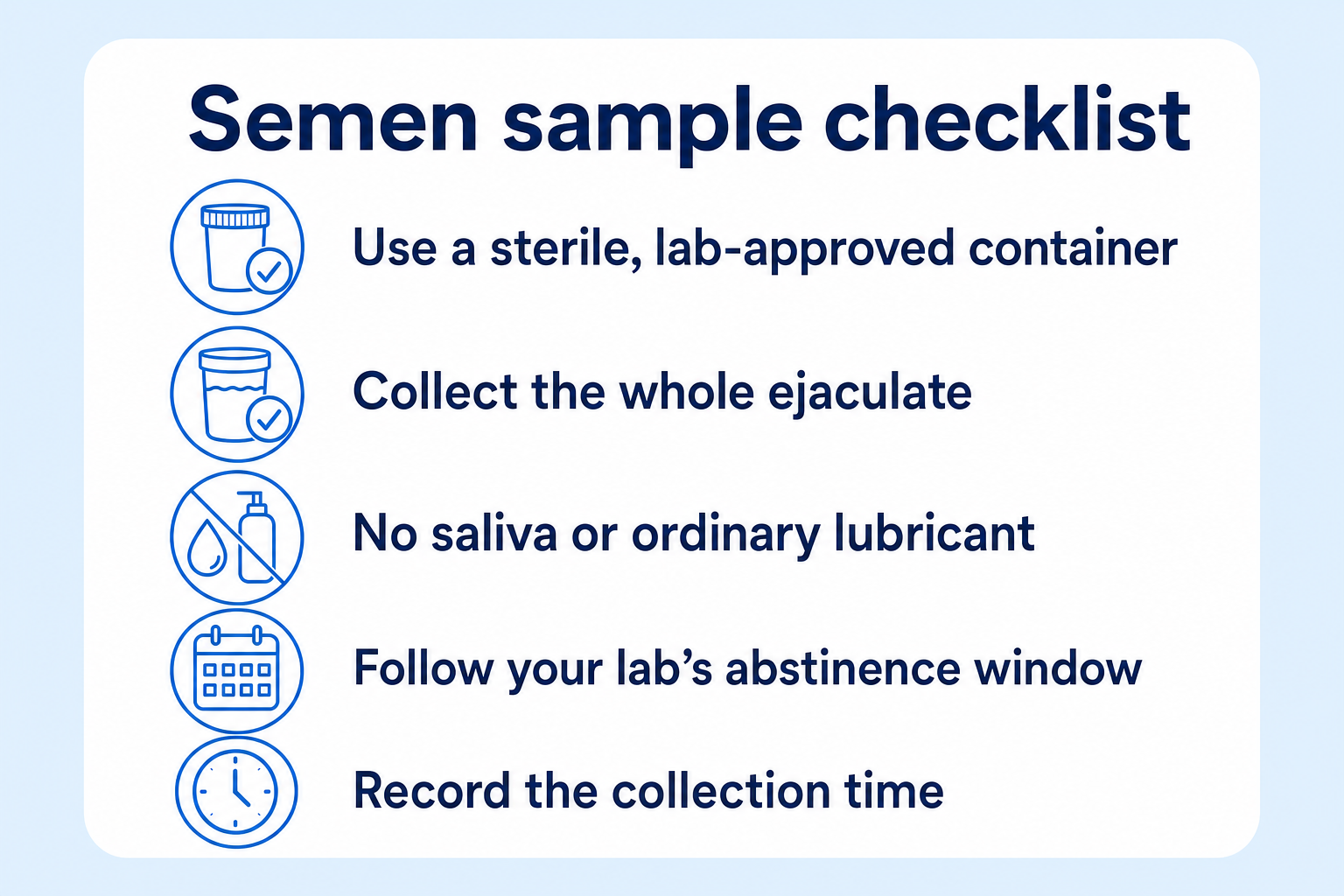
Follow the abstinence interval on your order. Many labs request two to five days without ejaculation. Broader WHO semen standards use a two-to-seven-day window, so your own lab's narrower instructions take priority.
Use the container provided or approved by the lab. Follow its washing instructions, then make sure your hands and genitals are rinsed and dry. Your partner should wash and dry their hands too. Soap, lotion, hand sanitizer, and lubricant residue should stay out of the cup.
Agree on the kind of help you want before starting. Either person can change their mind. Support can mean staying in the room, helping manually, or giving you privacy.
3. Collect the whole sample directly into the cup
Open the cup without touching its inside or the inner surface of the lid. Your partner can assist manually with clean, dry hands, but ejaculation should go directly into the cup. Do not add saliva, water, lubricant, or anything else.
Collecting the entire ejaculate matters because the lab measures semen volume, sperm concentration, and total sperm count. A split-ejaculate study found that the first fraction had a higher sperm concentration than later fractions, so losing it can make the result less representative. ASRM guidance calls for the entire ejaculate to be collected under the specified conditions.
4. Seal, record, and hand off the sample
Close the lid firmly and record the collection time as instructed. Label the container only as directed. If you collected on site, give it to staff promptly.
If the lab approved home collection, keep the cup upright, protect it from hot or cold temperatures, and travel directly to the lab. Many facilities require delivery within 30 to 60 minutes, but the exact window is location-specific. The MedlinePlus collection guidance also explains why the sterile cup, complete sample, prompt delivery, and freedom from saliva and regular lubricant matter.
For the rest of the appointment process, our sperm testing guide explains how to prepare, what the lab measures, and what happens after collection.
What if collection does not go to plan?
You missed or spilled part of the sample
Seal the cup and tell the lab exactly what happened, including whether the beginning, middle, or end was missed. Do not scrape semen from your skin, clothing, a surface, or another container into the cup. The lab may analyze the specimen with a note that it was incomplete, or it may arrange a repeat collection.
Saliva, lubricant, or an ordinary condom touched the sample
Tell the lab before it processes the specimen. The collection may need to be repeated because these substances can alter motility or contaminate the sample. Do not try to dilute, rinse, or transfer it to “fix” the problem.
You cannot ejaculate in the collection room
Let staff know. Difficulty producing a sample on demand happens, and it is not a personal failure. Depending on the test and facility, the options may include more private time, an approved home collection, a laboratory collection condom, or a new appointment.
Call the care team immediately if the sample is needed that day for IUI or IVF. Timing and chain-of-identity requirements are stricter for treatment samples, so changing the collection method without approval can make the specimen unusable. If this happens repeatedly, a urologist or sexual-medicine clinician can assess delayed ejaculation, medication effects, and other possible causes.
Your partner makes the situation feel more pressured
Pause and change the plan. Your partner can wait outside or help with logistics instead. The goal is a complete, uncontaminated sample, and the most supportive arrangement is the one that works for the person collecting it.
Do the rules change for IVF, IUI, or post-vasectomy testing?
The basic contamination rules stay the same, but the handoff can be different:
- Diagnostic fertility semen analysis: Partner support or manual assistance is often possible, subject to the lab's room and collection policies.
- IUI or IVF: Identity checks, timing, and handling are stricter because the sample will be used in treatment. Use only the method authorized by the fertility clinic.
- Post-vasectomy semen analysis: The test looks for sperm remaining after the procedure. Follow the urologist's collection instructions and keep using contraception until you receive formal clearance.
- Sperm banking: The bank's collection, consent, and identification procedure controls. Ask about partner access before the appointment.
Arrange a local semen analysis with clear instructions
We help you compare 700+ participating CLIA-certified labs, obtain a physician-signed lab requisition without a separate doctor visit or referral, and understand the results in plain English. Collection location and partner access remain specific to the chosen lab.
Find a local lab and choose a location whose collection process works for you.
Related Resource Articles
-
At-Home vs On-Site Sample Collection: Which Is Right?
At-home vs. on-site semen analysis: Which is right for you? Compare convenience, privacy, cost & accuracy to choose your best fertility testing option. Learn
11 min read
-
Can Men Take Prenatal Vitamins for Hair Growth?
Discover if can men take prenatal vitamins for hair growth. We break down the science, risks, fertility concerns, and smarter male alternatives.
12 min read
-
Can You Freeze Sperm at Home? A Guide to Safe Male Fertility Preservation
Thinking about 'can you freeze sperm at home'? This guide explains why DIY methods fail and explores safe, professional at-home collection kits for men.
24 min read