Let's get right to it: Will a vasectomy tank your testosterone? The short answer is no. This is probably one of the biggest myths floating around about the procedure, and it’s rooted in a simple misunderstanding of male anatomy.
A vasectomy is a permanent, highly effective form of male contraception, but it works on your body's plumbing, not its hormone factory.
Setting the Record Straight on Vasectomies and Testosterone
It’s completely normal for men to wonder about hormones when considering a vasectomy. Testosterone is the engine that drives so much of male health—from sex drive and muscle mass to mood and energy levels. The good news is that the overwhelming body of scientific evidence confirms your testosterone levels are safe.
Think of your testes as having two completely separate departments:
- Hormone Production: One department manufactures testosterone and releases it directly into your bloodstream. This is like a factory shipping goods nationwide via the main highway system.
- Sperm Transport: The other department makes sperm, which travels down a very specific local road—the vas deferens—to eventually mix with semen.
A vasectomy simply closes off that small local road. That’s it. It has absolutely no impact on the hormone factory or its access to the superhighway of your bloodstream. Your body keeps producing and circulating testosterone exactly as it did before.
Vasectomy Impact: What Changes vs. What Stays the Same
This distinction is key. Because the procedure only affects sperm transport, your hormonal health and sexual function remain completely unchanged. In fact, numerous studies have tracked men for years after a vasectomy and found no significant long-term changes in their testosterone levels. For more details, you can learn about the research showing that a vasectomy does not affect testosterone production or sex drive.
To put it all in one place, here’s a simple breakdown of what a vasectomy actually changes versus what it leaves alone.
| Function | Impact of Vasectomy | The Bottom Line |
|---|---|---|
| Testosterone Production | No Impact | Your testes continue to produce testosterone at the same levels as before. |
| Sperm Transport | Blocked | Sperm are blocked from traveling through the vas deferens to the penis. |
| Sex Drive (Libido) | No Impact | Your desire for sex is driven by testosterone, which remains stable. |
| Erections | No Impact | The physiological ability to get and maintain an erection is not affected. |
| Ejaculation | No Impact | You will still ejaculate semen, but it will no longer contain sperm. |
Ultimately, the only thing that changes after a vasectomy is that your semen will be sperm-free, preventing pregnancy. Everything else—your hormones, sex drive, erections, and the sensation of orgasm—stays exactly the same.
Understanding How a Man's Body Makes Testosterone
To get straight to the point, let's clear up how the male reproductive system is actually wired. A common myth is that a vasectomy messes with your hormones, but a quick look at the biology shows these two jobs are completely separate. Understanding this is the key to feeling confident about the procedure.
Think of your testes as a sophisticated factory with two totally independent production lines. Each line has its own unique product and its own dedicated shipping department.
The Two Separate Production Lines
The first production line is all about making sperm. Once these cells are made, they travel down a specific tube—the vas deferens—to mix with semen during ejaculation. A vasectomy simply closes this one specific shipping route. That's it.
The second production line manufactures testosterone. This hormone isn't packaged up and sent out with the sperm. Instead, it’s released directly into your body's internal delivery network: the bloodstream. From there, it travels everywhere it needs to go to do its job.
A vasectomy only cuts the tube for sperm. It has absolutely no impact on testosterone production or its direct path into your bloodstream. Your hormone factory continues running just as it always has.
This clean separation is precisely why a vasectomy does not cause low testosterone. The procedure is like closing a small local road while the national highway system keeps operating without a single delay.
Visualizing the Vasectomy Process
The diagram below makes it crystal clear what a vasectomy touches and, more importantly, what it leaves alone.
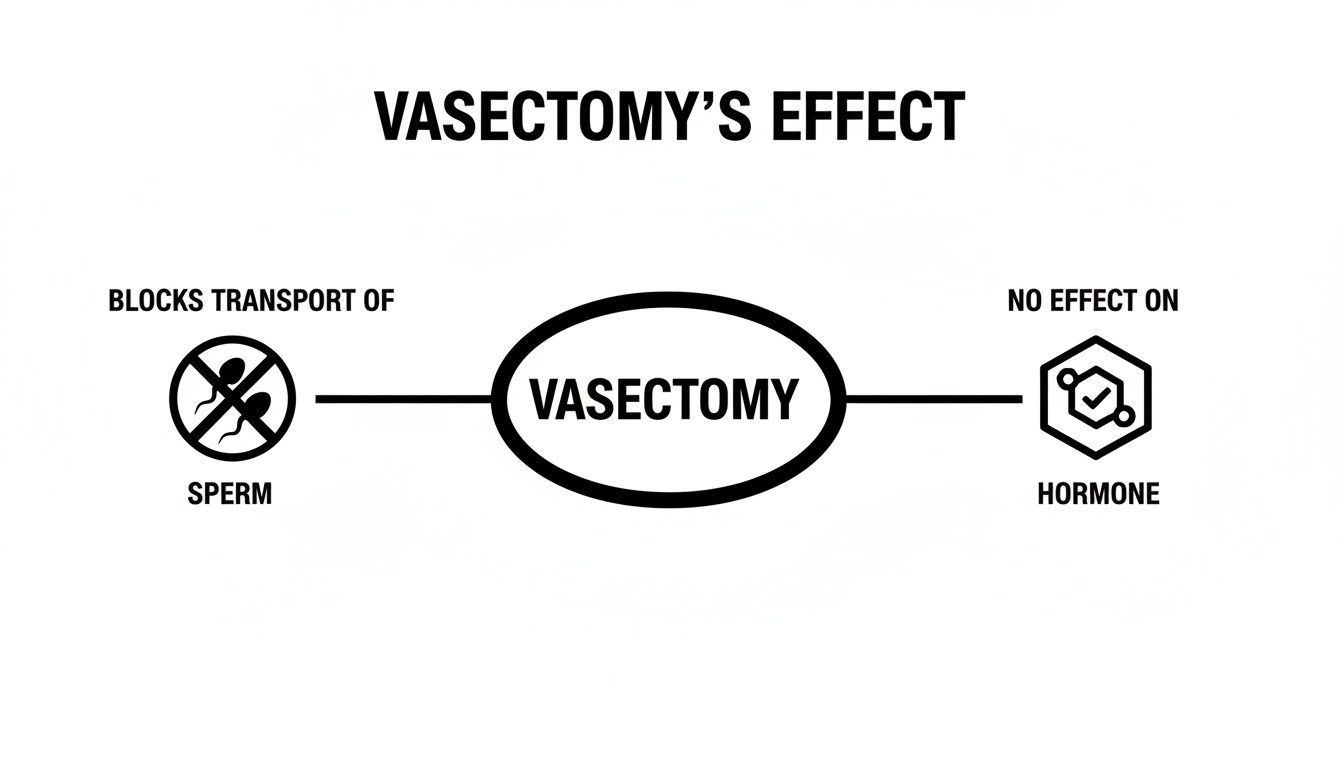
As you can see, the procedure is incredibly precise. It targets only the sperm transport tube, leaving the hormone production and delivery systems completely untouched.
This isn't just theory; it's backed by a mountain of clinical evidence. For instance, a major study published in the Asian Journal of Andrology found no significant difference in testosterone levels between men who had a vasectomy and those who hadn't. The research is consistent and conclusive.
After the procedure, your body will still make sperm. But since their path is blocked, the cells are simply and harmlessly reabsorbed by the body. This is a natural process that happens without affecting your hormones one bit. Understanding this basic biology provides the ultimate reassurance that your testosterone levels are safe.
What the Science Says About Vasectomy and Hormone Levels
While understanding the body's mechanics is a good start, the real confidence comes from the hard data. For decades, researchers have been looking at men's health after a vasectomy, and the scientific consensus is overwhelmingly clear: the procedure does not mess with your testosterone levels.
If you're considering a vasectomy, you can rest easy knowing this isn't just a theory—it's a conclusion backed by a mountain of clinical evidence. Study after study has compared men who've had a vasectomy to those who haven't and found no meaningful difference in their hormone profiles over the long haul.
Looking at the Clinical Evidence
The research consistently shows that testosterone, your primary male hormone, stays stable. Now, it's true that some men might see a very slight, temporary dip in testosterone right after the procedure. This is usually due to minor inflammation as your body heals.
Think of it as the body's natural response to any minor surgery. These levels quickly bounce back to normal, and it's definitely not a sign of a long-term hormonal problem.
In fact, the evidence doesn't just debunk the myth; it actually points in the opposite direction. Some long-term studies have uncovered a surprising trend.
Far from causing a drop, some research suggests that men may actually have slightly higher testosterone levels many years after a vasectomy compared to men who haven't had the procedure. This finding further reinforces that a decrease in testosterone is not a risk.
Long-Term Studies Provide Reassurance
This isn't a new area of study. Research going back decades gives us a solid foundation for this conclusion. For instance, a notable study from 1994 took a long-term look at men more than 20 years after their vasectomies. It found these men actually had higher testosterone levels than the control group, perfectly aligning with the broader evidence that low T fears are unfounded. You can dig into the findings from this long-term vasectomy research to see the data for yourself.
This makes perfect biological sense. As experts from leading health institutions confirm, testosterone production and its release into your bloodstream are completely separate from sperm transport. The vasectomy never touches the Leydig cells in the testes that make hormones or interferes with their ability to deliver testosterone throughout your body. If you're interested in hearing directly from medical professionals, you can find more insights in our collection of expert interviews on men's health.
The takeaway here is simple and powerful: science has thoroughly investigated this question, and the answer is a definitive no. Your body's hormonal balance is not affected, allowing you to make this decision with confidence.
Recognizing the Real Symptoms of Low Testosterone
It's completely normal to feel a little "off" after any medical procedure, vasectomy included. But it's also important not to mistakenly blame the surgery for symptoms that have nothing to do with it.
Since a vasectomy doesn't touch your testosterone production, any long-term symptoms you might experience are almost certainly due to other factors. This could be anything from the natural aging process and lifestyle habits to other underlying health conditions. Understanding the real signs of low testosterone helps you separate them from the normal, temporary healing process after your procedure.

Common Signs of Genuinely Low Testosterone
If your testosterone levels are actually low, the signs are usually persistent and noticeable enough to affect your daily life. They go far beyond the temporary discomfort you might feel while recovering from your vasectomy. Knowing what to look for is the first step in addressing the real root cause.
Common symptoms of low testosterone in men often include:
- Persistent Fatigue: This isn't just feeling tired after a long day. It’s a constant, bone-deep exhaustion that doesn't seem to improve much, even with rest.
- Reduced Sex Drive: A significant and lasting drop in your desire for sex is one of the classic indicators of a hormonal imbalance.
- Mood Changes: Many men with low T report feeling more irritable, having a harder time concentrating, or just dealing with a persistently low mood.
- Difficulty with Erections: While not always the case, trouble getting or maintaining an erection can definitely be linked to low testosterone levels.
- Loss of Muscle Mass: You might notice it's harder to build or maintain muscle, even if you’re still hitting the gym regularly.
- Increase in Body Fat: A shift in your body composition, especially gaining more fat around your midsection, can also be a clear sign.
Why It's Important to Know the Difference
It’s easy to connect any weird feeling you have after a medical procedure directly to that procedure. But the mild soreness and swelling from a vasectomy are temporary and localized—they are part of the physical healing process and have zero connection to your body's hormone production.
Recognizing the difference is crucial. Blaming a vasectomy for unrelated symptoms like ongoing fatigue or a low mood can keep you from finding the real problem. True hormonal issues need a proper diagnosis from a healthcare professional.
If any of the symptoms listed above sound familiar and they stick around long after you’ve healed from your procedure, it's time to take action. Don't just assume it's your new normal. These signs are your body’s way of telling you that something might be out of balance, and it’s worth investigating with a simple test to get clear answers.
What To Do Next: Your Action Plan for Testing and Getting Answers
If you’re worried about your testosterone levels—whether you're thinking about a vasectomy or you’ve already had one—the path forward is actually quite simple. The key is to get clear, data-driven answers so you can stop guessing and start making informed decisions.
First things first, you need to understand which tests matter. Confirming a vasectomy worked and checking your hormone levels are two totally different things, done with two totally different tests. Knowing the difference is crucial so you can ask your doctor for exactly what you need.

Making Sense of the Right Health Tests
It's easy to mix up medical tests, but each one serves a very specific purpose. Once you know what each test is looking for, you can take a much more proactive role in managing your health.
Here’s a quick breakdown of the two key tests for a man post-vasectomy:
Serum Testosterone Test: This is a straightforward blood test that measures the amount of testosterone floating around in your system. It is the only way to get a real diagnosis for low testosterone. If you’re dealing with symptoms like constant fatigue or a nosedive in your sex drive, this is the test to ask for.
Post-Vasectomy Semen Analysis: This test is performed a few months after your procedure for one reason and one reason only: to make sure the vasectomy was a success. It checks your semen to confirm there is zero sperm present, which means you can stop using other contraception. This test tells you absolutely nothing about your hormone levels.
A huge misconception is that the follow-up test after a vasectomy checks your hormones. It doesn't. Its sole purpose is to count sperm (or, hopefully, confirm their absence), not to investigate testosterone.
Taking Charge of Your Testing Journey
Getting lab tests can feel like a hassle, but it doesn't have to be. Modern platforms like Hera Fertility are built to streamline the whole process, putting you firmly in the driver's seat of your reproductive health. You can easily get a physician-approved order for the exact tests you need.
From there, our platform helps you find a convenient lab for your testosterone test from a network of certified partners. When your results are in, you'll get a clear, simple breakdown of your numbers. We use tools like the Hera SmartScore to translate complex medical jargon into easy-to-understand insights, so you know precisely where you stand.
When you walk into your doctor's office armed with this kind of clear information, the conversation changes completely. Instead of just vaguely describing how you feel, you can share concrete data. This allows your urologist or men's health specialist to give you the best possible guidance for your long-term health and well-being.
Common Questions About Vasectomies and Men's Health
Making the final call to get a vasectomy is a big decision, and it’s totally normal for a man to have a few last-minute questions running through his mind. Beyond the main worry of whether vasectomies can cause low testosterone, men often wonder how the procedure might affect other parts of their health and sex life.
Getting clear, straightforward answers is the best way to feel confident and know you're making the right choice. This final section cuts through the noise to tackle the most common questions we hear, so you know exactly what to expect.
Will My Sex Life Change After a Vasectomy?
This is a huge one for most men, but the answer is refreshingly simple: No, a vasectomy shouldn't negatively impact your sex life at all. In fact, many men find their sex life actually improves once the stress of an unplanned pregnancy is off the table.
Your libido, your ability to get an erection, and how an orgasm feels are all driven by testosterone. As we’ve already covered, the procedure doesn't touch the cells that produce testosterone, so none of that changes.
- Ejaculate Volume: You won't notice any difference. Sperm only accounts for about 2-5% of your total semen volume. The rest is fluid produced by glands that are left completely alone during a vasectomy.
- Orgasm Sensation: The feeling will be exactly the same. The pleasure of an orgasm is a complex mix of nerve signals and muscle contractions that remain totally unaffected.
Bottom line: everything will look, feel, and work just like it did before.
Is Post-Vasectomy Pain a Sign of a Hormone Problem?
It's completely normal to have some soreness, minor bruising, or a bit of swelling down there for a few days to a week after your procedure. This is just your body’s natural response to healing from minor surgery.
This discomfort is purely physical and localized to the surgical area—it has absolutely nothing to do with your hormone levels. It's really important not to mistake this temporary, physical healing pain for a sign of a hormonal issue like low T. The two are entirely unrelated.
The pain you feel while healing is temporary and physical. Hormone-related symptoms, like constant fatigue or a major drop in libido, are systemic and would not be caused by the procedure itself.
If you experience severe pain or discomfort that isn't getting better, you should always give your doctor a call. But rest assured, it’s not a signal that your testosterone has taken a nosedive.
Can a Vasectomy Be Reversed if I Change My Mind?
While vasectomy reversals are technically possible, they aren't a simple undo button. The surgery to reconnect the vas deferens is much more complicated and expensive than the original vasectomy, and success is never guaranteed.
The odds of a successful reversal really depend on a few key things:
- Time Since Vasectomy: The longer you wait, the lower the chances of success.
- Surgeon's Expertise: Reversals demand a highly skilled microsurgeon to get right.
- Development of Blockages: Sometimes, secondary blockages can form over time, complicating the repair.
For these reasons, a man should always go into a vasectomy viewing it as a permanent form of contraception. If there's any part of you that thinks you might want more children down the road, it’s smart to look at other options or consider sperm banking before you commit. Understanding the early signs of male infertility can also give you a broader perspective on your reproductive health.
Why Do I Need a Follow-Up Test?
A vasectomy isn't effective the moment you walk out of the clinic. Live sperm can hang out in the upper part of your reproductive tract for weeks or even a few months after the procedure. It's crucial for men to keep using another form of contraception until they get the all-clear.
The only way to know for sure that the vasectomy worked is to get a post-vasectomy semen analysis. This simple test, usually done about 12 weeks later, confirms that your semen is 100% sperm-free. Think of it as the final, critical step that gives you the green light to rely on the vasectomy for contraception.
At Hera Fertility, we make it easy to confirm your vasectomy was a success. You can get a physician-signed lab order for your post-vasectomy semen analysis in minutes and get tested at a lab near you. Our simple, clear reports give you the definitive answers you need to move forward with complete confidence. Get started by visiting https://herafertility.co.
Related Resource Articles
-
Can a vasectomy cause low testosterone levels? Debunking myths and hormones
Learn what can vasectomy cause low testosterone levels means for you. We break down science vs. myth to guide your hormonal health decisions.
21 min read
-
Vitamin for Men Fertility: The Ultimate Guide to Sperm Health
Discover how vitamin for men fertility can boost sperm health, testosterone balance, and overall reproductive wellness with science-backed vitamins.
20 min read
-
Vasectomy and Erectile Dysfunction A Guide for Men
Worried about the link between vasectomy and erectile dysfunction? We explore the evidence, debunk common myths, and explain what to expect. Get clarity now.
17 min read