Let's get right to the big question: a vasectomy will not cause your testosterone levels to drop. That’s not just an opinion; it's the overwhelming medical and scientific consensus. The machinery in your body that produces testosterone is completely separate from the sperm delivery system that a vasectomy deals with.
Separating Myth From Reality
It's completely normal for men considering a vasectomy to wonder about the impact on their hormonal health, sex drive, and overall vitality. It’s a valid concern, but luckily, it's one that’s based on a common misunderstanding of how a man's body works. The idea that a vasectomy and low testosterone are linked is a stubborn myth, usually fueled by confusing coincidence with cause.
Here’s the thing: men often get a vasectomy in their 30s, 40s, or 50s. This also happens to be the exact time when testosterone levels can naturally start a slow, gradual decline simply due to aging. So, if a man starts feeling symptoms like fatigue or a lower sex drive after his procedure, it’s easy to point the finger at the vasectomy. In reality, the timing is almost always coincidental, not causal.
The Vasectomy and Hormone Connection: Why They’re Separate
To really get why a vasectomy doesn't mess with your testosterone, it helps to think of the testicles as a factory with two totally different production lines and two separate shipping departments.
- Production Line #1: Sperm Manufacturing. This happens inside the seminiferous tubules. Their one and only job is to create sperm.
- Production Line #2: Testosterone Manufacturing. This is handled by specialized cells called Leydig cells, which are also located in the testicles but work independently.
A vasectomy simply closes down a tiny part of the shipping route for sperm—the tubes called the vas deferens. It's like shutting down a single local road.
Meanwhile, the testosterone factory keeps running at full steam. More importantly, it uses a completely different shipping network. Testosterone is released directly into your bloodstream, which acts like a national highway system, delivering it all over your body.
A vasectomy is a highly targeted procedure focused only on sperm transport. It doesn't touch the testicles' structure, their blood supply, or the hormonal work being done by the Leydig cells. Your body's hormone factory is left completely undisturbed.
To make this even clearer, let's break down the common myths versus the scientific facts.
Myth vs. Reality: Vasectomy and Testosterone Production
| Area of Concern | The Common Myth | The Scientific Reality |
|---|---|---|
| Hormone Production | "The procedure damages the testicles, stopping them from making testosterone." | Only the vas deferens tubes are cut. The Leydig cells in the testicles, which produce 95% of testosterone, are unaffected and continue their job as normal. |
| Hormone Delivery | "Cutting the tubes blocks testosterone from getting out." | Testosterone is released directly into the bloodstream, not into the vas deferens. This "shipping route" remains wide open. |
| Physical Changes | "A vasectomy will lower my sex drive, cause erectile dysfunction, or make me less 'manly'." | Libido, erections, and masculine traits are driven by testosterone levels, which remain unchanged. A vasectomy has no physical effect on sexual function. |
| Sperm Production | "Sperm will build up and cause problems that affect hormones." | Sperm continue to be produced, but they are simply reabsorbed by the body. This is a natural, harmless process that has no impact on hormone regulation. |
As you can see, the biological systems for creating sperm and creating testosterone are fundamentally separate. A vasectomy only interacts with the sperm transport system.
What the Experts Say
This isn't just theory; it's confirmed by years of medical research and clinical experience. As experts at leading institutions like Hackensack Meridian Health point out, there is no credible research showing that vasectomies lower testosterone levels.
The procedure only blocks the tubes carrying sperm. It has zero effect on the testicles' ability to produce testosterone, which enters the bloodstream directly. You can learn more about the procedure's hormonal safety from other trusted medical sources as well.
This clear separation of functions is the key takeaway. After a vasectomy, your hormonal health remains secure.
How a Vasectomy Actually Works in Your Body
To get why a vasectomy has zero impact on testosterone, we first need to look at what the procedure actually does inside your body. Forget the complex medical terms for a moment. At its heart, a vasectomy is an incredibly precise procedure that acts like a simple roadblock for sperm.
Think of your reproductive system as a sophisticated plumbing network. Your testicles have two main jobs that run on completely separate lines: making sperm and making testosterone. A vasectomy only ever touches the sperm's delivery route.
The procedure focuses entirely on the vas deferens—the two tiny tubes that carry sperm from your testicles up to mix with semen. A urologist simply cuts or seals these tubes, creating a permanent dead end. Sperm can no longer complete their journey, meaning they can’t show up in your ejaculate. It's as simple as that.
Two Systems, One Factory
It’s absolutely crucial to understand that the system for producing testosterone and the system for transporting sperm are completely separate, even though they start in the same place.
- Sperm Transport: This involves the vas deferens, the tubes that are cut or sealed during a vasectomy. Think of this as a local delivery route.
- Hormone Delivery: Testosterone is made by specialized cells in the testicles (called Leydig cells) and is released directly into your bloodstream. This is the major highway.
This separation is the entire reason a vasectomy does not and cannot cause low testosterone. The procedure never touches your testicles' ability to produce hormones or the circulatory system that distributes testosterone throughout your body.
The best analogy is a busy factory with two separate shipping docks. Dock A sends out finished products via a small local road. Dock B ships raw materials nationwide via a major highway. A vasectomy is like closing that small local road; it has absolutely no effect on the highway's operations.
This visual shows exactly how a vasectomy isolates the sperm pathway while leaving testosterone production completely untouched.
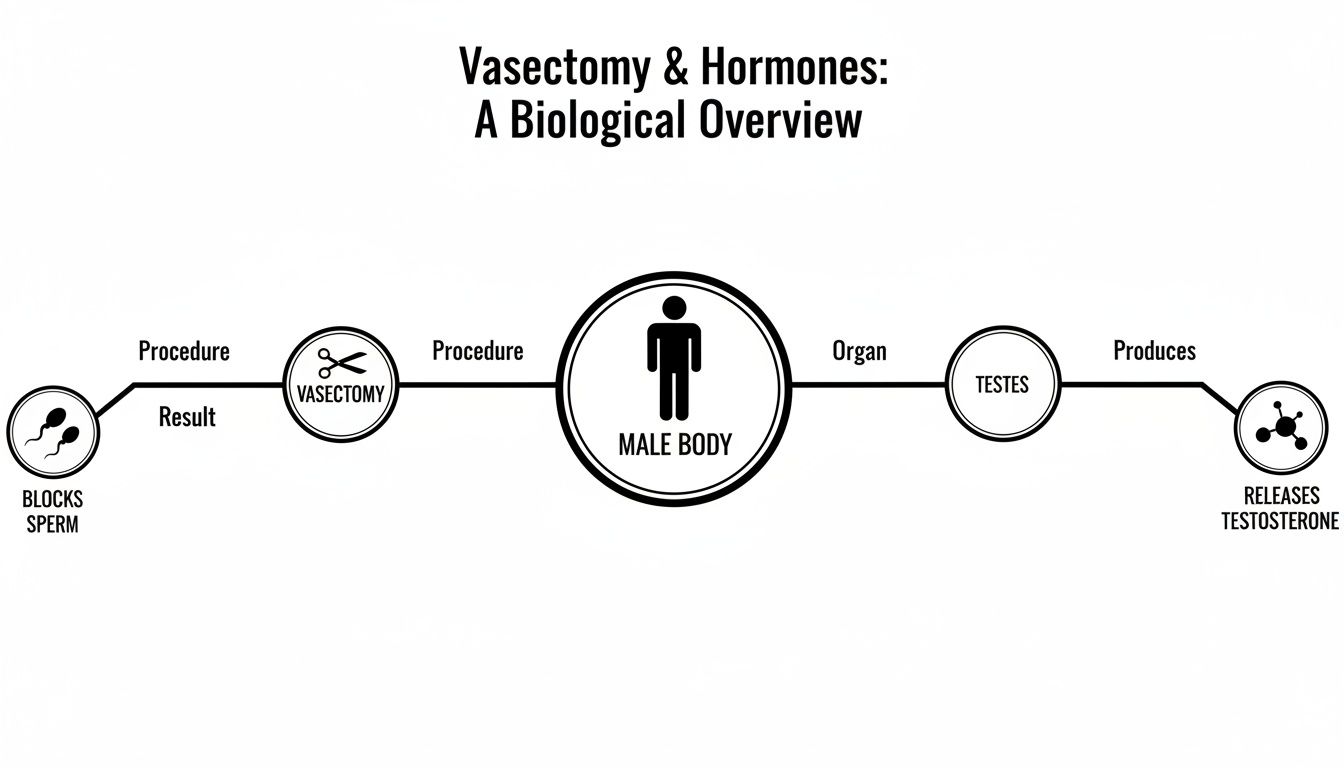
As you can see, the procedure creates a physical barrier for sperm, but the testes keep releasing testosterone straight into the bloodstream just like they always have.
So, What Happens to the Sperm?
This is one of the most common questions men ask: if the sperm can't get out, where do they go? The answer is simple. Your body continues making sperm after a vasectomy, but since they have nowhere to go, they are simply and harmlessly reabsorbed by your body.
It’s a natural process your body handles without any issue. Think of it as a clean, efficient internal recycling system that causes no harm, no buildup, and absolutely no hormonal changes. The two functions just aren't biologically linked.
This key point provides a lot of peace of mind. To dive deeper into this and other related topics, feel free to explore more about male fertility in our comprehensive guides.
Understanding How Your Body Produces Testosterone
To really get why a vasectomy has no impact on testosterone, we first need to look at how your body actually makes this crucial hormone. It's easy to think of the testicles as doing one single job, but they're more like a company with two completely separate departments working under one roof.
One department is all about making sperm. The other department is staffed by specialized workers called Leydig cells, and their one and only mission is to produce testosterone. These two operations run in parallel, but their paths never cross in a way that would let a vasectomy interfere. A vasectomy is a precision procedure—it only affects the route sperm travel, leaving the testosterone factory completely untouched.
The Testosterone Superhighway
Think of your circulatory system—your veins and arteries—as a massive highway network that connects every part of your body. The Leydig cells are like manufacturing plants built right on the on-ramp to this highway. As soon as they produce testosterone, they release it directly into your bloodstream.
This direct-to-bloodstream delivery is the key. Testosterone never travels through the vas deferens, the tiny tubes that are sealed off during a vasectomy. It uses the body's main circulatory system to get everywhere it needs to go, influencing everything from your muscle mass and bone density to your mood and sex drive.
Because of this setup, cutting the vas deferens is like closing a small local road miles away from the main highway. The testosterone delivery trucks were never going to use that road anyway, so their shipments continue without any disruption.
What Does the Science Show Us?
This isn't just a theory; it’s a fact backed by decades of medical research. The scientific community has repeatedly investigated whether vasectomies can cause low testosterone and has consistently found no connection. The evidence is overwhelming: your hormone levels are not negatively affected by the procedure.
Interestingly, some studies have even hinted at the opposite. While confirming no drop in testosterone, some long-term research has occasionally noted slight increases post-vasectomy. For instance, a well-known long-term vasectomy findings study from 1994 followed men for over 20 years and found their testosterone levels were actually a bit higher than those in the control group.
The biological separation between sperm transport and hormone production is the fundamental reason your hormone levels, sex drive, and sense of masculinity remain completely unaffected by a vasectomy.
Why Your Masculinity Remains Intact
It's completely normal to wonder if a vasectomy could impact your "manliness," but these concerns are rooted in a simple misunderstanding of male physiology. Masculine traits like a deep voice, facial hair, and muscle development are all driven by testosterone traveling through your bloodstream.
Since a vasectomy does not change:
- Testosterone Production: The Leydig cells keep working just as they always have.
- Testosterone Delivery: The hormone is still released directly into the bloodstream.
- Hormone Levels: Your overall testosterone balance stays the same.
The procedure has no effect on the physical or psychological characteristics that define you as a man. Your body’s hormonal engine keeps running exactly as it did before, ensuring your vitality and male traits are preserved. This clear separation of duties offers powerful peace of mind for any man considering this safe and effective procedure.
What Decades of Medical Research Confirms
The idea that a vasectomy could tank your testosterone levels isn't new. For decades, men have voiced this exact concern, and for just as long, the medical world has been digging into the data to find a clear, evidence-based answer.
And the good news? The conclusion from all that research is overwhelmingly decisive and reassuring. This isn't some hot debate in urology or endocrinology—the science is considered settled. Major health institutions and countless studies involving thousands of men have all landed on the same firm conclusion: there is no credible scientific link between getting a vasectomy and a drop in testosterone.
The Overwhelming Scientific Consensus
When scientists want the most rock-solid answer possible, they perform something called a meta-analysis. Think of it as a "study of studies." Researchers gather all the high-quality experiments on a topic and analyze the combined results, giving them a powerful, big-picture view that's far more definitive than any single study.
On the topic of vasectomies and testosterone, these large-scale reviews have been crystal clear. They consistently show that men who have had a vasectomy maintain the exact same testosterone levels as men who haven't. The procedure simply doesn't touch the body's hormonal machinery.
The verdict from years of rigorous scientific investigation is clear: a vasectomy is a hormonally safe procedure. Its mechanical function—blocking sperm—is completely separate from the biological process of testosterone production and distribution.
What the Data Reveals About Male Health
Digging deeper, the research looks beyond just testosterone levels to the broader picture of sexual health after a vasectomy. A comprehensive 2018 meta-analysis, which pooled data from thousands of cases, found the procedure had zero negative impact on testosterone, libido, or the ability to get an erection.
It even confirmed that semen volume only dips by a tiny amount, since sperm makes up just 2-5% of the total ejaculate. You can dive into the details yourself and learn more about common vasectomy myths and facts.
This makes perfect sense when you consider the biology. As top institutions like the Mayo Clinic report, a vasectomy doesn't interfere with the nerves or blood flow essential for sexual function. Your ability to have an orgasm and experience pleasure remains completely intact.
So, Why Does This Myth Persist?
If the science is so cut and dry, why does this worry still pop up? The answer usually boils down to timing and coincidence.
Men often choose to get a vasectomy in their 30s, 40s, or 50s. This also happens to be the exact same window of time when testosterone levels can naturally start to decline as part of the normal aging process.
So, if a man starts feeling run down or notices a lower sex drive a year or two after his procedure, it’s all too easy to connect the two dots. In reality, the true cause is almost always something completely unrelated, like:
- Natural Aging: Testosterone levels peak in a man's late teens and early 20s, then gradually decline year over year.
- Lifestyle Factors: Chronic stress, poor sleep, a bad diet, and lack of exercise can all hammer your hormone levels.
- Other Health Conditions: Underlying medical issues are also a common cause of low testosterone.
The bottom line from all the research is this: if you develop these symptoms after a vasectomy, the procedure isn't the culprit. This clarity is crucial because it allows you and your doctor to focus on finding the real cause and getting you an effective solution, instead of worrying about a procedure that's been proven safe for decades.
Identifying the Real Symptoms of Low Testosterone
If you’re feeling off after your vasectomy, it’s completely natural to start connecting dots and searching for a cause. But since we know the procedure itself doesn't touch your hormone production, it's time to shift focus from the surgery to what might actually be going on inside your body.
Recognizing the real signs of low testosterone is the first step. The symptoms of low testosterone, also known as male hypogonadism, are sneaky. They often creep in so gradually that it's easy to write them off as just stress, aging, or a busy life. The key isn't to panic but to become an informed observer of your own health. Knowing what to look for empowers you to have a much more productive conversation with your doctor.

Here's a breakdown of the common signs, which usually fall into physical, sexual, and emotional categories.
Common Signs of Low Testosterone in Men
This checklist covers some of the most common physical, sexual, and emotional symptoms that might point toward low testosterone levels.
| Symptom Category | What to Look For |
|---|---|
| Sexual Symptoms | A noticeable drop in your overall interest in sex (low libido). Difficulty achieving or maintaining an erection. A clear reduction in the volume of semen during ejaculation. |
| Physical Symptoms | Losing muscle mass and strength, even with regular workouts. An increase in body fat, especially around the belly. Persistent, deep fatigue that doesn't improve with rest. Hair loss (on the body, face, or head). |
| Emotional & Mental Symptoms | Uncharacteristic mood swings, irritability, or increased sadness. "Brain fog," difficulty concentrating, or memory problems. A general lack of motivation or a depressed mood. |
It's important to remember that experiencing one of these symptoms in isolation isn't necessarily a cause for alarm. However, if you're noticing a pattern or a combination of these signs, it's a strong signal that it's time to investigate further. You can learn more about the various signs related to male infertility and health to get a more complete picture.
Emotional and Mental Symptoms Aren’t Just “in Your Head”
The impact of low testosterone goes far beyond the physical. It can significantly affect your mood, mental clarity, and overall sense of well-being. This is an area men often overlook, chalking up feelings of burnout or irritability to a tough week at work.
Testosterone plays a key role in regulating neurotransmitters in your brain. When your hormone levels are out of whack, it can have a direct, measurable impact on your mood and cognitive function. Recognizing this connection is a huge step.
Think about it this way:
- Persistent Fatigue: We're not talking about feeling tired after a long day. This is a deep, relentless exhaustion and lack of energy that sleep doesn't seem to fix.
- Mood Swings or Irritability: You might find yourself with a shorter fuse, feeling down for no reason, or just not feeling like yourself.
- Trouble with Concentration: That mental fog, forgetting things, or an inability to focus can be incredibly frustrating—and it can be a subtle sign of a hormonal issue.
- Depressed Mood: While low testosterone doesn't automatically mean clinical depression, it can certainly contribute to a persistent feeling of sadness and a loss of enjoyment in things you once loved.
If you’re reading this and nodding along to several of these symptoms, it’s a clear signal that something in your body is out of balance. The next logical step is to stop guessing and start getting concrete answers.
Your Action Plan for Hormonal Health Concerns
If you're reading this, chances are you're dealing with symptoms that have you worried about low testosterone. Whether you've had a vasectomy or not, feeling tired all the time, being irritable, or noticing your sex drive has taken a nosedive are all valid reasons to be concerned. The good news? Getting clear, reliable answers is more straightforward than you might think.
Instead of getting lost in a cycle of "what ifs" and late-night internet searches, you can take back control with a simple, proactive plan. This isn't about jumping to conclusions. It's about methodically ruling out possibilities to find the real root of your symptoms so you can get the right solution.
Step 1: Start the Conversation with a Professional
Your first and most important move is to schedule a visit with your primary care doctor or a urologist. This conversation is the foundation for everything that follows. Before you go, take a few minutes to jot down the specific symptoms you've been having.
Get detailed. Note when they started, how often they happen, and how they're affecting your daily life. This isn't just a list of complaints; it's the crucial context your doctor needs to help you effectively.
Step 2: Ask for the Right Test
While talking through your symptoms is key, the only way to know for sure if your testosterone is low is with a simple blood test. It’s a standard, routine lab test that measures the amount of testosterone circulating in your system.
Don't be hesitant to ask directly: "Could we run a blood test to check my testosterone levels?" This single question cuts through all the guesswork and gives you hard data. It’s the only definitive way to confirm or rule out low testosterone.
Taking proactive steps to get your hormone levels checked is a sign of strength. It shows you are taking charge of your male health and well-being, moving from uncertainty to a place of empowered action.
Once the results are in, your doctor will walk you through them. They'll explain what your levels mean for your age and overall health, giving you a clear picture of what’s going on inside your body.
Step 3: Understand the Results and Explore Your Options
Based on that blood test, you'll have a clear path forward. If your testosterone levels come back normal, you and your doctor can start looking into other potential causes for your symptoms, like stress, poor sleep, or other underlying health issues.
If your levels are low, you can then work with your doctor on a management plan. This might start with lifestyle adjustments or, in some cases, involve medical treatments. Many men find real, long-term success by exploring the benefits of lifestyle medicine as part of a comprehensive health strategy.
Focusing on what you can control is always a powerful first step. Here are a few key areas that have a massive impact on male hormonal health:
- Prioritize Sleep: Seriously. Aim for 7-9 hours of quality sleep a night. Bad sleep is one of the biggest hormone killers out there.
- Manage Stress: Chronic stress floods your body with cortisol, a hormone that directly suppresses testosterone production. Find a healthy outlet to decompress.
- Focus on Nutrition and Exercise: A balanced diet and regular physical activity, especially strength training, are non-negotiable for supporting healthy hormone levels. You can also learn how to improve sperm health through many of these same lifestyle habits.
By following this three-step plan, you can tackle your concerns head-on. You'll get the clarity you need to move forward, confident that you’re addressing the real issue and taking the best possible care of your health.
Frequently Asked Questions About Vasectomy
Thinking about a vasectomy brings up a lot of questions. It's a big decision, so let's clear up some of the most common things men wonder about.
Will a Vasectomy Lower My Sex Drive or Cause Erectile Dysfunction?
Absolutely not. A vasectomy has zero impact on your sex drive (libido) or your ability to get and maintain an erection.
These functions are all about testosterone levels, healthy blood flow, and nerve function—none of which are touched during the procedure. Since your hormones stay exactly the same, your performance and desire won't change one bit.
What Happens to the Sperm My Body Produces?
Your body is a smart, efficient machine. After a vasectomy, it continues to make sperm, but since they can no longer travel through the vas deferens, they're simply and safely reabsorbed by the body.
Think of it as a quiet, internal recycling process. It's a natural, harmless function that happens in the background without causing any kind of buildup or hormonal shifts. You'll never even notice it.
If My Testosterone Is Low What Could Be the Actual Cause?
If you start experiencing symptoms of low testosterone after your procedure, the vasectomy is not the culprit. The real reason is almost always something else entirely.
The most common causes for low testosterone in men include:
- Natural Aging: Testosterone levels naturally start to decline by about 1% per year after age 30.
- Lifestyle Factors: Chronic stress, not getting enough quality sleep, a sedentary lifestyle, and a poor diet can all tank your hormone levels.
- Underlying Health Conditions: Other medical issues can often be the primary driver of hormonal imbalances.
The timing is usually just a coincidence. Many men get vasectomies in their 30s and 40s—the same years that age-related hormonal changes naturally kick in, making it easy to mistakenly connect the two.
How Do I Confirm My Vasectomy Was a Success?
A vasectomy isn't effective immediately. It takes a little while, and multiple ejaculations, to completely clear out any remaining sperm from your system.
To confirm you're in the clear, you'll need to submit a semen sample for analysis, usually a couple of months after your surgery. This post-vasectomy semen analysis checks for the complete absence of sperm in your ejaculate. This is the only way to be 100% sure you are sterile and can count on the vasectomy for permanent contraception.
Confirming your vasectomy worked is the critical final step for peace of mind. At Hera Fertility, we make post-vasectomy testing simple and straightforward. You can order a lab requisition online, get tested at a certified lab near you, and receive an easy-to-understand report confirming your status. Take the guesswork out of your recovery by visiting Hera Fertility.
Related Resource Articles
-
Can Vasectomies Cause Low Testosterone? Debunking the Myths
Can vasectomies cause low testosterone? Get clear, science-backed answers about vasectomies, male hormones, and what to expect for your reproductive health.
16 min read
-
Vasectomy and Erectile Dysfunction A Guide for Men
Worried about the link between vasectomy and erectile dysfunction? We explore the evidence, debunk common myths, and explain what to expect. Get clarity now.
17 min read
-
Understanding Male Hormone Imbalance Symptoms and Their Impact on Fertility
Discover male hormone imbalance symptoms and how they affect energy, mood, and fertility. Learn practical steps to restore balance today.
25 min read