So, how many times a week should a man release sperm? The honest answer is, it really depends on what you're trying to achieve.
There's no one-size-fits-all magic number here. Think of it less like a rule and more like a strategy you can adapt, depending on whether you're trying to start a family or just focusing on your long-term male health.
The Straight Answer on Weekly Ejaculation Frequency

Many men think there must be a universal schedule for optimal health, but the science actually points toward a more personal approach. The ideal frequency isn't about hitting a specific weekly count; it's about matching your habits to your immediate goals.
For example, a man who's actively trying to conceive has very different needs than a man focused on general wellness and prostate health. This guide will cut through the noise and give you clear, science-backed recommendations for both situations.
We’ll dig into the "why" behind these numbers, so you understand exactly how your choices impact your reproductive health.
Your Goal Dictates Your Frequency
Getting this concept down is the first step. Your body is constantly producing sperm, and how often you ejaculate is a bit like managing inventory. Ejaculating more frequently clears out the older sperm, while waiting longer allows the numbers to build up.
Let's break down the two main goals for men:
Improving Male Fertility: When you're trying to conceive, the objective is to have the highest number of healthy, motile (strong-swimming) sperm ready to go. This usually means a short period of abstinence—typically 2 to 3 days—to maximize sperm quality without letting the swimmers get too old.
Supporting Long-Term Male Health: For general wellness, especially prostate health, research suggests that more frequent ejaculation can be a good thing. Some studies have even linked ejaculating around 21 times per month to a lower risk of developing prostate cancer.
The bottom line is that there's no single "correct" frequency. The best approach is the one that's designed for your specific life stage and health goals.
This gives you the big picture. In the sections that follow, we'll explore exactly how different ejaculation patterns affect your sperm count, motility, and overall quality, giving you the knowledge to make the right call for your body.
Ejaculation Frequency Guidelines at a Glance
To make it simple, we've broken down the recommendations based on the most common goals men have. Use this as a quick reference guide.
| Your Goal | Recommended Frequency | The Core Reason |
|---|---|---|
| Trying to Conceive | Every 2-3 days. | Balances high sperm count with optimal motility and DNA quality. |
| General & Prostate Health | Around 21 times per month (or 4-5 times per week). | May help clear out potentially harmful substances from the prostate. |
| Semen Analysis Test | Abstain for 2-5 days before the test. | Follows WHO guidelines to get a standardized, accurate baseline measurement. |
| Post-Vasectomy Test | Frequent ejaculation (as advised by your urologist). | The goal is to clear any remaining sperm from the reproductive tract. |
Remember, these are guidelines, not rigid rules. The key is to understand the principle behind each recommendation and apply it to your own situation.
How Ejaculation Frequency Shapes Your Sperm Quality
Think of your body’s sperm production as a highly efficient factory that’s always running. It’s constantly churning out new, healthy sperm. Ejaculation frequency is simply the mechanism that clears out the older inventory to make room for the fresh stuff.
This balance between production and release is the key to understanding how your habits affect your fertility. There are definite trade-offs between ejaculating very frequently and waiting longer, and each approach impacts your sperm in different ways.
The Trade-Off: Sperm Count vs. Freshness
When a man ejaculates daily, both the semen volume and the total sperm count in each sample tend to be a bit lower. But there's a huge upside: the sperm that are released are younger, more energetic, and generally healthier. They simply haven't been sitting around in storage long enough to accumulate damage.
On the flip side, waiting five or more days between ejaculations can dramatically increase the sperm count in a single sample. While more might sound better, it comes with a catch. A lot of those sperm are older, which often means they have lower motility (their swimming ability) and a higher risk of DNA fragmentation. Damaged DNA is a major hurdle for successful conception.
The core idea is simple: frequent ejaculation prioritizes sperm quality and freshness, while longer abstinence periods prioritize sperm quantity and volume.
For any man trying to conceive, figuring out that sweet spot is the name of the game. That’s where understanding the impact on your key sperm metrics becomes so important.
How Frequency Impacts Key Sperm Metrics
Your ejaculation schedule directly affects the big three measures of sperm health: count, motility, and morphology.
Sperm Count: This is the total number of sperm in your ejaculate. Longer abstinence periods (3-5 days) usually lead to a higher count. Ejaculating daily will lower this number, but for most men with normal sperm production, it often stays well within a healthy range. For a deeper dive, check out our guide on how to increase sperm count.
Sperm Motility: This is all about how well sperm can swim. It’s a simple fact that fresher sperm are better swimmers. Daily or every-other-day ejaculation helps ensure the sperm you release are active and ready for their mission.
Sperm Morphology: This refers to the size and shape of your sperm. While frequency has less of a direct impact here compared to count and motility, maintaining a steady turnover helps clear out older, potentially abnormal sperm from the system.
For men focused on fertility, most experts point to a sweet spot. Semen quality often peaks after 2-3 days of abstinence. However, it is also clear that daily ejaculation doesn't significantly harm motility or count if a man's baseline numbers are solid to begin with. The only way to know for sure is to get tested—a semen analysis gives you the personalized data you need to create an effective plan.
Finding Your Ejaculation Rhythm for Conception
When you're actively trying to conceive, timing is everything. It’s not just about general health anymore; the goal is to deliver the highest quality sperm. This is where understanding the right ejaculation frequency—your personal rhythm—can make a huge difference.
For men focused on fertility, the science points to a clear sweet spot. The best strategy is to aim for a 2-3 day abstinence period. This short break strikes the perfect balance, letting your sperm count build up while ensuring the sperm themselves are fresh, healthy, and highly motile—ready for their mission.
Debunking the "Running Out of Sperm" Myth
A common worry for men is that frequent ejaculation will completely deplete sperm reserves. Let's clear this up: it's a myth. Your body is a non-stop sperm factory, constantly producing new ones. A man simply cannot "run out" of sperm from regular sexual activity.
Instead of worrying about scarcity, think about quality. Consistent, moderate ejaculation actually helps clear out older, less viable sperm, making way for a fresher, more potent team to take their place.
This decision tree helps visualize the two main paths for men—fertility and general health—and how your goal changes the ideal frequency.
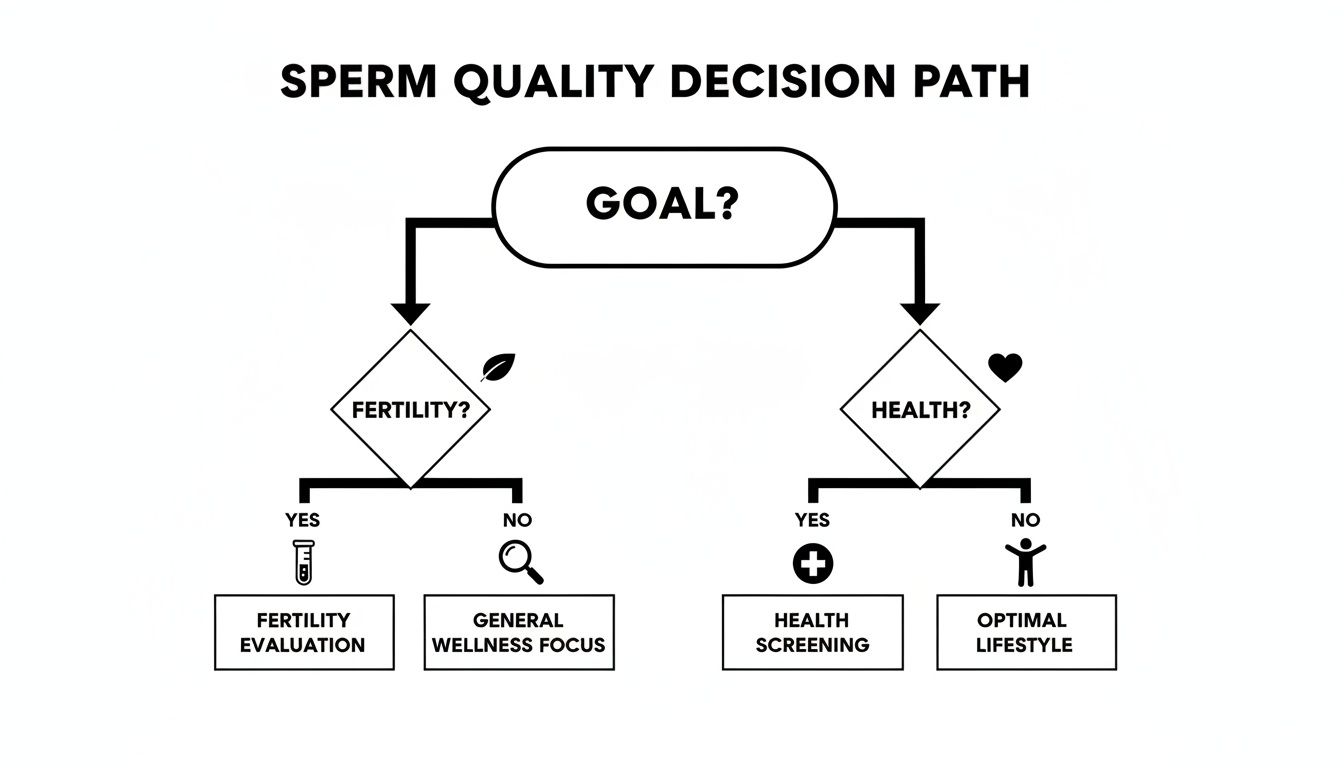
The key takeaway? Your personal goal directly shapes the recommended frequency. A targeted, strategic approach is what's needed for conception.
Creating Your Action Plan for Conception
So, what does this look like in practice? While there’s no magic weekly number, consistency is your best friend. Experts agree that a 2-3 day abstinence window optimizes semen quality.
However, for fertile men, even daily ejaculation doesn't cause harm. In fact, studies show that regular ejaculation, about 3-4 times per week, maximizes the chances of conception by ensuring sperm are available.
The table below breaks down how different abstinence periods can affect your sperm quality.
Abstinence Period and Its Impact on Sperm Quality
This table offers a clear comparison of how different abstinence windows affect the key sperm health metrics essential for successful conception.
| Abstinence Period | Effect on Sperm Count | Effect on Sperm Motility | Effect on DNA Integrity |
|---|---|---|---|
| Less than 2 days | Lower total count and volume | May be slightly higher due to fresher sperm | Generally good; lower levels of oxidative stress |
| 2-3 days (Optimal) | High count with optimal volume | Excellent motility and vitality | Best balance; low DNA fragmentation |
| 4-5 days | Highest count and volume | Starts to decline as older sperm accumulate | Worsens; increased risk of DNA damage from oxidative stress |
| More than 5 days | Very high count, but misleadingly "good" | Significantly reduced motility | Poor; highest levels of DNA fragmentation, which can harm conception |
As you can see, holding out for longer than 5 days might give you a higher sperm count on paper, but the quality of those sperm—their ability to swim and their genetic health—takes a serious hit. The 2-3 day window truly is the sweet spot for giving sperm the best possible chance.
Actionable Next Step: The most powerful first step you can take is to move from guessing to knowing. Understanding your personal baseline with a proper semen analysis provides the data you need to build a truly effective plan.
Knowing your numbers for sperm count, motility, and morphology takes the stress and guesswork out of the equation. It allows you to focus on what matters most: consistency and timing. By aligning your ejaculation frequency with your fertility goals, you give yourself the best possible advantage.
For more guidance on putting it all together, explore our resources on natural conception to build a comprehensive strategy.
Ejaculation's Role in Long-Term Male Health
While most conversations about ejaculation frequency zero in on fertility, its impact on a man’s long-term health is just as critical. The discussion often circles back to one key area of male wellness: the prostate.
Regular sexual activity is a natural part of a healthy male life, and a growing body of research suggests it may offer benefits that contribute to your overall well-being for years to come. This isn't just speculation; it’s an empowering way to view your sexual health as a core part of your body's maintenance system, not just something relevant to conception.
The Prostate Health Connection
One of the most compelling arguments for maintaining a regular ejaculation schedule is its potential link to a lower risk of prostate cancer. Think of it like flushing out a plumbing system. The prostate gland produces fluid that mixes with sperm to create semen.
Some theories propose that regular ejaculation helps clear out this fluid, potentially removing harmful substances or build-ups that could contribute to health issues over time. It reframes the question from "how often should I ejaculate to conceive?" to a much broader perspective on lifelong male wellness.
Major studies highlight a powerful link between frequent ejaculation and a lower risk of prostate cancer. While this is a correlation, not a direct cause-and-effect guarantee, it underscores the importance of regular sexual activity as part of a healthy male lifestyle.
What the Research Suggests
Landmark research has given us some of the most intriguing data on this topic. A widely cited study followed nearly 32,000 men for almost two decades, exploring the relationship between how often they ejaculated and their prostate health. The findings were remarkable.
Men in their 40s who ejaculated 21 or more times per month showed a significantly lower risk of developing prostate cancer compared to those who ejaculated only four to seven times per month. More recent analyses have backed this up, suggesting a moderate frequency of two to four times per week is beneficial.
This data provides a compelling look at how your habits today can influence your health down the road. It suggests that maintaining regular sexual activity is more than just about pleasure or conception—it’s a proactive step in your long-term health plan.
Preparing for a Semen Analysis or Post-Vasectomy Test

When it comes to any kind of clinical test, following the lab’s instructions is the single most important thing a man can do to get an accurate result. This is especially true for male fertility tests, where the timing of your last ejaculation has a direct and significant impact on the quality of your sample.
The guidelines for a standard semen analysis and a post-vasectomy check are worlds apart. Why? Because they’re designed to find completely opposite things. Getting the prep right for your specific test is key to avoiding confusion and ensuring the results are trustworthy.
Guidelines for a Standard Semen Analysis
When you’re getting a fertility test, the lab needs a clear, representative snapshot of your sperm health. To get this baseline, clinics and labs have a standard recommendation for sexual abstinence before you produce the sample. It’s also important to understand basic medical record documentation standards, as these results become a critical part of your long-term health history.
The standard advice, which comes from the World Health Organization (WHO), is to abstain from any ejaculation for 2 to 5 days before your test.
This abstinence window is the sweet spot. It gives your sperm count time to build up to a normal level but isn’t so long that older, slower sperm start to accumulate and skew the motility results.
Sticking to this 2-to-5-day window is crucial. Ejaculating too recently will likely lower your sperm count, while waiting too long can tank your motility score. Deviating from the guideline makes it nearly impossible for the lab to accurately compare your sample against the established fertility benchmarks.
Instructions for a Post-Vasectomy Test
With a post-vasectomy test, the goal is completely different. The lab isn’t analyzing sperm quality, shape, or swimming ability. They’re just looking for one thing: the complete absence of sperm.
This simple yes-or-no question means the strict abstinence window doesn't really matter. In fact, your urologist will probably encourage you to ejaculate frequently in the weeks after your procedure to flush out any lingering sperm. When it’s finally time for your test, just follow your doctor's specific instructions—there’s no need to worry about the 2-to-5-day rule that applies to fertility testing.
From Guesswork to Hard Data: What's Next?
Reading articles like this is a solid first step. But at the end of the day, general guidelines are just that—general. Your body has its own unique story, and understanding your fertility means moving from wondering to knowing.
The only way to get a clear, accurate picture of what's happening with your sperm is through a professional semen analysis. It's the bridge between common knowledge and personal health intelligence.
Trading General Advice for Personal Data
It’s easy to get lost in questions like, "how many times should a man release sperm in a week?" While the answer provides a great framework, it can't tell you your specific numbers. A semen analysis gives you the hard data you need to make informed decisions.
It gives you a detailed breakdown of your key metrics:
- Sperm Count: The total number of sperm you produce.
- Sperm Motility: How well your sperm are swimming.
- Sperm Morphology: The size and shape of your sperm.
Actionable Next Step: Getting your baseline numbers is the most powerful step you can take on your fertility journey. It replaces uncertainty with clarity and gives you a solid foundation to build on.
Your Action Plan for Getting Answers
Taking control of your reproductive health is more straightforward than you might think. With services like Hera Fertility, you can order a physician-approved lab test and get your analysis done at a certified lab near you.
The process is simple, private, and designed to give you the answers you deserve without the guesswork. This is your chance to understand your body on a deeper level and take proactive steps toward your future.
Common Questions About Ejaculation Frequency
When you're trying to conceive, it's natural for men to have questions about the specifics. Let's tackle some of the most common ones we hear about ejaculation and male sperm health to clear up any confusion.
Can a Man Run Out of Sperm from Ejaculating Too Often?
Short answer: no. A healthy man can't "run out" of sperm. Your body is a non-stop production line, making about 1,500 new sperm every single second.
While ejaculating very frequently (think multiple times a day) might temporarily lower the concentration of sperm in each sample, you won't ever deplete your supply. The system is constantly replenishing itself, so there's no risk of becoming infertile just from frequent ejaculation.
Does Waiting Longer to Ejaculate Improve Sperm Quality?
This is one of the biggest myths out there for men. Intuitively, it seems like saving up would lead to a bigger, better sample, but the biology doesn't quite work that way. Abstaining for more than 5-7 days can increase semen volume and the total sperm count, but the quality of those sperm often takes a nosedive.
Think of it like this: sperm that hang around in storage for too long start to lose their edge. They can lose motility (their ability to swim powerfully) and are more likely to suffer DNA damage. This is precisely why that 2-3 day window is the sweet spot for men trying to conceive.
What Is the Ideal Ejaculation Frequency for Men Over 40?
The fundamental rules of male sperm health don't really change as men get older. For a man over 40 who is trying to start or grow his family, the same advice holds true: ejaculating every 2-3 days is the best strategy for maintaining a healthy balance of sperm count and quality.
Of course, overall male fertility can decline with age. If you have any concerns about how age might be playing a role in your reproductive health, a semen analysis is the only way to get clear, personalized answers.
How Can I Know My Personal Sperm Health Numbers?
General advice is helpful, but the only way for a man to truly understand what's going on with his own body is through a professional semen analysis. This test shifts you from guessing games to hard data.
A comprehensive analysis will give you a detailed report on the metrics that matter most for male fertility:
- Sperm Count: The total number of sperm you produce.
- Sperm Motility: The percentage of your sperm that are active and swimming forward.
- Sperm Morphology: The percentage of your sperm that have a normal, healthy shape.
Getting these numbers replaces uncertainty with facts, empowering you to make confident, informed decisions on your path to fatherhood.
Ready to stop guessing and get real answers about your fertility? Hera Fertility makes it simple. Order your physician-approved semen analysis online and get tested at a certified lab near you. We provide clear, AI-powered reports that translate complex lab results into actionable insights. Take the first step toward understanding your reproductive health by visiting Hera Fertility today.