When you start looking into your fertility, one of the first questions that comes to mind is, "How much is this going to cost?" For a sperm test, the answer can vary quite a bit. You could pay as little as $50 for a basic at-home kit or upwards of $500 for a comprehensive analysis at a lab.
The price really comes down to how much detail you need to get a clear picture of your reproductive health.
Understanding the Real Cost of a Sperm Test
Taking that first step to check on your fertility is a big deal, and let's be honest, the cost is a major factor. Knowing what you might have to spend upfront helps you pick the right test, whether you're just curious about your baseline numbers or you're planning for the future.
The truth is, the costs for male fertility testing aren't always crystal clear. For the thousands of men who get a semen analysis each year, paying out-of-pocket can be a real obstacle. A single, basic sperm count test can easily run between $200 and $500. If you need a more thorough look at things like motility (how well sperm swim) and morphology (their shape), that price tag could jump to over $1,000 without insurance.
At-Home vs. Lab Testing Costs
The easiest way to break down the cost is to compare the two main options you have: doing it yourself at home or going to a professional lab.
This image gives you a quick visual of the starting price points for each.
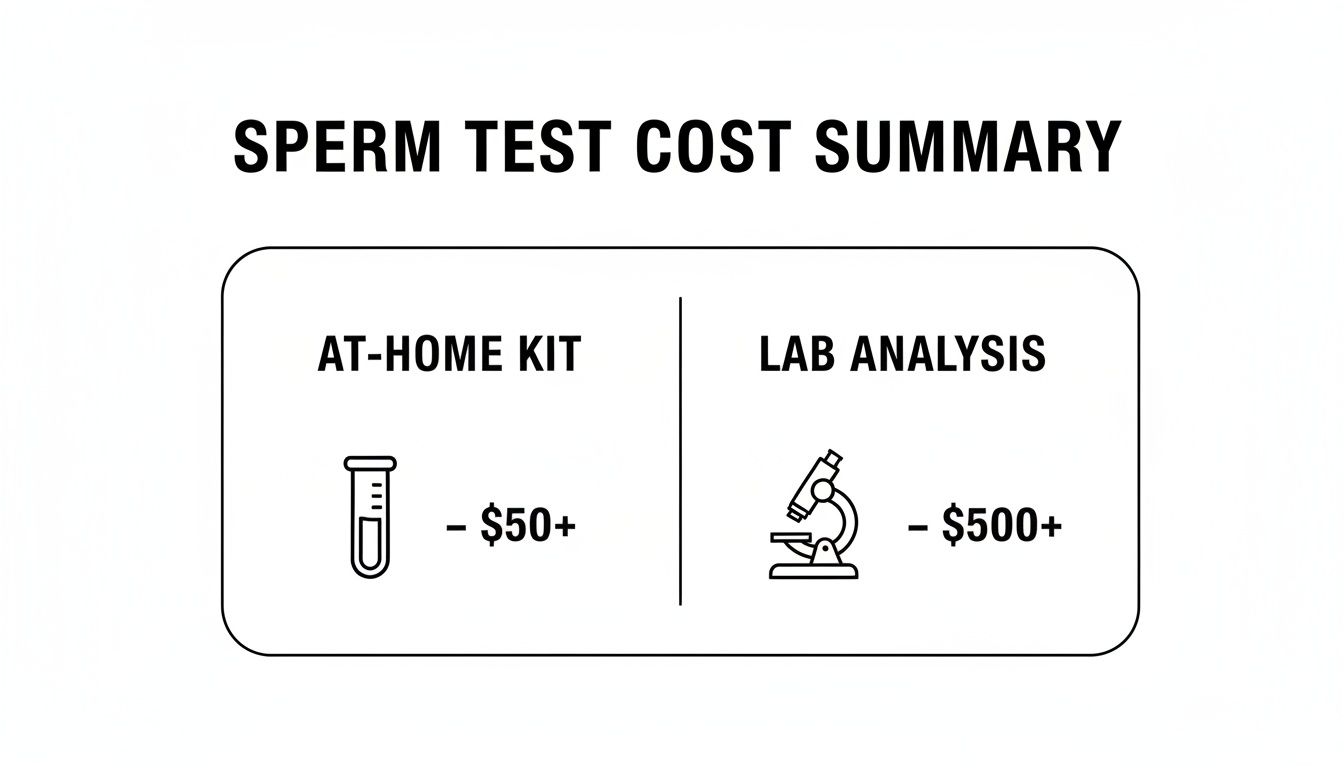
As you can see, the price gap is pretty significant, and it all comes down to the level of detail you get back. An at-home kit is a low-cost way to get a quick check, but a lab analysis gives you a much more complete and medically reliable assessment of your sperm health.
Sperm Test Cost At a Glance
Here’s a quick comparison to help you understand where your money goes with each type of sperm test.
| Test Type | Typical Price Range (USD) | What It Measures | Best For |
|---|---|---|---|
| At-Home Sperm Test | $50 - $200 | Often just sperm count or motility (above/below a certain threshold). | A quick, private screening to get a general idea of your sperm count. |
| Standard Lab Semen Analysis | $250 - $500 | Comprehensive metrics: sperm count, motility, morphology, volume, and more. | Men seeking a detailed fertility baseline or investigating potential issues. |
| Advanced Lab Testing | $500 - $1,000+ | All standard metrics plus specialized tests like DNA fragmentation. | Men with known fertility issues or those seeking advanced reproductive insights. |
Ultimately, the right test depends on your goals.
A sperm test is more than just a number; it's a detailed look into key health indicators. The cost reflects the difference between getting a simple count and receiving a complete analysis of your sperm’s ability to perform its job effectively.
Getting a handle on these price points is key. You can see a full breakdown of what’s included in different testing packages by checking out our Hera Fertility pricing and services. This should give you a solid idea of the investment involved as you plan your next steps.
Lab Analysis vs. At-Home Kits: What's the Difference?

When you start looking into sperm testing, you'll see two main options pop up: convenient at-home kits and comprehensive clinical lab analyses. It can be tough to know which path to take, but a simple analogy helps clear things up.
Think of an at-home kit like checking your car's oil with the dipstick. It's a quick, easy check that gives you a basic "yes" or "no" answer—is there enough oil, or isn't there? This is a decent starting point if you just want a general idea of where you stand.
A professional lab analysis, on the other hand, is like taking your car to a trusted mechanic for a full diagnostic. They won't just tell you the oil level; they'll report on its quality, check the engine's health, and spot other details you'd never see on your own. This is the option that gives you a complete, clinically accurate picture of your reproductive health.
What At-Home Kits Actually Measure
There's no denying the appeal of at-home sperm tests. They're private, easy to use, and give you a quick snapshot of one specific metric.
The biggest drawback, however, is that incredibly narrow focus. Most of these kits are only designed to measure one thing: sperm concentration, often just called sperm count. They'll tell you if your count is above or below a certain threshold, which is typically 20 million sperm per milliliter. While that number is certainly important, it's just one piece of a much larger male fertility puzzle.
The Clinical Lab Advantage
A clinical semen analysis, performed in a certified lab, is a different beast entirely. It gives you a much more complete evaluation because it's done by andrologists—scientists who specialize in male reproductive health—who examine your sample under a microscope to assess multiple critical factors.
Here’s what a proper lab analysis includes that at-home kits almost always miss:
- Motility: This is all about movement. It measures what percentage of your sperm are actually swimming and, just as importantly, how well they swim. A high sperm count doesn't mean much if they can't make the journey.
- Morphology: This looks at the size and shape of the sperm. Abnormally shaped sperm can struggle to achieve fertilization.
- Total Motile Sperm Count: Many experts consider this the single most important metric. It calculates the total number of swimming sperm in your entire sample, giving a much better indicator of fertility potential.
The crucial difference comes down to the depth of information. An at-home kit gives you a single, often limited, data point. A lab analysis offers a multi-faceted view of your sperm health, which is absolutely essential for making informed decisions with your doctor.
Understanding this distinction is the first step. To see how straightforward it is to get a professional test, you can find a certified lab near you and take control of your health journey.
What a Comprehensive Semen Analysis Actually Measures
When you get a comprehensive lab test, you're not just getting a single number back. You’re getting a full-blown report card on your reproductive health. It's a common misconception that it's all about sperm count—in fact, that's just the starting point. Most at-home kits stop there, but a true lab analysis goes much, much deeper.
Think of it this way: having a lot of players on a football team (sperm count) looks good on paper, but it doesn't mean you'll win the game. You need players who are fast, energetic, and built for the job. That’s exactly what a complete semen analysis looks at: the team's overall performance, not just how many players showed up.
Let's break down what those key metrics really mean so you can see what you're paying for with a lab-grade test.
Sperm Count and Concentration
This is the one everyone knows. Sperm concentration is the number of sperm packed into each milliliter of semen. A lab also looks at the total sperm count, which is the grand total in your entire sample.
It’s an important baseline, for sure. But a high number by itself isn't a guarantee of fertility. It's just one piece of a much larger puzzle.
Sperm Motility: The Ability to Swim
Here's where that football team analogy really clicks. Sperm motility is all about movement—specifically, what percentage of your sperm are actually swimming. But it gets even more specific with progressive motility, which measures how many are swimming forward with purpose, like they know where they're going.
It's simple, really. A high sperm count means nothing if the sperm can’t move effectively. Imagine a million swimmers lined up for a race, but none of them can actually get to the finish line. That’s why motility is often seen as a more powerful predictor of fertility than count alone.
A detailed lab analysis gives you a precise breakdown of your "active" swimmers, a critical detail that basic at-home tests just can't provide.
Sperm Morphology: The Importance of Shape
Finally, we have sperm morphology, which is a close look at the shape and structure of the sperm. For fertilization to be successful, a sperm needs to be built correctly—a well-formed head, a strong midpiece, and a functional tail.
An abnormal shape can prevent a sperm from doing its job. The lab report tells you what percentage of your sperm meet the strict criteria for normal shape.
So, when you see the price tag on a comprehensive test, you're paying for a detailed assessment of these three pillars of male fertility:
- Count (Concentration): How many sperm are there?
- Motility (Movement): Can they swim where they need to go?
- Morphology (Shape): Are they properly built for the job?
These three metrics together give you a clear, actionable snapshot of your reproductive health. To get into the nitty-gritty of how each factor is graded, take a look at our guide on what a complete semen analysis involves. It really puts the question of "how much is a sperm test" into perspective when you see the value you're getting.
Key Factors That Influence the Final Price
The sticker price for a sperm test rarely tells the whole story. Several factors can push that number up or down, and knowing what to look for can save you from a surprise bill later. Think of it less as a fixed cost and more as a starting point.
When you're trying to pin down the real answer to "how much is a sperm test?", it almost always comes down to two big variables.

The final amount you'll actually pay is shaped by your insurance plan and the specific type of analysis you need. These two things are often intertwined, creating a unique cost for every individual.
Insurance Coverage: The Biggest Variable
Your insurance coverage is, without a doubt, the single biggest factor that will determine your out-of-pocket cost. It's a common assumption that fertility testing is covered, but that's a gamble. Most insurance plans will only step in if the test is deemed “medically necessary” to diagnose a specific health problem.
What does that mean for you? If you’re getting a test just to be proactive about family planning or to confirm the success of a vasectomy, you're likely on your own to cover the full price. This insurance gap is a huge issue—only about 20-30% of U.S. plans offer comprehensive coverage for fertility diagnostics, leaving the vast majority of men paying out of pocket.
Advanced Diagnostics and Add-On Tests
A standard semen analysis gives you a fantastic baseline understanding of your fertility. But sometimes, the initial results point toward something that needs a closer look, prompting your doctor to suggest more advanced tests.
These add-ons can significantly raise the total cost. Common examples include:
- Sperm DNA Fragmentation Analysis: This looks at the genetic health of your sperm, a critical piece of the puzzle for a successful outcome.
- Anti-Sperm Antibody Test: In rare cases, the body can mistakenly create antibodies that attack its own sperm, and this test identifies that issue.
- Post-Ejaculate Urinalysis: This checks for a condition where sperm travels backward into the bladder instead of out of the body.
Each one of these specialized tests tacks on an additional fee. Suddenly, a $300 standard analysis can balloon into a $700+ comprehensive diagnostic workup. For a good comparison of how different evaluation types and insurance can affect pricing, the breakdown on how much ADHD testing costs offers some great insights.
Actionable Tip: Before you book anything, call your insurance provider. Be direct and ask them: "Is CPT code 89320 (semen analysis) a covered benefit under my plan for fertility assessment?" Getting a straight answer upfront is the best way to avoid a nasty surprise when the bill arrives.
Taking Control of Your Fertility Journey
Getting a report packed with medical numbers and terms can feel a little daunting. But here’s the most important thing to remember: a sperm test is just a snapshot of your health right now. It's not a final verdict on your fertility.
Think of it like a check-in. Many of the factors that shape your reproductive health are things you can actually influence. Your test results aren't a grade; they’re a roadmap, pointing out exactly where you can make some powerful improvements to your health and well-being. This is the moment you move from simply gathering information to taking meaningful action.
Turning Insights into Action
The good news is that sperm health isn't set in stone. It can respond surprisingly well to changes in your daily habits. The path to improving your numbers often starts with small, consistent tweaks that add up to a big impact over a few months.
You can start by focusing on these key areas:
- Nutrition: What you eat really matters. A balanced diet full of antioxidants, vitamins, and minerals helps support healthy sperm production. Think more leafy greens, colorful fruits, nuts, and lean proteins.
- Exercise: Getting regular, moderate physical activity can help boost testosterone and improve sperm quality. The key is consistency, not trying to become a pro athlete overnight.
- Stress Management: Chronic stress can mess with the hormones that control sperm production. Finding ways to unwind, whether it's meditation, a hobby, or just carving out some dedicated downtime, can make a real difference.
Your test results aren't just data points on a page. They're the beginning of a proactive conversation about your health. Use them to get to know your body better and make targeted changes that align with your family-building goals.
When to Consult a Specialist
While lifestyle changes can be incredibly effective, some results signal it's time to bring in a professional. Your sperm test report is the perfect tool for a productive, data-driven conversation with a doctor.
If your results show any significant issues, it’s a good idea to book an appointment with a urologist or a male fertility specialist. Make sure you bring your report with you. This helps the specialist get right to the point, skipping the basic questions and moving directly into a plan that’s tailored for you. The goal is to walk out of that appointment feeling confident, with a clear path forward.
Frequently Asked Questions About Sperm Testing
When you start looking into male fertility, you're bound to have questions. It’s a new world for most guys. Here are some straightforward answers to the most common things people ask, designed to cut through the confusion and help you figure out your next move.
Does My Insurance Cover a Sperm Test?
This is the big question, and the answer is… it depends. Coverage for a sperm test really comes down to your specific insurance plan and sometimes even the state you live in.
Many insurance companies won't cover fertility testing unless your doctor has flagged it as "medically necessary" to diagnose a suspected problem. If you're just being proactive about family planning or need a post-vasectomy check, it’s often not covered. The only way to know for sure is to always call your insurance provider directly. Ask them specifically about coverage for a "semen analysis" to get a clear yes or no before you schedule anything.
How Long Does It Take to Get Sperm Test Results?
Once you’ve provided your sample, a clinical lab usually has the raw numbers ready pretty quickly, typically within 24 to 72 hours.
But getting the raw data is only half the battle. The results then need to be sent to your doctor, who has to interpret them and then get back to you. That part of the process can sometimes stretch things out for several more days, or even weeks. Newer services are changing this, offering fully interpreted, easy-to-understand results sent directly to you, often just a couple of business days after the lab processes your sample.
How Should I Prepare for a Sperm Test?
Yes, a little prep work is key to getting an accurate reading. The most important rule is to abstain from any sexual activity for 2 to 5 days before your test.
This short break ensures your sperm count is at a representative level and hasn't been temporarily depleted. You’ll also want to avoid using any lubricants when collecting the sample, since many of them can damage sperm and affect motility results. Don't worry, though—any reputable testing provider will give you a simple, clear set of instructions to follow.
An abnormal result is not a final judgment on your fertility. It's a snapshot in time. Sperm health can fluctuate due to stress, diet, or recent illness. Think of it as the start of a conversation about your health, not the end.
What if My Results Are Not in the Normal Range?
It’s completely natural to feel a jolt of concern if your numbers aren't what you expected, but an abnormal result is not a life sentence. Sperm health is incredibly dynamic; it can and does change.
Your most important next step is to go over the results with a healthcare provider who can explain what the numbers mean and help you map out a plan. In many cases, simple, targeted lifestyle changes can lead to significant improvements in your sperm parameters in just a few months.
Ready to get clear, actionable insights into your reproductive health? With Hera Fertility, you can order a physician-approved lab test in minutes, get tested at a convenient location, and receive an AI-powered analysis of your results that’s easy to understand. Take the guesswork out of your fertility journey and get started today at herafertility.co.