Getting a lab report can feel like trying to decipher a foreign language. But interpreting your sperm analysis results is the crucial first step in understanding your reproductive health. This single test gives you a foundational snapshot of your male fertility, turning a page of confusing biological data into a clear starting point.
Think of it as the 'quick start guide' to your personal fertility journey, designed to replace anxiety with clarity.
Your First Look at the Sperm Analysis Report

When you first open that report, it's normal to feel a bit overwhelmed. You’re looking at a page full of technical terms, numbers, and reference ranges that probably don’t mean much right away. Take a breath—you’re not supposed to be an expert on day one.
The whole point of a sperm analysis is to assess your sperm health in a simple, non-invasive way. This isn’t a pass-or-fail exam. It’s a detailed profile that gives you and your doctor a solid understanding of what's going on so you can plan the best path forward.
What the Test Actually Measures
At its core, the analysis boils down to a few key pillars of sperm health. Getting familiar with these will give you an immediate handle on your report's most critical information.
Here’s a quick overview of the most important parameters you’ll see on your report. Each one tells a piece of the story, and together they create a comprehensive picture of your fertility potential.
Key Sperm Health Indicators at a Glance
| Parameter | What It Measures | Why It's Important for Male Fertility |
|---|---|---|
| Sperm Count (Concentration) | The total number of sperm in your sample. | Having enough sperm is the first step—think of it as having enough players on the team. |
| Sperm Motility | How well your sperm can move and swim forward. | It’s not enough to have players; they need to be able to get to the goal effectively. |
| Sperm Morphology | The percentage of sperm with a normal shape and structure. | A properly shaped sperm is better equipped for its journey. |
| Semen Volume | The total amount of fluid in your ejaculate. | The fluid protects and helps transport sperm. |
| pH | The acidity or alkalinity of the semen. | The right pH balance is crucial for sperm survival and motility. |
These metrics all work together. A single number rarely tells the whole story, which is why looking at the complete report is so valuable for getting an accurate assessment.
Why This Test Is the Starting Point
A sperm analysis is the cornerstone of any male fertility evaluation because it provides direct, measurable data. It moves the conversation from guessing to knowing, offering a concrete baseline for all future decisions. It’s an empowering first step that puts you in the driver’s seat.
This focus on men's reproductive health is becoming more common. The market for sperm count tests was valued at over USD 2 billion in 2022 and is projected to nearly double by 2032. This growth shows a rising awareness of how important male fertility is. You can explore more about these market trends and what they mean for men's health.
A sperm analysis report is not a final verdict on your ability to become a father. Instead, view it as a roadmap. It highlights your strengths and shows you exactly where you can focus your efforts for improvement.
Ultimately, understanding these results is the first real action you can take. It provides the clarity needed to have productive conversations with a specialist and make informed decisions about your health. This guide will walk you through each component, ensuring you feel prepared every step of the way.
Decoding the Key Numbers on Your Report
Getting your semen analysis report is a big moment. It’s full of data that can look pretty technical at first glance, but every number tells a crucial part of your reproductive health story. We'll walk through the key parameters line by line, so you know exactly what each one means for your fertility.
Let's use an analogy to make this simple. Think of your sperm as a highly specialized delivery team on a mission. For that mission to succeed, you need three things: enough team members, members who can move efficiently, and members who have the right gear for the job.
This is precisely what your report is measuring. Let’s start with the "big three" parameters.
Sperm Concentration: The Size of Your Team
Sperm concentration, which you'll often see called sperm count, is the measurement of how many sperm are in each milliliter (ml) of semen. It's the most fundamental piece of the puzzle. Put simply, do you have enough "delivery drivers" on your team?
The World Health Organization (WHO) gives us reference ranges to help make sense of the numbers.
- WHO Lower Reference Limit: 16 million sperm per milliliter.
A number above this is generally a great sign, suggesting your body is producing a healthy quantity of sperm. If your number falls below this, it’s known as oligospermia. This doesn't mean you can't become a father, but it's an important flag that a specialist will want to investigate further. You can learn more about what's considered a normal sperm count in our detailed guide.
You might also see a related number called total sperm count. This is just the concentration multiplied by your total semen volume, giving you the grand total of sperm in the entire sample. The lower reference limit here is 39 million.
Sperm Motility: How Your Team Moves
Having a huge team is a good start, but it doesn’t mean much if no one can move. Sperm motility measures the percentage of your sperm that are actively swimming. For a successful mission, your team has to be able to travel.
But not all movement is created equal. Your report will likely break this down even further:
- Progressive Motility: This is the number that really matters. It measures the percentage of sperm moving forward in a straight line or in large circles. Think of these as your star players—the ones actually making progress. The WHO sets the lower limit for this at 30%.
- Total Motility: This includes all moving sperm, even the ones just twitching in place or swimming in tight little circles. These are team members who are active, but not necessarily effective. The lower reference limit for total motility is 42%.
Low motility, a condition called asthenozoospermia, can be a major factor in male fertility because it directly impacts the sperm's ability to complete its journey.
Sperm Morphology: The Right Equipment for the Job
Finally, even a large, fast-moving team can fail if they don't have the right equipment. Sperm morphology refers to the shape and structure of the sperm. A normally shaped sperm has a smooth, oval head and a long tail—features that are critical for its function.
The shape of the head is vital for its journey, and the tail provides the engine for movement. Abnormally shaped sperm can struggle with these jobs.
According to the WHO's strict criteria, having just 4% or more of your sperm with a normal shape is considered within the typical range. This number often surprises men, but it's completely normal for the vast majority of sperm to have some imperfections.
Seeing a low morphology score, known as teratozoospermia, can be concerning, but it’s important to see it in the context of your count and motility numbers.
Other Important Details on Your Report
Beyond the "big three," your report contains other valuable data points that help paint a more complete picture of your reproductive health.
- Semen Volume: This is the total amount of fluid in your sample, measured in milliliters (ml). This fluid, which comes from several glands, is essential for protecting and transporting the sperm. The WHO lower reference limit is 1.4 ml.
- pH Level: This measures the acidity or alkalinity of your semen. The ideal environment for sperm is slightly alkaline, which helps them survive their journey. The standard is a pH of 7.2 or higher.
- Color and Viscosity: The report might also comment on the sample's appearance. It should typically be grayish-white. Viscosity refers to how thick or watery the semen is—it should liquefy within about 20-30 minutes to allow the sperm to swim freely.
It’s also critical to know which standards your lab is using. The 2021 World Health Organization semen analysis reference limits introduced updated criteria. A recent study found that while the reclassification of results was subtle, it was significant for some men, particularly for motility. You can read the full research on these updated criteria to understand how these standards evolve over time. Knowing this helps you and your specialist interpret your results with the most current information.
How to Read a Sample Sperm Analysis Report
All the theory in the world is helpful, but nothing makes it click like looking at a real report. At first glance, a lab report can feel like an intimidating grid of medical terms and numbers. But once you know how to read it, you'll see it’s actually a pretty straightforward map of your sperm health.
Think of your report as having three key columns: the parameter being measured (like "Sperm Concentration"), your personal result, and the lab's reference range. The most important part of this whole process is simply comparing your result to that reference range. The range tells you what’s considered typical for a fertile man.
This visual breaks down the analysis into its three most critical pillars—the main things your doctor is looking for.
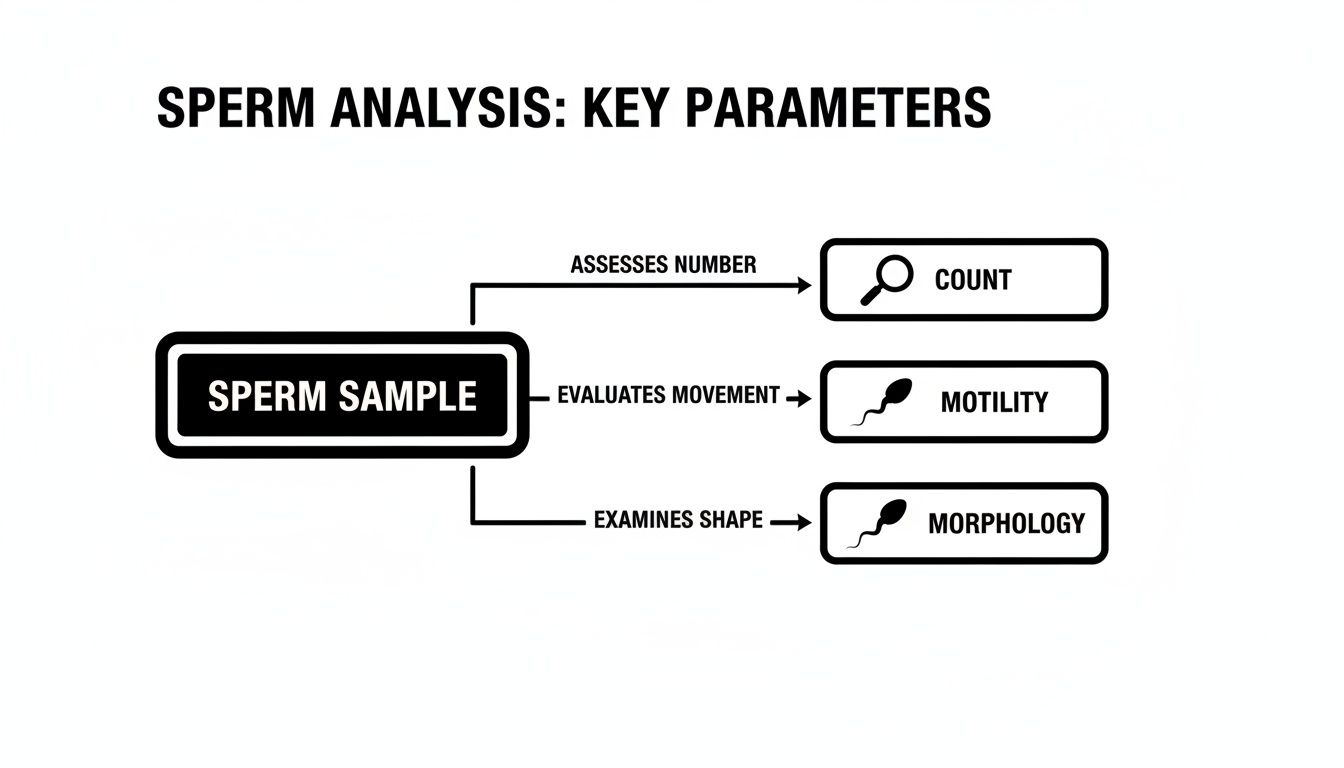
As you can see, everything comes down to understanding your sperm count, motility, and morphology. These three factors work together to give a complete picture of your fertility potential.
Locating the Key Values
When you first get your hands on the report, it's easy to feel overwhelmed. To cut through the noise, just focus on finding a few specific lines first. We’ll use a sample report to show you exactly what to look for.
Example: A Sample Report Snippet
| Parameter | Your Result | Reference Range |
|---|---|---|
| Semen Volume | 3.0 mL | > 1.4 mL |
| Sperm Concentration | 45 million/mL | > 16 million/mL |
| Total Sperm Count | 135 million | > 39 million |
| Total Motility | 55% | > 42% |
| Progressive Motility | 40% | > 30% |
| Morphology | 5% | > 4% (WHO Criteria) |
In this example, every result is sitting comfortably within or above the normal range. Let's walk through how you’d read this, step by step.
A Walkthrough of the Sample Results
First up, Semen Volume. The result is 3.0 mL, which is well above the lower limit of 1.4 mL. This means there's a healthy amount of fluid to help transport and protect the sperm.
Next, find Sperm Concentration. The result here is 45 million/mL, easily clearing the reference of 16 million/mL. That’s a sign of a very strong sperm density.
It's crucial to remember these numbers aren't a "grade" or a "score." They're just data points from one moment in time. Your results can be influenced by anything from a recent fever to a stressful week at work.
After concentration comes the Total Sperm Count. By multiplying the concentration (45 million/mL) by the volume (3.0 mL), we get a total of 135 million. This easily surpasses the 39 million threshold, confirming a robust overall number of sperm.
Now, let's look at how they move. Total Motility is 55%, safely above the 42% minimum. Even more importantly, Progressive Motility—the sperm that are actually swimming forward with purpose—is 40%, which is fantastic since the benchmark is 30%. This tells us the sperm are effective swimmers.
Finally, we have Morphology. A result of 5% normal forms is considered healthy, as it’s above the 4% lower limit set by the WHO. Seeing that 95% of sperm are abnormally shaped might sound alarming, but it’s completely normal and expected.
By breaking down the report this way, you can turn a confusing document into a clear overview of your reproductive health. This systematic approach gives you the power to have a much more informed conversation with your doctor or fertility specialist.
Understanding Atypical Sperm Analysis Results

Getting a sperm analysis report with numbers outside the "normal" range can feel like a gut punch. It’s easy to jump to worst-case scenarios, but it's crucial to take a breath. An atypical result is not a final verdict on your fertility.
Think of it as a single snapshot in time—a starting point for a deeper conversation about your health. Sperm production is a sensitive process, and many things can influence it. Often, these factors are temporary or totally manageable.
Understanding what’s behind these numbers is the first powerful step. It shifts the focus from worry to action, turning your results into a roadmap for improving your reproductive health.
What Could Be Affecting My Sperm Health?
There are countless variables that can influence your sperm parameters on any given day. A single semen analysis is just a glimpse into your current state, not a permanent label. Before you worry, it's worth exploring the common culprits that can throw your numbers off.
The factors below are some of the most frequent reasons we see for atypical results. The good news? Many of them are within your power to change.
| Factor Category | Specific Examples | Potential Impact on Sperm |
|---|---|---|
| Lifestyle | Poor diet, high stress, lack of sleep, smoking, excessive alcohol | Can lower count, motility, and morphology. Creates oxidative stress that damages sperm DNA. |
| Heat Exposure | Hot tubs, saunas, laptops on lap, tight underwear, frequent cycling | Raises testicular temperature, which impairs sperm production and can lower sperm count. |
| Medical Issues | Varicocele (enlarged veins), hormonal imbalances, infections, recent fever | Can directly harm sperm development, disrupt hormone signals, or create blockages. |
| Environmental | Exposure to pesticides, heavy metals, industrial chemicals | Can act as endocrine disruptors, interfering with hormones and damaging sperm health. |
Identifying potential factors from this list is an excellent first step. For many men, simple lifestyle adjustments can lead to significant improvements in their next test.
How Lifestyle Choices Impact Your Results
Your daily habits have a direct and surprisingly powerful effect on sperm quality. This is actually great news because it means you're in the driver's seat. Making smart lifestyle adjustments is often the most effective first line of defense.
Diet and Stress: What you eat literally provides the building blocks for sperm. A diet low in antioxidants (found in fruits and veggies) and key minerals like zinc and selenium can lead to oxidative stress, which is like "rust" for sperm cells. Chronic stress floods your body with cortisol, a hormone that can throw testosterone production out of whack.
Sleep and Heat: Your body does its most important repair and hormone-balancing work while you sleep. Skimping on sleep throws a wrench in this system. And heat is sperm's enemy. The testicles hang outside the body for a reason—to stay cool. Hot tubs, saunas, and even a hot laptop on your lap can cook sperm and temporarily tank your numbers.
Remember, the entire sperm production cycle takes about 74 days. Any positive changes you make today will show up in the sperm you produce about three months from now. Consistency is everything.
When It's More Than Just Lifestyle
Sometimes, an out-of-range result points to an underlying medical issue that needs a closer look. This isn't about what you did or didn't do; it's about your body's internal systems.
An abnormal semen analysis can be the first clue to a treatable medical condition. It's smart to view the test not just as a fertility check, but as a window into your overall health.
Here are a few common medical culprits:
Varicocele: This is basically a varicose vein in the scrotum and is one of the most common correctable causes of male infertility. The pooling blood raises testicular temperature and can damage sperm. A simple physical exam by a urologist can usually spot it.
Hormonal Imbalances: Sperm production relies on a delicate hormonal symphony conducted by your brain and testes. If hormones like testosterone, LH, or FSH are out of balance, the whole system can falter, leading to low counts and poor quality.
Infections: Past or present infections in the male reproductive tract can cause inflammation or create blockages that stop sperm from getting out.
If you suspect any of these, the next step is a visit with a urologist or a male fertility specialist. They can run more specific tests to pinpoint the problem and create a treatment plan.
The Bigger Picture: Environmental Factors
Beyond your personal health, your environment can also play a role. We're constantly exposed to chemicals in our food, water, and air. Things like pesticides, heavy metals, and plastics can disrupt hormone function and hurt sperm production.
When you look at your report, it's also worth knowing about the global conversation on sperm health. You may have seen headlines about declining sperm counts. One major study did report a significant drop in sperm concentration worldwide between 1973 and 2018.
However, the story is complicated. Other recent studies haven't found the same dramatic decline, suggesting that where you live and how the study was done really matter.
Finally, always look at your results as a whole. A low score in one area might not be a big deal if everything else looks great. For instance, a low morphology score is far less concerning if your sperm count and motility are sky-high. You can learn more about how sperm morphology is evaluated and what it really means for your fertility in our detailed guide.
What to Do After Getting Your Semen Analysis Results
Getting your semen analysis report back isn't the finish line; it's the starting block. This report is your personal roadmap, giving you the critical information needed to make smart, proactive decisions about your fertility. Whether your numbers look great or are a little off, there are always positive steps you can take next.
The most important thing to remember is that a single test is just a snapshot in time. Sperm health is dynamic. It can be influenced by dozens of things, from a recent fever to a stressful period at work. Think of it as a reflection of your health over the past three months, not a permanent verdict on your fertility.
Why One Test Isn't the Full Picture
It's a lot like checking the weather. One cloudy day doesn't mean it’s going to rain for the rest of the year. In the same way, one less-than-perfect semen analysis doesn't define your entire fertility potential. The sperm production cycle, a process called spermatogenesis, takes roughly 74 days from start to finish.
This means the sperm in your sample today actually began developing over two months ago. A fever you had six weeks back, a big project at work last month, or even a few nights of bad sleep can all show up in your results. This is exactly why a specialist will almost always recommend a retest if your numbers are outside the expected range.
A follow-up test, usually scheduled 2-3 months after the first one, gives a much more reliable and accurate picture. This timeframe allows for a completely new batch of sperm to be produced, giving you and your doctor a clearer look at your baseline health.
This second test helps figure out if the first results were just a temporary dip or part of a more consistent pattern that needs a closer look.
When to See a Urologist or Male Fertility Specialist
Your report is packed with valuable data, but a specialist is the person who can connect those dots to your overall health and build a personalized plan. They are experts at reading these results in the context of your complete medical history.
It’s a good idea to book a consultation if:
- Any key parameter is below the reference range: If your sperm count, motility, or morphology is flagged, a specialist can dig into the potential causes.
- You have a known medical condition: Things like a varicocele (an enlarged vein in the scrotum), a past testicular injury, or a known hormone imbalance require an expert evaluation.
- You and your partner have been trying for a while without success: A specialist can run a full male fertility workup.
- You just want professional guidance: Even with stellar results, a consultation can offer peace of mind and proactive tips for keeping your fertility in top shape.
A specialist won't just glance at the numbers. They’ll likely perform a physical exam and may order more tests, like blood work to check hormone levels, to get the full picture.
Your Plan for Strong Results
If your report shows all your numbers are well within the healthy range, that's fantastic news! It’s a great sign that your body is doing its job effectively. The focus now shifts from investigation to maintenance. Your goal is to protect that fertility and keep your sperm health optimal.
Here are a few proactive steps you can take:
- Eat a diet rich in antioxidants: Foods like berries, walnuts, and leafy greens help fight oxidative stress, which can damage sperm.
- Maintain a healthy weight: Being either underweight or overweight can throw your hormones out of balance and impact sperm production.
- Stay active, but don't overdo it: Regular, moderate exercise is great for circulation and hormonal health.
- Manage your stress and get enough sleep: These are the foundations for healthy hormone production, including testosterone.
Your Plan for Atypical Results
Seeing numbers outside the normal range can feel disheartening, but it’s actually your cue to take positive action. Many of the factors that impact sperm health are completely within your control. For men with atypical results, the first steps almost always focus on powerful lifestyle changes that can make a huge difference.
A specialist will likely start by recommending changes very similar to those for maintaining good results, but with a more targeted purpose. Making positive shifts in your diet, exercise routine, and stress levels can have a significant impact. You can explore our comprehensive guide on how to increase sperm count for more detailed, actionable strategies.
Beyond lifestyle adjustments, a specialist might discuss other options depending on your specific situation. This could include medical treatments for underlying issues like a varicocele repair or hormone therapy if an imbalance is found. The key is to see your results not as a final word, but as the first step toward a focused and effective plan to improve your health.
Common Questions About Sperm Analysis Results
Getting a semen analysis report can feel like it creates more questions than it answers. You've gone through the key parameters, but now you're probably wondering what it all means for you and your future. Let's tackle some of the most common questions that come up.
These are the real-world, practical questions we hear all the time. Getting clear on them will round out your understanding and help you feel more in control of the journey ahead.
How Long Until Lifestyle Changes Improve My Sperm?
This is easily one of the most important questions men ask, and the answer gets right to the heart of how dynamic sperm health really is. The full sperm production cycle, a process called spermatogenesis, takes roughly 74 days from start to finish. Think of it as a biological assembly line that's always running.
Because of this timeline, any positive changes you make today—improving your diet, quitting smoking, exercising, or cutting down on heat exposure—won't show up in your results tomorrow. It takes time for a completely new batch of sperm to be produced under these improved conditions.
This is why specialists almost always recommend retesting 2-3 months after you've made significant lifestyle adjustments. That window gives your body enough time for your hard work to be reflected in the results, giving you the most accurate picture of how much impact your efforts have had.
Does a Low Sperm Count Mean I Can't Have Children?
Absolutely not. This is a very common fear, but it's a huge misconception. A low sperm count, technically called oligospermia, just means you have fewer sperm per milliliter than the typical reference range. While it might mean it takes a bit longer to have children, many men with low counts go on to become fathers.
Your report is just one piece of the male fertility puzzle. A specialist will look at your complete results—including motility and morphology—to get the full picture.
A low sperm count is not a final verdict on your ability to become a father. It's a signal to investigate further, make positive changes, and work with a specialist to create a plan. It is a starting point for action, not an endpoint.
What Is the Difference Between Motility and Progressive Motility?
This is a crucial detail on your report that often causes confusion, but the distinction is everything.
- Total Motility: This is the percentage of sperm that are moving at all. It includes the ones just twitching, swimming in tight circles, or moving without any real forward direction.
- Progressive Motility: This is the number that really matters for male fertility. It measures the percentage of sperm that are actively swimming forward, either in a straight line or in large, purposeful circles.
Think of it like a team of swimmers in a race. Total motility counts everyone who's splashing around in the water. Progressive motility only counts the swimmers who are actually moving down the lane toward the finish line. These are the sperm capable of completing their journey, which is why specialists zoom in on this number.
Can I Do Anything to Improve My Sperm Morphology?
Sperm morphology—the shape and structure of your sperm—can feel like the one thing you have the least control over. While it can be harder to influence than count or motility, the same healthy lifestyle choices that support overall sperm health can definitely help here, too.
A primary cause of poor morphology is oxidative stress, which is essentially cellular damage caused by an imbalance in your body. You can fight back by:
- Eating a diet rich in antioxidants: Think colorful fruits, vegetables, nuts, and seeds.
- Avoiding smoking and limiting alcohol: Both are major sources of oxidative stress.
- Maintaining a healthy weight: Excess body fat increases inflammation and cellular damage.
By reducing these stressors, you create a better environment for your body to produce more normally shaped sperm. A fertility specialist can offer personalized advice based on your full health profile to give you the best possible shot at improvement.
Feeling overwhelmed by your lab report? You're not alone. Hera Fertility uses advanced AI to translate your complex sperm analysis results into a simple, clear SmartScore. Get instant insights, personalized action plans, and the guidance you need without the confusion. Upload your existing report for a free analysis or find a testing center near you at https://herafertility.co.