Figuring out the actual male infertility test cost can be a bit of a headache. You’ll see prices all over the map, typically from $75 to over $500, and what you end up paying depends on a handful of key factors. It's rarely a single, simple fee.
Instead, the final bill is usually a mix of the test's complexity, where you get it done, and what your insurance decides to cover. Let’s break it all down so you can navigate this with confidence.
What Is the Real Cost of a Male Fertility Test?
When you first start looking into male fertility testing, the cost is probably the first thing that comes to mind. It's a totally valid and practical question. The best way to think about it isn't like buying something off a shelf with a set price tag; it's more like a service where the final bill shifts based on the specific path you take.
A standard semen analysis—the cornerstone of male fertility evaluation—has a pretty wide price range. This test gives you the foundational answers about your reproductive health, but there are a few different financial routes to get there.

Male Fertility Test Cost at a Glance
To give you a clearer picture, it helps to see the different avenues for testing and their typical costs side-by-side. Each option strikes a different balance between convenience, how thorough it is, and whether a doctor is involved.
Here's a quick comparison of the most common testing methods to help you see how they stack up.
| Testing Method | Typical Cost Range | Key Features |
|---|---|---|
| Traditional Lab Test | $100 - $500+ | Ordered by a specialist; performed at a clinical lab; often requires referrals and multiple appointments. |
| At-Home Mail-in Kit | $75 - $250 | Convenient and private; you mail a sample to a lab; quality and comprehensiveness can vary a lot. |
| Lab Requisition Service | $150 - $350 | Order a doctor-backed lab request online, then visit a local lab; combines clinical accuracy with modern convenience. |
The main takeaway here is that you're looking for the right balance for your situation. A lower upfront cost might look good, but it's crucial to make sure the test is accurate and detailed enough to give you a clear path forward. Your next step should be to evaluate these options based on your personal needs for privacy, accuracy, and budget.
Why Prices Vary So Much
That big swing in the male infertility test cost isn't arbitrary. A few key things really drive the price up or down.
First, your location plays a big role. Labs in major cities often have higher overhead costs, and that gets passed on to you. Second, the depth of the analysis itself matters. A basic test that only looks at sperm count is a world away from a complete workup that also examines motility (how they swim) and morphology (their shape).
To get the full picture of your reproductive health, you’ll want to know more about what a comprehensive semen analysis should cover. Knowing what's involved helps you ask the right questions and pick a testing method that fits both your health goals and your budget, so you get the answers you need without any sticker shock.
Understanding What Drives Male Fertility Test Prices
Ever wonder why one male fertility test is $100 and another is $400? That huge price gap isn't random. The final cost is a lot like the sticker price on a new car—the base model is just the starting point, and several different factors stack up to determine the final number.
Breaking down these cost drivers is the key to understanding what you're actually paying for. It puts you in the driver's seat, allowing you to ask the right questions and make sure you're only paying for what you really need.
The Core Test and Lab Fees
At the heart of any male fertility test is the semen analysis itself. This isn't just a quick head count; it involves a highly trained lab technician carefully examining your sample under a microscope.
The lab’s fee is really covering a few key things:
- Expert Analysis: You're paying for the time and skill of the embryologist or technician who performs the analysis.
- Equipment and Supplies: The cost of using powerful microscopes, slides, and other specialized lab gear.
- Operational Overhead: This includes the lab's official certifications (like CLIA certification in the U.S.), quality control programs, and all the day-to-day costs of running a high-quality facility.
Think of this as the "base price." A more reputable lab with better credentials might charge more, but that often means you're getting more reliable and accurate results in return. Your next step is to verify that any lab you consider is CLIA-certified.
A lab's CLIA (Clinical Laboratory Improvement Amendments) certification is a crucial mark of quality. It confirms the lab meets strict federal standards for accuracy, reliability, and timeliness.
Advanced Diagnostics: The Add-Ons
Just like you can add leather seats or a premium sound system to a car, you can add advanced diagnostics to a standard semen analysis. These "add-ons" drive up the total cost but give a much deeper look into specific aspects of sperm health, especially if initial results show there might be an issue.
Some common add-ons include:
- Sperm DNA Fragmentation Test: This measures damage to the DNA inside the sperm, which can impact reproductive outcomes. This test alone can add $200 to $500 to your bill.
- Strict Morphology (Kruger's Criteria): This is a much more detailed evaluation of sperm shape than the standard analysis and sometimes comes with an extra charge.
- Anti-Sperm Antibody Test: This looks for antibodies that could be attacking the sperm, hurting their ability to swim and function properly.
Not every man needs these specialized tests. A specialist typically orders them based on your health history and initial results, so you probably don’t need to budget for them right out of the gate.
Geographic Location and Clinic Type
It’s a simple fact: where you get your test done matters. A test in a major city like New York or Los Angeles will almost always cost more than the exact same test in a smaller town. This is purely due to higher local costs for rent, labor, and operations.
The type of facility matters, too:
- Hospital-Based Labs: These often have higher overhead costs and tend to charge more.
- Independent Fertility Clinics: Prices here can be all over the map, and some clinics bundle the test with a mandatory consultation fee.
- Large National Laboratories: These labs usually have more standardized pricing, but even their costs can vary from one region to another.
This price difference based on location is a common issue across the entire medical field. The push for greater healthcare pricing transparency is helping people understand and question these differences. As a next step, always ask for an itemized price list before you commit to a test.
Consultations and Follow-Up Appointments
Finally, don't forget the cost of professional guidance. The traditional route through a urologist or fertility specialist often requires an initial consultation just to order the test, plus a follow-up appointment to go over the results.
Each of those appointments has its own fee, which can easily be $150 to $400 per visit, depending on the doctor and your insurance. While getting an expert's take is incredibly valuable, it’s a major cost to factor in. Some newer testing services are changing this by providing clear, physician-reviewed results and next steps without making you come in for multiple expensive visits, offering a more direct and often more affordable way to get answers.
Comparing Your Testing Options From Labs to At-Home Kits
When it comes to checking on your fertility, you've got more options today than ever before. But which path is right for you? It's really a balancing act between cost, convenience, accuracy, and the kind of professional support you get. Let's walk through the three main ways you can get a male fertility test: the traditional lab test, an at-home mail-in kit, and a modern lab requisition service.
Each route has its own trade-offs. The best choice really boils down to your budget, comfort level, and what you ultimately need the results for.
The Traditional Urologist-Ordered Lab Test
This is the old-school, standard approach. You book an appointment with a urologist or fertility specialist, they talk with you about your situation, and then write a referral for a semen analysis at a specific lab or hospital.
- Cost: This is usually the most expensive path when you add it all up. While the lab test itself might run between $100 to $500, you also have to account for the specialist consultations—both the initial visit and a follow-up—which can tack on another $300 to $800.
- Convenience: Honestly, this method is the least convenient. It means juggling multiple appointments, waiting for that referral to come through, and taking time off work. For a lot of men, the whole process can feel a bit drawn-out and intimidating.
- Accuracy & Support: The big plus here is the direct line to a specialist. Your test is done in a clinical lab, so accuracy is top-notch, and you have an expert right there to interpret the results and guide you on what to do next.
While it's thorough, the high price tag and all the hoops you have to jump through can be a major turn-off for men who just want a straightforward answer about their fertility.
At-Home Mail-in Sperm Test Kits
Lately, at-home kits have become a popular choice, mainly because they promise privacy and simplicity. You collect a sample at home, pop it in the mail, and a lab sends your results back through an app or website.
It sounds easy, and it is, but that convenience can sometimes mean sacrificing quality.
- Cost: At $75 to $250, these kits look like the cheapest option on the surface. That low upfront price is a huge draw for any man wanting a quick, low-commitment test.
- Convenience: You really can't beat the ease of this. Collecting a sample in the privacy of your own home means no clinic visits or awkward waiting rooms.
- Accuracy & Support: This is where at-home kits can fall short. While some use certified labs, many provide a very limited analysis. For instance, they might only check your sperm count and ignore other crucial factors like motility (how well sperm move) or morphology (their shape). This incomplete picture often isn't enough for a doctor to make a real diagnosis, which means you might have to pay for a second, more comprehensive test anyway.
Key Takeaway: A lower initial price doesn't always mean a lower total cost. If an at-home test isn't clinically robust enough, you may end up spending more money and time to get the complete answers you need. Your next actionable step is to research if the at-home kit provides a comprehensive analysis of all key sperm health parameters.
This chart helps visualize how the final cost can grow. The base price is just the starting point.
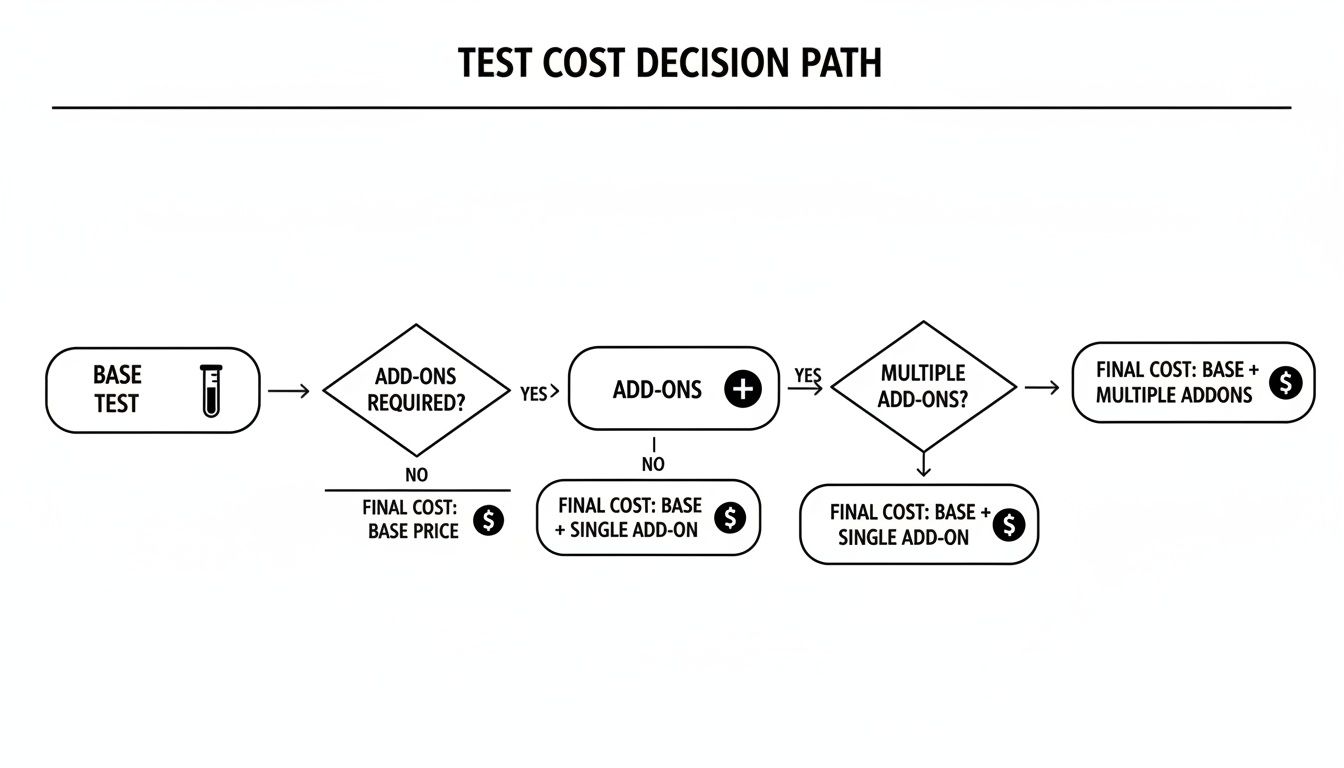
As you can see, the initial test is just one piece of the puzzle, and any extra diagnostics can really drive up the final bill.
Modern Lab Requisition Services
A newer model has started to pop up, blending the best of both worlds: the clinical accuracy of a lab with the modern convenience you'd expect. Services like Hera Fertility are built on this idea.
Here’s how it works: you order a physician-approved lab order (a requisition) online, pick a certified lab near you from a big network, and then just go in to provide your sample when it suits you. This approach neatly solves many of the headaches that come with the other methods.
- Cost: Priced between $150 and $350, these services are a great middle ground. They’re more affordable than the traditional route because you skip the expensive specialist consultation fees, and the pricing is totally transparent from the start.
- Convenience: While you do have to visit a local lab, you get to skip the doctor's referral and multiple appointments. You just find a lab that works for your schedule. It’s a smart compromise.
- Accuracy & Support: Your sample is analyzed at a CLIA-certified lab—the very same high-standard facilities that specialists use. This guarantees you get a comprehensive, clinical-grade report that any doctor will trust. Plus, platforms like Hera Fertility provide clear explanations of your results, translating all that complex medical data into insights you can actually use, without needing a separate follow-up visit. If you want to check for yourself, you can easily find labs in your area and see what’s available.
Detailed Comparison of Male Fertility Testing Methods
Making the right choice can feel overwhelming. This table breaks down the key differences between the three main testing methods to help you decide which one aligns best with your needs, budget, and comfort level.
| Feature | Traditional Lab Test | At-Home Mail-in Kit | Hera Fertility (Lab Requisition) |
|---|---|---|---|
| Typical Cost | $400–$1,300+ (includes consultations) | $75–$250 | $150–$350 |
| Convenience | Low | High | Medium (lab visit required) |
| Accuracy | High (clinical grade) | Varies (often incomplete analysis) | High (clinical grade) |
| Doctor's Referral | Required | Not required | Not required |
| Result Detail | Comprehensive (count, motility, etc.) | Limited (often count only) | Comprehensive (count, motility, etc.) |
| Privacy | Low (multiple appointments) | High (done at home) | High (discreet online process) |
| Physician Support | Direct access (at high cost) | Limited to none | Physician-approved, clear results |
Ultimately, the goal is to get accurate information without breaking the bank or jumping through unnecessary hoops. The modern lab requisition model offers a strong balance of all these factors, making clinical-grade testing more accessible than ever before.
The growth in these different options points to a bigger shift. There's a growing awareness among men about being proactive with their health, and the global male infertility market—valued between USD 4.4 to 4.85 billion as of 2025—is expanding to meet this demand for better, more convenient, and affordable testing.
Navigating Insurance Coverage for Your Fertility Test
Figuring out the true male infertility test cost almost always comes down to one big question: will insurance actually cover it? The answer, unfortunately, is rarely a simple "yes" or "no." Coverage often hinges on the reason for the test, the fine print of your specific plan, and sometimes even the state you live in.
This part of the journey can feel like a tangled mess, but a little bit of prep work goes a long way. If you know what to ask and what your options are, you can seriously reduce your out-of-pocket costs and make getting answers a whole lot less stressful.
Is Your Test for Diagnosis or Screening?
The single most important factor that determines insurance coverage is the "why" behind the test. Insurers draw a hard line between tests that are considered medically necessary and those that are just for general screening or personal curiosity.
- Diagnostic Testing: This is when a doctor orders a semen analysis to investigate a specific medical problem, like difficulty achieving a pregnancy. In this case, the test is part of a diagnostic process and is much more likely to be covered.
- Screening or General Wellness: If you're getting a test just to check your baseline fertility numbers without any specific medical reason, insurance companies often see this as elective and won't pay for it.
This distinction is everything. The way your doctor's office or the lab codes the test for the insurance claim can be the difference between paying a small copay and being stuck with the entire bill.
Key Questions to Ask Your Insurance Provider
Don't wait for a surprise bill to show up in the mail. The best thing you can do is call your insurance company before you get tested. Going into that call armed with the right questions will help you get the clarity you need.
Here’s a checklist of exactly what to ask:
- "Is a semen analysis a covered benefit under my plan?" Start broad to make sure it’s even a possibility.
- "Is CPT code 89320 covered for the diagnosis code Z31.41?" This is the insider language they understand. CPT code 89320 is for a standard semen analysis, and diagnosis code Z31.41 is for male fertility testing.
- "Do I need a referral or pre-authorization for this test?" Some plans require your doctor to get a green light from them first.
- "What is my deductible, and how much have I met this year?" Even if the test is "covered," you might have to pay your full deductible before the insurance kicks in.
- "What will my copay or coinsurance be for this lab service?" This will tell you exactly what your out-of-pocket cost will be.
Being this specific shows the insurance representative you know what you're talking about and helps you sidestep any confusion. This call is a critical next step to manage your costs effectively.
Remember, coverage isn't just about your plan; it's also about where you live. Regional variations in healthcare infrastructure and patient awareness can influence insurance policies and access to care. For example, in the Americas, a high density of specialized clinics and evolving guidelines have boosted the use of advanced diagnostics. You can discover more insights about these regional differences in the male infertility market at imarcgroup.com.
Using Tax-Advantaged Accounts to Your Advantage
Even if your insurance plan comes up short or leaves you with a high deductible, you’ve got other tools in your belt to bring down the cost. Tax-advantaged accounts like a Health Savings Account (HSA) or a Flexible Spending Account (FSA) were made for these exact situations.
Think of these accounts as a way to get an automatic discount on healthcare. Here's the rundown:
- Health Savings Account (HSA): If you're on a high-deductible health plan, you can put pre-tax money into an HSA. That money grows tax-free and can be spent tax-free on qualified medical expenses, which includes a male fertility test.
- Flexible Spending Account (FSA): Many employers offer FSAs, which also let you set aside pre-tax dollars for healthcare. These are typically "use it or lose it" accounts, making them perfect for planned expenses like fertility testing.
By paying with funds from an HSA or FSA, you're using money that hasn't been taxed. This can effectively save you 20-35% on the final cost, depending on your tax bracket. It's a smart and simple way to manage the male infertility test cost and make getting clear answers more affordable.
How Hera Fertility Offers a Clear and Affordable Path
Let’s be honest: after wading through all the different test types, surprise fees, and confusing insurance policies, most men are just looking for a simpler way to get straight answers. The traditional route for male fertility testing often feels slow, needlessly expensive, and more than a little intimidating. This is exactly where newer approaches are making a real difference, putting control, clarity, and affordability back where they belong—with you.
Hera Fertility was built from the ground up to fix these very problems. It creates a straightforward path that gives you the accuracy of a clinical lab without all the usual headaches, removing the biggest roadblocks that stop men from taking that crucial first step.

Clinical-Grade Accuracy Without the Hassle
The real magic of Hera Fertility is in its smart, direct approach. Instead of making you jump through hoops with multiple expensive specialist appointments just to get a lab order, the platform provides a physician-backed lab requisition right to you.
It's a simple idea, but it completely changes the experience:
- Order Online in Minutes: You start by requesting your lab order from home. A licensed physician in your state reviews the request and issues the official order. It's that easy.
- Choose a Convenient Lab: You get access to a network of over 250+ CLIA-certified labs all over the country. Just pick the one that’s closest to your home or office.
- Get Tested on Your Schedule: With the lab order ready to go, you can visit the lab whenever it works for you. No more waiting weeks for a referral or an appointment to open up.
This model truly offers the best of both worlds. You get your analysis done at the same high-quality, certified labs that top fertility specialists use, so you know the results are rock-solid. But you get to skip the traditional gatekeepers—and their fees and wait times—entirely.
Transparent Pricing and Clear Results
One of the most common frustrations with the male infertility test cost is the sticker shock. You rarely know the final bill until it shows up in the mail. Hera Fertility flips the script by offering upfront, transparent pricing. You know exactly what you're paying for before you commit.
But that clarity doesn't end with the price tag. A typical lab report is a wall of medical jargon and numbers that don’t mean much to anyone without a medical degree. Getting a confusing document with zero context is a classic dead end.
Hera Fertility fixes this by translating your complex lab data into an easy-to-understand Hera SmartScore. This score gives you an immediate, clear snapshot of your sperm health, along with actionable insights and personalized next steps.
This means you’re not just handed raw data and left to figure it out. You get a clear explanation of what your results actually mean for your fertility journey and what you can do about it. This guided approach empowers you to make informed decisions without needing to book another expensive follow-up just to have the report explained. You can learn more about how the platform works by exploring Hera Fertility's pricing and process.
Ultimately, this modern path is all about making essential health information more accessible. By cutting out unnecessary steps, offering clear costs, and delivering results you can actually use, Hera Fertility provides a supportive, affordable, and understandable way forward for any man looking to take control of his reproductive health.
Frequently Asked Questions About Male Fertility Test Costs
Once you start looking into male fertility testing, a lot of questions pop up, especially around the cost. It's totally normal. After you get the basics down, you start wondering about the nitty-gritty details.
Let’s tackle some of the most common questions men have about the price of getting a clear picture of their reproductive health.
Is a Semen Analysis Covered by Insurance in the USA?
This is the big one, and the honest answer is: it's a toss-up. Whether your insurance covers a semen analysis really depends on your specific plan and even the state you're in. The deciding factor is almost always whether the test is considered “medically necessary.”
If a doctor orders the test to investigate a potential male fertility problem, there's a good chance your insurance will cover it. But if you’re just getting checked out for your own peace of mind, coverage is a long shot.
Here's your next step:
- Grab your insurance card and give them a call.
- Ask specifically if CPT code 89320 (the medical billing code for a semen analysis) is covered for diagnostic testing.
- Don't forget to ask about your deductible and copay—even with coverage, you'll likely have some out-of-pocket costs.
Why Is There Such a Big Price Difference Between Labs?
You're not imagining things. It can be jarring to see one lab advertising a test for $100 while another just a few miles away is charging $400. This gap isn't random; a few key things are driving those prices.
For starters, where you live matters. Labs in big cities with a high cost of living have higher rent and staff salaries, and that gets passed on to you. A hospital-based lab might also have a totally different pricing model than a standalone national chain like Labcorp or Quest.
And finally, you have to look at what's actually included. Some labs give you one all-inclusive price that covers the analysis, lab fees, and maybe even a follow-up call. Others nickel-and-dime you, billing for every little thing separately, which can lead to a nasty surprise when the final bill arrives.
Are Cheaper At-Home Sperm Tests Reliable?
At-home sperm tests have definitely grown in popularity—they’re cheap, private, and convenient. The problem is, when it comes to reliability, you often get what you pay for. Most of the cheaper kits on the market only check one or two things, like sperm count.
A complete fertility picture is so much more than just a headcount. Key factors like motility (how sperm swim) and morphology (their shape) are crucial for successful fertilization, and most basic kits don't even look at them.
For results a doctor can actually trust and use to guide you, a semen analysis from a CLIA-certified laboratory is still the gold standard. It's the only way to get an accurate, comprehensive look at what's really going on.
Can I Get a Fertility Test Without a Doctor's Referral?
In the past, getting a lab-grade semen analysis meant you had to see a doctor first to get a referral. This was a huge hurdle for a lot of men. Between the cost of the appointment, the long wait times, and the awkwardness of the conversation, many just gave up.
Thankfully, that’s not the only way anymore.
Newer services like Hera Fertility have figured out how to solve this. They connect you with a licensed physician in your state who reviews your request online and issues the necessary lab order. This lets you skip the in-person appointment and go straight to a professional, certified lab—making the whole thing faster, more private, and way less of a hassle.
Ready to get clear, affordable answers about your fertility? With Hera Fertility, you can order a physician-backed lab test online, get tested at a certified lab near you, and receive easy-to-understand results without the headache. Take control of your reproductive health today. Learn more at Hera Fertility.