For most men, the short answer is yes, you’ll probably need a doctor’s order for a semen analysis. Think of it as a prescription for a highly specialized medical test. This isn't just a hoop to jump through; it's a critical step to make sure the test is clinically sound and the results actually lead to clear, responsible medical advice for your reproductive health.
Why a Doctor's Order Is Standard Practice
When you're looking into your reproductive health, a semen analysis gives you a detailed snapshot of key male fertility factors. Because it’s a diagnostic medical test, it's regulated to ensure both accuracy and patient safety. A doctor's involvement is the first step in this controlled, clinical process.

This requirement all comes down to quality control. In the U.S., for example, clinical laboratories must follow strict guidelines set by the Clinical Laboratory Improvement Amendments (CLIA). A physician’s order, often called a lab requisition, officially kicks off this process. It ensures the lab runs the right tests and handles your sample according to established medical standards.
The Role of Medical Oversight
Having a doctor involved from the very beginning provides essential medical context. Your results won't just be a list of numbers and percentages; they'll be interpreted by a professional who understands your entire health profile.
This oversight is crucial for a few big reasons:
- Accurate Diagnosis: A doctor can connect your semen analysis results to your broader health, helping to pinpoint underlying issues that might be affecting your fertility.
- Clear Next Steps: Instead of leaving you to Google complex medical terms, a physician gives you a clear action plan based on what they find.
- Insurance and Medical Records: A doctor's order is almost always required for insurance coverage and ensures the results become a legitimate part of your medical history.
A semen analysis is much more than a simple count; it's a sophisticated diagnostic tool. A doctor's order ensures the entire process—from collection to interpretation—is handled with the clinical precision required for meaningful results.
To give you a quick overview, here's a breakdown of why a requisition is standard and how you can get one.
Semen Analysis Requisition At a Glance
| Requirement Category | Why It's Important | How to Obtain an Order |
|---|---|---|
| Clinical Validity | Ensures the lab performs the correct, medically necessary tests according to CLIA standards for accuracy and reliability. | Your primary care physician (PCP) or a urologist can provide one after a consultation. |
| Medical Interpretation | A doctor translates complex data into a clear diagnosis and actionable next steps, connecting results to your overall health. | A telehealth provider can often issue an order after a virtual visit, saving you a trip to the doctor's office. |
| Insurance Coverage | The requisition is the official "prescription" needed for insurance companies to cover the cost of the test. | Modern men's health platforms like Hera Fertility provide a physician-signed order as part of their testing service. |
Getting this order is the first step toward getting real answers and a solid plan for your reproductive health.
A Pathway to Clear Answers
Ultimately, the need for a physician’s order is designed to protect you and guide your journey. It stops men from being left alone with confusing data, turning a lab report into a powerful tool for understanding and improving their reproductive health.
This process is especially important when you consider that male factor is a huge part of fertility challenges. In both the USA and Canada, a doctor's order is the standard because it guarantees medical supervision for an accurate diagnosis—a vital step, since male factor infertility contributes to about 40-50% of cases globally.
Modern platforms like Hera Fertility make this seamless by providing a physician-signed lab requisition in minutes, connecting men to over 250 CLIA-certified labs without the hassle of multiple appointments. You can explore further insights into the semen analysis market and its regulations.
How to Get a Doctor's Order for Your Test
So, you need a doctor’s order for a semen analysis. This might sound like a hassle, but getting that lab requisition is probably more straightforward than you think. You’ve got a few different paths to choose from, letting you pick whatever feels most comfortable for your schedule and privacy.
This step isn't just a bureaucratic hurdle; it's there to ensure you get a clinically accurate, reliable result. And that's becoming more important than ever. Male infertility isn't a fringe issue—it affects about 7% of men globally. As awareness grows, especially in the U.S. and Canada, the demand for high-quality testing has shot up. The good news is that modern services have streamlined the process, making it simple to get a physician-signed order for labs just about anywhere.
The Traditional Path: Your Primary Doctor or Urologist
The most familiar route is simply making an appointment with your primary care physician (PCP) or a urologist. A face-to-face visit is a great chance to have an open conversation about your goals, whether that’s building a family or just getting a post-vasectomy all-clear.
During the visit, your doctor will ask about your medical history and why you’re seeking the test. It's a pretty standard conversation. From there, they’ll give you a signed lab requisition form to take to a local lab. This is a solid option if you prefer an in-person discussion and already have a doctor you trust.
Modern, Convenient Options for Men
Let's be real—scheduling an in-person appointment isn't always easy. If your calendar is packed or you'd just prefer a more private approach, there are excellent modern alternatives that are just as valid.
Here are a couple of popular choices:
- Telehealth Consultations: Virtual doctor visits have become a go-to for a reason. You can chat with a licensed physician from your own home, explain that you need a semen analysis, and they can send an electronic order directly to a lab in your area. Quick and discreet.
- Men's Health Platforms: Companies focused specifically on male reproductive health, like Hera Fertility, offer the most direct path. You typically fill out a simple online questionnaire which is then reviewed by a physician. If approved, a signed lab order is generated in minutes, often integrated with a network of thousands of certified labs across the country.
At the end of the day, how you get the order is up to you. Whether you go the traditional route with your family doctor or use a digital platform, the goal is the same: secure a valid doctor’s order to unlock clinical-grade testing.
Each of these options puts you in the driver's seat of your own health. The system is designed to be supportive, not a roadblock, so you can get the answers you need without jumping through unnecessary hoops.
Exploring Your Options Without a Doctor's Order
While getting a doctor’s order is the most common path for a clinical semen analysis, it’s not the only one. Certain situations allow you to get tested without needing an external lab requisition, especially when you're already working within a self-contained medical system.
Think of it this way: if you're already a patient at a dedicated fertility clinic, the semen analysis is just one part of a much larger workup for male reproductive health. The clinic’s in-house andrology lab handles the test directly, so a separate order from your family doctor is completely unnecessary. It’s all built into their process.
Specific Scenarios Without an External Order
The same logic applies if you're looking to become a sperm donor. Sperm banks have their own comprehensive screening protocols, and a detailed semen analysis is a fundamental first step. Their own medical staff manages the entire evaluation internally.
A third, more recent path involves direct-to-consumer options. You can now buy at-home sperm test kits online or in pharmacies. These kits are definitely convenient for a quick, private check-in, but they come with some significant limitations.
It's critical to understand that most at-home kits only give you a very basic look at sperm health, often just measuring sperm count. They simply don't offer the detailed, multi-parameter analysis of a clinical lab test, which is essential for a complete male fertility diagnosis.
This decision tree shows the common pathways for obtaining a lab order when one is needed, highlighting the roles of traditional doctors, telehealth, and online platforms.
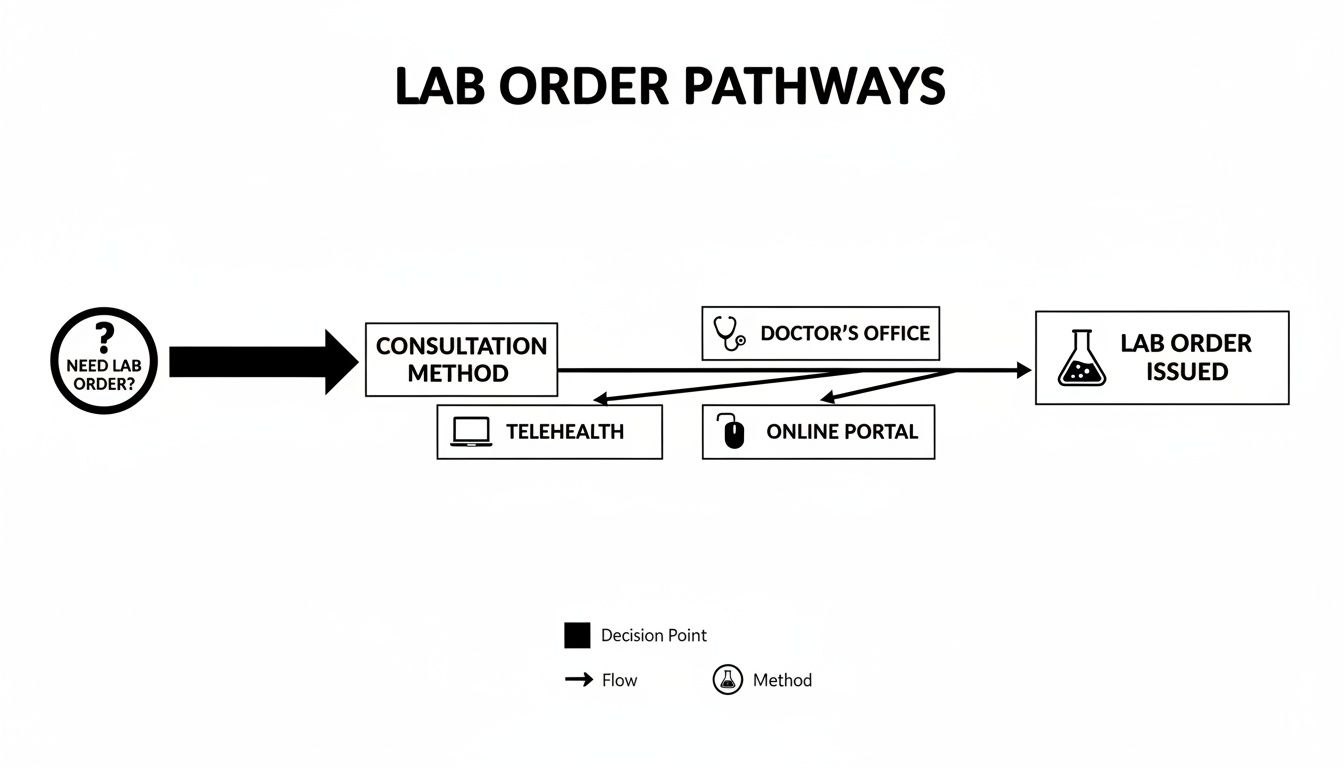
As the visual makes clear, while a few exceptions exist, most roads to a clinical-grade analysis start with some form of physician consultation, whether that’s in-person or virtual.
When a Clinical Test Is Still Best
At-home kits can be a decent starting point if you're just curious, but they are no substitute for a professional, lab-based analysis. For any man serious about understanding his fertility, a clinical test provides the accuracy and depth needed for real answers.
You can learn more about these differences in our guide on how to check sperm count at home. For a definitive diagnosis or a post-vasectomy confirmation, the clinical route remains the gold standard.
Why the Doctor's Order Matters for Your Health and Wallet
That signed piece of paper from your doctor does more than just get you in the door at the lab; it’s the key that unlocks both medical legitimacy and, just as importantly, financial coverage. When you need a doctor order for semen analysis, it's because that step officially plugs the test into your overall healthcare journey.

Think of the doctor's order as the bridge between a simple lab test and professional, integrated healthcare. It turns the analysis from a standalone data point into a valid part of your permanent medical record. This is absolutely critical for getting a formal diagnosis for male factor infertility or for officially confirming a successful vasectomy.
Securing Insurance Coverage
Let's talk money, because this is where the doctor's order really pulls its weight. Most insurance companies won’t even look at a claim for a semen analysis without that official requisition form. No order, no coverage. You’ll likely be stuck paying the entire bill yourself.
Insurers live and die by a concept called "medical necessity." The doctor's order provides a specific diagnostic code that tells them why the test is being performed, justifying it as a necessary procedure. This piece of documentation is almost always non-negotiable for them.
- With an Order: The test is flagged as a medically necessary diagnostic tool, making it eligible for coverage under your health plan.
- Without an Order: It’s often seen as elective or purely informational, leaving you to foot the bill—which can easily run several hundred dollars.
This requirement for a doctor's order isn't just bureaucratic red tape. It's designed to protect men by ensuring a medical professional is in the loop to properly interpret the results and guide the next steps. As male fertility testing becomes more common, this oversight is more important than ever.
The Importance of Professional Guidance
There's a good reason regulations require a doctor's involvement: reading these results is a nuanced skill. For example, a "normal" sperm count is generally considered to be above 15 million per milliliter. But a doctor knows that number is just one piece of the puzzle and will analyze it alongside crucial factors like motility (how sperm swim) and morphology (their shape).
This expert interpretation is vital, especially when you consider that male factors contribute to a staggering 30-50% of infertility cases. Modern platforms like Hera Fertility are making this process easier by providing instant, physician-signed requisitions online. But the end goal is the same: the order ensures your results don't just sit on a page, but lead to actionable, personalized health advice from a professional who understands the complete picture. You can discover more about the growing semen analysis market and see why this is becoming such a key area of healthcare.
Navigating Your Lab Visit with Confidence
Alright, you've got the doctor's order in hand. Now for the lab visit itself. Knowing exactly what to expect on test day can take a lot of the awkwardness and anxiety out of the equation, making the whole process feel much more straightforward. Let's walk through it.
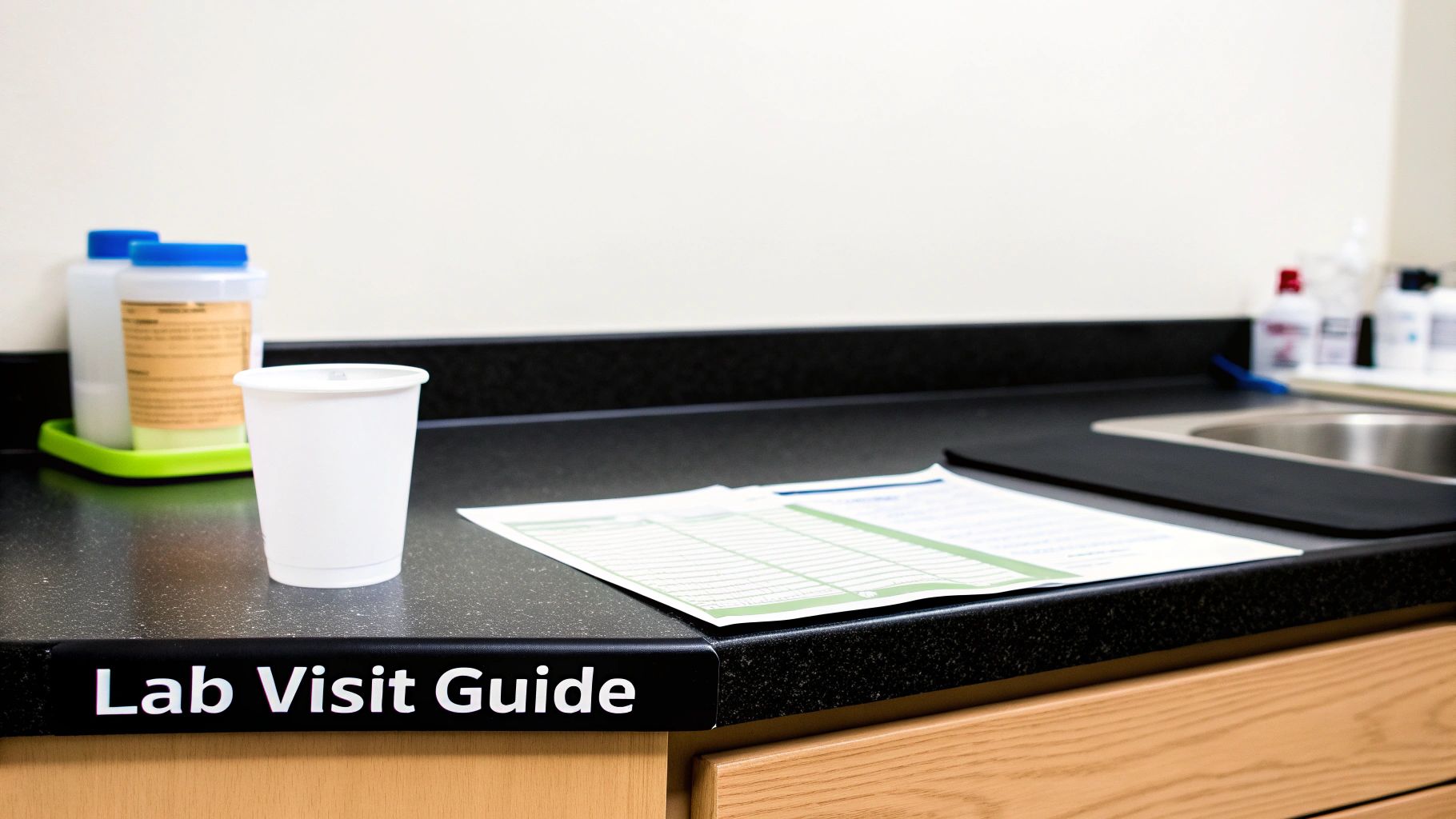
If there's one instruction to follow to the letter, it's this: you need to abstain from any ejaculation for 2 to 5 days before your test. Any shorter or longer than that, and you risk skewing the results. Sticking to this window is critical for getting an accurate snapshot of your sperm health.
Pre-Test Best Practices
To make sure your sample is a true reflection of your baseline health, there are a few simple things to keep in mind in the days leading up to your appointment. The idea is to avoid anything that could throw off the numbers temporarily.
Here's a quick checklist of things to skip:
- Lubricants: Most commercial lubricants—and yes, that includes saliva—can damage sperm or mess with how they swim, so it's best to avoid them completely during collection.
- Excessive Heat: Stay out of hot tubs, saunas, and super-hot baths for at least 48 hours beforehand. High temperatures are a known enemy of healthy sperm production.
- Heavy Alcohol Use: It’s smart to lay off heavy drinking for a few days before your test.
Following these guidelines helps ensure the lab is analyzing a sample that’s genuinely representative of you.
What to Expect at the Lab
When you get to the lab, the check-in process is designed to be quick and private. You’ll just need to show your doctor’s order and your ID at the front desk. From there, a lab tech will guide you to a private collection room.
These rooms are built for one purpose: to provide a sterile, comfortable, and totally discreet space. Inside, you’ll find a sterile collection cup and clear instructions.
Once you’re finished, you’ll pass the sample to the technician, usually through a small, private pass-through window so you don't have to walk through the waiting room. The whole process is designed to be as professional and comfortable as possible. In fact, many organizations focus on improving patient experience in healthcare settings, and these discreet lab protocols are a perfect example of that.
What if you’re collecting at home? In that case, the clock is ticking. You absolutely must keep the sample at body temperature (tucked in a pocket close to your body works well) and get it to the lab within 30 to 60 minutes. Any longer, and the sperm can start to die off, making the motility results completely unreliable. To make this easier, you can use an online tool to find labs close to home to cut down on travel time.
Turning Your Test Results into Actionable Next Steps
Getting your semen analysis report back is a big moment. But let's be honest, it can also feel like you've been handed a document in a foreign language. You’ll see a list of terms like motility, morphology, and sperm count, each with a number next to it.
These numbers tell a story about your reproductive health, but they aren't self-explanatory. For instance, motility is all about how well your sperm are swimming, while morphology looks at their shape. A doctor is the one who can translate these individual data points into a complete, meaningful picture of your fertility.
Understanding Your Key Metrics
Making sense of the report is the first real step toward taking action. The numbers on the page are compared against established reference values, which gives you a baseline for whether your results fall within a typical range for fertile men.
A few of the most important parameters you'll see include:
- Sperm Concentration: This is the number of sperm in each milliliter of semen. A healthy count is generally considered 16 million/mL or higher.
- Total Motility: This measures the percentage of sperm that are moving at all. You're looking for a result of 42% or more.
- Morphology: This is the percentage of sperm with a normal shape. It might sound low, but even a small percentage, like 4%, can be considered perfectly healthy.
Remember, these are just reference points. A result that falls outside the "normal" range isn't a final verdict; it's a starting point for a conversation with your doctor about what comes next.
Why Professional Interpretation Is Crucial
This is exactly why having a doctor in your corner is so important. They won't just look at one number in isolation. Instead, they’ll analyze how all the factors play off each other and consider them in the bigger context of your overall health, lifestyle, and family-building goals.
Your doctor will help you create a clear, proactive plan based on your unique situation. This could involve simple lifestyle adjustments, a recommendation to see a urologist for a closer look, or even just giving you the peace of mind that comes with clear answers. No matter the outcome, professional guidance is what turns your report into a powerful tool for managing your reproductive health.
Your Questions About Semen Analysis, Answered
If you're looking into a semen analysis, you probably have a few questions. Let's walk through some of the most common ones to clear things up.
Can I Just Use an At-Home Sperm Test Instead?
It's tempting to grab an at-home kit for convenience, but they're no substitute for a real clinical analysis. At-home tests usually only check one or two things, like sperm count, and can't give you the full, medically accurate picture a doctor needs for a diagnosis.
For results you can actually rely on, a lab test is the gold standard.
How Much Is a Semen Analysis Going to Cost?
The cost can vary quite a bit depending on where you live and your insurance coverage. If you have a doctor's order, insurance will often cover a good chunk of the fee. Without it, you might be looking at $100 to over $300 out-of-pocket.
Some of the newer men's health platforms can offer more transparent, upfront pricing and help you find affordable labs in your area.
How Long Will I Be Waiting for My Results?
Turnaround time depends on the lab, but you can typically expect your results back within a few days to a week. The report is sent directly to the doctor who ordered the test, and their office will then contact you to go over what it all means.
A clinical semen analysis gives you a detailed, medically valid snapshot of your fertility. While at-home kits offer a tiny glimpse, only a lab-based test delivers the complete picture you need for confident family planning or to confirm the success of a vasectomy.
Getting actionable insights is the whole point, and a proper test is the only way to start.
Ready to get clear answers about your fertility? Hera Fertility lets you order a physician-signed lab requisition in minutes. You can test at a certified lab near you and get a simple, easy-to-understand Hera SmartScore report. Take control of your reproductive health today at https://herafertility.co.
Related Resource Articles
-
A Guide to the Sperm Count Test for Male Fertility
Understand the sperm count test and what it means for your fertility. This guide covers how the test works, what results mean, and your next steps.
21 min read
-
When to see a fertility doctor: A Guide for Men
Struggling to conceive? Learn when to see fertility doctor with clear signs, timelines, and next steps.
17 min read
-
When to See a Fertility Specialist: A Guide for Men
Wondering when to see fertility specialist? This concise guide for men covers key signs, timelines, and practical next steps.
22 min read