Sperm testing at home is an umbrella label. “At home” may describe where you collect the sample, where it is analyzed, or both. A retail screen, smartphone test, mail-in analysis, and home collection for rapid local-lab handoff answer different questions. The right route depends on what you need to decide next: whether to get a full fertility workup, establish a baseline, or confirm a vasectomy.
What sperm testing at home actually means
There are four main testing routes:
- Instant home screen: You collect and analyze the sample yourself with a color-change strip or smartphone device. Some return a simple above-or-below-threshold result. Others provide numeric concentration and selected motility measures.
- Mail-in laboratory analysis: You collect at home, prepare the sample with the kit’s materials, and ship it to a remote laboratory. The reported parameters depend on the service and its validated preservation method.
- Home collection with local handoff: You collect at home and deliver the fresh sample to a nearby laboratory within its specified time and temperature limits. The lab performs the same analysis it would have performed after on-site collection.
- On-site collection and laboratory analysis: You collect at the testing site, and trained laboratory staff analyze the fresh sample there.
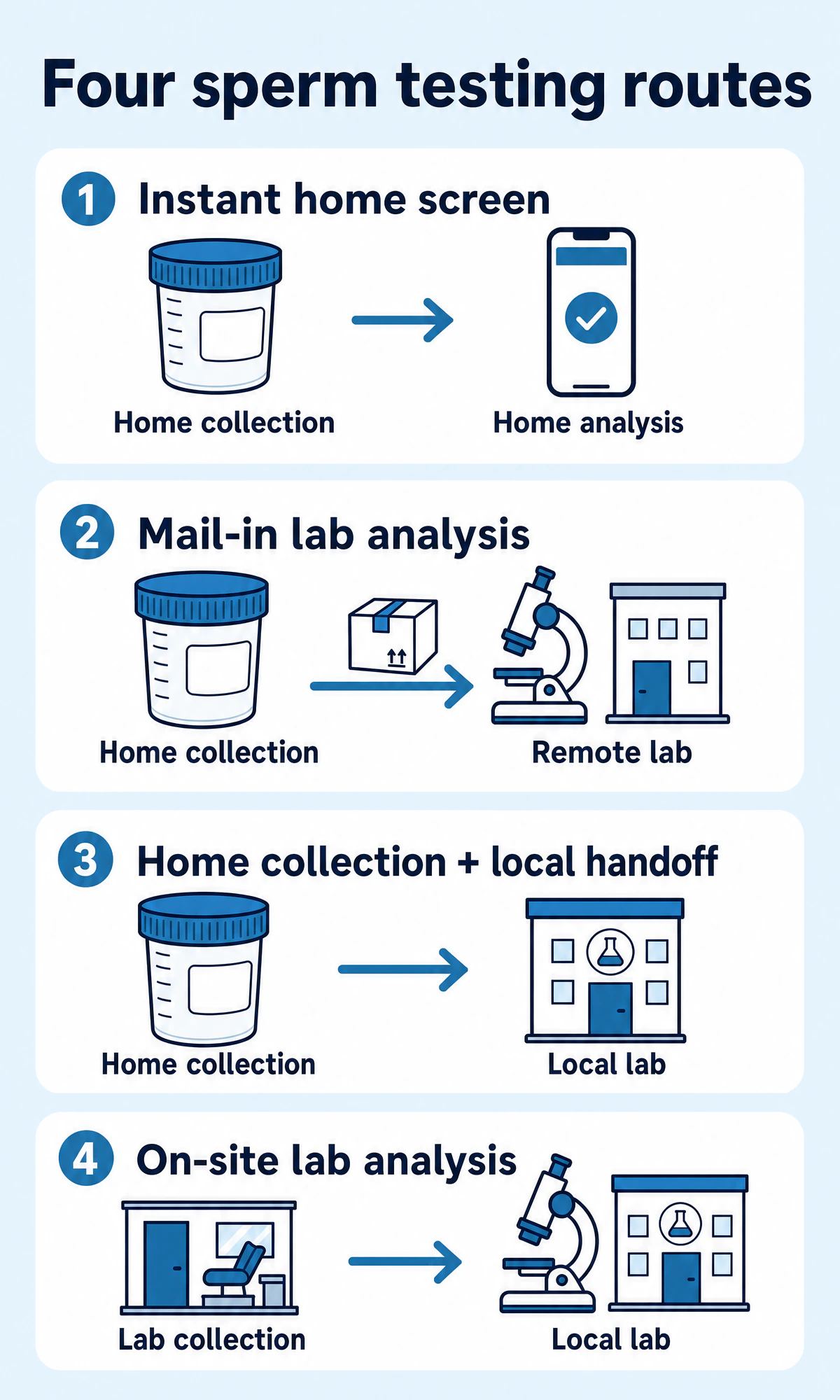
That distinction matters because home collection is not automatically a home test. If a local lab accepts a correctly collected sample and performs a full fertility semen analysis, you can get lab-based results without collecting in the facility.
For someone trying to conceive who wants a useful fertility baseline, we recommend a comprehensive local laboratory semen analysis. With Hera, you can choose a confirmed local testing site, get the required physician-signed lab requisition, and receive plain-English interpretation. No separate doctor visit or referral is needed because the order is included. The order itself is not a consultation or diagnosis.
At-home sperm test vs. lab semen analysis
The useful comparison starts with the analysis method. The address where you produce the sample is secondary.
Instant home screen
- What it does: You run a strip, cassette, or phone-based device at home. It usually reports sperm concentration, or concentration plus selected motility measures.
- Practical trade-offs: Results often take minutes, and kit prices vary by device and number of tests. No sample leaves home, but privacy also depends on the device, app, account, and data-handling policy.
- Best fit: An early screen or tracking the same reported measure. A limited result cannot establish fertility or exclude problems the device does not measure.
Mail-in laboratory analysis
- What it does: A remote lab analyzes a preserved sample. The report may include volume, concentration, total count, motility, and morphology, depending on the service.
- Practical trade-offs: Collection is private, but packing and shipping are required. Preservation, shipping, result time, and total price vary.
- Best fit: Someone with limited local access. The result is only as complete as the service’s validated methods and report.
Home collection with local handoff
- What it does: A nearby fertility or andrology lab analyzes a fresh sample after you deliver it. The report includes the parameters offered by that specific lab.
- Practical trade-offs: Collection is private, with a strict handoff window. Scheduling, fees, and result time are lab-specific. A late, incomplete, overheated, or contaminated sample can affect the result.
- Best fit: Someone who wants collection privacy and a comprehensive local-lab report, when the lab permits home collection.
On-site collection and laboratory analysis
- What it does: A local lab analyzes the fresh sample at the testing site and reports the comprehensive fertility parameters it offers.
- Practical trade-offs: You do not transport the sample, but collection is less private. Scheduling, fees, result time, and availability are test- and location-specific.
- Best fit: A first fertility workup, an abnormal home result, or clinician-requested testing.
The word “accurate” does not settle this comparison. A device can measure one parameter accurately and still leave out the parameter that explains your situation. Before choosing, ask two separate questions: Does it measure reliably? and Does it measure enough for the decision I need to make?
Why a sperm count result is not a fertility verdict
“Sperm count” is often used loosely. A report may mean:
- Sperm concentration: the number of sperm per milliliter of semen
- Total sperm count: concentration multiplied by the semen volume in the full ejaculate
A concentration-only screen can miss a low total count caused by low semen volume. It can also miss poor movement or shape. A high count does not compensate for every possible concern, and a low reading does not diagnose infertility by itself.
A comprehensive fertility semen analysis commonly evaluates several parameters together:
| Parameter | What it tells you | WHO 2021 lower reference limit |
|---|---|---|
| Semen volume | Amount of fluid in the ejaculate | 1.4 mL |
| Total sperm number | Sperm in the entire ejaculate | 39 million per ejaculate |
| Sperm concentration | Sperm in each milliliter | 16 million/mL |
| Total motility | Sperm showing any movement | 42% |
| Progressive motility | Sperm moving forward | 30% |
| Morphology | Sperm meeting strict shape criteria | 4% normal forms |
These figures are lower fifth-percentile reference limits based on men whose partners conceived within 12 months. They are not a line separating “fertile” from “infertile.” The WHO laboratory manual standardizes laboratory examination, while current reproductive-health guidance stresses that the parameters must be interpreted together and in the context of both partners. A lab may also report vitality, pH, liquefaction, viscosity, or other observations when indicated.
One sample is also a snapshot. Semen parameters vary between ejaculates. The 2024 amended AUA/ASRM guideline advises that at least two semen analyses, ideally at least one month apart, are important when the first analysis is abnormal.
Are at-home sperm tests accurate?
There is no honest universal accuracy percentage for at-home sperm testing. Strip tests, phone-based analyzers, and mail-in laboratory services use different methods, thresholds, and validation studies. Accuracy also applies to a specific reported measure, not to fertility as a whole.
A peer-reviewed clinical review of home testing found that available devices can provide useful concentration or motility screening, but they should not be the sole test for male-factor infertility. The review also warns about false-negative results and the parameters many devices omit.
The practical rule is simple: treat an instant home result as a screen. Treat a mail-in result according to the exact parameters and methods on its report. An abnormal, conflicting, or incomplete result needs a comprehensive local laboratory analysis. Our detailed guide to at-home sperm test accuracy explains how to read device validation claims without confusing agreement on one measure with a full fertility assessment.
Choose the test that matches your situation
You are trying to conceive or want a fertility baseline
Start with a comprehensive fertility semen analysis when the result will guide medical care or family-planning decisions. It gives you concentration, total count, movement, shape, and semen-volume context in one report.
You do not have to wait for an infertility diagnosis to learn your baseline. If pregnancy has not occurred, professional evaluation should generally begin after 12 months of regular unprotected sex when the partner who may become pregnant is younger than 35, or after 6 months at age 35 or older. Evaluation should start sooner when either partner has a known risk factor, and both partners should be assessed in parallel. Those timelines come from ASRM fertility-evaluation guidance.
Your home result is low, abnormal, or different from a prior result
Do not diagnose yourself from the color of a strip or one app score. Move to a full local laboratory analysis. If a laboratory result is abnormal, a reproductive urologist or other male reproductive specialist can connect it with your history, medications, physical examination, hormones, or further testing when indicated.
If results conflict, sample collection and normal biological variation may both contribute. Report a missed portion of the sample, collection error, fever or illness, and any delay in delivery. Those details can change how a clinician interprets the numbers.
A clinician or fertility clinic requested the test
Use the exact test and performing laboratory specified by the care team. A retail screen may be shareable, but it may not meet the clinic’s requirements or include the measures needed for treatment planning. The order should identify a standard fertility semen analysis, post-vasectomy analysis, sperm-preparation test, or another specific service.
Privacy is your main concern
Ask whether the local lab accepts home collection. When it does, you can collect privately and still receive a comprehensive laboratory report. Use only the provided or approved container and follow the receiving lab’s instructions for abstinence, collection, temperature, and handoff.
Do not assume every general laboratory location accepts semen samples. The exact test, appointment, collection location, container, and handoff procedure are site-specific.
You need post-vasectomy confirmation
Use a post-vasectomy semen analysis ordered or accepted by the clinician managing your vasectomy. A fertility screen and a clearance test have different intended uses and sensitivity requirements. The 2026 AUA vasectomy guideline supports continued contraception until post-vasectomy semen analysis confirms success. Keep using contraception until your clinician formally clears you based on the required result. You can review the separate post-vasectomy sperm test pathway for this purpose.
A local fertility lab is genuinely hard to reach
A mail-in laboratory service may provide more information than an instant screen. Its materials should state exactly what is measured, which lab performs the analysis, how the sample is preserved, whether the method has been validated for those parameters, and whether the report is intended for clinical use. “Analyzed in a lab” does not guarantee that every standard fertility parameter is included.
Seven details to compare before buying a home sperm test
A useful product description and sample report should answer these questions:
- Intended use: Is it for general fertility screening or post-vasectomy monitoring? These are not interchangeable.
- Reported parameters: Does it give a pass/fail threshold, a numeric value, or a full panel? Look for concentration, total count, total and progressive motility, morphology, and semen volume by name.
- Analysis location: Is the result generated by you, an app, or trained staff in a named laboratory?
- Sample handling: Does the method require immediate analysis, local delivery, or a preservation solution and shipping? The instructions should match how the test was validated.
- Regulatory and lab details: FDA clearance applies to a device’s stated intended use. It does not turn a limited screen into a complete fertility evaluation. For lab-analyzed testing, identify the performing laboratory and its credentials.
- Report and follow-up: Can you see a sample report? Is there a clear next step for a low, conflicting, or invalid result? Will your clinician accept it?
- Total cost: Include refills, shipping, required consultations, repeat tests, and local laboratory fees. For a local clinical test, compare location-specific details rather than relying on a national price claim. Our semen analysis cost guide explains the parts of the total.
Frequently asked questions
Can I collect a semen sample at home and still get a full lab analysis?
Yes, if the performing lab permits home collection. You must use its approved container and follow its deadline and temperature instructions. Some sites require on-site collection, so the exact test and location must explicitly allow it before you collect.
Can an at-home sperm test tell me whether I am infertile?
No. A home screen can report the parameter it was designed to measure. Even a comprehensive semen analysis does not prove fertility or infertility on its own. Results need the context of both partners, medical history, and sometimes repeat testing.
What should I do after a “normal” home sperm test?
Read what was actually measured. A result within range for concentration or motility is reassuring only for that measure. If you have been trying without pregnancy, have a fertility risk factor, or need the result for clinical care, move to a comprehensive laboratory analysis rather than repeating a limited screen indefinitely.
Do I need a doctor’s referral for a lab semen analysis?
Order requirements vary. When you test through us, a physician-signed lab requisition is included, so you do not need a separate doctor visit or referral. The selected lab’s appointment, payment, insurance, and collection arrangements remain location-specific. We do not submit insurance claims.
How quickly will I receive laboratory results through Hera?
Results are typically available in 2 to 5 days, depending on the selected lab. We then help turn the report into a clear view of what each parameter means and the next sensible step.
If you want a fertility baseline you can act on, find a local semen analysis lab through Hera. We include the physician-signed requisition, coordinate the testing path, and provide plain-English interpretation after the lab reports your results.
Related Resource Articles
-
How to Choose the Best Semen Analysis Facility Near You
Choose the best semen analysis facility near you. Get accurate results from CLIA-certified labs with expert review. Learn what to look for!
11 min read
-
Best At-Home Male Fertility Test: How to Choose
Compare home male fertility test types by what they measure, sample handling, regulation, privacy, cost, and collection logistics.
11 min read
-
How to know if you're infertile male without test: Key signs and steps
Discover how to know if your infertile male without test: learn early signs, health history clues, and why testing gives certainty.
18 min read