A sperm count test kit is a tool that lets a man get a private, first look at his sperm concentration right from home. For any man curious about his reproductive health, these kits offer a convenient and discreet starting point.
Your First Step in Understanding Your Male Fertility

Deciding to learn more about your fertility is a big deal, and it's a powerful one. It’s a proactive choice that puts you in the driver’s seat of your own health journey. For a lot of men, the whole topic can feel a bit mysterious or even intimidating, but getting good information is the best way to cut through the noise.
Today, there are really two main ways you can get answers about your sperm health. Knowing how they differ is crucial for figuring out which approach makes the most sense for you right now.
Two Paths to Gaining Insight
The first option, and one that’s grown a lot in popularity, is the at-home sperm count test kit. These are designed from the ground up for privacy and ease of use, letting a man collect and test a sample without leaving his house. Most will give you a pretty straightforward result, often just indicating if your sperm count is above or below a certain level.
The second path is the clinical semen analysis, which is done at a certified laboratory. This is what doctors consider the gold standard for male fertility testing. A professional lab analysis goes way beyond a simple count, digging into several critical factors that all play a role in a man's overall reproductive potential.
Choosing to get tested isn't about looking for a problem—it's about gathering information. Knowledge gives you the power to make informed decisions about your health and future, whether you're planning for a family now or simply want a baseline for down the road.
Each method comes with its own set of pros and cons. The right one for you really depends on what you’re trying to find out and what you’re comfortable with. To make it a bit clearer, let's break it down.
A Quick Look at Your Sperm Testing Options
Here’s a brief comparison of the primary methods available for men to test their sperm health, highlighting the main features of each approach.
| Feature | At-Home Sperm Count Test Kit | Clinical Semen Analysis |
|---|---|---|
| Location | Performed entirely at home | Sample collected at home or a lab |
| Scope | Typically measures only sperm count | Measures count, motility, morphology, and more |
| Accuracy | Varies; potential for user error | High; performed by trained professionals |
| Privacy | Maximum privacy and discretion | Requires visiting a clinic or lab |
| Cost | Generally lower upfront cost | Typically a higher cost per test |
| Results | Simple "yes/no" or range result | Detailed report with multiple metrics |
As you can see, the choice isn't just about convenience. It's about how deep you want to go and what kind of information you need to make your next move.
Why Male Fertility Is a Bigger Deal Than Ever
Let’s be honest, the conversation around fertility has been a bit one-sided for a long time. But that’s finally changing. There's a growing understanding that male health isn't just a footnote in the fertility story—it's a massive part of the whole picture. This isn't about blame; it's about getting a complete, 360-degree view of men's reproductive health.
This new perspective is empowering men to get in the driver's seat of their own health. Instead of waiting for problems to pop up, more guys are getting curious, asking questions, and taking control of their wellness from the get-go. It's a shift driven by a simple desire for knowledge and the realization that understanding your own body is just part of being a modern man.
A Global Shift in Thinking
This isn't just a small-town trend; it's happening everywhere. We now know that male factors play a significant role in fertility challenges. That single fact completely reframes the conversation, taking male fertility from a quiet concern to a major health topic that impacts millions of men around the world.
The demand for easy, accessible testing options shows just how big this shift is. The global market for the sperm count test kit is a perfect example. It was valued at over USD 2 billion in 2022 and is expected to keep climbing, all because more men recognize that their health is a critical piece of the puzzle. You can learn more about the growth of the male fertility market and its drivers.
Understanding your fertility isn't just about family planning. It's a proactive step toward managing your overall health, giving you powerful insights that can shape your lifestyle choices and future plans.
This growing interest really underscores a fundamental change in how men are approaching their health.
The Need for Privacy and Convenience
Not too long ago, getting a semen analysis involved a clinic appointment, an awkward room, and a process that felt anything but personal. While clinical lab tests are still the most comprehensive option, that traditional route doesn't really mesh with modern life. Men today are looking for solutions that respect their privacy and fit into a packed schedule.
This is where new testing solutions really shine. The simple ability to start the process from your own home removes a huge hurdle for a lot of guys. It lets a man take that first step discreetly and on his own timeline, without having to book time off work or have a sensitive conversation before he’s ready.
Getting Ahead of the Curve
Even outside of immediate family planning, a lot of men are just plain curious about their long-term health. Getting a baseline of your fertility metrics can be an incredibly valuable piece of your personal health puzzle. Think of it as a snapshot in time that can help you and your doctor make smarter decisions later on.
This is all about being proactive instead of reactive. By understanding where you stand early on, you can:
- Make informed lifestyle choices to support your reproductive health.
- Have much more productive conversations with a doctor if you decide to get professional advice.
- Feel more confident and prepared for whatever the future holds.
Ultimately, this whole movement toward proactive male health is about empowerment. It’s about giving men the tools and information they need to take charge of their well-being, turning what used to be a taboo topic into an open, positive, and productive conversation.
Choosing Your Path: At-Home Kits vs. Lab Analysis
When you decide to get proactive about your fertility, you’ll find two main roads you can take. One is the increasingly popular at-home sperm count test kit, and the other is the traditional semen analysis done in a clinical lab. Figuring out the pros and cons of each is the key to picking the right first step for you.
This decision tree can help you visualize which factors might be most important on your journey.
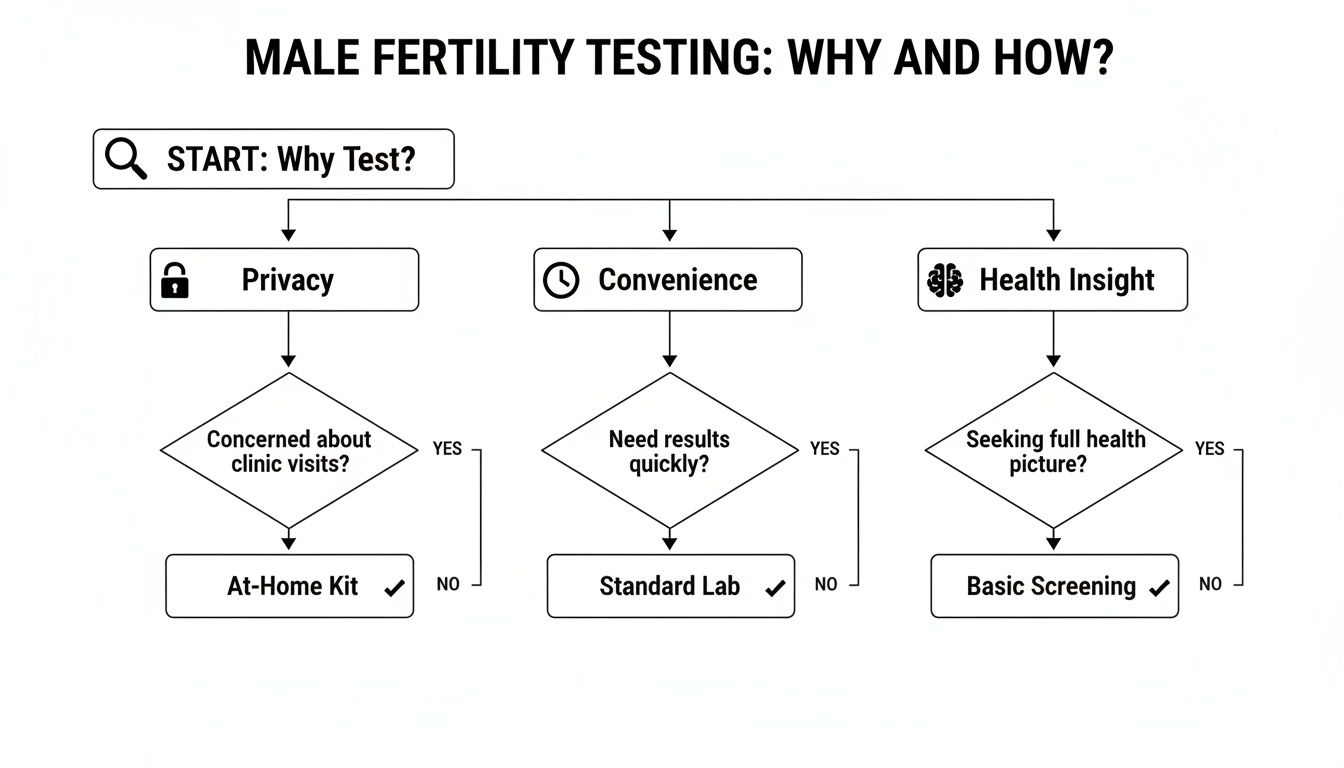
As you can see, things like your desire for privacy, convenience, and the depth of health insight you're after can point you toward the best testing option for your situation.
The Case for At-Home Sperm Count Test Kits
The biggest draw of an at-home kit is, without a doubt, privacy. For a lot of men, the idea of producing a sample in a sterile, clinical setting is awkward at best. An at-home test completely sidesteps that discomfort, letting you handle the whole process in your own space, on your own schedule.
Then there’s the convenience factor. No appointments to book, no driving to a clinic, and no taking time off work. You order a kit online, and it shows up at your door. This ease of access encourages guys who might otherwise procrastinate to take that crucial first step.
Finally, the upfront cost of a sperm count test kit is usually much lower than a full lab workup. If you're just curious or want a quick, preliminary check, it's a budget-friendly way to get a basic reading.
But it's crucial to know what they don't do. Most at-home kits only measure one thing: sperm count. They often give you a simple "yes" or "no" answer—telling you if your count is above or below a specific number. They can't tell you how well your sperm swim (motility) or if they have the right shape (morphology). Plus, there’s always a risk of user error during collection, which could skew the results.
The Gold Standard: Clinical Semen Analysis
When you need the full, unvarnished truth about your sperm health, a clinical semen analysis is the definitive answer. This test is run by trained lab technicians in a controlled environment, making it far more thorough than any kit you can buy online. It gives a man a detailed report covering all the key pillars of male fertility.
An at-home test can tell you if there are players on the field. A clinical analysis tells you how many players there are, how fast they run, and if they're in the right shape to play the game.
This is exactly why doctors rely on lab analysis to make their assessments. It removes the guesswork and provides a solid, reliable foundation for any conversations you might have with a fertility specialist. The results are precise and offer much deeper insight into a man's reproductive potential.
Of course, this option has its own trade-offs. The cost is higher, and it means a trip to a lab. For some men, the clinical setting can feel intimidating and far from private, which can be a real roadblock.
At-Home Test Kit vs. Clinical Semen Analysis
To help you weigh your options, here’s a straightforward comparison of the key differences between using a direct-to-consumer sperm count test kit and getting a professional semen analysis at a certified laboratory.
| Factor | At-Home Sperm Count Test Kit | Clinical Semen Analysis (via Lab) |
|---|---|---|
| Primary Advantage | Absolute privacy and convenience. | Unmatched accuracy and comprehensive data. |
| Metrics Measured | Usually only sperm concentration. | Count, motility, morphology, volume, and more. |
| Accuracy Level | Variable; potential for user error. | High; professionally analyzed in a controlled setting. |
| Best For | A discreet, initial screening for curious men. | A definitive assessment for family planning or health concerns. |
| Actionable Next Steps | Limited; an abnormal result requires lab follow-up. | Provides a clear, detailed basis for a doctor's consultation. |
Ultimately, there is no single "best" choice that fits every man. The right path really depends on your personal situation—why you're testing, your comfort level with the process, and how much detail you need to feel confident about what comes next.
Decoding the Three Pillars of Sperm Health

When it comes to understanding male fertility, looking at a single number from a sperm count test kit is like judging a sports team by its roster size alone. It tells you part of the story, but not whether they can actually win the game. True male fertility is a team effort, and three key players determine the team's strength.
To really make sense of your results—whether they come from a simple at-home test or a full clinical analysis—you need to get familiar with these three critical factors. Knowing what they are and why they matter is the first step toward getting a complete picture of your reproductive health.
Pillar 1: Sperm Count (Concentration)
First up is the metric most men have heard of: sperm count, sometimes called sperm concentration. This one is pretty straightforward. Using our sports team analogy, this is simply the number of players you have on the field.
Sperm count is measured in millions of sperm per milliliter (mL) of semen. While more is generally better, the real goal is just to have enough players to start with. Most basic at-home kits stop here, giving you a simple yes/no on whether you meet a certain threshold.
So, what’s a good number? According to the World Health Organization (WHO), a normal count is 15 million sperm per milliliter or higher. Anything below that is considered a low sperm count. But even if your numbers are great, it’s only one piece of the puzzle. You also need to know if your players are any good.
Pillar 2: Sperm Motility
That brings us to our second pillar: sperm motility. This is all about how well your sperm can move. In our analogy, it's not enough to have players on the field—you need to know how fast and effectively they can run toward the goal.
Motility is absolutely critical for male fertility. Sperm have a long, challenging journey ahead of them, and they need to be powerful swimmers to make it. A clinical lab analysis will measure two key types of movement:
- Progressive Motility: This is the percentage of sperm swimming with purpose—moving forward in straight lines or large circles. Think of these as your star athletes, the ones making real progress down the field.
- Total Motility: This includes all moving sperm, even those just twitching in place or swimming in tight, useless circles.
For healthy male fertility, the benchmark is to have at least 40% of your sperm showing any movement (total motility), and more importantly, at least 32% showing strong, forward motion (progressive motility). A high sperm count means very little if most of them can't swim.
Pillar 3: Sperm Morphology
Finally, we have the most overlooked pillar: sperm morphology. This refers to the size and shape of the sperm. Back to our team analogy, are your players in the right physical shape to perform their job?
A "normal" sperm has a smooth, oval-shaped head (which carries the genetic material) and a single, long tail to propel it forward. Any irregularities, like a misshapen head or a bent tail, can seriously hinder its ability to complete its task.
It might sound a bit scary, but it’s perfectly normal for the vast majority of sperm in any given sample to be abnormally shaped. What matters is having enough of the well-formed ones.
The healthy range for normal morphology is surprisingly low. A man only needs 4% or more of his sperm to have the correct shape to be considered in the normal range. This is the kind of crucial detail that a simple sperm count test kit just can’t provide.
Together, these three pillars—count, motility, and morphology—paint the full picture of a man's reproductive health.
A New Way to Test: Bridging the Gap
For a long time, men faced a frustrating choice: an at-home sperm count test kit that offered privacy but questionable accuracy, or a full clinical analysis that felt invasive and inconvenient. It was a classic trade-off between convenience and completeness. But what if a man didn’t have to choose?
Thankfully, there's a smarter approach now that combines the best of both worlds. This modern method delivers clinical-grade insights without the traditional headaches, putting men back in control of their health journey.
The Best of Both Worlds: A Hybrid Approach
Think of this new model as a guided lab experience. A man gets the professional accuracy of a clinical setting, but without all the friction that used to come with it. Instead of trying to navigate the healthcare system on your own, a platform handles all the logistics for you.
Here’s a quick look at how it works:
- Order Online: It all starts from the comfort of your home, where you securely order a physician-backed lab test.
- Choose a Lab: Next, you pick a certified lab from a network of locations near you. No more driving across town to a specific clinic.
- Test on Your Time: Finally, you visit the lab whenever it fits your schedule to provide your sample. The entire process is professional, private, and fast.
This hybrid approach effectively removes the biggest barriers that stop many men from getting tested in the first place. You get the privacy of an online service with the undeniable reliability of a professional semen analysis, giving you the detailed data you need without sacrificing comfort.
Turning Complex Data into Clear Answers
Let's be honest—getting a lab report can be overwhelming. They’re usually packed with medical jargon and numbers that don’t mean much to anyone without a medical degree. This is where the real innovation comes in: translating that dense data into something a man can actually understand and act on.
The market for male fertility solutions is growing fast, and it's not just about accessibility. New technologies are making the results easier to interpret. The entire sperm count test kit market is on track to hit USD 4.71 billion by 2031, a surge driven by a few key factors. There’s a greater awareness of male fertility, and men are increasingly seeking out private, anonymous ways to get tested. You can read more about these global male fertility trends.
The goal isn't just to give you data; it's to give you clarity. Modern platforms translate your clinical results into a simple, single score that instantly tells you where you stand.
Think of it like a credit score for your sperm health. It takes all the key metrics—count, motility, and morphology—and boils them down into one easy-to-understand number.
Your Personalized Path Forward
Getting a score is just the starting line. The real power of this modern approach lies in the personalized action plan that comes with your results. Instead of leaving a man with a confusing report and a "what now?" feeling, these systems provide concrete, evidence-based recommendations tailored specifically to him.
This plan might include suggestions for:
- Lifestyle Adjustments: Specific, actionable changes to your diet, exercise routine, or daily habits known to support sperm health.
- Targeted Supplements: Guidance on vitamins and minerals that research has shown can impact key fertility metrics.
- Next Steps: Clear advice on when it might be time to talk to a urologist or male fertility specialist for a deeper look.
This level of personalization empowers you to take immediate, proactive steps. It turns your test results from a static piece of paper into a dynamic roadmap for improving your reproductive wellness. You get clinical-grade accuracy without the hassle, all while keeping your information completely private and secure.
Your Action Plan After Getting the Results
So, you've got the results in hand. Whether it’s from a basic sperm count test kit or a full-blown lab report, that first look can feel a little overwhelming. But here’s the most important thing to remember: this isn't a final verdict. It's a starting point—your first real piece of data on the path to understanding and improving your reproductive health.
No matter what the numbers show, you now have a baseline. That's a powerful thing to have. Your next move depends on the results, but either way, the goal is to move forward with a clear, positive plan.
If Your Results Are in the Normal Range
Seeing good numbers is a huge relief. If your results fall into the healthy range, that’s fantastic news! Now, the goal is to keep it that way. Think of this as great reinforcement for maintaining a healthy lifestyle, since strong sperm health is so closely tied to a man's overall well-being.
To stay on the right track, you can double down on a few key areas:
- Eat Well: A balanced diet packed with antioxidants, vitamins, and minerals is fuel for healthy sperm production.
- Stay Active: You don't need to run marathons, but regular, moderate exercise is a known booster for male reproductive health.
- Manage Stress: It's no secret that chronic stress messes with your hormones. Finding healthy ways to relax and decompress is more important than you might think.
This isn’t about a one-time fix; it's an ongoing commitment to your health.
When Your Results Are Outside the Normal Range
If your results come back lower than you hoped, the first rule is simple: don't panic. An at-home test, or even a single lab analysis, is just a snapshot in time. It's not the whole story. So many things can temporarily throw your numbers off, from a recent fever to a particularly stressful week at work.
This is your cue to shift from just gathering data to taking meaningful action.
An abnormal result from a sperm count test kit isn’t a dead end. It’s a signpost, pointing you toward the next step: talking to a professional who can help you see the complete picture.
Your single most important next step is to book a consultation with a urologist or a male fertility specialist. They're the experts who can put your results into context, order more tests if necessary, and give you a real understanding of what's going on. Starting that conversation with an interpreted report already in hand makes it infinitely more productive.
Male fertility is finally getting the attention it deserves. With a clear understanding of male reproductive health, men can have a clear plan. Discover more insights about the rise in male fertility awareness. Whatever your results, there's always a path forward.
Your Top Questions About Sperm Testing, Answered
When you're first looking into male fertility, it's natural to have a ton of questions. We get it. Getting straight answers is the first step toward feeling in control of your reproductive health. Let's walk through some of the most common things men ask about sperm testing.
How Accurate Are At-Home Sperm Count Kits?
At-home kits can be a decent starting point. They usually give you a basic "yes" or "no" answer on whether your sperm concentration is above or below a certain threshold, like 20 million sperm per milliliter.
But here's the catch: they aren't nearly as thorough as a real lab analysis. Their biggest blind spot is that they only measure sperm count. That means they completely miss the other two make-or-break factors for male fertility: motility (how sperm swim) and morphology (their shape).
Do I Need to See a Doctor Before I Can Get a Test?
Not necessarily. A man doesn't have to go through the traditional route of scheduling a doctor's visit just to get a lab order. Modern services like Hera Fertility have streamlined the whole process. You can order a physician-approved lab requisition right from your computer, which lets you get a full-blown semen analysis at a certified lab while keeping things private.
Of course, if you have known health issues or your results come back with some red flags, scheduling a follow-up with a urologist is the right move.
What Are the Biggest Things That Affect Sperm Health?
Your lifestyle has a massive impact on your sperm quality. The good news is that many of the most important factors are things you can actually control.
Think of your sperm health as a direct reflection of your overall health. The same habits that are good for your heart, energy, and mind also happen to be great for producing healthy sperm.
Here are the heavy hitters:
- Diet and Nutrition: A diet loaded with antioxidants (think fruits, veggies, and nuts) acts like a shield, protecting sperm from damage.
- Exercise and Heat: Regular, moderate exercise is fantastic for sperm quality. On the flip side, too much heat from things like saunas, hot tubs, or even tight underwear can do some real harm.
- Stress Levels: Being chronically stressed out can seriously mess with the hormones your body needs to make sperm.
- Substance Use: This one’s a biggie. Heavy drinking, smoking, and any kind of recreational drug use are all proven to tank sperm count and quality.
Making positive changes in these areas is one of the best things a man can do for his fertility, regardless of what a test might show.
Ready to get the full story on your sperm health, not just a small piece of it? Hera Fertility offers physician-backed, AI-interpreted lab testing that transforms complex lab data into a simple score and a clear plan of action. Get your clinical-grade analysis today.
Related Resource Articles
-
Male Fertility Test Reddit: Lab vs. Home, Results
Find male fertility test Reddit answers. Get clear, supportive guidance on lab vs. at-home tests, reading results, and your next steps. No jargon, just facts.
17 min read
-
Zinc for Sperm Count: A Practical Guide for Men
Does zinc for sperm count actually work? This guide explains the science, safe dosing, food sources, and when to test your fertility with a semen analysis.
15 min read
-
What Is Sperm Concentration and How Does It Affect Male Fertility
Confused about your semen analysis? Learn what is sperm concentration, the normal ranges, and practical, actionable steps men can take to improve it.
19 min read