When men ask, "what does healthy sperm look like," they're usually talking about semen—the fluid that actually carries the sperm. Visually speaking, healthy semen is typically a whitish-gray color and has a gel-like consistency right after ejaculation. As for volume, you should see about half a teaspoon or more.
What You Can Actually See at Home

Getting a handle on your reproductive health begins with knowing what's normal for your body. While a lab test is the only way to get the full story, you can actually learn quite a bit just from simple, at-home observations. Think of these visual cues as your first checkpoint.
It’s a bit like checking the outside of a car. A clean exterior and shiny paint look great, but they don’t tell you a thing about what’s happening under the hood. In the same way, the appearance of your semen gives you some initial clues, but it doesn't reveal the whole picture of your fertility.
Key Visual Characteristics
Let's break down the three main things you can observe at home: volume, color, and consistency. These factors can give you a solid baseline and help you spot any significant changes that might need a closer look.
- Volume: This is simply the amount of semen in a single ejaculation. A typical volume is between 1.5 to 5.0 milliliters (mL), which is about half a teaspoon to a full teaspoon.
- Color: The standard color is a pearly, whitish-gray. It's normal for this to vary a bit, so slight changes aren't usually a cause for alarm.
- Consistency: Immediately after ejaculation, semen is usually thick and almost gelatinous. Thanks to natural enzymes, it will start to thin out and become more liquid within about 15 to 30 minutes.
To help you keep track, here’s a quick visual guide.
Visual Guide to Semen Appearance
This table breaks down the common characteristics of a healthy semen sample and what some variations might mean.
| Characteristic | What's Considered Normal | What an Atypical Appearance Might Mean |
|---|---|---|
| Color | Pearly, whitish-gray | Yellow/green (infection), red/brown (blood), consistently clear (low sperm count) |
| Volume | 1.5 mL to 5.0 mL (about 1/2 to 1 teaspoon) | Consistently less than 1.5 mL (hypospermia), more than 5.5 mL (hyperspermia) |
| Consistency | Thick, gel-like at first; liquefies in 15-30 mins | Remains thick and clumpy (poor liquefaction), very watery (potential low count) |
Remember, this is just a general guide. These characteristics are a good starting point, but they’re just one piece of the male fertility puzzle. They can't tell you anything about sperm count, how well the sperm are moving, or their shape—all of which are critical for fathering a child.
Curious about other methods? You can learn more about how to check sperm count at home in our detailed guide.
Paying attention to these visible signs is a proactive first step in understanding your reproductive health. It empowers you to recognize what is normal for you and identify when something might be off.
When to Pay Closer Attention
While slight variations are totally normal, some changes in appearance could point to an underlying issue. For example, if your semen is consistently yellow, green, or has a reddish tinge, it might suggest an infection or another medical condition that needs attention.
If you notice persistent and significant changes in the color, volume, or consistency, it’s a good idea to talk to a healthcare professional. These observations can provide valuable information for your doctor. Taking this step moves you from guessing about your health to getting clear, actionable answers.
Why Sperm Count Is a Numbers Game
Let’s get into the metric most people know when it comes to male fertility: sperm count. The easiest way to think about it is like trying to win a lottery. The more tickets you buy, the better your chances are. Sperm count is a numbers game in a very similar way—more is almost always better.
But first, we need to clear up two key terms that often get mixed up: sperm concentration and total sperm count.
- Sperm Concentration: This is how many sperm are packed into a single milliliter (mL) of semen. Think of it as the density of swimmers in one lane of the pool.
- Total Sperm Count: This is the grand total of sperm in the entire sample. It's the total number of swimmers in the entire pool, no matter how spread out they are.
Having high numbers for both is a fantastic sign of solid reproductive health. A higher starting number simply improves the odds for a successful outcome.
What Is a Healthy Sperm Count?
So, what numbers are we actually aiming for? The World Health Organization (WHO) has set clear guidelines to help men and their doctors make sense of semen analysis results.
According to the WHO, a healthy baseline is at least 15 million sperm per milliliter or a total of 39 million sperm per sample. Falling below this threshold is a condition called oligozoospermia—the medical term for a low sperm count.
It’s important to remember that this is just a reference point. Plenty of men with counts a bit below this range have no trouble starting a family. But knowing your numbers gives you a solid starting point for any conversation you have about your fertility. These "normal" ranges were actually set by studying thousands of men who had recently become fathers.
For instance, the data from over 4,000 proven fathers across 14 different countries helped establish these modern standards. Their fertile ranges went as high as 259 million sperm per mL. On the flip side, a 2023 study sounded a warning bell, finding that 35.45% of young men in Western countries had counts below the healthy baseline, pointing to potential fertility red flags. You can get more insights about normal sperm count ranges on Healthline.
Why Quantity Is a Key Factor
Understanding what healthy sperm look like goes way beyond what you can see with the naked eye. The sheer number of sperm is one of the most fundamental parts of the fertility equation.
It’s a tough journey, and a higher count is nature’s way of compensating for the millions of sperm that get lost along the way. Think of it as an insurance policy. A robust sperm count gives you the best possible shot at success, ensuring that even after a grueling trip, there are enough strong candidates left to finish the job. It's one of the first and most important numbers you’ll see on a semen analysis for a reason.
The Importance of Strong Swimmers

Having a high sperm count is a great start, but it's really only half the battle. For sperm to have a real shot at success, they also need to be strong, effective swimmers. This crucial quality is called sperm motility, and it’s a direct measure of how well sperm can actually move.
Think of it like a marathon. It doesn’t matter how many runners show up to the starting line if they can’t move purposefully toward the finish. The quality of their movement is just as important as the size of the team.
Progressive Motility: The Key to Success
When a lab analyzes sperm movement, they aren't just looking for any old wiggle. They’re looking for a specific type of movement called progressive motility. This is the powerful, forward-moving thrust that sperm need to travel to their destination.
Sperm with good progressive motility swim in mostly straight lines or large, sweeping circles. This forward momentum is everything. Without it, sperm are essentially stuck, unable to complete their long and difficult journey. It's why, when you ask what healthy sperm look like under a microscope, the answer is often, "It looks like it’s going somewhere."
A semen sample full of these vigorous swimmers paints a clear picture of strong fertility. According to benchmarks from the World Health Organization (WHO), a healthy sample should have at least 40% of sperm moving (this is called total motility). Even more importantly, at least 32% of them should show that strong forward progression.
What Influences Sperm Movement?
Several lifestyle factors can have a real impact on how well your sperm swim. The good news is that making positive changes in these areas can directly support better motility and your overall reproductive health.
- Diet and Nutrition: A diet packed with antioxidants, vitamins, and minerals provides the fuel sperm need for energy.
- Exercise: Regular, moderate physical activity can help boost testosterone levels and improve semen quality.
- Avoiding Overheating: The testicles function best when they're slightly cooler than the rest of the body, so limiting time in hot tubs and saunas can make a difference.
Beyond diet, some studies suggest that certain CoQ10 supplements for sperm health can help support better sperm quality, especially motility and concentration. Of course, you should always talk to your doctor before starting any new supplements.
While sperm count tells you how many players are on the field, motility tells you how many are actually in the game and moving toward the goal. Both are essential for understanding your complete fertility picture.
If you want to go a little deeper on this, you can learn more about the different types of sperm motility and exactly how they’re measured. Understanding the dynamics of sperm movement gives you a much clearer view of your reproductive potential.
How Sperm Shape Affects Fertility
The final piece of the microscopic puzzle is sperm morphology—the technical term for the size and shape of an individual sperm. If count tells us how many players are on the field and motility tells us how well they move, then morphology tells us if they have the right equipment for the job.
Think of it this way: a sperm needs to be built correctly to function properly. A well-shaped sperm is far better equipped for its mission, with all the right components working together seamlessly.
The Anatomy of a Healthy Sperm
When we look at what healthy sperm look like up close, we're searching for a very distinct structure. A structurally sound sperm has three key parts, and each one has a vital role to play.
- The Head: This should be smooth and oval-shaped. Most importantly, the head is the precious cargo hold, containing all the crucial genetic material.
- The Midpiece: Acting as the "engine room," the midpiece connects the head to the tail. It’s packed with mitochondria that generate the raw energy needed for the long swim ahead.
- The Tail: This long, whip-like tail is the propeller. It uses the energy from the midpiece to drive the sperm forward.
When these three parts are formed correctly, the sperm has the best possible chance of completing its journey.
Understanding "Normal" Shape
This is where things can get a bit surprising. When a lab analyzes morphology, they use incredibly strict criteria to grade each sperm. A "normal" result only requires 4% or more of the sperm in a sample to have a perfect shape.
That’s right. It’s completely expected for the vast majority of sperm to have some kind of imperfection, like a double head, a bent tail, or a misshapen midpiece. These strict guidelines, known as the Kruger criteria, mean a sperm is only classified as "normal" if it meets every single specification down to the micrometer.
This means that even in a healthy sample, up to 96% of your sperm might have slight defects. This is absolutely not a cause for panic and is considered perfectly normal in fertility assessments.
A low percentage of perfectly shaped sperm is far from a deal-breaker, especially if your sperm count and motility are strong. With millions of sperm in the running, having just 4% with the ideal shape still means there are plenty of excellent candidates ready for the journey.
To get a clearer picture of how these different factors work together, you might be interested in our guide on what sperm morphology means for your fertility.
Getting Clear Answers With a Semen Analysis
You’ve learned about sperm count, motility, and morphology—but how do you see exactly what’s happening inside? A semen analysis is the only way to move past guesswork and get a clear snapshot of your reproductive health.
Think of it as a comprehensive check-up for your fertility. It measures every key factor we’ve discussed—and delivers real numbers you can act on. Many men feel nervous before their first test, but in practice it’s quick, straightforward, and oddly empowering.
Preparing For The Test
A bit of planning helps make sure your results truly reflect your current sperm production. Most labs ask you to pause any ejaculatory activity for 2 to 5 days before you provide a sample.
- Too Short (Under 2 Days): You risk a lower sperm count and reduced volume.
- Too Long (Over 5 Days): Older sperm can slow down, hurting motility.
Sticking to that window is like calibrating a scale: it guarantees your “score” is accurate.
What Happens At The Laboratory
Once you hand over your sample, it heads to a specialized lab where technicians dive into both the visible traits and the microscopic details that really matter.
A semen analysis is the gold standard for male fertility testing. It moves you from guessing about your health to knowing exactly where you stand.
Over the next few hours, you’ll get a full report card on your reproductive health, covering:
- Volume: Total amount of semen produced
- Sperm Count: Overall number of sperm in the sample
- Motility: Percentage of sperm that are actively swimming
- Morphology: Percentage of sperm with a normal shape
- pH Level: Acidity of the semen, which influences sperm survival
With these objective measurements in hand, you’ll have the clarity to understand exactly what “healthy sperm” looks like—and the confidence to plan your next steps.
Understanding Your Semen Analysis Results
Getting a lab report back can feel like trying to decipher a secret code. It’s usually packed with medical terms and numbers that don’t mean much on their own, and it's easy to feel a little lost. This section is all about turning that complex data into clear, actionable knowledge.
Instead of getting overwhelmed, think of your results as a personal roadmap for your reproductive health. Whether your numbers are right in the "normal" range or they point to a few areas that could use some attention, this knowledge is power. It puts you back in the driver's seat of your own health journey.
Decoding the Key Metrics
A standard semen analysis report breaks down the most critical factors for male fertility. Each number tells a piece of the story, and looking at them together gives you the full picture of what’s happening on a microscopic level.
- Sperm Count: This is the total number of sperm you have, usually measured in millions per milliliter of semen. A higher number generally improves the odds of starting a family, simply because there are more swimmers in the race.
- Motility: This is a crucial one—it’s the percentage of your sperm that are actually swimming and moving forward. Strong, purposeful movement is what helps them complete their journey.
- Morphology: This refers to the percentage of sperm that have a normal, healthy shape. The ideal shape is a smooth oval head with a long, single tail, which helps with speed and function.
This infographic gives you a quick visual breakdown of these core components and how they all fit together.
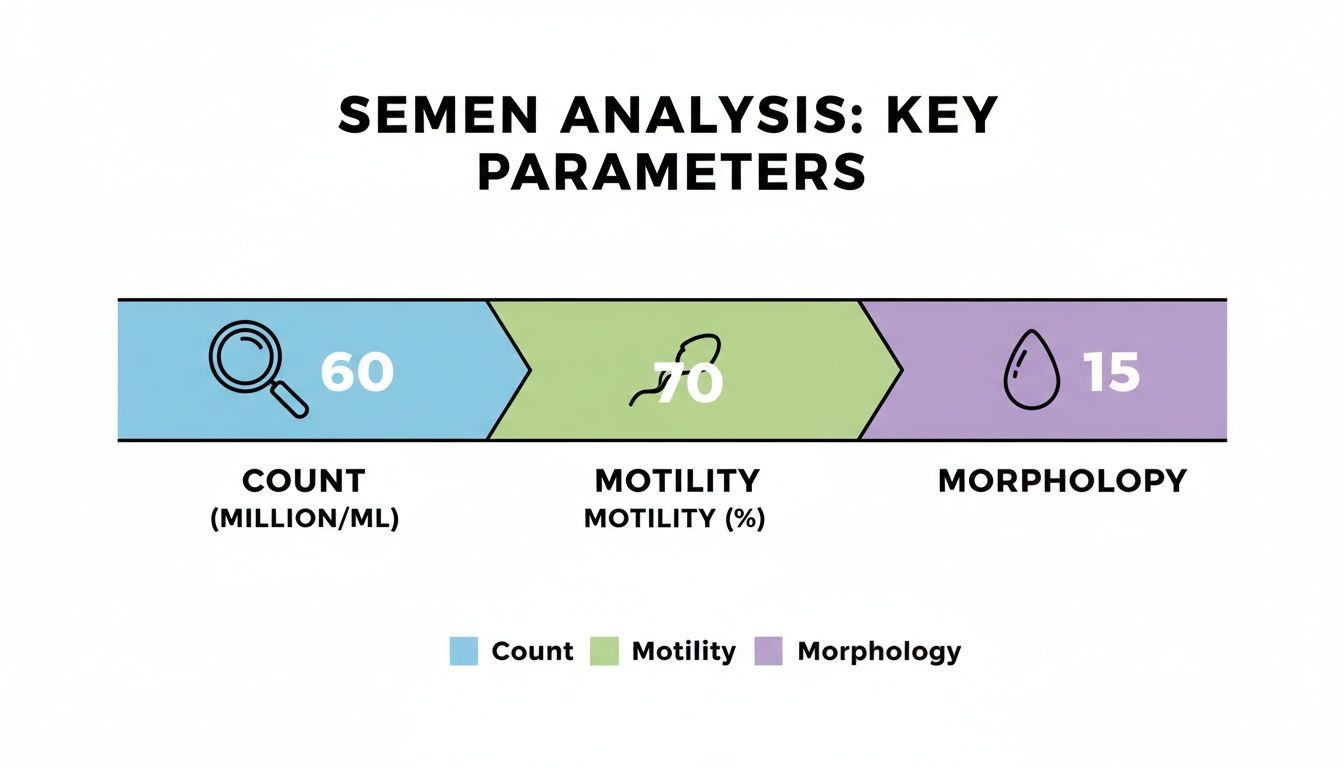
As you can see, healthy fertility isn't just about one number. It’s a team effort—a balance of quantity, movement, and proper structure all working in sync.
Your semen analysis results are not a pass-fail test. They are a valuable tool that provides a baseline of your reproductive health, identifying strengths and potential areas for focus.
With this information in hand, you can have a much more productive conversation with your doctor. That’s why companies like Hera Fertility are taking it a step further. We use AI to translate these complex lab results into a simple Hera SmartScore. This score makes it incredibly easy to understand your overall fertility status at a glance and gives you personalized, actionable next steps.
This kind of clarity transforms a confusing piece of paper into a practical guide, helping you move forward with confidence. It's the essential first step toward taking control of your reproductive health.
Common Questions About Male Fertility
Diving into the world of male reproductive health can bring up a lot of questions. It's completely normal. Getting clear, straightforward answers can take a lot of the anxiety out of the process and help you figure out what to do next. Let's tackle some of the most common concerns men have.
Can I Improve My Sperm Health?
Yes, you absolutely can. For many men, key factors like sperm count and motility aren't set in stone. They can often be improved with some smart lifestyle adjustments.
Focusing on a balanced diet, getting regular exercise, quitting smoking, and cutting back on alcohol can make a real difference. Because new sperm take about 74 days to fully develop, the consistent, healthy changes you make today can lead to measurable improvements in just a few months.
Does Semen Color Change Often?
Slight variations are totally normal. Semen is usually a whitish-gray color, but don't be surprised if it’s occasionally yellowish. This can be due to something you ate or even just traces of urine in the urethra.
The time to pay attention is when the color is consistently off. If your semen is always yellow, or if you notice green or red tints, it might signal an infection or another health issue. In that case, it’s a good idea to chat with a doctor to see what’s going on.
An 'abnormal' result on a semen analysis is not a final verdict on your fertility. Think of it as a signal to investigate further and the starting point for a conversation with your doctor about potential causes and next steps.
What if My Results Are Outside the Normal Range?
First, don't panic. An out-of-range result is just a single piece of the puzzle. Plenty of men with one or more parameters outside the standard guidelines go on to become fathers.
Think of it as information—a data point that helps build a complete picture of your health. It's not a judgment, just a guide for what to look at next.
How Often Should a Man Get Tested?
A semen analysis is usually recommended if you and your partner have been trying to start a family for a year without success. Some men also get a baseline test just for future planning.
If you're actively working to improve your sperm health, re-testing every 3 to 6 months is a great way to track your progress and see the impact of your efforts.
Take the guesswork out of your fertility journey. With Hera Fertility, you can order a physician-approved semen analysis, get tested at a top lab near you, and receive a simple, AI-powered report that tells you exactly where you stand. Understand your results and get personalized steps to move forward with confidence. Get your Hera SmartScore today.
Related Resource Articles
-
Understanding Sperm Health: Decoding Semen Analysis Results | Hera Fertility
Learn how to decode semen analysis results and understand sperm health parameters. Expert guide to interpreting fertility tests and sperm quality assessments.
6 min read
-
How Long Does It Take to Get Pregnant? A Clear Timeline
Learn what is typical over months of trying, what happens after sex, when to test, and when both partners should consider a fertility evaluation.
11 min read
-
What Is Sperm Concentration and How Does It Affect Male Fertility
Confused about your semen analysis? Learn what is sperm concentration, the normal ranges, and practical, actionable steps men can take to improve it.
19 min read