Let's get right to it: can you actually trust an at-home sperm test? The answer is a resounding yes—for a reliable first look. Modern, FDA-cleared kits are surprisingly accurate for screening key male fertility factors like sperm count and motility, often hitting over 97% accuracy when compared side-by-side with a lab analysis.
This gives men a dependable, private preview of their reproductive health without ever leaving home.
So, How Accurate Are At-Home Sperm Tests, Really?
When you’re trying to understand your own fertility, accuracy is everything. You need to know that the result on that little device or your smartphone screen is something you can count on. And the great news is, for most men, a high-quality at-home sperm test provides a very solid starting point.
Now, these tests aren't meant to replace a full clinical workup from a fertility specialist. Think of them more like a private, convenient screening tool. They’re designed to give you a quick snapshot of your sperm health, zeroing in on the most critical factors that play a role in male fertility.
Understanding the Numbers
When we talk about 'accuracy,' it's not just one simple number. It’s about knowing what a test measures and how well it measures it. The best at-home tests are fantastic at telling you whether your sperm concentration and motility are above or below the established health thresholds.
This gives you a clear signal: are things on the right track, or is it a good idea to chat with a specialist?
For instance, some of the most advanced kits have gone through rigorous testing against professional laboratory equipment. The graphic below shows just how impressive the accuracy of a leading smartphone-based test can be.
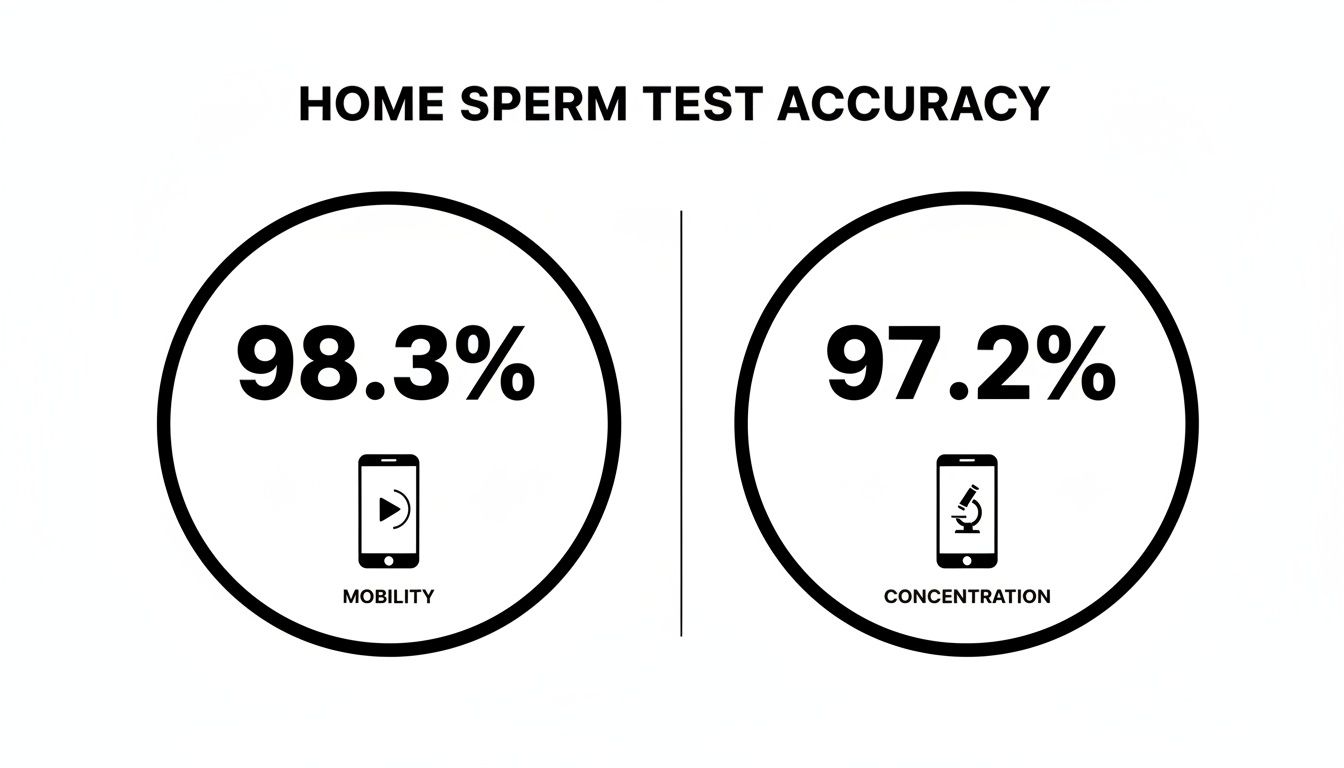
These figures demonstrate that today's at-home technology can closely mirror the results from the sophisticated systems used in professional labs, at least for these key metrics.
Clinically Validated Performance
One of the standout examples is the YO Home Sperm Test, which is backed by impressive clinical validation. A detailed 2021 clinical update revealed that the test achieves a striking 98.3% accuracy for motility and 97.2% for concentration when compared directly with the computer-assisted semen analysis (CASA) systems used in fertility clinics.
The whole point of an at-home sperm test is to empower men with private, reliable information. It gives you a solid foundation to decide on the best next steps for your health journey, without the pressure of an immediate clinic visit.
By using a validated test, you can feel confident that you’re getting a meaningful and actionable first look at your fertility. From there, you'll have a much better sense of where you stand.
If you decide you want to dig deeper with professional testing, you might be interested in our complete guide to semen analysis.
What Does "Accuracy" Really Mean for a Man's Fertility Journey?
When you see a claim like "97% accurate," it's natural to take it at face value. But in the world of male fertility, "accuracy" isn't just one simple number. It's a much more layered concept.
Getting a handle on these layers is what lets you correctly interpret your results and make confident decisions about your reproductive health.
Think of it less like a simple pass/fail grade and more like a detailed performance review. Three key terms help pull back the curtain on what at-home sperm test accuracy truly means: sensitivity, specificity, and concordance. Once you grasp these simple ideas, you'll see both the power and the limitations of these tests, and you'll be able to move from just getting a number to understanding what that number means for you.
Unpacking Sensitivity and Specificity
Let's use a simple analogy to get to the heart of accuracy: a smoke detector. It has two very important jobs.
Sensitivity is the detector's ability to pick up on real smoke from a fire. A highly sensitive test is fantastic at correctly identifying a potential problem, like a low sperm count. You want a test that won’t miss an issue if it’s there.
Specificity is the detector's ability to ignore harmless things, like a little burnt toast. A highly specific test excels at correctly confirming when things are normal, preventing false alarms. This is crucial so you’re not worried for no reason.
A reliable at-home sperm test needs to be a master of both. It must be sensitive enough to flag a potential concern but specific enough to not cause undue stress when everything is in a healthy range. Without this delicate balance, a test's results lose their meaning.
A truly accurate test provides peace of mind by minimizing both missed problems and false alarms. It’s about getting the right answer, whether the news is good or suggests it's time for a deeper conversation with a specialist.
This balanced approach is what allows you to trust what you see on the screen. It validates the test as a dependable first step in understanding your personal fertility status.
Concordance with Lab Results
The third piece of the accuracy puzzle is concordance. It’s a straightforward idea: how closely do the results from an at-home test match up with a professional laboratory analysis? That lab test is the gold standard in male fertility testing.
High concordance means that if you took an at-home test and a formal lab test on the same day, the results would tell you the same story.
So, when a company says their test is "clinically validated," they're usually talking about studies that show strong concordance. It's the proof in the pudding—the evidence that the convenient, private test you can do in your own bathroom mirrors what experts with advanced equipment would find. This alignment is what gives at-home screening its power, providing men with accessible and dependable insights before ever stepping into a clinic.
Not all at-home sperm tests are created equal, and the right one for you really depends on what you’re trying to find out. Think of it like a toolbox—you wouldn't grab a hammer when you need a screwdriver. Different tests are built to answer different questions about your sperm health.
It can feel a little overwhelming trying to sort through the options, but they mostly break down into three main types. Getting to know the pros and cons of each will help you pick the best tool for the job, whether you're just getting a quick baseline or taking a more serious look at your male fertility.
Let's dive in.
Count-Only Tests: The Simple Pass/Fail Check
The most basic option you'll find is the count-only test. These kits are designed to do one thing and one thing only: tell you if your sperm concentration is above or below a certain line in the sand. That line is usually the World Health Organization's guideline for what's considered a "normal" count, which is 15 million sperm per milliliter.
Think of it as a simple pass/fail checkpoint. It uses a chemical reaction that changes color, giving you a straightforward "yes" or "no" on whether you meet that minimum threshold.
- Pros: They’re typically the most affordable and dead simple to use. You get a quick, private answer to a very basic male fertility question.
- Cons: This test tells you absolutely nothing about sperm motility—how well your sperm can swim—or anything else about their health. A high count doesn't mean much if the sperm are not moving correctly.
This kind of test is best for a man who just wants an initial screening to see if his count is in the ballpark. It’s a starting point, not the whole story.
Count and Motility Kits: A Deeper Look
Taking a step up, you'll find at-home kits that measure both sperm count and motility. Motility is a huge piece of the male fertility puzzle because it’s all about the percentage of sperm that are actively moving forward.
These more advanced kits give you a much more useful snapshot of your fertility. They help answer not just, “How many sperm are there?” but also, “Are they actually capable of moving effectively?”
An at-home test that includes motility is like watching a game replay—it shows you not just how many players are on the field (count), but also how effectively they’re moving (motility). This dual insight offers a much more meaningful assessment of your potential.
These kits often have a few more steps than the count-only versions, but the information they provide is significantly more valuable for any man serious about understanding his reproductive health.
Smartphone-Enabled Analyzers: The Modern Approach
The most advanced options available today are smartphone-enabled sperm analyzers. These kits use a special device that clips onto your phone's camera, turning it into a powerful microscope that can create a live video of your sperm sample. From there, an app uses some pretty smart technology to analyze the video and give you real data on both concentration and motility.
This is where at-home testing really starts to shine. Seeing a live video of your own sample provides a level of insight that, until recently, you could only get in a clinic. You can literally watch your sperm in action, which is both incredibly informative and pretty empowering.
For example, analyzers like O'VIEW-M PRO are pushing the boundaries of what's possible at home. Studies have shown they can achieve 84.6% overall accuracy for both motility and concentration, making them a really solid option for an initial fertility screening. You can read more about these advancements in research published by the National Institutes of Health.
Common Factors That Affect Your Test Accuracy
An at-home sperm test can be a powerful tool, but its accuracy really hinges on one crucial element: you. How you collect and handle your sample can dramatically influence the final numbers. Think of it like a delicate science experiment—straying from the instructions can easily skew the outcome.
To get a reliable reading, you need to control the variables that are within your power. This means paying close attention to everything from timing and collection to other factors you might not have even considered. Let's walk through the key things that can impact your test results.
The Abstinence Period
Timing is everything. When you last ejaculated before the test is a non-negotiable detail for getting an accurate result. This is what's known as the abstinence period, and you have to get it just right.
- Too short: If you collect a sample less than two days after your last ejaculation, your sperm concentration will probably be lower than usual. This could give you a result that looks alarmingly low, even if your sperm production is perfectly fine.
- Too long: On the flip side, waiting too long (more than seven days) creates its own set of problems. Your sperm count might look higher, but a larger percentage of those sperm could be older, less motile, or even non-viable, which can also throw off your results.
For the truest snapshot of your sperm health, aim for an abstinence period of 2 to 7 days. This window gives your body enough time to replenish its supply without letting older, less active sperm build up.
The goal here is simple: get a sample that reflects your typical, day-to-day sperm health. Sticking to the 2-7 day guideline ensures your test is analyzing a representative sample, not one skewed by timing.
Proper Sample Collection and Handling
How you collect the sample is just as critical as the test itself. Every at-home kit comes with very specific instructions for a reason—each step is there to protect the integrity of the sperm and ensure the test can do its job correctly.
For example, using the wrong lubricant is a huge no-no. Many common lubricants contain spermicidal agents, which can harm or kill sperm on contact. This could tank your motility results, giving you a completely false picture of your fertility. Always, always use the sperm-safe lubricant provided in your kit.
Contamination can also ruin a sample in seconds. Make sure your hands and the collection cup are spotless and dry. Avoid touching the inside of the cup, and be careful not to get any foreign substances like soap, water, or lotion in there. These small mistakes can easily invalidate the entire test.
Timing and Temperature
Sperm are incredibly sensitive to their environment, especially to temperature and time. Once you collect the sample, the clock starts ticking.
Most at-home tests require you to analyze the sample within a very specific window, often just 30 to 60 minutes. If you wait too long, sperm will naturally start to lose their motility, making your results look worse than they really are. Set a timer as soon as you're done to stay on track.
Temperature is another big one. Exposing the sample to extreme heat or cold will damage the sperm. You'll want to keep the sample at body temperature while you get ready to test—holding the container in your hand or keeping it close to your body works well. Following the kit's instructions for maintaining temperature is absolutely vital.
For a deeper dive into this metric, you can learn more about what a healthy sperm motility percentage looks like and why it's so important.
When Is an At-Home Sperm Test the Right First Step?

Knowing exactly when to reach for an at-home sperm test is key to taking charge of your reproductive health. While they aren't a substitute for a full clinical workup, they act as powerful, private tools in a few specific situations. Understanding these scenarios helps you get real value out of them.
Think of an at-home test as your first move, not the final word. It's a way to gather some initial data from the comfort of your home, giving you a baseline picture before deciding if you need to take more formal medical steps. For many men, this low-pressure approach is the perfect entry point into their fertility journey.
As an Initial Fertility Screening
If you're just starting to think about your reproductive health, an at-home test is an excellent starting point. It gives you a private and completely stress-free way to get a preliminary check on key sperm health metrics, like count and motility, without having to book a clinic visit right away.
This initial screening can bring a huge sense of relief if your results look normal. And if the test shows a potential issue? You now have a clear, concrete reason to schedule a chat with a doctor, and you’ll walk in already armed with some useful information. It essentially helps answer the question, "Is my sperm health generally on track, or should I look into this further?"
An at-home test serves as a personal checkpoint. It empowers you with private knowledge, helping you decide whether to move forward with confidence or to seek professional guidance for a more detailed look.
To Monitor Progress After Lifestyle Changes
Making positive changes to your health can have a real, measurable impact on sperm quality. If you've recently cleaned up your diet, started exercising, cut back on alcohol, or quit smoking, an at-home test can be a great way to track your progress.
Sperm production takes about 74 days, so you won't see changes overnight. But testing every three months or so can provide tangible feedback on your efforts. Honestly, it can be incredibly motivating to see that your hard work is paying off in a way you can actually measure.
- Dietary Improvements: Are changes like adding antioxidants or cutting out processed foods making a difference in your sperm motility?
- Fitness Goals: Can you see an improvement in your numbers after committing to a consistent workout routine?
- Stress Reduction: Is your sperm count healthier after bringing mindfulness or other stress-management techniques into your life?
For Post-Vasectomy Confirmation
Another incredibly practical use for at-home sperm tests is for post-vasectomy checks. You absolutely must follow your doctor's specific instructions for the final green light, but some men use at-home tests for extra peace of mind during that waiting period.
These tests are designed simply to detect the presence of sperm. Seeing a negative result can be reassuring, but it is critically important to remember that only a lab-based analysis ordered by your doctor can officially confirm the procedure was a success. Think of the at-home test as a supplementary check-in, not the official all-clear.
Turning Your At-Home Results into Actionable Insights
Getting a result from an at-home sperm test is a huge first step, but it’s really just the beginning of the journey. The real power isn't in the number on the screen; it's in what you decide to do with that information. This is where a simple screening can become a clear, confident path forward for your reproductive health.
An at-home test gives you a private, convenient snapshot of key metrics like sperm count and motility. It’s important to remember, though, that these are just two pieces of a much larger puzzle. A complete picture of male fertility requires a deeper look, and that’s where professional guidance is non-negotiable.
The Bridge Between Home and Clinic
Think of your at-home test result as a powerful conversation starter. Whether your numbers look great or they flag a potential concern, this data empowers you to have a much more productive discussion with a healthcare provider. Instead of starting from scratch, you walk in with preliminary insights.
A formal, clinical semen analysis is the gold standard for a reason—it goes much further than any home test can. Professionals in a lab evaluate several other critical factors that at-home kits simply can't measure.
- Morphology: This is all about the shape and structure of your sperm. Abnormally shaped sperm might have difficulty with fertilization, a detail that only a trained andrologist can spot under a high-powered microscope.
- Semen Volume and pH: The lab measures the total amount of fluid and its chemical balance, both of which can point to other health factors impacting male fertility.
- Total Motile Sperm Count: This is a crucial calculation that combines count, motility, and volume to figure out the total number of swimming sperm in your entire sample—a key indicator of male fertility potential.
These additional data points are vital for painting a complete and accurate picture of your fertility status.
Your Next Actionable Steps
So, what do you do with your results? The answer depends on your situation, but the next step always involves moving from data to action. Your at-home result isn't a final diagnosis; think of it more like a directional guide.
An at-home sperm test result is a signpost, not a destination. It points you toward the right path, whether that's celebrating good news or seeking a more comprehensive map from a fertility expert.
If your results were normal, that's fantastic news and can offer some valuable peace of mind. But if you have ongoing concerns about your reproductive health, a professional consultation is still a great idea.
If your results came back low, don't panic. A single test is just one snapshot in time. The most important thing you can do now is book a follow-up with a specialist for a formal semen analysis. This will confirm the findings and give you the full story.
It helps to know what to expect from a full lab report before your visit. To get a head start, you can explore our guide on how to read semen analysis results, which breaks down what each metric really means. At Hera Fertility, we specialize in helping men navigate this exact process, from getting a physician-ordered test to understanding the results with total clarity.
Frequently Asked Questions About At-Home Sperm Tests
When you're digging into your reproductive health, it's completely normal for questions to pop up. At-home sperm tests can give you a ton of useful information, but the results can also open up a new can of worms. We’ve pulled together the most common questions we hear about test accuracy and what to do next, so you can move forward with clarity and confidence.
If My At-Home Test Shows a Low Count, Is It Definitely Accurate?
A low result from a high-quality, FDA-cleared test is a very strong signal, but it's not the final word. Think of it as a reliable heads-up that you need a follow-up clinical analysis. These kits are fantastic screening tools, often hitting over 97% accuracy for spotting lower sperm counts.
But remember, a single test is just a snapshot in time. A lot of things can temporarily throw off your numbers, like a simple collection error, a recent illness, or even just a period of high stress.
The essential next step is a formal lab analysis. A professional lab won't just confirm the count; they’ll look at everything else, like sperm shape (morphology), to give you the complete and definitive picture of your fertility.
Can an At-Home Test Replace a Full Semen Analysis From a Lab?
In a word, no. An at-home test is a powerful screening tool, but it’s not a substitute for a comprehensive semen analysis from a clinical lab. Home kits are great for a quick, private check on one or two key metrics—usually sperm count and sometimes motility. They give you a valuable baseline without leaving your house.
A lab analysis, on the other hand, is the gold standard. It’s the full report card on your fertility, detailing:
- Sperm Count: The total number of sperm.
- Motility: The percentage of sperm that are moving properly.
- Morphology: The percentage of sperm with a normal shape.
- Semen Volume: The total amount of ejaculate.
- And more: Including factors like pH level and viscosity.
Use the at-home test as your convenient first step. But for a full diagnostic workup, the lab is where you need to go.
How Often Should I Use an At-Home Sperm Test?
This really depends on your goal. If you just want a baseline understanding of where you stand right now, one test is a great place to start. It gives you a snapshot of your current fertility status.
If you're actively making lifestyle changes—improving your diet, hitting the gym, or cutting down on stress—re-testing every three months is a solid way to track your progress. That timeline makes sense because it takes about 74 days for the body to produce a new batch of sperm.
For men doing post-vasectomy checks, you absolutely must follow your doctor's specific schedule. Outside of these scenarios, it’s probably best to avoid testing too often. Normal day-to-day fluctuations can sometimes cause unnecessary worry.
What Should I Do If My Results Are Normal?
Getting a normal result for sperm count and motility from an accurate home test is fantastic news! It's a great confidence booster and suggests these key indicators of your male reproductive health are in a healthy range.
But it’s important to remember that male fertility is a complex puzzle. Sperm count and motility are major pieces, but they aren't the whole picture.
A normal at-home result is a very positive sign, but it doesn’t rule out other potential issues. If you have concerns about your fertility, a professional consultation is still the right move to explore all factors.
A fertility specialist can run a complete evaluation to make sure every aspect of your reproductive health is covered, giving you a clear path forward.
Navigating your fertility journey can feel overwhelming, but it doesn't have to be. Hera Fertility simplifies the entire process for men, starting with a physician-ordered lab test from one of our 250+ CLIA-certified partners. We translate your results into clear, actionable insights, so you always know your next step. Take control of your reproductive health by visiting Hera Fertility.