For men ready to get a handle on their reproductive health, the best at home male fertility test is one that balances the privacy of collecting your sample at home with the rigor of a professional lab analysis. Options like Legacy and Fellow offer collect-at-home and mail-in kits, while other services facilitate a local lab drop-off. These comprehensive tests move beyond basic sperm count checks to give you a complete picture of your fertility—all from the comfort of home.
Finding the Right At Home Male fertility Test
Taking that first step to understand your fertility can feel like a big one, but you’re definitely not alone. More and more men are looking for real answers about their reproductive health, and at-home testing offers a private, convenient way to get them. Think of this guide as your roadmap, here to break down your options with supportive, clear advice.
The conversation around male fertility is more critical than ever. Did you know that male factors contribute to nearly 50% of all infertility cases? Things like low sperm count or poor sperm movement play a massive role. This reality check is underscored by alarming reports showing that sperm counts have dropped by over 50% globally in the last 50 years. You can dig into these trends in various fertility market reports.

Comparing At Home Male Fertility Test Options
When you start looking into at-home tests, you'll find two main approaches. Each one strikes a different balance between convenience and accuracy, and understanding the difference is key to picking the right path for you.
Here's a quick breakdown of how these test types stack up against each other.
Comparing At Home Male Fertility Test Options
| Test Method | How It Works | Primary Advantage | Best For |
|---|---|---|---|
| Collect at Home + Mail-in Kit | You're sent a kit, you collect your sample at home, and then you ship it to a central lab for analysis. | Ultimate convenience and privacy; no need to leave your house at all. | Men who prioritize discretion above all else or live far from a certified lab. |
| Collect at Home + Local Lab Drop-off | You receive a physician's order online, collect your sample at home, and drop it off at a nearby professional lab, usually within an hour. | Mimics the gold-standard clinic process, ensuring sample freshness and result accuracy. | Men who want the highest possible accuracy while still maintaining the privacy of at-home collection. |
The main difference really boils down to how your sample gets from point A to point B. Shipping a semen sample can introduce variables like temperature swings or simple time delays, which can unfortunately skew the results for sensitive measurements like motility.
Key Takeaway: For most men, the 'best' option is the one that minimizes the time and environmental stress on the sample. This often makes local lab drop-offs a more dependable choice for getting a true picture of your sperm health.
Ultimately, the goal is to get results you can actually trust. While both methods are a huge leap forward from the basic, over-the-counter sperm count checkers, the local lab model is specifically designed to mirror the quality control of a traditional clinic visit—all while keeping your privacy intact. It provides a solid, reliable starting point for your fertility journey.
Exploring Different Types of At-Home Tests
When you start looking for an at-home male fertility test, you’ll quickly realize they aren't all the same. The market is expanding fast as more men look for private, convenient ways to get a handle on their reproductive health.
In fact, the male infertility market is projected to shoot up from USD 4.85 billion in 2025 to USD 8.05 billion by 2035—a clear sign that at-home testing is becoming a mainstream choice. You can dig into the numbers in the full male infertility market report.
This growth gives you more options, but it also means you need to know what you’re looking at. The biggest difference between tests comes down to how your sample is analyzed, which is the single most important factor for getting reliable results. Let's break down the three main types you'll find.
Mail-In Kits: The Convenience Play
Mail-in kits from companies like Legacy and Fellow are popular for a reason: they’re incredibly convenient and private. You get a collection kit sent to your door, provide a sample at home, and ship it off to a lab. Simple.
But this convenience comes with a major trade-off. Semen samples are fragile and highly sensitive to their environment, especially time and temperature. The shipping process introduces a lot of variables that can mess with the sample’s integrity.
- Shipping Delays: A day or more in transit can harm sperm viability and movement.
- Temperature Swings: A sample getting too hot or too cold in a truck or warehouse can damage sperm, throwing off critical results like motility (how well they swim).
- Best For: Men who prioritize total privacy above all else or live far from any local labs.
While easy, it’s crucial to remember that the journey your sample takes could impact the accuracy of your results before it even reaches a microscope.
At-Home Collection with Local Lab Drop-Off
A far more reliable method blends the privacy of collecting at home with the precision of a professional lab. In this model, you get a physician-authorized order online, collect your sample privately, and drop it off at a nearby certified lab—ideally within an hour.
This is widely considered the gold standard for at-home testing because it mimics the exact process used in fertility clinics. By cutting out the shipping step, you protect the sample from damage and delays.
The local drop-off model ensures your sample is analyzed fresh and under perfect conditions, delivering clinical-grade results that you and your doctor can actually trust. It removes the guesswork of mail-in transit.
Because the sample is analyzed so quickly, the measurement of time-sensitive parameters like sperm motility is much more accurate. This gives you a truly dependable picture of your sperm health.
Basic Smartphone Analyzers
The third option involves simple, often cheaper devices that use your smartphone’s camera to get a rough idea of your sperm count. These kits offer a very basic snapshot, usually limited to concentration.
They can be a quick first look, but their limitations are huge. A real semen analysis is about much more than just counting sperm.
- Limited Scope: These tests almost never measure crucial factors like sperm motility or morphology (shape).
- Lower Accuracy: They simply can't provide the comprehensive, clinical-grade analysis that a trained andrologist performs in a certified lab.
- High Risk of User Error: Mistakes in preparing the sample or using the device can easily lead to wrong readings. For a deeper dive into different ways to check your numbers, our guide on how to check sperm count at home is a great resource.
Think of these smartphone kits as a preliminary screening tool, at best. If you're serious about understanding your fertility, they don't provide the detailed, actionable information you need. For that, nothing beats combining at-home privacy with professional, local lab analysis.
What a Quality Semen Analysis Actually Measures
A truly useful male fertility test does more than give you a simple “yes” or “no.” It delivers a detailed breakdown of your sperm health, painting a clear picture of exactly what’s happening on a microscopic level. Understanding these key metrics is the first real step toward taking control of your fertility journey.
Instead of just one number, a proper semen analysis looks at several critical factors. Think of it like a performance review for your sperm. It's not enough to know how many players are on the field; you need to know how well they move and if they're in the right shape.
The three most important metrics are sperm count, motility, and morphology.

Sperm Count: The Size of Your Team
The first metric everyone knows is sperm count, often called sperm concentration. This simply measures the density of sperm in your sample, usually reported as millions of sperm per milliliter (mL) of semen.
Think of it as your team’s size. Having more players on the field naturally increases your odds of success. According to the World Health Organization (WHO), a normal count is 15 million sperm per mL or more.
But a high count is just the starting point. The quality and performance of those sperm are equally, if not more, important.
Motility: How Well Your Team Moves
Next up is sperm motility, which is all about how well your sperm can swim. For a sperm to be successful, it has to be an active, forward-moving swimmer. It’s not enough to have a large team; your players need to be able to move effectively.
A lab analysis will look at a few types of movement:
- Progressive Motility: This is the MVP. It measures sperm swimming forward in a straight line or in large circles.
- Non-Progressive Motility: This includes sperm that are moving but not going anywhere, like wiggling in place or swimming in tight circles.
- Immotility: This counts the sperm that aren't moving at all.
Based on WHO guidelines, a healthy sample should have at least 40% total motility, with a significant portion of that being progressive. This ensures enough of your team is moving efficiently.
A common issue with mail-in kits is that shipping delays and temperature changes can negatively impact motility scores, making a fresh sample analyzed at a local lab a more reliable option for this sensitive metric.
Morphology: The Shape of Your Players
Finally, there’s sperm morphology—an analysis of the sperm's size and shape. A properly formed sperm has a smooth, oval head and a long, single tail. This structure is critical for its ability to swim correctly.
Think of this as having players with the right equipment and in proper form. An abnormal shape—like a double head, a bent tail, or a head that’s too large or small—can stop it from swimming straight. The WHO benchmark for normal morphology is 4% or more of sperm having the correct shape.
That might sound shockingly low, but it's completely normal for the vast majority of sperm to have some imperfections. As long as at least 4% have the ideal structure, it's a strong indicator of good fertility.
A comprehensive semen analysis report will give you a clear view of these core pillars. The table below breaks down what you can expect to see.
Your Semen Analysis Report Explained
| Sperm Health Metric | What It Measures | WHO Normal Value | Why It's Important |
|---|---|---|---|
| Sperm Count | The number of sperm per milliliter of semen. | ≥ 15 million/mL | Higher numbers can increase the probability of success. |
| Sperm Motility | The percentage of sperm that are actively moving forward. | ≥ 40% total motility | Sperm must be strong swimmers to achieve their goal. |
| Sperm Morphology | The percentage of sperm with a normal size and shape. | ≥ 4% normal forms | The correct shape is crucial for effective swimming. |
Understanding these three pillars—count, motility, and morphology—is the key to getting a true picture of your reproductive health. For a deeper dive into your numbers, you can learn more about how to read semen analysis results and what they mean for you.
How to Choose a Reliable and Accurate At-Home Test
When your health is on the line, you need answers you can trust. With so many at-home male fertility tests popping up, figuring out which one is actually worth your time and money can feel like a shot in the dark. This checklist will help you cut through the marketing fluff and pick a high-quality test that prioritizes clinical accuracy and your privacy.
Think of it like choosing a surgeon. You wouldn't just pick the one with the flashiest website; you'd look for credentials, experience, and a proven track record. The same logic applies here.
The Non-Negotiable Lab Certification
The single most important factor is making sure your sample is analyzed in a CLIA-Certified Lab. CLIA stands for Clinical Laboratory Improvement Amendments—these are strict federal standards that regulate all human lab testing in the U.S.
A CLIA certification isn't just a sticker they slap on the box; it's a guarantee of quality.
- Standardized Procedures: These labs follow meticulous protocols for everything from handling your sample to calibrating their equipment.
- Qualified Staff: Your analysis is done by trained andrologists—specialists in male reproductive health—not just fed into a machine.
- Quality Control: They face regular, rigorous inspections to ensure they consistently deliver accurate and reliable results.
Any at-home test that doesn't use a CLIA-Certified Lab cannot be considered clinical-grade. It's the absolute gold standard, ensuring the results you get are just as accurate as those from a top fertility clinic.
Choosing a test backed by a CLIA-certified lab means you’re getting a medically valid result, not just a ballpark estimate. This is the foundation everything else is built on.
Why Physician Involvement Matters
Next up, look for physician involvement. A legitimate at-home test should have a licensed physician authorize your test order, just like they would in a doctor's office. This oversight is a critical checkpoint that confirms the entire process is medically sound from start to finish.
This step separates a genuine medical diagnostic tool from a simple consumer product. It adds a layer of professional accountability and is a clear sign the company cares more about your health than just selling you a kit.
Protecting Your Private Health Data
Your fertility data is about as personal as it gets. That’s why HIPAA compliance is an absolute must-have. The Health Insurance Portability and Accountability Act (HIPAA) is a federal law that sets the standard for protecting sensitive patient health information.
If a company is HIPAA-compliant, it means they have serious security measures in place to protect your identity and your results.
- Data Encryption: Your information is scrambled to prevent anyone without authorization from reading it.
- Secure Portals: Results are delivered through protected platforms, not insecure channels like standard email.
- Strict Privacy Policies: The company is legally bound to keep your information confidential.
Choosing a HIPAA-compliant service gives you the peace of mind that your privacy is being taken seriously.
Evaluating the Final Report and Service
Finally, think about the actual experience of using the test. A quality service makes the process clear, supportive, and easy to navigate. Here’s what to look for:
- Clear, Understandable Reports: You shouldn’t need a medical degree to figure out what your results mean. The best companies translate complex data—like sperm count, motility, and morphology—into clear insights and actionable next steps. A page full of raw numbers isn't helpful.
- Transparent Pricing: There should be zero hidden fees. The price you see should be the final price you pay for the test kit, the lab analysis, and your results.
- Reasonable Turnaround Times: While accuracy is king, the service should give you a clear and realistic timeline for when you can expect your results after the lab receives your sample.
By using this framework—CLIA certification, physician oversight, HIPAA compliance, and a clear user experience—you can confidently choose the right at-home male fertility test and get the reliable answers you deserve.
Your Step-by-Step Journey From Ordering to Results
Thinking about fertility testing can feel a little overwhelming, but the actual process is way more straightforward than you might expect. Let's walk through exactly what happens, from the moment you decide to get tested to the day you get your results. The whole experience is designed for privacy, accuracy, and convenience, turning what used to be a clinical headache into a simple, supportive process.
Ordering and Preparing for Your Test
It all starts online. With a service that partners with local labs, you’ll typically begin by ordering a physician-authorized lab requisition. This is the same official order a doctor would give you in person, which means your test is medically valid right from the get-go.
Once your order is in, it’s time to prep for collection. To get the most accurate snapshot of your sperm health, you’ll need to abstain from ejaculation for a short period.
- Abstinence Period: Plan to abstain for 2 to 5 days before collecting your sample.
- Too Short: Less than two days might lead to a lower sperm count in your sample.
- Too Long: Waiting more than five days can actually hurt sperm motility, as older sperm tend to be less active.
Hitting that sweet spot is key to providing a sample that truly reflects your current fertility status.
Collecting Your Sample and Getting It to the Lab
This is where the privacy and comfort of at-home testing really shine. You'll collect your sample in a sterile cup provided in your kit, all from the privacy of your own home. No more awkward, sterile rooms at a clinic.
After collection, the next step is critical for accuracy—especially for time-sensitive metrics like motility. You'll need to drop the sample off at a nearby certified lab, usually within one hour. This quick turnaround prevents the sample from degrading due to time or temperature changes, which is a common risk with mail-in kits. This local drop-off model protects the integrity of your sample, leading to much more reliable results.
This infographic breaks down the key checkpoints to look for when choosing a reliable testing service, ensuring your entire journey is secure and medically sound.
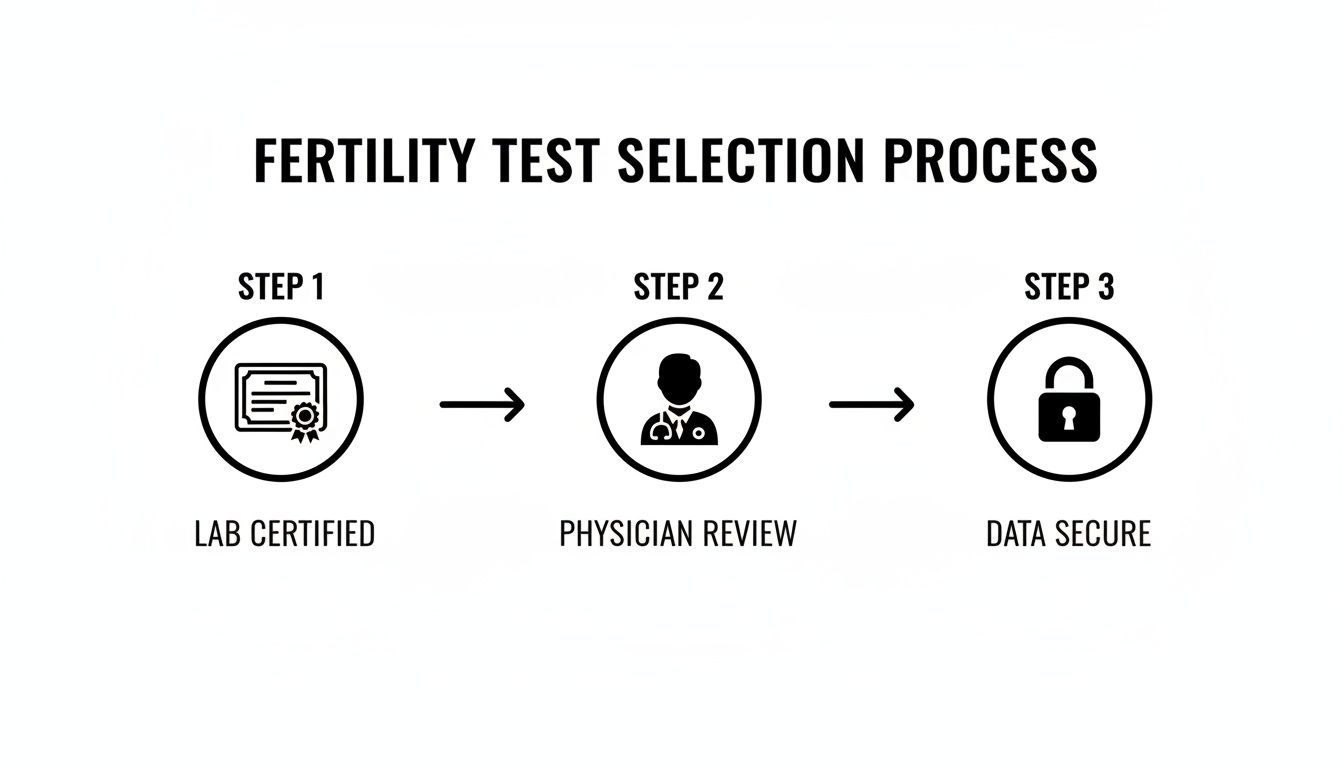
As you can see, the three pillars of a trustworthy test are ensuring the analysis happens at a certified lab, the results are validated by a physician, and your personal data stays secure.
Receiving and Understanding Your Results
Once the lab completes its analysis, your results are sent to you through a secure, HIPAA-compliant digital platform. A quality service won’t just dump a confusing list of medical terms and numbers in your lap. Instead, they'll translate that complex data into a clear, understandable report.
You should expect a breakdown of the key metrics—sperm count, motility, and morphology—explained in simple terms. The best services also provide context, comparing your numbers to established healthy ranges and offering actionable next steps.
This final step is all about empowerment. The goal isn't just to give you data, but to give you the insights you need to truly understand your reproductive health. With a clear report in hand, you're equipped to have more informed conversations and make proactive decisions about your future.
So, you have your semen analysis report. What now?
Getting your results isn’t the finish line—it’s the starting block. Think of this report as a personalized roadmap, giving you the crucial information you need to be proactive about your reproductive health. Whether the news is great or needs a closer look, you now have a clear direction.
It’s important to remember that your results are just a snapshot in time, not a final verdict. Sperm health can fluctuate daily based on diet, stress, a recent illness, or even just one bad night's sleep. The first step is to breathe and avoid jumping to conclusions.
If Your Results Are Normal
Seeing that your sperm count, motility, and morphology are all within healthy ranges is fantastic news. This gives you a solid baseline and, frankly, some well-deserved peace of mind. Your goal now shifts from investigation to maintenance.
This is the perfect time to double down on the healthy habits that support male fertility. Consistent, positive lifestyle choices are your best tool for protecting and preserving your sperm health for the long haul. It's all about building on this strong foundation.
If Your Results Are Suboptimal
If your numbers come back outside the normal range, the most important thing to do is not to panic. Seriously. An abnormal result from a single test is simply a signal that it's time to pay closer attention. So many factors can cause a temporary dip in sperm quality.
Because of these natural fluctuations, a specialist will almost always recommend a follow-up test to see what’s really going on.
- Confirm Your Findings: A second test, usually scheduled two to three months later, helps confirm if the first result was just a blip or part of a consistent pattern.
- Talk to a Specialist: If the follow-up test also shows suboptimal results, it’s time to consult a urologist who specializes in male fertility. They can perform a physical exam and order more tests to pinpoint any underlying causes. For those curious about how clinics manage this process, the use of tools like healthcare practice management software offers a glimpse into the systems that support patient care.
Remember, knowledge is power. An abnormal result isn't a dead end; it's a clear directive on where to focus your energy and what questions to ask.
Actionable Steps for Improving Sperm Health
Regardless of your initial results, there are always positive steps you can take to support your sperm production and quality. Small, consistent changes can make a huge difference over time.
Focus your efforts on these key areas:
- Diet and Nutrition: Load up on foods rich in antioxidants, vitamins, and minerals. Think leafy greens, nuts, colorful fruits, and fish.
- Regular Exercise: Moderate, consistent physical activity can boost testosterone and improve semen quality. Just 30 minutes of exercise most days of the week can help.
- Stress Management: Chronic stress wreaks havoc on hormones and sperm production. Find what works for you—meditation, yoga, hiking, or just a hobby you enjoy—and make it part of your routine.
- Avoid Harmful Exposures: This is a big one. Limit your exposure to excessive heat (hot tubs, saunas, laptops on your lap), environmental toxins, heavy alcohol use, and all tobacco products.
Taking these steps puts you back in the driver's seat. For a deeper dive into specific strategies, check out our guide on how to increase sperm count. Your results are the map—now you can start the journey.
Your Questions About Male Fertility Testing, Answered
Let's tackle some of the most common questions men have when they start looking into at-home fertility tests. The goal here is to give you direct, clear answers so you can feel confident and informed about your next steps.
How Accurate Are At-Home Male Fertility Tests?
The accuracy of an at-home male fertility test really hinges on the type you choose. If you're looking for results you can genuinely trust, your best bet is a service that sends your sample to a CLIA-certified lab for analysis. This certification is a big deal—it means the lab meets strict federal quality and oversight standards.
Whether it's a mail-in kit or a model where you drop your sample off at a local lab, using an accredited facility means you’re getting a clinical-grade semen analysis. These tests measure all the key metrics: sperm count, motility, and morphology. The simpler smartphone-based kits that only check one or two of these parameters are far less reliable and can't give you the complete picture of your sperm health.
Is One Semen Analysis Enough to Understand My Fertility?
A single semen analysis is an excellent first move. It gives you an invaluable snapshot of your sperm health at one specific moment in time. However, it's crucial to remember that sperm quality can fluctuate naturally due to things like a recent illness, high stress levels, or even what you've been eating.
Because of this, if your initial results come back outside the normal range, fertility specialists often recommend a second test two to three months later. This follow-up helps to confirm the first set of findings and see if there's a consistent issue before making any diagnosis. Think of your first test as your baseline—a powerful starting point for understanding and taking action.
Key Insight: Don't treat a single test as the final word. It’s a snapshot in time. Confirming any suboptimal results with a second test is a standard, and very wise, next step.
What Is the Main Difference Between Mail-In Kits and Local Lab Tests?
The crucial difference comes down to how your sample is handled right after you collect it. This single step can significantly impact the accuracy of your results, especially for time-sensitive metrics like motility.
- Mail-In Kits: With these, you collect your sample at home and then ship it to a central lab. This process can take a day or more, leaving the sample vulnerable to shipping delays and temperature changes that can damage sperm and artificially tank your motility scores.
- Local Lab Drop-Off: This model involves collecting your sample at home and delivering it to a nearby professional lab, usually within an hour. This rapid turnaround minimizes the risk of sample degradation, ensuring the lab analyzes the freshest possible sample for the most accurate results.
Do I Need a Test After a Vasectomy?
Yes, absolutely. A post-vasectomy semen analysis is the only definitive way to confirm the procedure was a success and that no sperm are left in your semen. It's the critical final step for total peace of mind.
Doctors typically recommend getting tested about three months after the procedure. This gives any remaining sperm enough time to clear out of your system. An at-home ordered test provides a completely private and convenient way to get this essential confirmation without needing to schedule another clinic visit.
Ready to get clear, actionable insights into your reproductive health? With Hera Fertility, you can order a physician-backed test online, get tested at a local CLIA-certified lab, and receive a comprehensive analysis of your results. Take the first step toward understanding your fertility today.