When you're thinking about future family planning, a common question pops into your head: can you freeze sperm at home?
Let's cut right to the chase: no, you absolutely cannot safely and effectively freeze sperm in your kitchen freezer. While the idea of a simple, private DIY method is definitely appealing, the actual science behind preserving sperm is incredibly delicate and relies on specialized medical technology to even have a chance of working.
Why Your Home Freezer Just Won't Cut It
The question "can you freeze sperm at home" comes up a lot, and it's crucial for men to understand why it’s a non-starter for preserving their fertility. The real process, known as cryopreservation, is a precise scientific method designed to protect incredibly fragile cells from being destroyed. A standard freezer in your garage or kitchen simply isn't built for that kind of delicate work.
Think about it like this: if you toss a fresh strawberry into your freezer, it slowly turns into a mushy, icy block. Why? Because the slow freezing process allows large, sharp ice crystals to form, which tear apart the fruit's cell walls. When it thaws, you’re left with a watery puddle that’s lost all its structure. That's exactly what happens to sperm cells in a home freezer.
The Damage from Slow Freezing
A typical home freezer cools things down gradually to about 0°F (-18°C). This slow-and-steady temperature drop is lethal for sperm for a couple of big reasons:
- Ice Crystal Formation: As the temperature drops, large, jagged ice crystals form both inside and outside the sperm cells, literally puncturing their delicate membranes.
- Cell Dehydration: Water freezing outside the cells pulls moisture from within them, causing them to shrink and dehydrate, which leads to irreversible damage.
- Structural Collapse: This combination of ice damage and dehydration completely destroys the sperm’s head (where the DNA is) and its tail (needed for swimming).
A sample frozen this way would be totally useless for any fertility treatment down the road. It's not just a long shot; it's a guaranteed failure.
The entire goal of professional cryopreservation is to hit the "pause" button on cellular activity without causing any harm. A home freezer, on the other hand, inflicts fatal damage, making future use impossible. This is precisely why specialized lab equipment and strict protocols are non-negotiable for successfully preserving a man's fertility.
To put it in perspective, here’s a direct comparison of the two approaches.
DIY Home Freezer vs Professional Lab Freezing
| Feature | DIY Home Freezer | Professional Lab Cryopreservation |
|---|---|---|
| Freezing Method | Slow, uncontrolled cooling | Rapid, controlled-rate freezing with computer assistance |
| Temperature | Around 0°F (-18°C) | Stored in liquid nitrogen at -321°F (-196°C) |
| Cell Protection | None. Causes large, damaging ice crystals. | Cryoprotectant solution ("antifreeze") prevents ice crystals. |
| Viability After Thaw | 0%. Cells are destroyed. | High. Most healthy sperm survive the process. |
| Testing & Analysis | None | Comprehensive analysis of count, motility, and morphology. |
| Usability for Assisted Reproduction | Not viable for any medical procedure. | Yes, the sample is prepared for clinical use. |
As you can see, there's really no comparison. Professional cryopreservation is the only path that actually preserves your options.
The Professional Lab Difference
In a certified fertility lab, the process couldn't be more different. Technicians use a highly controlled, rapid freezing method. They also mix the sample with a special cryoprotectant solution—think of it as a biological "antifreeze"—that shields the cells and prevents those destructive ice crystals from ever forming.
The good news is that modern services have bridged the gap between at-home privacy and clinical-grade quality. You can now use at-home sperm freezing kits from cryobanking services. These allow you to produce a sample in the comfort of your home and ship it overnight to a professional lab for proper preservation.
The actual freezing and long-term storage happen in the lab, where your sperm is kept safely in liquid nitrogen at an incredible -321°F (-196°C). At that temperature, all biological activity stops, allowing the sample to be preserved indefinitely without degrading.
This modern approach gives you the convenience you're looking for without sacrificing the viability of your sample one bit. Actionable Next Step: If you're ready to explore this option, you can find CLIA-certified labs that specialize in this exact service.
The Science Behind Professional Sperm Freezing
So, while your home freezer is definitely out, a professional fertility lab makes sperm preservation a reliable science. The official term for this is cryopreservation, and it’s a whole lot more complex than just making things cold. Think of it as a carefully choreographed process designed to protect the very delicate structure of each sperm cell so they stay healthy and ready for the future.
Breaking down the steps shows you exactly why this can't be a DIY project. It’s not just about freezing; it’s about hitting the pause button on life at a cellular level without causing any damage. Every single stage, from the first look at the sample to its long-term storage, is make-or-break.
The Critical First Step: Semen Analysis
Before a single thing gets frozen, the lab runs a complete semen analysis. This isn't just a quick check—it's a detailed health report card for your sperm. Lab technicians look at several key metrics to gauge the quality of the sample and figure out its chances for a successful freeze and future use.
This analysis typically measures:
- Sperm Count: How many sperm are in the sample.
- Motility: What percentage of them are swimming properly.
- Morphology: The percentage of sperm that have a normal, healthy shape.
This initial review gives every man a vital baseline. It confirms the sample is healthy enough for cryopreservation and gives you a clear snapshot of your fertility right now.
Cellular Antifreeze: The Role of Cryoprotectants
Once the analysis is done, the most critical part of the process kicks off. A lab technician carefully mixes a special solution called a cryoprotectant into the semen. You can think of it as a kind of cellular antifreeze. Its main job is to stop large, sharp ice crystals from forming—the very things that would shred sperm in a standard freezer.
The cryoprotectant works by drawing some water out of the sperm cells and replacing it with this protective agent. This simple exchange prevents ice from forming inside the cell and puncturing its delicate membrane as the temperature plummets. Without this shield, the cells would be destroyed, making the whole effort pointless.
This diagram shows the clear difference between trying to freeze sperm at home versus using a professional service that combines at-home collection with lab-based freezing.
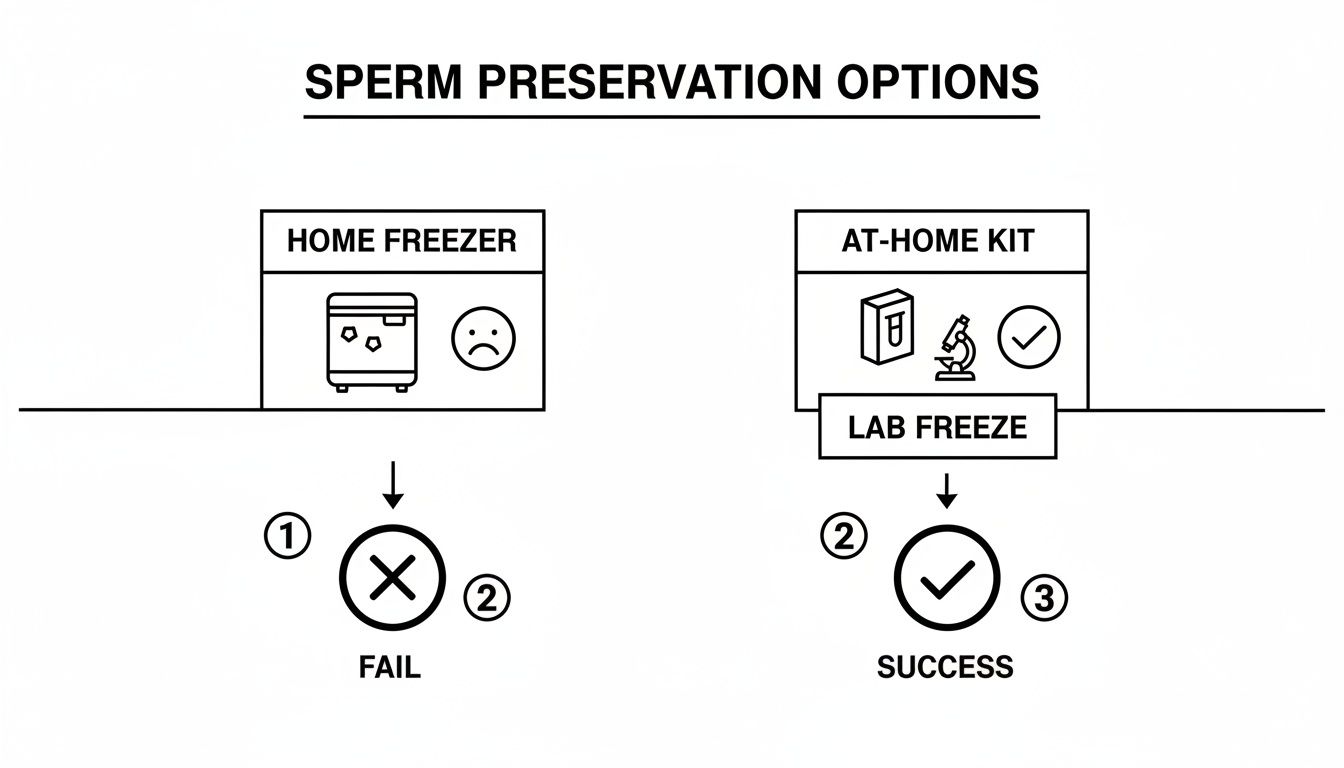
As you can see, collecting your sample at home is perfectly fine, but the actual freezing has to happen in a controlled lab environment for it to work.
Controlled-Rate Freezing and Deep-Freeze Storage
With the cryoprotectant mixed in, the sample is finally ready for the freeze. But it’s not as simple as sticking it in a cold box. Labs use sophisticated, computer-guided controlled-rate freezers that bring the temperature down gradually on a very precise schedule. This slow, managed descent minimizes stress on the cells and helps them vitrify—turn glass-like—without any ice crystal damage.
Once fully frozen, the vials are moved into massive cryogenic storage tanks filled with liquid nitrogen. Here, they are kept at a stable -321°F (-196°C). At this incredibly low temperature, all biological activity just stops, effectively pausing the sperm in time until you need them.
A certified lab’s job goes way beyond the science. It’s also about maintaining a sterile environment to prevent contamination, running constant quality control checks, and managing a strict chain of custody. This legal and procedural side of things guarantees your sample is not only viable but also correctly identified and legally usable for fertility treatments down the road.
And we know this meticulous process works. Extensive clinical research shows that frozen sperm can lead to successful outcomes that are right on par with fresh sperm. For example, one major analysis found that the live birth rates for cycles using frozen sperm were 40.3%, which wasn't statistically different from the 42.4% rate for fresh sperm.
This confirms that when done the right way, professional freezing is an incredibly reliable method for preserving a man's reproductive options. Actionable Next Step: If you're looking to learn more, our guide to finding reputable sperm banks and cryopreservation labs is a great next step.
Modern Options for Male Fertility Preservation
So, we've established why trying to freeze sperm in your home freezer is a non-starter. But that doesn't mean the process has to be a hassle. Far from it. Today’s professional fertility services are built for real life—meaning they prioritize privacy, convenience, and putting you in control.
The question isn't really "can you freeze sperm at home?" anymore. It’s "how can I start the professional freezing process from home?" The great news is you have options. There are two main routes you can take, and both blend top-tier clinical security with the convenience you expect.
The Two Main Paths for Sperm Banking
When it comes to freezing your sperm, the decision really boils down to what fits your life and comfort level. Both options end with the exact same result: your sample is professionally cryopreserved by experts in a certified lab. The only difference is where you provide the sample.
Here’s a look at the two modern choices for preserving your fertility:
- At-Home Collection Kits (Mail-In Service): This is the most private and flexible path. A specialized kit is delivered to your door, you collect your sample when and where you're comfortable, and ship it overnight to the lab in a temperature-controlled container.
- In-Clinic Collection: This is the traditional approach. You make an appointment at a fertility clinic or sperm bank and provide your sample in a private room on-site.
Both methods are medically sound and get the job done right. The best choice is simply the one that works for you.

A Step-By-Step Look at At-Home Collection Kits
Mail-in kits have quickly become a go-to for men who value discretion and simplicity. If you prefer to handle things on your own time without having to go anywhere, this is an excellent route. The whole process is designed to be straightforward and stress-free.
Here’s exactly what to expect from start to finish:
- Order Your Kit: It starts with ordering a collection kit online from a reputable service. It shows up at your home in discreet packaging—no broadcasting your business to the neighbors.
- Collect Your Sample: When you're ready, you produce a sample by ejaculating into the sterile collection cup that comes in the kit. No appointments, no travel, just complete privacy.
- Prepare for Transit: The kit includes a vial of transport medium. You’ll mix this special liquid with your sample to keep the sperm cells healthy and stable during their journey to the lab.
- Package and Ship: Next, you place the prepared sample into the kit's temperature-stabilized shipping container. This isn't just a basic box; it's engineered to protect the sample for up to 48 hours. Then, you just drop it off for overnight shipping with the pre-paid label.
Once it arrives, the lab team takes over. They run a complete semen analysis, treat the sample with cryoprotectants, and transfer it to long-term storage in liquid nitrogen. You’ll get a full report detailing your sperm quality and confirming that your sample is safely stored.
Key Takeaway: At-home collection isn’t DIY freezing. It’s a professional medical service that cleverly separates the collection step (which you do at home) from the high-tech cryopreservation step (which experts handle in the lab).
The In-Clinic Collection Process Explained
For some men, there’s an added sense of security in going to a physical location. The in-clinic option is direct, and you have staff right there to answer questions. It’s just as effective and follows a well-established procedure.
The process for banking at a clinic is also very simple:
- Schedule an Appointment: First, you’ll book a visit with a local fertility clinic or sperm bank, which you can typically do online or by phone.
- Visit the Facility: On your appointment day, you'll head to the clinic. You’ll check in, handle some paperwork, and show your ID.
- Provide Your Sample: A staff member will show you to a private, designated collection room. There, you'll produce your sample in a sterile container provided by the clinic.
- Hand Off to the Lab: Once you’re done, you pass the sample directly to a lab technician, usually through a secure window. Because the lab is on-site, they can begin the analysis and freezing process almost immediately.
Just like with the mail-in option, you’ll receive a comprehensive report on your sperm health and official confirmation that your sample is securely frozen. The end result is identical—your choice just comes down to where you’d rather be when you provide the sample.
Who Should Consider Sperm Freezing?
Thinking about freezing sperm is obviously a big, personal decision. But it's also one of the most proactive things a man can do for his future health. It’s all about securing your options and giving yourself peace of mind, no matter what life decides to throw at you. I like to think of it as a form of biological insurance—a smart move for any man who wants to protect his ability to have a family down the road.
Men from all walks of life are choosing to preserve their fertility for a whole host of reasons. Ultimately, it’s a decision that puts you back in the driver’s seat of your own reproductive future.
Men Facing Medical Treatments
One of the most common and critical times to consider freezing sperm is before starting certain medical treatments. If you're facing a new diagnosis, this is a conversation you absolutely need to have with your doctor.
Some of the biggest culprits known to impact male fertility include:
- Chemotherapy and Radiation: These cancer treatments are lifesavers, but they work by targeting rapidly dividing cells. Unfortunately, that includes the cells responsible for producing sperm.
- Certain Surgeries: Any procedure involving the testicles, prostate, or bladder carries a risk of affecting either sperm production or ejaculation.
- Testosterone Replacement Therapy (TRT): It might seem counterintuitive, but TRT often shuts down the body's natural sperm production as a side effect.
Banking sperm before you start any of these treatments acts as a crucial safety net. It ensures your path to fatherhood stays wide open long after you’ve recovered.
Planning for the Future
Let's be honest, life rarely follows a neat, predictable timeline. More and more men are choosing to start families later in life, and proactive sperm freezing fits perfectly with that reality. It’s like hitting the pause button on your biological clock.
This forward-thinking approach is gaining traction for a reason. You may have seen headlines about the significant decline in global sperm counts, which has really put a spotlight on male fertility. In fact, the average sperm count per milliliter of semen plummeted by more than 50% between 1973 and 2011. This has helped people realize that men contribute to 30% to 50% of infertility cases, making proactive steps like sperm freezing an even smarter move. You can read more about how sperm counts are changing on draliabadi.com.
Sperm freezing isn’t just for medical emergencies. It's for any man who wants to decouple his life timeline from his fertility timeline, giving himself the freedom to build a family when the time is right for him.
By freezing sperm when you're younger and healthier, you're essentially preserving your fertility at its peak. This takes the pressure off, letting you focus on your career, relationships, or personal goals without worrying about a decline in sperm quality down the line.
High-Risk Professions or Lifestyles
Your job can also be a pretty compelling reason to think about sperm banking. For men in certain high-risk fields, it’s just a practical and logical precaution.
This is especially true for men in roles like:
- Active-Duty Military Personnel: Deployment to combat zones comes with a unique set of risks.
- First Responders: Firefighters and police officers face occupational hazards every single day.
- Athletes in High-Impact Sports: Repeated physical trauma can, in some cases, take a toll on reproductive health.
For these men, having sperm banked offers a profound sense of security. It means their family-building dreams are protected, no matter what happens on the job.
Keeping Your Options Open
Sperm freezing is also a brilliant strategy if you're considering a vasectomy but aren't 100% sure you're done having kids. While a vasectomy is an incredibly effective form of birth control, reversals aren't always successful or even possible.
Banking sperm before the procedure gives you a reliable backup plan. It lets you move forward with the surgery confidently, knowing you've kept a path to biological fatherhood open if your life circumstances or feelings change. It’s the ultimate way to keep all your options on the table. Actionable Next Step: If this sounds like you, a good first step is to understand your baseline fertility by learning how to read semen analysis results.
Understanding the Process: Costs and Timeline
So, you're thinking about freezing your sperm. It's a big decision, and naturally, you've got practical questions. What's this actually going to cost? How long does it all take? Let's walk through exactly what to expect from start to finish, including the essential health screenings you'll need.

Getting a handle on these details upfront helps you plan with confidence and avoid any surprises down the road. Whether you decide to visit a fertility clinic in person or use a mail-in kit, the core steps and costs are pretty similar.
Breaking Down the Costs of Sperm Freezing
The total investment for sperm banking usually falls into two main buckets: the upfront cost for analysis and freezing, and the ongoing fee for storage. The exact prices will vary depending on your location and the lab you choose, but this gives you a solid idea of what to budget for.
Here’s what you’re paying for:
- Initial Analysis and Cryopreservation: This is the one-time, upfront fee. It covers the in-depth semen analysis, all the lab work needed to prep the sample, and the highly technical freezing process itself.
- Annual Storage Fees: Once your samples are frozen, you'll pay a recurring fee to keep them safely stored in liquid nitrogen. This is typically billed once a year, and many labs will offer a nice discount if you prepay for several years at once.
You can think of it like this: the initial fee is for the expert setup and processing, while the annual fee is the 'rent' for the ultra-secure, deep-freeze storage that keeps your samples viable for the long haul. Both are critical parts of the service.
Clinic vs. Mail-In Kit: A Cost Comparison
Your choice between going to a clinic or using a mail-in kit will also affect the total cost. Mail-in kits are great because they often bundle the initial services into one clear price, making it simpler to see the all-in cost from the start.
Here's a breakdown of the typical costs you might encounter, giving you a clear picture of how professional sperm freezing services are structured.
Estimated Costs for Professional Sperm Freezing
| Service Component | Typical Cost Range (Clinic) | Typical Cost Range (Mail-In Kit) |
|---|---|---|
| Initial Semen Analysis | $150 – $300 | Often included in the kit price |
| Cryopreservation Fee (per sample) | $400 – $1,000 | $800 – $1,200 (often includes 1 year of storage) |
| Annual Storage | $300 – $800 | $150 – $500 |
As you can see, while a mail-in kit might look more expensive at first glance, it often bundles in that first year of storage, which can make it a very competitive and convenient option in the end.
Mapping Out the Timeline
One of the best parts about this process is how quick it is. From the moment you decide to move forward to getting confirmation that your samples are safely stored, you're usually looking at about a week. It’s designed to be efficient.
Here’s how a typical timeline plays out:
- Day 1: You either book an appointment at a local clinic or order your at-home collection kit online.
- Days 2-3: Your mail-in kit arrives at your doorstep, or you head to the clinic for your appointment to provide the sample.
- Days 3-4: The lab gets your sample (either from you in person or via overnight shipping) and immediately starts the analysis and cryopreservation.
- Days 5-7: You get the good news! A comprehensive report lands in your inbox with all your semen analysis results and, most importantly, official confirmation that your sample is securely frozen.
The Non-Negotiable Step: Infectious Disease Screening
There’s one step that is absolutely mandatory for any professional sperm banking service: an infectious disease screening. This is a simple blood test that checks for diseases like HIV, Hepatitis B, and Hepatitis C.
This isn't just a box-ticking exercise; it serves two vital purposes. First, it ensures your own sample is free of any infections that could affect its use later on. Second, and just as crucial, it protects the integrity of the entire storage facility. By screening every single sample, labs prevent any possibility of cross-contamination between samples stored together in the liquid nitrogen tanks. It’s a fundamental quality control measure that makes professional cryopreservation a truly safe and reliable medical procedure.
Taking Control of Your Reproductive Health
The journey to understanding your reproductive options can feel overwhelming, but now you have the facts. The most important thing to remember is this: you cannot safely freeze sperm in a regular home freezer. The process just doesn't work; it destroys the cells and makes them completely unusable for future conception.
But that doesn't mean you're stuck making multiple appointments at an impersonal clinic. Modern fertility services have evolved, giving men a way to take proactive steps from the privacy and comfort of their own homes. Professional at-home collection kits are a safe, reliable, and discreet alternative that blends the convenience of home collection with the scientific precision of a certified lab. That’s the crucial difference: you collect the sample at home, but the freezing—the professional cryopreservation—is handled by the experts.
Your First Actionable Step
So, what's the best place to start? The single most powerful first step you can take is a baseline semen analysis. Before you even think about freezing, you need to get a clear picture of your current fertility. This isn't just a box to check; it’s an essential tool that gives you a snapshot of your reproductive health right now.
A semen analysis looks at the three core pillars of male fertility:
- Sperm Count: How many sperm are in your sample?
- Motility: What percentage of them are swimming effectively?
- Morphology: What percentage have a normal, healthy shape?
Getting these numbers is empowering. It takes any vague worries you might have and turns them into concrete, actionable data, letting you plan your next move with confidence.
A semen analysis is the foundation of proactive male reproductive health. It gives you the information you need to understand your options, whether that’s moving forward with sperm freezing, making lifestyle adjustments, or simply having peace of mind.
Making an Informed Decision with Confidence
Once you're armed with this knowledge, you are in the driver's seat. You can decide if sperm freezing aligns with your personal timeline and future family-building goals. This entire process is about securing your future options, and it all begins with understanding where you stand today.
Taking that initial step is easier than you think. With a service like Hera Fertility, you can get a physician-approved requisition for a semen analysis in just a few minutes. We connect you to a network of certified labs, so you can get tested on your own schedule. By turning information into action, you can take charge of your reproductive future with total confidence.
Your Top Questions About Sperm Freezing, Answered
Deciding to freeze your sperm is a big step, and it's natural to have questions. Let's walk through some of the most common ones to clear things up and help you feel confident about your next move.
How Long Can Frozen Sperm Last?
This is probably the number one question we hear, and the answer is pretty incredible: once properly frozen, sperm can last almost indefinitely. The real magic isn't about the length of time it's stored, but about the quality of the freezing and thawing process itself.
When a sample is professionally cryopreserved in liquid nitrogen at a chilling -321°F (-196°C), all biological activity grinds to a halt. The sperm cells are essentially paused in time. There are plenty of real-world examples of successful pregnancies using sperm frozen for over 20 years, which proves that time in the tank doesn't hurt the quality.
Should I Freeze More Than One Sample?
Absolutely, yes. Think of it as a biological backup plan. Most fertility experts will strongly recommend banking at least 2-3 separate samples (often called vials). It's a strategic move that gives you far more flexibility down the road.
Each vial is typically used for a single round of fertility treatment. Having a few vials stored away means you have enough for multiple attempts, which can seriously boost your chances of starting or growing your family. It's about maximizing the investment you're making in your future.
Banking multiple samples provides an essential safety net. It ensures you have enough opportunities to achieve a successful pregnancy when you decide the time is right.
Is Frozen Sperm as Good as Fresh Sperm?
This is a common myth, but the science is clear: no, frozen sperm is not less effective. When professionally frozen and thawed, sperm used in assisted reproductive treatments has success rates that are right on par with fresh sperm.
The entire cryopreservation process is designed from the ground up to protect the health and viability of the sperm cells. Study after study has shown no meaningful difference in success rates for treatments when comparing fresh and frozen samples. As long as the initial sample was healthy and the lab did its job right, you can trust it to be effective.
What if My Semen Analysis Results Aren't Great?
Getting a less-than-perfect semen analysis report can feel discouraging, but it's not the end of the road. In fact, it's crucial information. It gives you a clear snapshot of where your fertility stands right now, and it doesn't automatically disqualify you from freezing sperm. Actionable Next Step: A fertility specialist can look at your results and might recommend simple lifestyle tweaks, supplements, or other steps to improve your sperm health. The advice might be to freeze one sample now and then work on boosting your numbers before banking more. It's the first step toward taking control of your reproductive health.
Navigating your fertility journey starts with solid, trustworthy information. At Hera Fertility, we can provide physician-approved requisitions for your semen analysis and connect you with certified labs to get the process started. Visit Hera Fertility to take the first step in understanding and protecting your future.