No. There is no fertility pill that works for every man. The right treatment depends on the cause: a prescription may help a specific hormone problem, while a pill cannot remove an obstruction, repair a varicocele, or restore testicular tissue that cannot respond. Testing separates the men who may benefit from medicine from those who need a different path.
What can a “fertility pill” actually do?
The phrase can refer to an over-the-counter supplement, an oral prescription such as clomiphene, or any medicine used in male fertility care. Some established treatments, including human chorionic gonadotropin (hCG) and follicle-stimulating hormone (FSH), are injections rather than pills.
Treatment can be useful when it addresses the cause. A change in testosterone, sperm concentration (count), motility, or another semen parameter shows a biological response. It does not prove that pregnancy or live birth is more likely. Those outcomes also depend on the other partner and the couple's treatment path.
| Option | When it may fit | What the evidence can show | Oversight |
|---|---|---|---|
| Over-the-counter vitamins or antioxidants | A diagnosed nutrient deficiency, or selected empirical use after a clinical discussion | Correcting a deficiency supports general health. The fertility benefit of multi-ingredient products remains uncertain. | A clinician or pharmacist should review the full ingredient list and possible interactions. |
| Oral prescription medicine | A defined hormone pattern, proven high prolactin, or a confirmed infection | Some medicines can change hormone levels or semen measures in selected men. Evidence for pregnancy and live birth varies and is often limited. | A reproductive urologist, endocrinologist, or other prescriber selects and monitors treatment. |
| hCG and FSH | Most clearly established for hypogonadotropic hypogonadism, where brain or pituitary signals are deficient | specific hCG and FSH products have FDA-labeled uses in selected men with this condition. | Specialist prescribing, bloodwork, and repeat semen analysis are required. |
| A procedure or assisted reproduction | An obstruction, clinical varicocele, severe testicular dysfunction, or a couple whose timing favors a direct treatment path | Results depend on the cause and procedure. A pill may have no role. | A reproductive urologist and fertility team plan care together. |
Testosterone can work against a fertility goal. External testosterone and anabolic steroids suppress the brain signals that support sperm production. Sperm concentration can fall sharply or reach zero. The 2024 AUA/ASRM guideline states that testosterone monotherapy should not be prescribed to men interested in current or future fertility. The Endocrine Society guideline also recommends against starting testosterone in men planning fertility in the near term. Recovery after testosterone or steroid suppression may take months and, rarely, years. If you use prescribed testosterone or anabolic steroids, discuss your fertility plans with the prescriber and a reproductive specialist. Do not stop prescribed treatment on your own.
What should be checked before treatment?
Two men with the same low sperm concentration can need completely different care. The AUA/ASRM evaluation guidance starts with concurrent evaluation of both partners, a male reproductive history, and one or more semen analyses.
The male evaluation usually includes:
- A reproductive and medical history. This covers prior pregnancies, sexual function, childhood testicular conditions, surgery, infection, cancer treatment, medicines, supplements, testosterone or steroid use, and relevant exposures.
- One or more semen analyses. A laboratory semen analysis measures sperm concentration, total sperm count, motility, progressive motility, morphology, semen volume, and other lab-specific measures. Results vary between samples. Values below reference limits do not diagnose infertility by themselves, and values within reference ranges do not prove fertility.
- An examination and directed tests. A reproductive urologist looks for findings such as a varicocele, small testes, or signs of an obstruction. FSH and morning testosterone are commonly checked when sperm concentration is low, no sperm are found, sexual symptoms are present, or the examination suggests a hormone problem. A low morning testosterone result usually needs confirmation, followed by tests such as LH, estradiol, and prolactin to identify the cause.
- The other partner's evaluation. Age, ovarian reserve, duration of infertility, and the couple's goals can change whether it makes sense to spend months trying medicine or move to another treatment.
Azoospermia, meaning no sperm in the ejaculate, needs prompt evaluation to distinguish an obstruction from impaired production. Very low sperm concentration can also lead to genetic testing. A supplement cannot make either distinction.
Testing, identifying the cause, matching treatment, and monitoring are separate steps. Pregnancy and live birth remain separate outcomes from a hormone result or semen parameter.
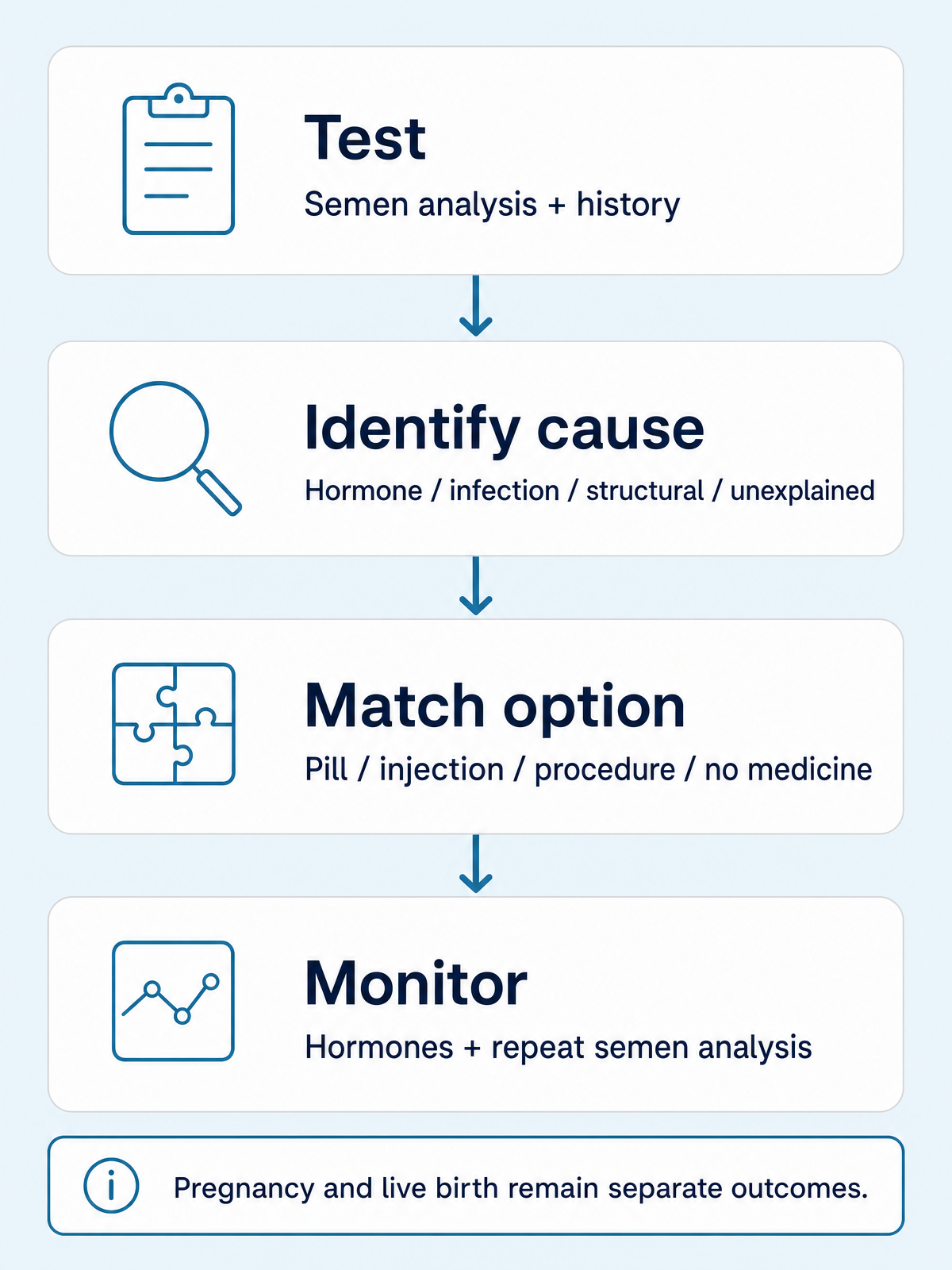
Which treatment matches which cause?
The current EAU guideline and AUA/ASRM guidance both support cause-led care. Some prescription use is empirical, meaning it is tried despite no proven correctable cause, and many uses in men are off-label. Off-label means the US Food and Drug Administration has not approved that drug for that specific use.
| Finding or diagnosis | What a specialist may consider | Form and status | Evidence boundary |
|---|---|---|---|
| Hypogonadotropic hypogonadism, with deficient LH and FSH signaling | hCG, with an FSH-containing gonadotropin when needed | Injections; specific hCG and FSH products have FDA-labeled uses in selected men with this condition. | The EAU guideline strongly recommends gonadotropin treatment to induce sperm production in men with this diagnosis who wish to conceive. It does not apply to primary testicular failure. |
| Low testosterone with a functioning pituitary and a suitable hormone pattern | A selective estrogen receptor modulator (SERM), aromatase inhibitor, hCG, or a combination | Clomiphene and aromatase inhibitors are oral and off-label for male infertility; hCG is injected | The 2024 AUA/ASRM guideline allows these options conditionally. They may raise the body's own testosterone and sometimes improve semen measures. Pregnancy and live-birth evidence is limited. |
| Proven hyperprolactinemia | Treat the cause; cabergoline or bromocriptine may be used for a symptomatic prolactinoma | Oral medicine for a diagnosed prolactin disorder | The Endocrine Society guideline recommends dopamine agonists for symptomatic prolactin-secreting tumors and prefers cabergoline for its effect on prolactin and tumor size. This is not an empirical sperm treatment. |
| Confirmed or strongly suspected genital-tract infection | An antibiotic selected for the organism and site | Prescription medicine for infection | The EAU guideline says treatment may improve sperm quality, while evidence does not show a consistent increase in conception. White blood cells in semen can reflect infection or inflammation and need evaluation. |
| Primary testicular failure, obstruction, clinical varicocele, or another structural cause | Surgery, sperm retrieval, assisted reproduction, or other cause-specific care | A procedure or fertility treatment | Hormone pills generally cannot restore a failed testicular response or remove a physical blockage. |
| Idiopathic infertility, where evaluation finds no cause | Sometimes a SERM, aromatase inhibitor, or FSH after shared decision-making | Usually off-label; FSH is injected | Benefits are limited or uncertain. The EAU advises against routine SERM or aromatase-inhibitor treatment for idiopathic infertility. |
Prescription medicines used in male fertility care
Clomiphene and other SERMs
Clomiphene reduces some estrogen feedback at the brain. This can increase LH and FSH signaling to the testes, helping the body produce its own testosterone. A specialist may consider it for an infertile man with low testosterone and a pituitary that can respond. Its use in men is off-label.
Clomiphene may raise testosterone and improve some semen measures in selected men. The effect on pregnancy is uncertain. A 2025 meta-analysis of randomized trials in idiopathic male subfertility found similar pregnancy rates with clomiphene and placebo, with a wide confidence interval. The AUA/ASRM treatment guidance says SERM benefits in idiopathic infertility are limited compared with assisted reproduction. Our guide to Clomid side effects in men explains the risks and monitoring questions in more detail.
Enclomiphene is one component of clomiphene, and it is not FDA-approved. A small phase II trial in 12 men and two phase III trials in overweight men with secondary hypogonadism found changes in testosterone, LH, FSH, and sperm concentration. These trials studied hormone and semen outcomes, not infertile couples, pregnancy, or live birth. They do not establish enclomiphene as a better fertility pill than clomiphene.
Aromatase inhibitors
Anastrozole and letrozole reduce the conversion of testosterone to estradiol. The AUA/ASRM treatment guidance conditionally allows an aromatase inhibitor for an infertile man with low testosterone. A specialist is most likely to consider one when estradiol is also elevated and the hormone signaling pathway can respond.
Use for male infertility is off-label. Most studies are small or nonrandomized. Hormone levels and some semen measures may improve, while effects on pregnancy and live birth remain unclear. Monitoring matters because estradiol also has important functions in men.
hCG, FSH, and other gonadotropins
hCG acts like LH at the testes, while FSH directly supports sperm development. These treatments are injections. The current EAU guideline strongly recommends gonadotropins for congenital or acquired hypogonadotropic hypogonadism in men who wish to conceive. Treatment requires specialist bloodwork and repeat semen analysis and can take many months.
The evidence is weaker when gonadotropins are used empirically for unexplained abnormal semen parameters with normal hormone signaling. This is a different clinical situation from replacing deficient signals in hypogonadotropic hypogonadism.
Dopamine agonists and antibiotics
Cabergoline or bromocriptine may be appropriate when proven hyperprolactinemia disrupts the reproductive hormone axis. The cause must be identified first. Medicines, thyroid or kidney disease, and pituitary tumors can all raise prolactin. The Endocrine Society guidance calls for cause-specific evaluation and cautions against changing a prolactin-raising medicine without the treating clinician.
Antibiotics belong in fertility care when an infection is documented or strongly suspected. They are not a general treatment for low count, poor motility, white blood cells alone, or unexplained infertility. The EAU evidence review found that antibiotics can clear organisms and sometimes improve sperm quality, but have not consistently improved conception.
Our guide to medicines used to help conceive covers these prescription categories in more detail.
What do trials show about antioxidant supplements?
Products commonly combine CoQ10, L-carnitine, zinc, selenium, and vitamins C and E. Biological plausibility or a change in one semen measure is not proof that a combination improves pregnancy or live birth.
Two randomized trials tested specific antioxidant combinations:
- In the MOXI trial, the tested seven-ingredient combination did not improve semen parameters or sperm DNA fragmentation after three months. The study also found no significant live-birth benefit after six months.
- In the larger SUMMER trial, the tested eight-ingredient combination did not improve ongoing pregnancy within six months. Rates were 33.8% with the supplement and 37.5% with placebo, a difference that was not statistically significant.
These results do not establish that every possible formulation is ineffective. They show that the tested combinations did not deliver the broad benefits often implied by supplement marketing. The 2024 AUA/ASRM guideline calls the clinical utility of antioxidants and vitamins questionable because evidence is inadequate to recommend specific agents. The current EAU guideline advises against routine antioxidant treatment for idiopathic infertility.
Correcting a documented deficiency is a different goal from taking a broad fertility blend. Supplements can also duplicate nutrients or interact with medicines. Our male fertility supplement guide goes deeper on common ingredients and safety.
How do you know whether treatment is working?
A useful plan defines the target before treatment begins. For a hormone disorder, monitoring may include symptoms and selected blood levels. For a sperm-production goal, it usually includes a repeat semen analysis interpreted beside the baseline.
One sperm-development cycle takes roughly 74 to 90 days, so about three months is a common reassessment point for semen measures. It is not a promise of improvement or conception. Gonadotropin treatment for hypogonadotropic hypogonadism can take much longer. Recovery after testosterone or anabolic-steroid suppression may take months and, rarely, years.
Monitoring should keep three outcomes separate:
- Did the intended hormone level or semen parameter change?
- Did that change improve the couple's realistic treatment options?
- Did pregnancy or live birth occur without unacceptable side effects?
A higher sperm concentration may change which fertility treatments are realistic. It does not guarantee fertilization, pregnancy, or live birth.
Choose the next step from your starting point
- You have not had a semen analysis. Start with a comprehensive local laboratory test rather than choosing a pill from symptoms or marketing.
- Your result is outside a reference range. A reproductive urologist can interpret the full pattern with your history and examination. Repeat testing is often useful because results vary.
- You have low-testosterone symptoms. Morning hormone testing and a fertility-aware evaluation can distinguish a pituitary signaling problem from primary testicular dysfunction.
- You use testosterone or anabolic steroids. Discuss conception plans with the prescriber and a reproductive specialist. Our guide to testosterone and male fertility explains why sexual symptoms and sperm production can move in different directions.
- Your report shows azoospermia or a very low sperm concentration. Seek specialist evaluation promptly. Hormone, genetic, obstructive, and testicular causes lead to different paths.
- Your semen values fall within reference ranges. Those values do not prove fertility. Review both partners' evaluation, intercourse timing, health factors, and how long you have been trying instead of defaulting to a pill.
Start with a fertility baseline
We help you arrange a comprehensive semen analysis at a local CLIA-certified lab. The service includes a physician-signed lab requisition, so no separate doctor visit or referral is needed to order the test. That order is different from a specialist consultation or diagnosis. Results are typically available in 2 to 5 days, depending on the selected lab, with plain-English interpretation and clear next steps.
Find a semen analysis lab near you.
Related Resource Articles
-
A Man's Guide to Abnormal Sperm Morphology
Struggling to understand abnormal sperm morphology? This guide explains what it means for male fertility, its causes, and clear, actionable steps you can take.
22 min read
-
Oligo-Astheno-Teratozoospermia (OAT): What It Means and What to Do
Oligo-astheno-teratozoospermia means count, motility and morphology are all low. Learn to read the result, confirm it and plan next steps.
12 min read
-
Selenium for Male Fertility: A Practical Guide for 2026
Learn how selenium for male fertility works. Our guide covers benefits, safe dosing, food sources, risks, and when to get a comprehensive sperm analysis.
13 min read