A home sperm test is a private, convenient way for a man to get a first look at his sperm count without leaving the house. Think of it as an initial screening—a way to get a baseline understanding of a key male fertility factor before you need to step into a clinic.
Understanding Your First Step in Male Fertility Testing
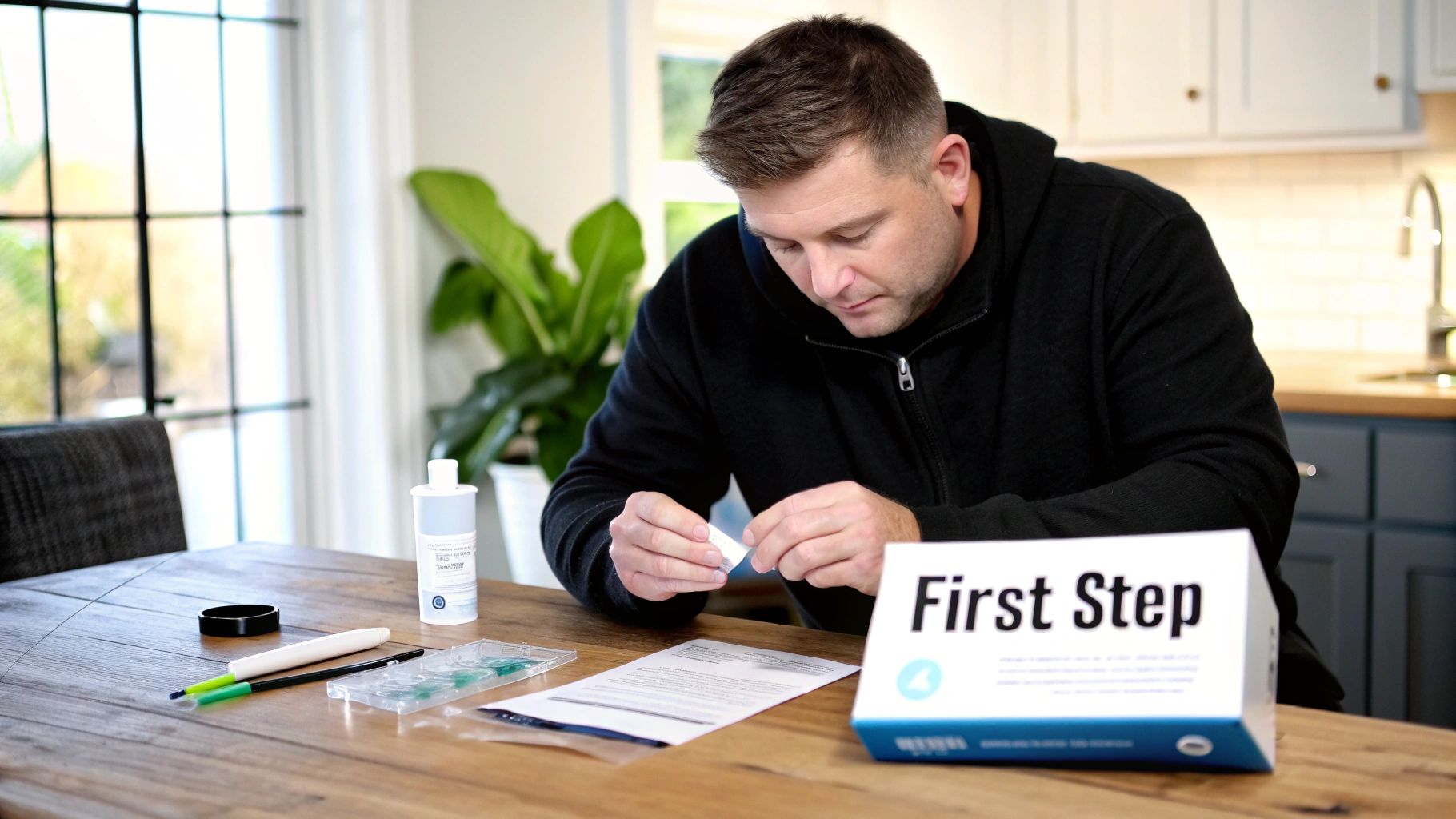
Starting the journey to understand your fertility can feel like a big deal, but that first step is an empowering one. A home sperm test helps demystify the process, giving you a private way to gather some preliminary info about your reproductive health.
Whether you're actively trying to start a family, just curious about your baseline, or checking your status after a vasectomy, these kits offer a concrete starting point.
And it’s a choice more and more men are making. In fact, the global market for these kits is projected to jump from USD 74.9 million in 2025 to USD 119.5 million by 2033. This boom shows a clear shift toward men taking an active, private, and convenient role in their own reproductive health. You can explore more insights on the at-home testing market here.
Different Types of At-Home Collection
It’s important to know that "at-home collection" can mean a couple of different things. Understanding the difference is key to picking the right option for what you need to find out.
The market generally offers a few distinct models for getting your sample analyzed. Here’s a quick breakdown of what you'll find.
Home Sperm Test Options at a Glance
| Test Type | What It Measures | How It Works |
|---|---|---|
| Basic Count Test | Sperm Concentration (Count) | You collect a sample and mix it with a solution. A color change or line appears, indicating if your count is above or below a certain threshold (e.g., 20 million/mL). |
| Smartphone-Based Test | Count & Basic Motility | A device attaches to your smartphone camera. You place a sample on a slide, and a video analysis app estimates sperm count and sometimes basic movement. |
| Mail-In Lab Analysis | Full Semen Analysis | You collect your sample at home in a kit with a special preservation medium. You then mail it overnight to a certified lab for a complete, clinical-grade analysis. |
These different approaches offer a trade-off between convenience, cost, and the level of detail you get back.
A home sperm test isn't meant to be a final diagnosis. Instead, it’s a valuable screening tool that helps you decide on the next steps, putting you in control of your health journey from the very beginning.
This guide will walk you through everything you need to know about these options. We’ll explore how the technology works, compare its accuracy to a formal clinical analysis, and provide clear, actionable advice on what to do with your results. By the end, you'll understand how a home sperm test fits into the bigger picture of male fertility and how services like Hera Fertility can provide the professional-grade analysis needed for a complete answer.
Two Paths for At-Home Collection

When you hear "home sperm test," it’s easy to picture the entire process happening in your house. But the term actually covers two very different models for collecting your sample from the comfort of home.
Understanding these two paths is the key to choosing the one that best fits your life, location, and what you’re most comfortable with. One option sends your sample away for you, while the other involves a quick trip to a local facility.
Let’s break down how each one works.
The Mail-In Kit: A Lab Test Shipped from Home
The first model is the mail-in lab analysis kit. This option brings a full-service male fertility test right to your doorstep. You order a kit online, and it arrives with everything you need to collect your sample privately and securely at home.
These kits include a special vial containing a preservation medium. This fluid is scientifically formulated to protect the sperm cells, keeping them stable while they travel.
After collecting your sample and mixing it with the preservation fluid, you package it up and drop it off with a designated courier, like UPS or FedEx, for overnight shipping to a certified lab. There, technicians perform a comprehensive analysis and send the results directly to you.
This method gives you the best of both worlds: the complete privacy of at-home collection combined with the accuracy of a professional lab analysis. It’s a fantastic choice if you don’t live near a fertility clinic or just want maximum convenience.
The real magic behind this model is the preservation technology. It essentially hits "pause" on the natural degradation of the sample, making sure the lab gets a specimen that accurately reflects your sperm health, even a day later.
The Local Drop-Off: At-Home Collection for Lab Delivery
The second path is the local drop-off at a nearby testing facility. This is a hybrid model that blends at-home comfort with immediate clinical processing. You still collect your sample in the privacy of your own home, but you are responsible for delivering it to a nearby fertility clinic or lab.
The biggest factor here is the time crunch. A semen sample begins to change the moment it's collected. Because of this, you have a very tight window—usually just 30 to 60 minutes—to get it to the facility. This quick turnaround ensures the lab can analyze the sperm while its motility (movement) is at its peak.
This option is perfect for men who live close to a testing center and can manage the logistics of a fast delivery. It cuts out the shipping step and gets a fresh sample directly into the hands of lab technicians.
To go this route, you’ll typically need a lab requisition—a formal order from a physician—and you’ll need to coordinate with the lab to schedule your drop-off time.
Comparing Your At-Home Collection Options
So, which path is right for you? It really comes down to your personal circumstances. There’s no single "best" option, only the best option for you.
To make the right choice, think about these key factors:
- Proximity: How close do you live to a certified lab or fertility clinic? If a facility is a short drive away, the local drop-off is a practical choice. If not, a mail-in kit is far more accessible.
- Schedule: Can you realistically make a rapid drop-off within a one-hour window? If you have a demanding job or an unpredictable schedule, the flexibility of a courier drop-off with a mail-in kit might be a much better fit.
- Comfort Level: Are you more comfortable packaging a kit and dropping it at a shipping center? Or would you feel more confident personally delivering your sample to make sure it arrives on time?
Both paths start with the same empowering step: taking control of your reproductive health from home. By understanding the logistics of each, you can confidently pick the method that works best for your life.
How Home Sperm Tests Work: The Tech and Key Metrics
To figure out what a home sperm test can actually tell you, it helps to peek under the hood. Different kits use surprisingly different methods to give you a snapshot of your sperm health, from simple chemical reactions to smartphone-powered video analysis.
Each approach is designed to measure specific, vital aspects of male fertility, giving you a preliminary look at what’s going on.
Basic Tests: The At-Home Screening
The most common and accessible home sperm tests provide a simple, straightforward answer to one question: is my sperm count above or below a certain level?
That threshold is typically set around the World Health Organization's guideline for what's considered a normal concentration, which is 15 million sperm per milliliter.
You just collect a sample, mix it with a solution from the kit, and apply the mixture to the test strip. A colored line or symbol will pop up, indicating a "positive" (above the threshold) or "negative" (below the threshold) result. It's that simple.
Think of this as a basic headcount. It's not counting every single sperm, but it's checking to see if you have enough to meet a baseline number. It’s a quick, private screening tool to spot a potentially significant issue with sperm numbers.
These tests are built for simplicity and privacy, giving you a clear yes-or-no answer about your sperm concentration.
Smartphone-Based Tests: A Deeper Look
More advanced home sperm test kits essentially bring a mini-lab to your smartphone. These kits usually include a small device that clips over your phone's camera, turning it into a surprisingly powerful microscope.
You place a tiny drop of your sample onto a slide, pop it into the device, and a dedicated app records a short video. From there, artificial intelligence (AI) gets to work.
The app's AI software analyzes the video in real-time to estimate two crucial metrics:
- Sperm Concentration: Like the basic tests, it estimates the number of sperm per milliliter.
- Sperm Motility: This is the big one. It measures how many of your sperm are actually moving, which is a critical part of male fertility.
If a basic test just checks for enough sperm, a smartphone test checks how many of them are actively moving. It gives you a much more dynamic picture of your sperm health. The demand for these private, detailed insights is booming. The global home-based sperm analysis market was sized at roughly $450 million in 2023 and is expected to rocket to $1.2 billion by 2032, with this kind of AI-driven software leading the charge. You can learn more about the growth of the home sperm analysis market here.
The Key Metrics Measured at Home
While a full clinical semen analysis looks at more than a dozen different factors, home sperm tests wisely focus on the fundamentals. Understanding what they measure—and what they don’t—is the key to interpreting your results correctly.
Most home kits will primarily assess one or both of these:
- Sperm Count (or Concentration): This is the number of sperm in your sample, usually measured in millions per milliliter (M/mL). A low count can be a factor in male fertility because there are fewer sperm available.
- Sperm Motility: This is all about movement. Good motility means a high percentage of your sperm are swimming forward with purpose. Poor motility can be a significant hurdle for sperm.
These two metrics are excellent starting points for evaluating your fertility. They give you foundational data that can help you decide if more detailed, professional testing is your next best step. Just remember, they don't tell the whole story, which is why a comprehensive lab analysis remains the gold standard for a complete diagnosis.
Comparing Home Tests to Clinical Semen Analysis
Choosing a home sperm test is a great first move, but it's important to understand where it fits in the bigger picture of male fertility. Think of it as a helpful screening tool, not the final word.
A home test gives you a quick, private look at a couple of key numbers. A clinical semen analysis, on the other hand, tells the complete, detailed story of your sperm health. Both have their place, and knowing the difference helps you make the most informed decision.
What Home Tests Actually Measure
Most at-home kits are designed to give you a snapshot of one or two fundamental aspects of your sperm. They’re streamlined for fast, easy-to-understand results on the most common indicators of male fertility.
This is what they're looking at:
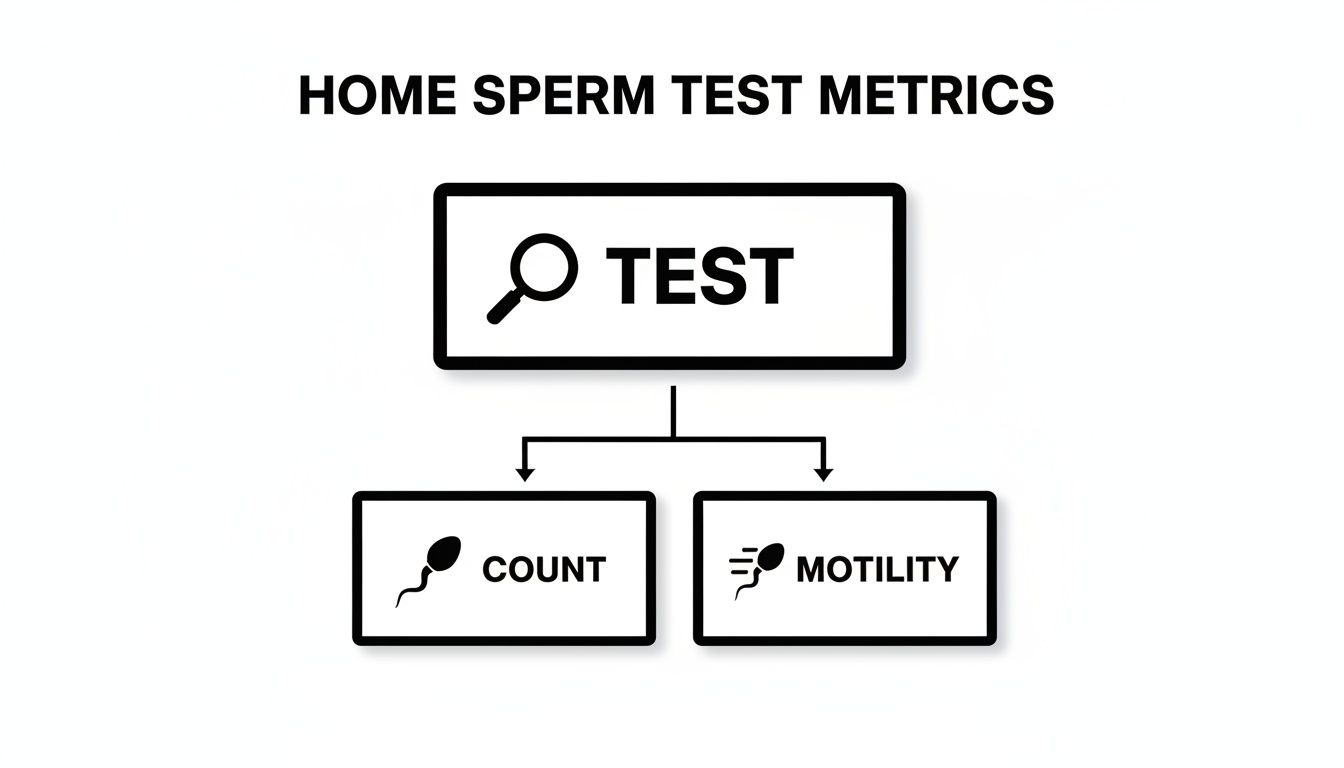 Essentially, these tests boil down to two core parameters: sperm count (how many) and sperm motility (how many are moving). These are absolutely crucial first indicators.
The Gold Standard: Clinical Analysis
A clinical semen analysis, performed in a CLIA-certified lab by trained andrologists, is far more exhaustive. It's considered the gold standard because it evaluates the "whole picture" of your reproductive health, not just a few data points.
This professional analysis examines a wide range of factors that are essential for a man's fertility.
A clinical semen analysis provides a detailed blueprint of your fertility. It moves beyond a simple headcount to assess the quality, structure, and environment of your sperm, giving you and your doctor a much clearer path forward.
While at-home kits are a booming market, holding 41.3% market share in 2024, their main focus is on count and basic motility. In contrast, a comprehensive clinical analysis assesses crucial parameters like morphology (sperm shape), where having over 4% normal forms is the standard. This highlights the gap between initial screening and getting a full, actionable diagnosis.
A Head-to-Head Comparison
Understanding the specific differences can help you see why a home test is a great start, but a lab test is necessary for a complete answer. Let’s put them side-by-side.
Home Sperm Test vs. Clinical Semen Analysis
| Feature | Home Sperm Test | Clinical Semen Analysis |
|---|---|---|
| Parameters Measured | Primarily sperm count and sometimes basic motility. | A full panel including count, motility, morphology (shape), volume, pH, liquefaction time, and white blood cell count. |
| Accuracy & Detail | Good for screening if count is above or below a threshold. Provides an estimate, not a diagnostic figure. | Provides precise, diagnostic-level measurements analyzed by a trained professional using high-powered microscopy. |
| Morphology Analysis | No. Almost no home tests can assess sperm shape, a critical factor for male fertility. | Yes. This is a standard and vital part of the analysis, as abnormally shaped sperm can be a factor in male fertility. |
| Environmental Control | Variable. User error or home environment can potentially affect results. | Strict. Performed in a controlled lab environment to ensure the sample's integrity and the accuracy of the results. |
| Cost | Generally lower upfront cost, ranging from $50 to $200. | Can be higher, often covered by insurance. Provides significantly more diagnostic value for the cost. |
| Next Steps | Provides a signal (normal/low) but doesn't explain why. Often requires follow-up testing. | Delivers a complete diagnostic report that a physician can use to recommend specific lifestyle changes or treatments. |
Ultimately, a home sperm test gives you a valuable clue, but a clinical semen analysis gives you the complete answer.
If you've taken a home test and want a definitive look at your fertility, the next logical step is a professional lab test. You can learn more about the complete semen analysis process and see why it’s so important for truly understanding male fertility. Making that transition from initial screening to a full diagnosis is a key part of taking control of your reproductive health.
What to Do After You Get Your Home Test Results

Getting the results from a home sperm test can bring a rush of emotions—relief, confusion, or maybe a bit of anxiety. Whatever that screen or test strip shows, it’s important to remember one thing: this is just a starting point.
A single home test is a snapshot in time. A man's sperm health isn’t static; it can change with his lifestyle, stress levels, or even a recent illness. So before you jump to any conclusions, take a breath and let this information guide your next move.
If Your Results Are Normal
Seeing a "normal" or "positive" result is definitely good news. It suggests your sperm count, and maybe your motility, is above the basic threshold, which is a great first sign.
But this isn’t the full story. Home tests are screeners, not deep dives. They usually don't look at things like sperm shape (morphology) or the total volume of your sample, which are key pieces of the male fertility puzzle.
Here are some actionable next steps:
- Keep Up the Good Habits: Double down on what's working. Stick to a balanced diet, get regular exercise, manage stress, and make sure you're getting enough sleep. These are all positive steps for a man's reproductive health.
- Get a Clinical Baseline: The best way to confirm the good news and get the full picture is with a clinical semen analysis. This gives you detailed insights into all your sperm parameters.
If Your Results Are Abnormal or Low
A "low" or "negative" result can feel concerning, but it’s not a reason to panic. Many men who get a low reading on a home test discover their numbers are perfectly fine when they get a more detailed lab test.
An abnormal result from a home test is a signal, not a diagnosis. It’s an indication that it’s time to get a more accurate and comprehensive look at your sperm health from a certified lab.
This is the moment to shift from a simple screening tool to a true diagnostic test. The most important next step is to get a formal, clinical-grade semen analysis. This professional test will either confirm the home test’s findings or, as often happens, provide a more reassuring and complete picture. It's the only way for a man to know for sure what's going on with his fertility.
The Clear Path to a Definitive Answer
Going from an uncertain home test to a clear clinical answer shouldn’t be complicated. That’s exactly why Hera Fertility exists—to make that critical next step simple and stress-free for men.
Forget waiting for a doctor's appointment. You can order a physician-signed lab requisition directly from our platform in a few minutes. Take that form to any of our 250+ partnered CLIA-certified labs across the country, and you’ll get a definitive, gold-standard semen analysis.
We take the guesswork out of the process. Once you have your results, our platform helps you make sense of the report, so you’re not left staring at a confusing jumble of numbers. If you want a preview of what a full report looks like, you can learn more about how to read semen analysis results and see what a comprehensive evaluation covers.
Where Hera Fertility Fits In: From Home Test to Clear Plan
So you’ve taken a home sperm test. Now what? Whether the result was “low” or “normal,” it’s a screening test—a single snapshot that often leaves you with more questions than answers. This is exactly where Hera Fertility comes in, turning that initial, often confusing, result into a clear and actionable path forward for men.
Our platform is designed to close the gap between the uncertainty of a home test and the clarity of a real clinical diagnosis. Forget the hassle of getting a doctor’s appointment just to get a referral. In minutes, you can order a physician-signed lab requisition directly from our site and find a convenient location from our network of over 250 CLIA-certified partner labs.
This puts you in control, letting you get a gold-standard semen analysis when and where it works for you.
From Complex Data to Clear Answers
Getting the test is one thing; understanding the report is a whole different challenge. A typical lab report is a dense document packed with medical jargon and numbers for metrics like motility, morphology, and concentration. It’s intimidating, and it rarely comes with a simple explanation of what it all means for your fertility.
We built the Hera SmartScore to solve this. Our AI technology analyzes every single detail of your clinical lab report and translates all that complex data into one simple, easy-to-understand score.
Think of the Hera SmartScore as a translator for your male fertility. It takes the confusing language of a lab report and converts it into a single, meaningful number that gives you an immediate understanding of your overall sperm health.
This score gives you an instant, clear benchmark of exactly where you stand.
A Personalized Plan for Your Next Steps
But a score is just a number. The real value is in knowing what to do next. Our platform doesn't just score your report; it generates a personalized action plan based on your specific results. It breaks down what each metric means and provides tailored recommendations to support your reproductive health.
This could include anything from targeted lifestyle adjustments and dietary changes to clear guidance on when it might be time for a man to see a specialist. We don't just hand you data—we give you direction. This approach finally answers that critical "what now?" question that so many men face after getting a report back.
Already Have a Lab Report?
If you've already done a semen analysis at a clinic, our tools are ready for you. You can upload your existing report to our platform for free and get an instant AI-powered analysis and your Hera SmartScore. We believe every man deserves to understand his results, no matter where he was tested.
With Hera Fertility, you can move beyond the limits of a home sperm test and gain a deep, actionable understanding of your reproductive health. To see how it works, get an instant interpretation of your semen analysis report and take the next confident step on your journey.
Your Questions About Home Sperm Tests, Answered
Thinking about using a home sperm test? It’s a common starting point, and it’s natural to have questions. Here are some clear, straightforward answers to the most frequent queries we hear from men.
How Accurate Are These Home Tests?
For what they’re designed to do—which is usually just measuring sperm count—most FDA-cleared home tests are quite accurate. Many kits report accuracy rates over 95% when it comes to telling you if your count is above or below a certain number.
But here's the crucial part: accuracy has its limits. A home test is a screening tool, not a full diagnostic picture. The gold standard is still a clinical semen analysis, which looks at everything—sperm motility (how they swim) and morphology (their shape), two factors absolutely critical for male fertility that most home kits don't even touch.
Think of it this way: a home test can tell you if you have enough players on the field, but a lab test tells you if those players are healthy, athletic, and ready for the game.
Can Lifestyle Changes Actually Improve My Results?
Absolutely. A man's sperm health isn't set in stone; it's dynamic and very responsive to his lifestyle. The entire sperm production cycle, from start to finish, takes about 74 days. That means the positive changes you start making today can show up in your results in about three months.
Here are some actionable steps men can take:
- Eating a healthy diet full of antioxidants (think fruits, vegetables, and nuts)
- Getting regular, moderate exercise
- Finding healthy ways to manage your stress
- Avoiding too much heat from things like hot tubs, saunas, or even a laptop on your lap
- Quitting smoking and cutting back on alcohol
If you get a low result from a home test, don't panic. View it as a signal. Making these changes and then getting a full clinical analysis is a fantastic, proactive next step.
A single test result is just one snapshot in time. A man's sperm health can improve, and taking control of lifestyle is one of the most powerful things a man can do for his fertility.
Can I Use a Home Test to Check if My Vasectomy Worked?
While you might see some tests marketed for this, most urologists will give you a hard "no" on relying on them for vasectomy confirmation. The only way to be certain a man is sterile is with a proper lab-based semen analysis.
Why? A clinical lab uses a centrifuge to spin and concentrate your sample. This process allows technicians to spot even a tiny number of remaining sperm that a home test would easily miss. When it comes to something as important as confirming a successful vasectomy, you need the absolute certainty that only a professional lab can provide.
What if My Home Test Results Are "Normal"?
Getting a normal result is definitely good news, but it's only one piece of the male fertility puzzle. If your results are normal but you are having trouble conceiving, it could easily be due to factors a home test can't measure.
Things like poor sperm morphology or high DNA fragmentation won't show up on a basic screening kit. If a man's home test looks good but conception is not occurring, the best move is to consult a fertility specialist or a urologist. They can order a complete evaluation to get the full picture of a man's reproductive health.
Take the guesswork out of what to do next. With Hera Fertility, you can order a physician-approved requisition for a clinical-grade semen analysis at one of over 250 labs. We’ll help you translate those complex results into a simple, actionable plan. Visit Hera Fertility to get started.