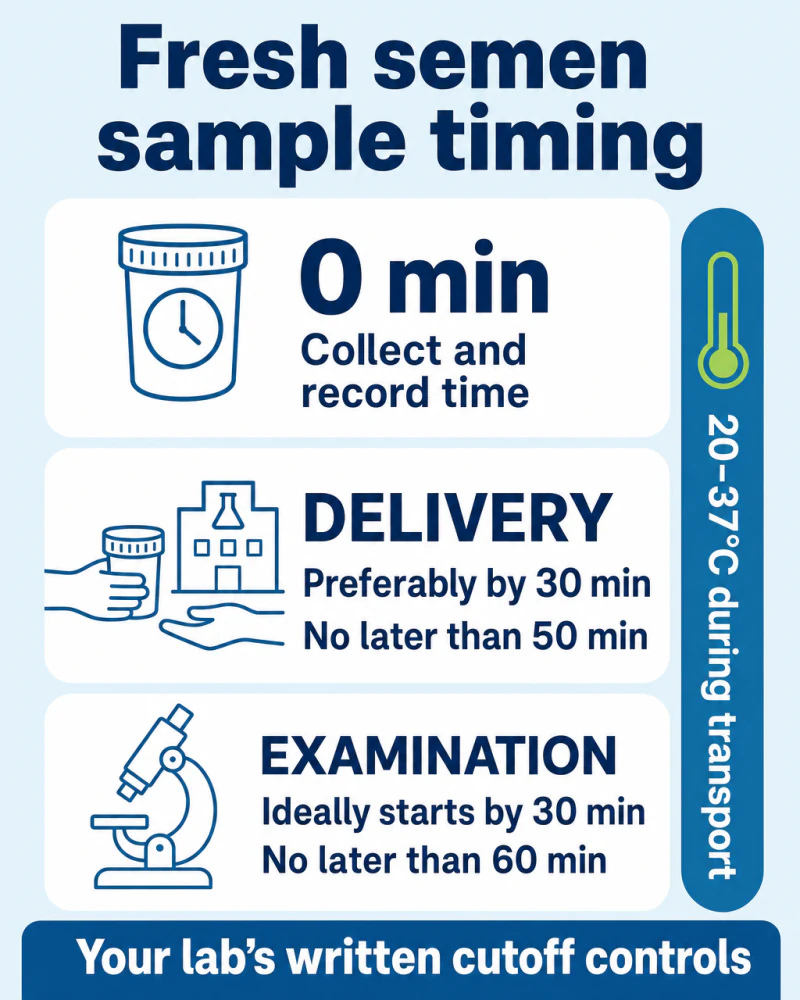
For a standard fertility semen analysis collected away from the lab, the WHO target is delivery preferably within 30 minutes and no later than 50 minutes after collection. That leaves time for the laboratory to start the examination within 60 minutes. Keep the sealed cup upright and between 20°C and 37°C (68°F to 98.6°F) during the trip. Your receiving lab's written cutoff controls when it is shorter or more specific.
Sixty minutes is the outer examination limit for a standard fresh analysis, rather than an exact lifespan for every sperm cell. A late sample may still contain living sperm, yet it may no longer give a dependable fertility result.
The short answer depends on the test
“Sperm sample” is the everyday term. For testing, the specimen is semen because the laboratory examines both sperm cells and seminal fluid. People use the same phrase for several different specimens, but their usable windows are not interchangeable.
| Sample purpose | Practical timing rule | What matters |
|---|---|---|
| Fresh fertility semen analysis | Off-site delivery preferably within 30 minutes and no later than 50, so examination can start within 60 | Count, motility, progressive motility, morphology, volume, pH, liquefaction and other measures need controlled handling |
| Fresh post-vasectomy semen analysis | Follow the vasectomy order and lab cutoff, which may differ from fertility testing | The lab may be looking for sperm presence, concentration and motility under a specific clearance protocol |
| Lab-validated mail-in sample | Follow the supplied collection, transport and shipping protocol exactly | A validated delayed-analysis method can extend transport time for defined results, but it cannot assess motility reliably |
| Professionally cryopreserved sperm | Stored long term by a sperm bank or fertility laboratory | Conventional protocols typically use cryoprotectant, controlled freezing and liquid- or vapor-phase nitrogen storage |
| At-home test used immediately | Use at the exact time listed in the kit instructions | These screens may measure fewer parameters than a laboratory semen analysis |
If the trip from home will not fit the receiving lab's cutoff, collect in its private room when that option is available. Our semen analysis lab finder helps you compare participating local labs before ordering. We include a physician-signed lab requisition, coordinate the appointment and give you the selected location's collection instructions. You do not need a separate doctor visit or referral.
Why timing changes the result
Semen does not become unusable at one exact minute. Different parts of the analysis change at different rates.
Fresh semen usually liquefies within 15 to 30 minutes after ejaculation. The lab expects that change. Once the specimen is outside the body, sperm movement can decline, carbon dioxide escapes and pH gradually rises. Temperature swings can also change motility and vitality.
The WHO laboratory manual recommends starting the examination ideally within 30 minutes and no later than 60 minutes after collection. For a sample collected away from the lab, it recommends delivery preferably within 30 minutes and no later than 50 minutes, while keeping the sample from falling below 20°C or rising above 37°C.
These are separate milestones. For an off-site sample, 30 minutes is the preferred delivery target and 50 minutes is the latest WHO delivery target. Sixty minutes is the outer limit for starting the examination, not the home-to-lab travel allowance. A receiving lab may use a shorter handoff cutoff, and its written instructions control your sample.
The 2024 andrology laboratory guidelines say pH, motility, vitality and agglutination should all be assessed within 60 minutes. Concentration is less immediately sensitive to loss of movement, yet a complete fertility analysis still depends on the whole specimen. In an observational study of 1,079 samples, progressive motility was 6 to 8 percentage points lower when analysis began after 60 minutes compared with earlier analysis groups.
This is also why “Are the sperm still alive?” is the wrong standard for deciding whether a sample is good. The useful question is whether the laboratory can still measure the requested parameters under its validated procedure.
How to transport a fresh sperm sample
The clock, container and temperature all matter. Set up the handoff before you collect.
Before collection
- Use the sterile, non-toxic specimen cup supplied or approved by the receiving lab.
- Know the appointment time, drop-off desk and travel route.
- For a fertility analysis, follow the prescribed abstinence period. The WHO standard is 2 to 7 days, although your order may set a narrower window.
- Do not use saliva, ordinary lubricant or a regular condom. A lab-approved lubricant or special collection condom is different and should be used only when supplied or approved for your test.
Immediately after collection
- Collect the entire ejaculate directly into the cup when possible.
- Close the lid firmly. Keep the container upright.
- Record the exact collection date and time on the label or form.
- Report any spill, missed portion or use of an unapproved product. Do not scoop up spilled semen or add it back to the cup.
During the trip
Carry the sealed container close to your body under clothing, such as in an inside jacket pocket. This protects it from temperature swings. It does not need extra heat.
Do not put a fresh fertility-analysis sample in a refrigerator, freezer, cooler, on ice, beside a hand warmer, in direct sun or in front of a car vent. Do not stop for errands. Hand it directly to lab staff and state the collection time.
What to do if you miss the delivery cutoff
Do not try to rescue an untreated sample by chilling, heating or freezing it. Do not combine it with a second ejaculation. Those steps create a different specimen and can distort the result.
Use this sequence instead:
- Write down the actual collection time and conditions. Include a spill, temperature exposure or delay.
- Contact the receiving lab before traveling farther. It may reject the sample, analyze it with a limitation noted or ask for a new collection.
- Recollect if the lab cannot perform the ordered test reliably. A new sample is more useful than a report built on uncertain handling.
If a delayed sample was processed and the report shows low motility or vitality, the delay belongs in the interpretation. The result does not prove that those values reflect your usual sperm health. Semen parameters also vary naturally between ejaculates, so one result is a snapshot rather than a fertility diagnosis.
Post-vasectomy samples follow a separate rule
A post-vasectomy semen analysis asks whether sperm remain after the procedure. It is not a comprehensive fertility evaluation, and current protocols can accept different delivery methods.
The 2026 AUA vasectomy guideline allows laboratory, office or mail-in evaluation. For a fresh uncentrifuged sample assessed within two hours, clearance can be based on azoospermia or no more than 100,000 rare non-motile sperm per milliliter. When analysis happens after two hours, the guideline requires azoospermia for clearance because motility can no longer be assessed reliably.
That two-hour rule does not extend the window for a full fertility semen analysis. It also does not override a shorter delivery cutoff printed by your lab. Follow the protocol connected to your vasectomy order, and keep using contraception until your clinician formally confirms clearance. Our post-vasectomy sample instructions explain the collection and clearance process in more detail.
Fresh, mail-in and frozen samples are different
An untreated sample in a specimen cup cannot be left overnight and treated like a fresh sample the next day. A legitimate mail-in test must follow the service's supplied, lab-validated collection, transport and analysis protocol. Some protocols use a stabilizing medium, while others use different validated handling. Delayed samples cannot assess motility reliably, so mail-in methods are limited to the specific results their protocols validate. Never add water, saline or another liquid yourself.
Conventional professional sperm cryopreservation typically mixes the sample with cryoprotectant, cools it under controlled conditions and stores it in liquid- or vapor-phase nitrogen. Exact methods vary by laboratory and specimen. Cryopreserved sperm has produced live births after decades of storage, but a household freezer cannot reproduce a clinical protocol.
For IVF, IUI, sperm banking or donor insemination, use the fertility clinic's treatment-day instructions. Processing steps and acceptable intervals differ from a diagnostic semen analysis.
Frequently asked questions
Can a semen sample be kept at room temperature for two hours?
That is too long for a routine fresh fertility semen analysis unless the receiving laboratory has explicitly validated and instructed that interval. Motility, vitality and pH are time-sensitive. For off-site collection, the WHO delivery target is preferably within 30 minutes and no later than 50, so the examination can start within 60 minutes.
Can I refrigerate a sperm sample overnight for testing?
No. Do not refrigerate an untreated fresh sample unless the laboratory supplied instructions for a specific preserved test. Standard fertility semen analysis requires prompt delivery at a controlled temperature between 20°C and 37°C.
Does the 60-minute examination window start when I leave home?
No. It starts at collection. Record the time you produced the sample, then travel directly to the lab within its delivery cutoff.
Can I collect the sample at home?
Yes, when the receiving lab accepts home collection and you can meet its container, temperature and delivery rules. Under the WHO off-site targets, the sample should arrive preferably within 30 minutes and no later than 50. On-site collection is the better route when travel time is close to the lab's cutoff.
How long do sperm live in a collection cup?
There is no single dependable lifespan. Some sperm may remain alive for hours in a sealed sample under favorable conditions, while motility and other measurable properties change sooner. Survival does not make an old sample suitable for a standard fertility analysis.
Is a sample ruined if it does not liquefy right away?
No. Semen normally starts thick and often liquefies within 15 to 30 minutes. If it remains incompletely liquefied at 60 minutes, the lab records that finding and handles it under its procedure.
To get a fresh sample analyzed under the correct local protocol, find a participating semen analysis lab. We will coordinate the physician-signed order, location-specific instructions and results guidance in one place.
Related Resource Articles
-
How Long Do Semen Analysis Results Take? Timeline Guide
Semen analysis results: How long do they take? Get fast answers (24-72 hrs) with Hera's guide & at-home tests. Understand timelines & get results faster!
10 min read
-
Does Sperm Quality Matter More During Your Fertile Window?
For couples trying to conceive, understanding the interplay between timing and male fertility is paramount. The fertile window, a critical but narrow period,...
9 min read
-
How Long Does It Take to Get Pregnant? A Clear Timeline
Learn what is typical over months of trying, what happens after sex, when to test, and when both partners should consider a fertility evaluation.
11 min read