For a lot of men, choosing a fertility clinic starts with one critical step: the semen analysis. The best clinic for you will not only make this foundational test easy but will also offer deep, specialized support for male reproductive health, making sure you’re an active, informed participant from day one.
Your First Step in the Fertility Journey
Kicking off the fertility process can feel isolating, but the first move toward taking control is understanding your central role. This guide is built for men, cutting through the confusion to focus on what actually matters for your health and acknowledging the unique pressures you face.

For too many guys, the journey begins and ends with being told to provide a sample. But a truly supportive clinic sees your health as a critical piece of the puzzle, not just a lab requirement. This is why you have to proactively dig into a clinic’s male fertility services.
Why Your Approach Matters
It's vital to shift your mindset from being a passive participant to an advocate for your own health. This means walking in armed with the right questions to find a team that genuinely has your back. As you start this major decision, understanding what to look for in a high-quality practice can help frame your choices, even beyond fertility-specific details.
The goal is simple: find a clinic that doesn't just process your sample but actually investigates your health. They should offer a clear roadmap and be completely transparent about their expertise and process.
The right clinic empowers you with information. They should make it easy to understand your results, discuss potential underlying causes, and explore treatments that focus directly on improving male health parameters, rather than immediately defaulting to more intensive procedures.
Key Areas for Your Initial Focus
As you begin your research, zero in on these four areas from a male perspective. They'll tell you almost everything you need to know about a clinic's commitment to men's reproductive health.
- Ease of Semen Analysis: How simple is it to get this first test done? A complicated, bureaucratic process can be a huge red flag. Thankfully, modern services make it easier than ever, and you can even find labs near you to complete a semen analysis before you even have a consultation.
- Access to a Urologist: Does the clinic have a urologist specializing in fertility on staff, or at least a seamless referral partnership? Direct access to a male fertility specialist is non-negotiable for a thorough evaluation.
- Transparent Male Fertility Costs: How much will your side of the workup and any potential treatment cost? A good clinic will be upfront about the expenses for semen analysis, consultations, and any procedures for male-factor issues.
- Male-Centric Treatment Options: Do they push everyone straight toward IVF, or do they present a full range of options? Look for a clinic that discusses lifestyle changes, supplements, or minor procedures that could improve your own health first.
Evaluating a Clinic's Focus on Male Health
It’s an unfortunate truth of the fertility world: not all clinics are created equal, especially when it comes to men's health. Many places still operate on an outdated model where the male partner’s role is reduced to simply providing a sample.
But male factors contribute to 30-50% of infertility cases. A clinic that genuinely values your role will go far beyond the basics. You need to dig a little deeper to see if they're truly equipped—and committed—to giving you the attention you deserve.

How Easy Is It to Get a Semen Analysis?
The semen analysis is the absolute cornerstone of any male fertility evaluation. Pay close attention to this process, because it will tell you almost everything you need to know about a clinic's attitude toward male patients.
If just scheduling the test feels like a bureaucratic nightmare, that’s a huge red flag. The collection environment is just as important. Is it a private, comfortable, and respectful space? Or is it a sterile, awkward room that just adds stress to an already sensitive process?
This is a bigger deal than you might think. Despite the statistics, many clinics have shockingly inconvenient or outdated procedures for what should be a routine test. This exact gap is why services like Hera Fertility were created—to give men an easier way to get physician-signed requisitions online and test at a network of over 250 labs, with clear, AI-interpreted results. To see why this matters, you can discover more about these fertility statistics.
Do They Have a Urologist on Staff?
The primary doctor at many fertility clinics is a Reproductive Endocrinologist (RE). They are experts, but their focus is typically not on male reproductive health. The real expert for you is a urologist who specializes in male fertility, often called an andrologist.
An andrologist’s job is to look beyond the numbers on a semen analysis report and figure out the why behind them.
A top-tier clinic will either have a urologist in-house or a very strong, seamless referral partnership. This is non-negotiable. If a problem is found, you shouldn't be left scrambling to find a specialist on your own. Direct access is critical for properly diagnosing and treating underlying issues like varicoceles, hormonal imbalances, or blockages.
A clinic that only focuses on the semen analysis without a clear path to a urological evaluation is only doing half the job. Your overall health is directly linked to your fertility, and a urologist is the only one qualified to connect those dots.
To gauge a clinic’s expertise, you need to be direct. The table below outlines some essential questions you should be asking during your initial consultation.
Essential Questions to Vet a Clinic's Male Fertility Services
Use this checklist to assess a clinic's commitment to and expertise in male reproductive health.
| Area of Inquiry | What to Ask |
|---|---|
| Experience & Focus | "What percentage of your cases involve male-factor infertility?" |
| Specialist Access | "How do we get an appointment with your andrologist or a partner urologist? What is the wait time?" |
| Diagnostic Protocol | "What is your standard protocol if the initial semen analysis shows abnormal results?" |
| Advanced Diagnostics | "Do you offer advanced tests like sperm DNA fragmentation analysis? When do you recommend it?" |
| Integrated Care | "How does the clinic's team collaborate with the urologist on a treatment plan?" |
Asking these questions upfront shows you're an informed and engaged patient, and the clinic's answers will reveal how seriously they take the male side of the equation.
What Are the Costs for Male Fertility Services?
Let's be honest: the financial side of fertility treatment can be a massive source of anxiety. Transparency here is key. When you ask about pricing, don't settle for a single package number. Ask for a clear breakdown of costs specifically for male fertility services.
This goes way beyond the initial consult. You need to know the price of:
- The Semen Analysis: Is this a one-time charge, or will repeat tests cost extra?
- Urologist Consultation: If they refer out, is that visit covered by your regular health insurance, or is it part of a fertility package?
- Advanced Testing: What are the costs for tests like sperm DNA fragmentation or hormone panels if they're needed down the line?
- Sperm Freezing: Be sure to ask about the initial cost for cryopreservation and the annual storage fees.
A reputable clinic will give you a detailed fee schedule without any hesitation. If they get vague or evasive about costs, see it as the warning sign it is.
What Treatment Options Do They Offer Men?
Finally, pay very close attention to how they talk about treatment. A common pitfall is the clinic that pushes almost every man straight toward IVF, regardless of the underlying cause. While effective, it’s also the most invasive and expensive option. It's often the fastest path for the clinic, but it might not be the best one for you.
A truly male-focused clinic will first explore all options to improve your health and sperm parameters directly.
They should be talking about lifestyle changes, nutritional supplements, hormonal treatments, or even minor surgical procedures like a varicocele repair. These interventions can sometimes improve sperm quality enough to allow for natural conception or make less invasive treatments possible.
You're looking for a partner in your health, not just a service provider. The right clinic is one that invests in diagnosing and treating you, because they see you as an equal and essential part of the process.
Looking Beyond IVF for Male Treatment Options
It’s a familiar story. You get your semen analysis results, walk into a consultation, and within minutes the conversation jumps straight to IVF. While IVF is an incredible technology, a clinic truly dedicated to comprehensive male fertility care won't treat it as the automatic next step for every man.
A great clinic sees your health as an opportunity to optimize, not just an obstacle to bypass. The first question they should help you answer is, "Can we improve the man's fertility before trying something more invasive?" Skipping this step means potentially overlooking a correctable, underlying health issue that's affecting more than just your sperm.
A Philosophy of Treating the Patient, Not Just the Semen Sample
When you’re vetting clinics, listen carefully to how they frame your options. A clinic with a strong male fertility focus will want to dig into the why behind your numbers. They should be curious about what's causing the issue, treating you as a whole patient.
After all, male factor contributes to infertility in up to 40-50% of cases. This isn't a niche problem; it’s a massive piece of the puzzle. Top-tier clinics recognize this and integrate advanced diagnostics to get a clearer picture. For example, many of the 250+ CLIA-certified labs we partner with use AI-powered tools like the Hera SmartScore to get incredibly precise data on count, motility, and morphology. This level of detail is what allows for a truly personalized treatment plan, as you can learn more about these fertility statistics.
The best clinics operate on a simple principle: treat the cause, not just the symptom. They’ll outline a logical, stepped approach that starts with improving your own health first, reserving more complex procedures for when they’re truly needed.
What First-Line Male Treatments Should Look Like
A clinic invested in your health will walk you through a full spectrum of male-focused treatments. They'll be upfront about the pros, cons, and realistic success rates for your specific situation.
Here are some of the options that should be on the table for discussion:
- Lifestyle & Nutrition: This is ground zero. A good team provides specific, evidence-based advice—not just "eat healthier." They'll talk about diet, stress reduction, exercise, and avoiding specific environmental toxins known to harm sperm.
- Targeted Supplements: Instead of a generic multivitamin, they should recommend specific antioxidants like CoQ10, zinc, or selenium based on your lab work and lifestyle.
- Hormonal Therapies: If blood tests show a hormonal imbalance (like low testosterone), they'll explore medications that can correct the issue and kickstart healthy sperm production.
- Varicocele Repair: Varicoceles—enlarged veins in the scrotum—are a common and fixable cause of male infertility. This minor surgical procedure can lead to huge improvements in sperm quality for many men.
Spotting the Red Flags
So, how can you tell if a clinic is just fast-tracking you to its most expensive procedures? Keep an eye out for these warning signs.
A clinic may be defaulting to IVF if they:
- Dismiss Male-Focused Options: If you bring up supplements or varicocele repair and they brush it off as ineffective without a solid medical reason, that's a major red flag.
- Lack a Urologist on Staff or a Referral System: A clinic serious about male fertility has a reproductive urologist in-house or a seamless partnership for referrals. Without one, they can't properly diagnose or treat you.
- Frame IVF as the Only "Guarantee": No fertility treatment is a guarantee. If they present IVF as the only realistic path forward from day one, it suggests a one-size-fits-all mentality.
Ultimately, you’re looking for a partner. The right clinic is one that educates you, respects your role in the process, and helps you make a choice that aligns with your health goals, budget, and personal comfort level.
Decoding Lab Quality for Male Fertility
The success of any fertility treatment often boils down to what happens behind the closed doors of the andrology lab. For men, this is where the magic really happens. The quality, precision, and expertise of this lab team are completely non-negotiable.
This is where your sample is analyzed, prepared, and potentially used for advanced procedures. That makes the lab's technical skill one of the most important factors in your decision.

When you're checking out a clinic, don't just focus on the waiting room or the doctor's credentials. The lab is the engine room of the entire operation. A clinic with an average lab can undermine the work of the best doctors, while a top-tier lab can significantly boost your odds of success.
Look for These Key Lab Accreditations
Accreditations aren't just fancy badges for a website; they are hard proof that a lab sticks to the highest standards for quality control, safety, and staff training. For any lab handling sperm, a couple of credentials should be considered essential.
Make sure the clinic's lab is certified by:
- CLIA (Clinical Laboratory Improvement Amendments): This is the baseline federal certification in the United States. It ensures quality standards for all lab testing on humans. Any legitimate medical lab must have this.
- CAP (College of American Pathologists): CAP accreditation is the international gold standard. These labs go through rigorous on-site inspections and proficiency testing, which shows a serious commitment to the highest level of quality and accuracy.
A lab that holds these certifications is telling you they're serious about what they do. If a clinic is cagey about sharing this info, that’s a major red flag.
Analyze Success Rates from a Male Perspective
Clinics love to advertise their overall "live birth rates," but that big number doesn't tell the whole story for a man dealing with male-factor infertility. You need to dig deeper and ask for data that’s specific to your situation. This shows you're an informed patient and pushes the clinic to be transparent about its real expertise.
When you have your consultation, ask them directly:
- "What are your success rates for cases involving severe male-factor infertility?"
- "How much experience does your lab have with low sperm counts or poor morphology?"
- "What are your live birth rates specifically for cycles using ICSI (Intracytoplasmic Sperm Injection)?"
ICSI is a procedure where a single sperm is injected directly into an egg—a technique that relies heavily on the skill of the lab technician. A clinic's success with ICSI is a direct reflection of its lab's proficiency in handling and selecting individual sperm. Understanding these details is crucial, and it starts with knowing how to read semen analysis results in the first place.
A clinic's willingness to share male-factor-specific data is a sign of confidence and transparency. If they can only provide broad, generic statistics, they may not have the specialized experience you need.
The Importance of Transparency and Accountability
At the end of the day, certifications, safety records, and transparency are what separate the top fertility clinics from the average ones. Global data shows massive differences in standards. Some countries, for example, have incredibly high standards, like Thailand, which boasts impressive success rates and a national registry that enforces accountability through certifications.
This level of oversight ensures clinics are held to a high standard, which is good for everyone.
Beyond the lab's reputation, learning how to read blood test results yourself empowers you to have more meaningful conversations with your doctor and truly understand your own fertility diagnostics. This knowledge gives you another tool to assess the quality and thoroughness of the care you're getting. Choosing a clinic that invests in a high-quality lab and is open about its processes is one of the most critical decisions you'll make on this journey.
Understanding the Costs of Male Fertility Care
Let's be honest—the financial side of fertility care can be a huge source of stress. When you’re trying to figure out what’s going on, the last thing you need is a surprise bill. Getting a clear, upfront breakdown of expenses is non-negotiable when choosing a fertility clinic.
A good clinic will be totally transparent about costs. They should see you as a partner in this process, and that means being straight with you about the financial investment from day one. If a clinic is vague or seems hesitant to give you a detailed fee schedule, that’s a major red flag.
What to Expect for Initial Male Fertility Costs
Your journey will start with diagnostics. These initial costs are usually the most straightforward, but you need to know exactly what you're paying for. Don't just accept a single package price; ask for an itemized list.
Your first round of expenses will likely include:
- Consultation Fee: This covers your first meeting, typically with a reproductive endocrinologist or a urologist. Find out if this is a one-time fee or if follow-up visits are billed separately.
- Semen Analysis: The cornerstone of the male workup. Ask for the price and confirm it includes a detailed report covering all key metrics like count, motility, and morphology.
- Blood Work: Hormone panels to check testosterone and other key levels are common. You’ll want to know which tests are standard and what they cost individually.
Getting clarity on these numbers before you commit is crucial. It sets the tone for your entire experience. For a real-world example of how this should look, reviewing a clear fertility pricing guide can give you a solid baseline of what to expect from a clinic that values transparency.
Digging Deeper into Treatment and Long-Term Costs
If your initial tests suggest you need more intervention, the costs can start to add up. This is where a clinic's financial transparency is really put to the test. You need a clear picture of what potential treatments might cost down the road so you can plan.
Be ready to talk about the costs of more advanced services. It's much better to know these potential expenses upfront, even if there's a good chance you won't end up needing them.
Don’t just ask for the price of a procedure. Ask for the total estimated cost, which should include lab fees, medications, facility charges, and any required follow-ups. Hidden fees can derail your budget if you're not careful.
Some of the more significant costs to ask about include:
- Advanced Sperm Testing: Things like Sperm DNA Fragmentation Analysis aren't always standard. Find out when the clinic recommends them and how much they cost.
- Sperm Retrieval Procedures: If needed, a surgical sperm retrieval (like TESE or MESA) is a major expense. Get a full quote that includes the surgeon's fee, anesthesia, and facility costs.
- Sperm Freezing and Storage: Ask about the initial cost for cryopreservation and, just as importantly, the annual storage fees. These recurring costs are easy to overlook but can add up over time.
Navigating Insurance for Male Fertility
Insurance coverage for male fertility can be a minefield. It varies wildly between plans, employers, and even states. Many guys are shocked to learn that while their insurance might cover a urologist visit for a health issue, it may not cover that exact same visit if it’s coded for "infertility."
Take these steps to get real answers:
- Call Your Provider Directly: Don't just rely on the clinic's front desk staff. Pick up the phone, call your insurance company, and specifically ask about your coverage for "male infertility diagnosis" and "male infertility treatment." Use those exact phrases.
- Get CPT Codes: Ask the clinic for the specific CPT (Current Procedural Terminology) codes they use for services like semen analysis (89320) and consultations. You can give these codes directly to your insurance rep to check for coverage.
- Understand Your Deductible: Even if a service is "covered," you’ll probably have to meet your deductible first. Know what that number is so you can budget for your out-of-pocket expenses.
Having these conversations early will help you build a realistic budget and choose a clinic that will work with you, not against you, on the financial front.
Your Action Plan for Moving Forward
Alright, you've done the homework and now know what separates a great clinic from an average one. It's time to put that knowledge to work. Your very first move? Get a baseline semen analysis.
This initial test is your most powerful tool right now. Walking into your first consultation with results already in hand completely changes the dynamic. It puts you in a position of strength, shifting the conversation from hypotheticals to a data-driven discussion about your specific situation from day one.
First Steps for Men
Your top priority is to start vetting clinics based on their male fertility expertise. You need to dig into how they handle the essentials that matter most for your side of the equation.
Here are the key questions you need answered right away:
- Semen Analysis Process: How easy is it to schedule? Is the collection environment private, comfortable, and respectful?
- Urologist Access: Does the clinic have a urologist on staff, or do they have a seamless, established referral partnership? A vague "we'll figure it out later" response is a major red flag.
- Treatment Philosophy: Do they immediately funnel everyone toward IVF, or do they present a full spectrum of male-focused options? This could range from simple lifestyle adjustments to advanced surgical corrections.
Understanding the Financial Picture
Let's be real—cost is a huge factor. You need absolute clarity here, and a clinic's willingness to be upfront about money speaks volumes about its overall transparency. Don't be shy about asking for a detailed breakdown of costs related specifically to the male evaluation.
This decision tree gives you a roadmap for the key financial questions to ask any potential clinic.
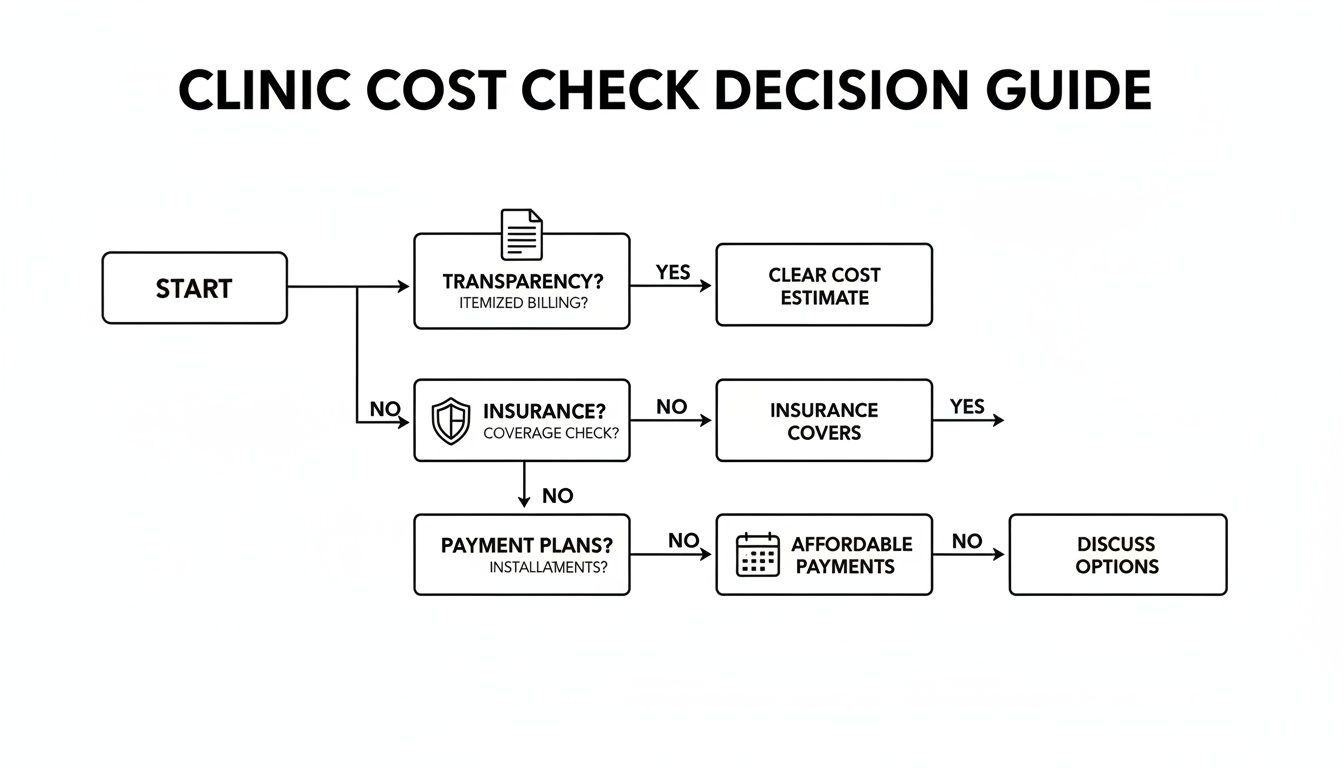
As the guide shows, getting clear documentation, verifying every detail of your insurance coverage, and asking about payment plans are non-negotiable steps you must take before committing to anything.
With this information in your back pocket, you can schedule your first appointments with confidence. You’re no longer just a passive patient; you're an informed partner in the process, fully equipped to ask intelligent questions, evaluate a clinic's approach to male fertility, and find a team that will truly support you on the path to fatherhood.
Questions to Ask a Fertility Clinic
Alright, you've got a list of potential clinics. Now it's time to dig in and figure out if they truly prioritize the male side of the equation. Navigating this world can feel overwhelming, but asking the right questions upfront makes all the difference. Think of this as your personal checklist for vetting a clinic.
How Easy Is It to Get a Semen Analysis Done?
This is your first, most basic test, and how a clinic handles it tells you a lot. The process should be simple, respectful, and private. If scheduling feels like a bureaucratic nightmare or the collection environment is uncomfortable, that’s a major red flag about their attention to the male patient experience.
Actionable Next Step: Before even booking a consultation, call the clinic's front desk and ask about their process for a semen analysis. How quickly can you get in? What is the collection environment like? Their answer will be very revealing.
Do They Have an In-House Urologist?
This is a non-negotiable question. A reproductive endocrinologist (RE) usually leads the charge at a fertility clinic, but a urologist who specializes in male fertility (often called an andrologist) is your expert. A top-tier clinic will have one on their team or, at the very least, a seamless and well-established referral partnership.
If a clinic can't offer you direct access to a urologist, you risk getting an incomplete diagnosis. Don't settle for a place that doesn't have a clear, expert-led plan for your care from day one.
A clinic's connection to a male fertility specialist is a direct indicator of how seriously they take your health. A strong partnership ensures you're not just a lab result but a patient receiving comprehensive care.
How Much Do Male Fertility Services Cost?
Let's talk money. Costs for male fertility diagnostics can vary wildly, and you need transparency, not surprises. You should expect to pay for the initial consultation, the semen analysis, and any necessary follow-up tests like blood work.
Actionable Next Step: Ask for a written fee schedule for male-specific services. This should include:
- Initial and follow-up consultations with the urologist
- The semen analysis itself
- Sperm cryopreservation (freezing)
- Annual sperm storage fees
A good clinic will provide this without hesitation.
Will They Push Me Toward IVF?
This is a huge concern for many men, and for good reason. You don’t want to feel like you're being fast-tracked to IVF without exploring every other avenue first.
A clinic that genuinely cares about your health will first investigate if your sperm parameters can be improved directly. They should be discussing lifestyle tweaks, supplements, or even minor procedures as potential first-line treatments. You want a team that presents a full menu of options, treating you as a whole patient, not just as a contributor to an IVF cycle. Your goal is a partner invested in your health outcomes.
Getting these questions answered is the first hurdle. The next is making sense of your results. At Hera Fertility, we provide AI-powered analysis of your semen analysis report, translating complex data into a clear Hera SmartScore with personalized next steps. Upload your report for free and get the clarity you need to move forward.