Getting a low sperm count diagnosis can feel like a punch to the gut. But that number isn’t the end of the story. In fact, it’s the exact opposite—it’s the start of a real, actionable plan for your reproductive health.
Your First Step on the Path to Fatherhood
A diagnosis of low sperm count, technically called oligospermia, isn't a verdict. Think of it as a signpost pointing you in the right direction. It gives you and your doctor a specific problem to solve, taking the guesswork out of the equation for you as a man.
The most critical first move is to get a comprehensive semen analysis. This isn't just about counting sperm; it's about getting the full intelligence report on your reproductive health. Without it, you're flying blind. With it, you've got a roadmap.

Why a Semen Analysis Is Your Starting Point
Getting tested is the single most powerful thing a man can do right now. A detailed analysis looks at several key factors that all play a role in male fertility. "Low sperm count" is just one piece of a much bigger puzzle.
Here’s what a lab is actually looking at:
- Sperm Count (Concentration): This is the raw number of sperm in your sample. A lower number means fewer swimmers are in the race.
- Motility (Movement): This is all about how well those sperm can swim. You can have a billion sperm, but if they are not moving effectively, their potential is limited.
- Morphology (Shape): This looks at the physical structure of the sperm. Abnormally shaped sperm can have a tough time with their function.
These three pillars—count, motility, and morphology—are completely interconnected. A doctor needs the data on all of them to understand what's really going on and map out the best path forward for you.
Getting a clear, comprehensive semen analysis is non-negotiable. It transforms uncertainty into a concrete action plan, giving you the power to address the specific challenges you're facing.
Taking Control of the Process
The good news is that getting tested has become way more straightforward. Modern resources like Hera Fertility can help you get a physician-approved lab order in just a few minutes and point you to a certified lab nearby. This puts you back in the driver's seat, letting you get answers on your own terms.
Once you have those results, the goal isn't just to stare at the numbers. It's about understanding what they mean for your health. This knowledge completely changes the conversation with your doctor, making it far more productive. This proactive approach helps you shift from feeling overwhelmed to actively managing your path to fatherhood.
Making Sense of Your Semen Analysis Results
Getting that semen analysis report back can feel like trying to decipher a secret code. It's a page full of medical jargon and numbers that, on their own, don't mean much. But learning to read this report is one of the most powerful first steps you can take on your fertility journey.

The key is to see these numbers not as a final grade, but as data points. Together, they paint a clear picture of your sperm health, telling you exactly where you stand and what you can work on.
The Big Three: Count, Motility, and Morphology
Your report will focus on three main parameters. Each one tells a crucial part of the story of your male fertility.
Sperm Count (Concentration): This is the density of sperm in your sample, measured in millions per milliliter (mL). The World Health Organization (WHO) considers 15 million sperm/mL the lower threshold of a typical range. While more can be better, it's just one piece of the puzzle.
Sperm Motility (Movement): This is the percentage of sperm that are actually moving. The really important number here is progressive motility—the sperm swimming forward with purpose. The WHO benchmark is for at least 40% of sperm to be moving, with 32% or more showing good forward progression.
Sperm Morphology (Shape): This looks at the physical structure of your sperm. A "normal" sperm has a smooth, oval-shaped head and a single, long tail. It might sound alarmingly low, but the WHO guideline says that having just 4% or more of sperm with a normal shape is considered within the typical range.
It's easy to fixate on the count, but motility and morphology are equally vital. Think of it like a delivery service: you might have millions of packages (high count), but if the delivery trucks can't move (low motility) or are broken down (poor morphology), they won't be effective.
What Really Matters: The Total Motile Sperm Count (TMC)
While those individual numbers are helpful, the single most useful metric on your report is often the Total Motile Sperm Count (TMC). This one powerful number combines your concentration, motility, and semen volume to tell you the total number of working sperm in your entire sample.
A TMC of 20 million or more is generally considered good. If your TMC is below this, it might be more challenging, and a TMC under 5 million is considered severe. This is the figure that fertility specialists often zero in on because it represents your functional team of swimmers—the ones with a real shot at succeeding.
The table below breaks down the key metrics you'll find on a standard semen analysis report.
Semen Analysis Key Metrics Explained
| Sperm Parameter | WHO Lower Reference Limit (5th percentile) | What It Means for Male Fertility |
|---|---|---|
| Semen Volume | 1.5 mL | The total amount of fluid produced. Low volume can sometimes indicate a blockage or hormonal issue. |
| Sperm Concentration | 15 million per mL | The density of sperm. A lower number means fewer swimmers are starting the race. |
| Total Sperm Count | 39 million per ejaculate | The total number of sperm in the entire sample (volume x concentration). |
| Total Motility | 40% | The percentage of sperm that are moving at all, even if just wiggling in place. |
| Progressive Motility | 32% | The "A-team." This is the percentage of sperm that are swimming forward in a straight line. |
| Morphology | 4% normal forms | The percentage of sperm with a normal size and shape, which is important for their function. |
Seeing these numbers in context helps you understand the full story your results are telling about your reproductive health.
Putting Your Results in Perspective
It’s crucial to remember that a single test is just a snapshot in time. A man's sperm health can fluctuate with stress, a recent illness, or even a few bad nights of sleep. This is why doctors almost always recommend getting at least two tests, spaced a few weeks apart, to establish a true baseline.
If your numbers are low, you're not alone. Low sperm count, known as oligospermia, is incredibly common. Male factor plays a significant role in fertility challenges. Research has shown just how much count can matter: one study found that for men with a sperm count under 20 million/mL, the chance of conception over six months was 36.4%, compared to 65% for men with counts above that mark.
Your results are not a verdict—they're a starting point. This data empowers you to have a meaningful conversation with your doctor, make targeted lifestyle changes, and build a clear plan to move forward.
For a more in-depth guide on every single parameter, check out our complete breakdown on how to read semen analysis results.
Lifestyle Changes That Can Boost Your Sperm Health
While medical treatments are powerful, some of the biggest wins for improving a man's sperm health are completely within your control. It takes about 74 days to produce a new batch of sperm, which means the positive choices you make today can have a real impact on your fertility in about three months. Think of it as a training period for your body.

These adjustments aren't just about avoiding bad habits; they're about actively creating the best possible environment for sperm production. Every change you make sends a signal to your body to prioritize reproductive health.
Fuel Your Body for Fertility
What a man eats directly impacts his sperm. It's that simple. Your body uses the nutrients from food as the building blocks for new, healthy sperm cells. One of the best things you can do is focus on a diet packed with antioxidants to fight oxidative stress—a major enemy of sperm health.
A great place to start is by loading up on these key nutrients:
- Zinc: Often called the cornerstone of male fertility, zinc is vital for sperm formation and testosterone metabolism. You'll find it in lean meats, shellfish (especially oysters), seeds, and legumes.
- Selenium: This potent antioxidant protects developing sperm from damage and is key for good motility. Brazil nuts are a fantastic source, as are fish and eggs.
- Vitamin C and E: This antioxidant power couple works together to shield sperm from cellular damage. Load up on citrus, berries, and leafy greens for Vitamin C, and turn to nuts, seeds, and spinach for Vitamin E.
- Folic Acid and L-Carnitine: These are critical for sperm development and energy. Folic acid is in leafy green vegetables, while L-Carnitine is abundant in meat and dairy.
By focusing on whole, unprocessed foods, you'll naturally boost your intake of these sperm-friendly nutrients. For a deeper look at specific diet and supplement strategies, check out our guide on how to increase sperm count.
Make Health-Conscious Choices Every Day
Your daily habits, big and small, add up. Two of the absolute worst offenders for a man's sperm health are smoking and excessive drinking.
Study after study shows that men who smoke have lower sperm counts and motility. The toxins in cigarettes are known to damage sperm DNA directly. In the same way, heavy drinking can lower testosterone levels and throw a wrench in sperm production. Cutting back to just a few drinks per week can make a noticeable difference.
Maintaining a healthy weight is another critical piece of the puzzle. Being either overweight or underweight can disrupt the delicate hormonal symphony required for making sperm. If you're dealing with issues like insulin resistance, finding natural ways to reduce insulin resistance can improve your metabolic health, which is tightly linked to your reproductive function.
The connection is clear: a healthier man produces healthier sperm. Every positive lifestyle change—from quitting smoking to eating a balanced meal—is a direct investment in your future.
Protect Your Sperm from Environmental Stressors
Sperm production is incredibly sensitive to heat. There's a biological reason a man's testicles are outside the body—they need to stay a few degrees cooler than the core temperature. When they get too hot, sperm production can temporarily shut down.
A few simple changes can help you keep things cool:
- Skip the Hot Tubs and Saunas: Soaking in hot water can raise scrotal temperature enough to impact your sperm count for weeks.
- Watch the Laptop: Try not to place a hot laptop directly on your lap for long stretches. A desk or a lap pad is a much better option.
- Cool the Seat: If your car has heated seats, think about using them sparingly.
- Wear Loose-Fitting Underwear: Give boxers a try instead of briefs. They allow for better air circulation and help regulate temperature.
Beyond heat, managing your stress is also a big deal. Chronic stress floods your body with cortisol, a hormone that can interfere with testosterone and hurt sperm health. Finding healthy outlets—whether it's regular exercise, meditation, or just making time for a hobby you love—can keep stress in check and support your fertility journey.
Medical Treatments for Low Sperm Count
When lifestyle changes have been made but haven't quite moved the needle, it might be time to look at medical options. These interventions aren't a last resort; they're a direct and often powerful way forward, especially if your doctor has pinpointed a specific, underlying cause for the low numbers.
This is all about correcting the problem at its source. It’s a logical, step-by-step process guided by a male fertility specialist, usually a urologist. Their job is to figure out exactly what’s going on—whether it's a structural issue, a hormone imbalance, or something else entirely—and map out a plan that actually makes sense for you.
Treating Physical and Structural Issues
Sometimes, the root cause of a man's low sperm count is a physical roadblock that can be fixed with a minor surgical procedure. These are common, highly effective, and designed to get your reproductive system back to functioning as it should.
One of the most frequent culprits here is a varicocele. Think of it as varicose veins, but in the scrotum. These enlarged veins can raise the temperature around the testicles, which is terrible for sperm production. The fix is a straightforward outpatient surgery called a varicocelectomy.
During the procedure, a urologist simply ties off the faulty veins, forcing the blood to flow through healthier ones. This brings the temperature back down to where it needs to be for optimal sperm development. It's not an overnight fix, but many men see significant improvements in their sperm count and quality within just a few months.
For many men, correcting a physical issue like a varicocele isn't just about improving lab numbers. It can be the key that finally unlocks the door to improving natural fertility potential.
Balancing Hormones and Fighting Infections
Sperm production is heavily dependent on a finely tuned hormonal symphony. If key hormones like testosterone and FSH (follicle-stimulating hormone) are out of whack, sperm health suffers. A simple blood test is all it takes for a man to see if he has a hormonal imbalance.
If an issue is found, your doctor might prescribe medications to get things back on track. This could include drugs like Clomid (clomiphene citrate) or HCG (human chorionic gonadotropin), which nudge your body to produce the right levels of hormones on its own. The goal is simple: create the ideal internal environment for producing healthy, strong sperm.
Another possibility is a subtle infection in the male reproductive tract. These often fly under the radar without obvious symptoms but can cause inflammation that damages sperm. If your semen analysis flags an infection, a course of antibiotics can often clear it right up, leading to a quick rebound in sperm health.
The Real-World Impact of Medical Intervention
It’s easy to get discouraged by a low sperm count diagnosis, but it's important to know how effective these treatments can be. When you address the root cause, you give your body a real shot at restoring its natural fertility.
The outcomes can be really impressive. One study found that after successful treatment, 65% of couples were able to conceive naturally. You can dig into the full male fertility study here for more details. This just goes to show that getting tested early and pursuing targeted treatment can completely change your outlook. These interventions work because they fix the specific biological problem standing in your way.
Your next step is to have a candid conversation with a specialist. They can help you understand if one of these medical paths is right for your situation, making the whole journey feel a lot less intimidating and a lot more hopeful.
How Assisted Reproduction Helps Overcome Male Infertility
When lifestyle changes and medical treatments haven't led to a pregnancy, it's easy to feel stuck. But this is often where Assisted Reproductive Technology (ART) comes in, offering a direct and powerful path forward for men.
These technologies are designed to bypass the natural hurdles that low sperm count can create. Instead of leaving things to chance, ART can dramatically increase the odds of success, even with very low numbers. It’s a proactive step that gives many men a renewed sense of control.
Giving Sperm a Head Start with IUI
Intrauterine Insemination (IUI) is often one of the first options explored, especially for mild to moderate male factor infertility. Think of it as giving your best sperm an express lane to the finish line.
The process is pretty straightforward. A semen sample is collected and then "washed" in a lab. This technique separates the healthiest, most motile sperm from the rest of the fluid. What you're left with is a small, concentrated sample of your strongest swimmers. This prepared sample can then be used in the insemination process, giving the sperm a major head start.
IUI can be a great option when a man's:
- Total motile sperm count is in a moderate range, often between 5-15 million.
- Sperm motility is a bit low, but there are still enough good swimmers to get the job done.
- Lifestyle changes and medical treatments haven't resulted in success yet.
It’s a much less intensive procedure than IVF and is an effective next step for many men.
This flowchart gives you a visual of the decision-making process for some common causes of low sperm count.
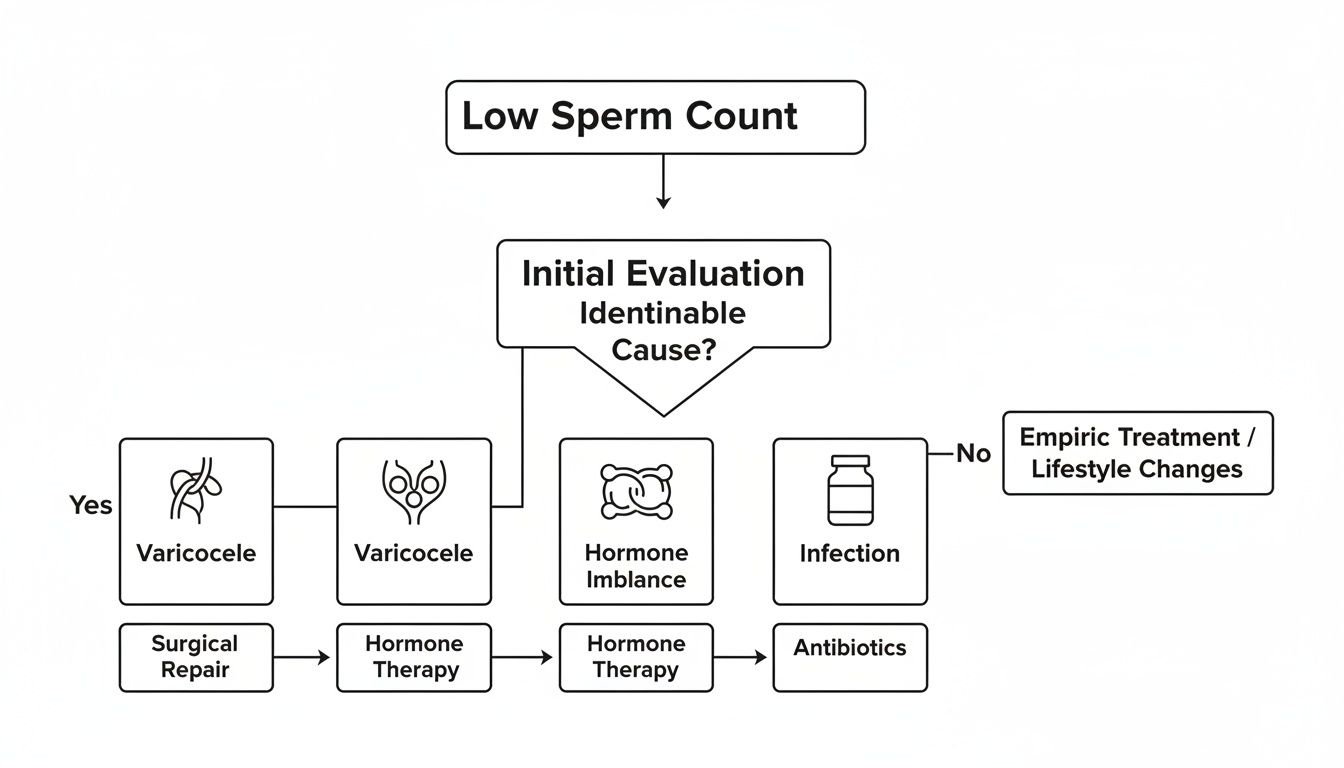
As you can see, identifying specific issues like varicoceles or hormonal imbalances can point a man toward targeted medical treatments first, potentially improving his numbers enough for IUI or even natural conception.
IVF with ICSI: A Game Changer for Severe Low Sperm Count
When a man's sperm numbers are very low, In Vitro Fertilization (IVF) combined with Intracytoplasmic Sperm Injection (ICSI) is the gold standard. This technology is a true game-changer because it literally only requires a single healthy sperm for each available egg.
In a standard IVF cycle, tens of thousands of sperm are placed in a dish with an egg, hoping one fertilizes it on its own. ICSI takes things a step further by removing chance from the equation. An embryologist carefully selects a single, healthy-looking sperm and, using a microscopic needle, injects it directly into the egg.
ICSI bypasses nearly every barrier related to a man's low sperm count, motility, or morphology. It's the most powerful tool we have for severe male infertility, turning what feels like a statistical impossibility into a real possibility.
This level of precision is why ICSI has completely revolutionized male fertility treatment. Data from the Cleveland Clinic shows that even for men with severe infertility, ICSI achieves fertilization rates of 40.1% and live birth rates of 28.6% per cycle. The technology is so effective that it can work even with just a handful of viable sperm found in a sample.
In the most severe cases where there's no sperm in the ejaculate at all (azoospermia), surgeons can often retrieve sperm directly from the testicles. This sperm can then be used for ICSI, giving men with blockages or production issues a path to biological fatherhood.
Choosing Your Path: IUI vs. IVF/ICSI for Low Sperm Count
Deciding between IUI and IVF/ICSI can feel overwhelming, but it often comes down to your specific semen analysis results and your doctor's recommendation. Here's a quick breakdown to help you understand the key differences.
| Feature | Intrauterine Insemination (IUI) | IVF with ICSI |
|---|---|---|
| Process | A man's washed sperm is prepared for the insemination process. | Eggs are retrieved. A single sperm from a man's sample is injected directly into each mature egg in a lab. Resulting embryos are prepared for transfer. |
| Ideal Candidate | Men with mild to moderate low sperm count (typically >5 million total motile sperm) or mild motility issues. | Men with severe low sperm count, low motility, or poor morphology. The go-to when other treatments fail or numbers are extremely low. |
| Key Considerations | Less invasive, lower cost per cycle. Success rates are lower, and it may require multiple cycles. | More invasive and higher cost. Significantly higher success rates per cycle, especially for severe male factor. Bypasses nearly all sperm-related issues. |
Ultimately, both are incredible technologies that have helped millions of men become fathers.
For some men, when sperm retrieval isn't possible or they choose another route, using donor sperm is also a wonderful way to build a family. You can learn more about this option by exploring information on reputable sperm banks. These advanced techniques ensure that almost every man facing male infertility has a viable path forward.
Common Questions About Low Sperm Count
Getting a low sperm count diagnosis can feel like a gut punch, and it almost always brings a flood of questions. That’s completely normal. Getting clear, straightforward answers is the first step toward feeling like you’re back in the driver's seat on your path to fatherhood.
Let’s walk through some of the most common questions we hear from men after they get their semen analysis results.
How Long Does It Take to Improve Sperm Count?
This is usually the very first question a man asks, and for good reason. The answer is grounded in some pretty straightforward male biology. The entire lifecycle of a sperm cell—from its creation as a stem cell to being mature enough for ejaculation—takes about 74 days.
This means that any positive changes you make right now, like cleaning up your diet, quitting smoking, or avoiding hot tubs, won’t really show up in a semen analysis for about two to three months. It's not a quick fix, but it is a predictable timeline. Think of it as putting your body through a three-month training camp with the goal of producing a healthier, stronger team of sperm at the end.
Patience and consistency are your best friends here. The good habits a man builds and sticks with over a three-to-six-month period give him the best shot at seeing real, meaningful improvements in his sperm parameters.
Can a Man with Low Sperm Count Achieve a Natural Pregnancy?
Absolutely, yes. A low sperm count diagnosis is not a zero sperm count diagnosis. It just means you have fewer sperm than the typical range. Natural conception is still on the table, though it might take a bit longer.
How likely it is really depends on the numbers. For men with mild to moderate low sperm count, just dialing in those lifestyle factors can be enough to do the trick. But as the total motile sperm count drops, especially below 5 million, the odds of natural conception go down significantly. At that point, it starts to make more sense to look into assisted reproduction options.
What Causes Low Sperm Count in Men?
It's rarely just one single thing; it’s usually a combination of factors. Figuring out the potential root causes is the key for a man to create a plan that actually works.
Some of the most common culprits include:
- Varicoceles: These are basically varicose veins in the scrotum. They can raise the temperature down there, creating a hostile environment for sperm production. It's a leading, and often fixable, cause of male infertility.
- Hormonal Imbalances: The symphony of hormones needed for sperm production is delicate. If a man's testosterone, FSH, or other key players are out of tune, it can disrupt the whole process.
- Lifestyle Factors: This is a big one. Smoking, heavy drinking, obesity, and chronic stress are all well-known sperm killers. The good news is that these are things you can control.
- Environmental Exposures: Too much heat is bad news for a man's sperm. Regular visits to the hot tub or sauna, or even just working with a laptop directly on your lap for hours, can temporarily lower your count.
- Genetic Conditions: In some cases, there might be an underlying genetic reason that affects a man's ability to produce healthy sperm.
How Often Should a Man Ejaculate to Improve Chances?
This is a classic point of confusion. A lot of men think they should "save up" sperm, but that can actually backfire. When a man abstains for too long, he ends up with a higher concentration of older, slower, and less effective sperm.
For men dealing with a low sperm count, the general advice is to ejaculate every 2-3 days. This schedule keeps things fresh, ensuring the sperm being ejaculated are younger, healthier, and more energetic. It’s the perfect balance between having a good supply ready to go and making sure that supply is of the highest possible quality.
Ready to stop guessing and start getting real answers about your fertility? With Hera Fertility, you can get a physician-approved order for a semen analysis in minutes and find a certified lab near you. Our AI-powered platform transforms those confusing lab reports into a clear Hera SmartScore with personalized, actionable steps. Take control of your journey at https://herafertility.co.
Related Resource Articles
-
Oligoteratozoospermia: A Clear Guide for Men
Received an oligoteratozoospermia diagnosis? Our clear guide explains what it means for male fertility, the causes, and your next steps for treatment.
14 min read
-
Oligozoospermia Treatment: A Man's Guide to Your Options
Explore your oligozoospermia treatment options. Our guide for men covers causes, diagnosis, lifestyle changes, medical therapies, and when to consider IVF/ICSI.
17 min read
-
Meaning of Oligozoospermia: A Guide for Men
Understand the meaning of oligozoospermia, its causes, and proven steps to improve fertility - expert guidance for couples.
20 min read