When a man decides to get a vasectomy, he is looking for one thing above all else: certainty. It’s a major step, and the biggest question on every man's mind is what the real odds of a surprise pregnancy are.
While a vasectomy is one of the most reliable forms of permanent male contraception out there, the chance isn't zero. But let's be clear: it is extremely small. The success rate is well over 99% once a man gets the final all-clear from his urologist.
Understanding the Real Numbers Behind Vasectomy Success

Peace of mind comes from knowing the facts, not from vague assurances. So, let's cut through the confusion and break down what the statistics actually mean for men's reproductive health.
Think of a vasectomy like a plumbing job. A urologist carefully cuts and seals the vas deferens—the pipes that carry sperm. When done correctly and, crucially, confirmed with follow-up checks, it's an incredibly effective, permanent solution for male contraception.
To give you a quick snapshot of the numbers, here’s a table summarizing the key statistics.
Vasectomy Success and Failure Rates at a Glance
| Metric | Success/Failure Rate | What This Means for a Man |
|---|---|---|
| Overall Effectiveness | >99% success rate | One of the most reliable forms of permanent male contraception available. |
| Early Failure | ~1 in 500 procedures | This is almost always due to not waiting for the "all-clear" before having unprotected sex. |
| Late Failure (Recanalization) | ~1 in 4,000 procedures | A very rare event where the tubes naturally reconnect over time. |
These numbers paint a very clear picture: the risk is incredibly low, but it exists. The key is understanding why failures happen and how to prevent them.
The Modern Statistics on Vasectomy Effectiveness
You might have heard the old figure floating around: a 1 in 2,000 chance of causing a pregnancy after a vasectomy is confirmed. But medicine evolves, and so does our data.
A massive analysis involving nearly half a million men in the United States gives us a much sharper picture. This research revealed an annual risk of causing a pregnancy at about 0.226% after a man's vasectomy is confirmed successful. You can explore the details of this large-scale vasectomy study to see how modern data is shaping our understanding.
This number, while still exceptionally low, highlights why the post-procedure process is so critical. The risk isn't just about the surgery itself; it’s about what a man does in the weeks and months that follow.
A successful vasectomy is a two-part process: the surgical procedure and the post-procedure verification. The second part is entirely in a man's hands and is the key to achieving the near-perfect success rates he expects.
Early vs. Late Failure: A Critical Distinction
That tiny chance of causing a pregnancy almost always falls into two very different categories. Getting your head around the difference is crucial for any man considering this procedure.
Early Failure: This is the most common reason for a post-vasectomy pregnancy. It happens when a man has unprotected sex before his system is completely clear of sperm. Think of it like turning off a hose at the spigot—there’s still water left in the hose itself. It takes time and multiple ejaculations to flush out the remaining sperm downstream from the blockage.
Late Failure (Recanalization): This is a true, but very rare, procedural failure. In this scenario, the body's powerful healing process manages to create a tiny new channel between the sealed ends of the vas deferens, allowing sperm to cross over. This can happen months or even years later, but it is an extremely uncommon event.
The good news? Early failures are almost entirely preventable. All a man has to do is follow his doctor's instructions to the letter. By using backup contraception until he gets that official "all-clear" from his semen analysis, he eliminates the single biggest risk factor. This is how a man can turn an already highly effective procedure into a bulletproof family planning method.
Why a Vasectomy Can Fail Explained Simply

It’s a totally fair question: how can a procedure with a 99% success rate sometimes go wrong? Understanding why a vasectomy might fail isn't about random bad luck. There are specific, predictable reasons, and knowing them puts a man in control.
These failures fall into two main categories: early failures and late failures. Getting a handle on the difference is the key to both ensuring the procedure is a success and getting that total peace of mind every man is looking for.
Early Failures: The Most Common (and Preventable) Scenario
The vast majority of pregnancies that happen after a vasectomy are due to what we call an early failure. This isn't really a failure of the surgery itself. It's just a matter of male biology and timing.
Think of a man's reproductive system as a plumbing network. The vasectomy is like shutting off the main valve, stopping any new sperm from leaving the factory (the testes). But there are still millions of sperm already "in the pipes" past that valve.
It simply takes time and a number of ejaculations to flush those remaining sperm out of a man's system. This is why any urologist will be crystal clear: a man is still fertile right after his procedure. He absolutely must use another form of birth control until a lab test confirms his semen is sperm-free.
The post-vasectomy waiting period is non-negotiable. Having unprotected sex before getting the official "all-clear" from a semen analysis is the single biggest reason for an unplanned pregnancy.
Understanding the Numbers Behind Early Failures
The data really drives home just how critical that follow-up test is. A major UK study of over 94,000 vasectomies found that early failure rates—meaning motile (moving) sperm were still present three months after the operation—were around 0.6%. That's about 6 in every 1,000 men who still had active swimmers at that first major checkpoint. You can learn more about these vasectomy safety findings and see for yourself.
This statistic proves the semen analysis isn't just a friendly suggestion; it's a man's safety net. It’s specifically designed to catch these exact cases, preventing an "oops" by confirming the job is well and truly done. Without it, a man is just guessing.
Late Recanalization: The Rare Exception
The second type of failure is called late recanalization. This is a true biological event, but it's extremely rare. It’s when the body’s powerful healing abilities manage to create a tiny, new channel between the two severed ends of the vas deferens.
This can happen months or even years after a man has already been confirmed sterile by a semen test. If this new microscopic pathway forms, sperm can start mixing into the semen again, restoring fertility without the man having any clue.
Fortunately, the chances of this are incredibly slim. The same UK study found that late failures occurred in just 0.04% of cases. To put that in perspective, that’s roughly 1 man in every 2,500. While it's biologically possible, it’s a genuine statistical anomaly. Experienced urologists use specific surgical techniques—like sealing the tube ends and placing a layer of tissue between them—to make this already rare event even less likely.
By understanding these two distinct possibilities, the path to a successful vasectomy becomes much clearer. A man has direct control over preventing the most common cause of failure, simply by following his doctor's instructions to the letter.
Your Most Important Step: The Semen Analysis
Getting a vasectomy is just the first half of the process. The second, and without a doubt most crucial, part is the follow-up post-vasectomy semen analysis (PVSA). This isn’t an optional check-up; it’s the final, non-negotiable step that officially gives a man the all-clear.
Think of it like this: the plumbing job is done, the pipes are sealed, but a man still needs to run the water and check for leaks before he can be 100% sure the system is closed. The PVSA is that definitive pressure test for his reproductive system. It’s the hard evidence he needs for total peace of mind.
Why You Absolutely Must Wait Before Getting Tested
It’s completely normal for a man to want that confirmation right away, but patience is key for an accurate result. After the procedure, there are still millions of live sperm hanging out in the upper part of the male reproductive tract—the section beyond the blockage. A man's body needs time to clear these guys out.
This clearing-out process happens naturally with every ejaculation. That’s why most urologists have a waiting period based on two milestones before a man should test:
- Time: A wait of 8 to 16 weeks after the vasectomy.
- Ejaculations: At least 20 to 30 ejaculations during that time.
Hitting both these targets ensures that when a man provides his sample, his system has had plenty of opportunities to flush out any residual sperm. Testing too early can lead to a false positive, showing leftover sperm from before the vasectomy and causing a whole lot of unnecessary stress.
What the Semen Analysis Is Actually Looking For
The goal here is refreshingly simple: to find zero sperm. The medical term for this is azoospermia. When a man's lab report comes back showing azoospermia, it’s official—the vasectomy was a success and has stopped sperm from mixing with his semen.
A finding of azoospermia is a man's definitive proof of sterility. It’s the green light that confirms his odds of causing a pregnancy are effectively zero, allowing him to stop using other forms of birth control with confidence.
The process itself is straightforward. A man's doctor will give him instructions for collecting a sample at home, which he’ll then drop off at a certified lab. There, technicians will examine it under a powerful microscope, looking specifically for the presence—and just as importantly, the movement (motility)—of any sperm. If a man is curious about the nuts and bolts of what labs check for, he can get the full picture in this detailed guide to a semen analysis.
This test cuts through all the guesswork. It replaces hope with hard biological fact, putting a man firmly in control.
How to Complete Your Test Correctly
An accurate result really hinges on following the collection and delivery instructions to the letter. A man's clinic will give him specific directions, but these are the universal rules designed to make sure the sample is perfect for analysis.
- Follow Your Doctor's Timeline: Don't even think about scheduling the test until both the time and ejaculation requirements have been met.
- Use the Provided Container: The lab provides a sterile container for a reason. Using a jar from home can contaminate the sample and mess up the results.
- Collect the Entire Sample: It’s critical to get the entire ejaculate into the cup. This ensures the lab has enough volume to do a thorough and accurate check.
- Keep it at Body Temperature: The sample is sensitive to hot and cold. The easiest way to transport it is to keep it in a pocket close to the body.
- Deliver it Promptly: Time is of the essence. Most labs need the sample within one hour of collection.
Following these steps ensures the lab gets a high-quality sample, giving a man a result he can trust. This final step is his personal guarantee that the job is well and truly done.
Making Sense of Your Semen Analysis Results
Getting that lab report back after a vasectomy can feel a little intimidating. All the medical terms might seem like a foreign language, but figuring out the results is actually pretty straightforward once a man knows what he’s looking for.
The report will show one of three possible outcomes, and each one points to a clear path forward. The goal here is to cut through the confusion so a man can understand his results and know exactly what to do next.
The Ideal Outcome: Azoospermia
The result every guy is hoping for is azoospermia. This is simply the clinical term for zero sperm found in a semen sample.
When a report says azoospermia, that’s the definitive green light. It means the vasectomy was a complete success—the pipes are officially closed, and sperm are no longer part of the equation. This is the confirmation of sterility and the moment a man gets the peace of mind he was after.
Actionable next step: Once a urologist confirms this result, a man can stop using other forms of contraception.
The Gray Area: Rare Non-Motile Sperm
Sometimes, the lab finds "rare non-motile sperm." This just means they spotted a few sperm under the microscope, but none of them were moving.
This result can feel a bit confusing, but it’s not an automatic sign that the vasectomy failed. More often than not, these are just some leftover, non-functional sperm that are still clearing out of the system. They pose an exceptionally low risk because they aren’t motile (meaning, they can't swim).
A finding of rare non-motile sperm is not a cause for alarm. A urologist will typically recommend a simple follow-up test in a few weeks to confirm that these last remnants have cleared out, which they almost always do.
Actionable next step: Keep using backup contraception and schedule another semen analysis as the doctor advises. In the vast majority of cases, the follow-up test comes back showing complete azoospermia. If you want to dive deeper into what different lab values mean, our guide can help you learn how to read semen analysis results with more confidence.
A Clear Sign to Follow Up: Motile Sperm Present
The third possible outcome is a report that shows motile sperm. This means the lab found sperm that are actively moving.
This result is a clear signal that the vasectomy isn't successful yet. The presence of moving sperm means a man is still fertile, and the odds of causing a pregnancy remain a real possibility. It's critical to take this result seriously and continue using other forms of birth control without exception.
Actionable next step: This isn’t a dead end, though. It’s just a sign that a man needs to have a conversation with his urologist to figure out the best next steps.
This visual decision tree outlines the simple wait, test, and confirm process for post-vasectomy verification.
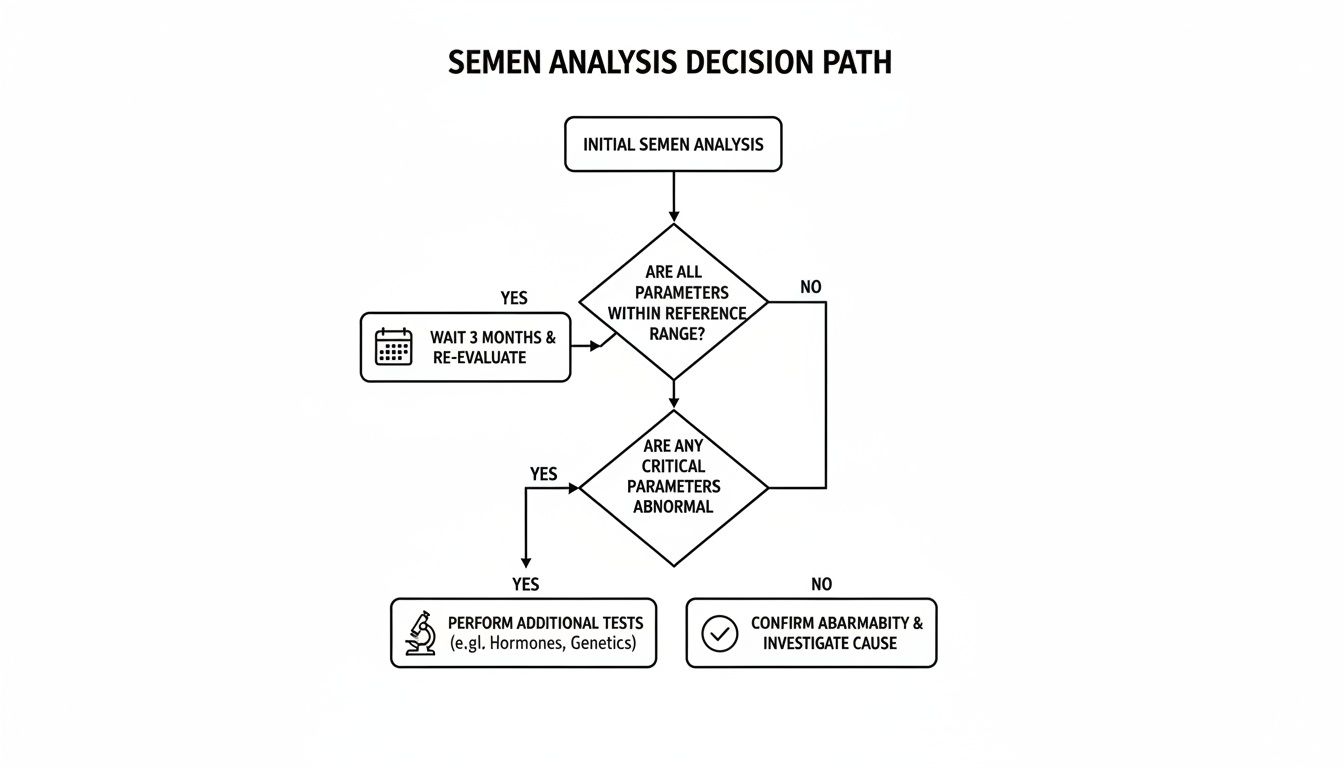
The infographic highlights that a clear semen analysis result is the final confirmation needed for a successful vasectomy.
Your Actionable Next Steps for Each Result
Navigating your results is all about taking the right action based on the facts. There's no need for stress or uncertainty when you have a clear plan.
Your next steps will depend entirely on which of the three outcomes you receive:
- If you have Azoospermia: Congratulations. Your urologist will confirm the success, and you have achieved sterility.
- If you have Rare Non-Motile Sperm: Continue using backup contraception. Schedule a follow-up semen analysis as advised by your doctor to confirm the system has fully cleared.
- If you have Motile Sperm: Continue using backup contraception without fail. Schedule an appointment with your urologist immediately to discuss your results and explore your options.
No matter the outcome, the semen analysis provides the critical information needed to make an informed decision. It’s the final and most important checkpoint on a man's vasectomy journey, putting him in complete control of his reproductive future.
What to Do if Your Vasectomy Is Not Successful

Getting the news that a vasectomy didn't work can be a real gut punch. A man takes a definitive step for his future, so finding out he's not in the clear is frustrating, to say the least. But this is not the end of the road.
This isn't a time to panic. It’s a time for a clear, practical conversation with a urologist. While the first procedure didn't stick, there are well-established ways to get to the finish line.
The first move should be to book that follow-up appointment. A specialist will go over the semen analysis, discuss what might have happened during the initial procedure, and lay out a game plan. This conversation is the foundation for deciding what to do next.
Your Primary Options on the Table
When a vasectomy fails to achieve azoospermia (zero sperm), a man has a few solid choices. The best one hinges on his personal situation and what his urologist recommends. The goal is to get back in control and achieve the peace of mind he was looking for.
For most men, the most straightforward path is to simply do it again.
It's a frustrating thought, but a repeat vasectomy has a very high success rate. A urologist is now armed with more information and can adjust their approach to ensure a better outcome this time around.
Surgeons often use more robust techniques for a do-over. This might mean removing a larger piece of the vas deferens or using advanced sealing methods like cautery and fascial interposition. That’s a technique where they place a layer of tissue between the sealed ends, creating a much stronger barrier to prevent the tubes from reconnecting. After a successful repeat procedure is confirmed, the odds of causing a pregnancy after a vasectomy drop to near zero.
Other Pathways to Consider
While repeating the procedure is the most common route, it’s worth knowing all the options, especially if a man's life plans have shifted since the first vasectomy.
Here’s a breakdown of the typical paths forward:
- Repeat the Vasectomy: This is the go-to for men who are still committed to permanent contraception. The urologist will explain why the first one may have failed and what they’ll do differently to lock in success.
- Consider a Vasectomy Reversal: This might sound counterintuitive, but if a man's life circumstances have changed and he is now thinking about having children, this could be an unexpected opportunity. A reversal reconnects the vas deferens to restore sperm flow.
- Sperm Retrieval with IVF: If a man wants the option of biological children in the future but doesn’t want a full reversal, this is another route. Sperm can be retrieved directly from the testes and used for in vitro fertilization (IVF). It’s a more involved medical process but a very effective one.
Making Your Decision with Confidence
The key here is open communication with the medical team. A man shouldn't be afraid to ask direct questions. What’s the success rate for a repeat procedure? What technique will be used this time? What will recovery look like?
Remember, an unsuccessful first attempt doesn't mean the goal is out of reach. It's a setback with clear solutions. By working closely with a urologist, a man can land on the right plan and get the certainty he wanted from the start.
Most importantly: he must continue using reliable backup contraception until he has a confirmed all-clear from a follow-up semen analysis.
Thinking About the Future: Vasectomy Reversibility
Choosing a vasectomy usually feels like a final step, and for most men, that's exactly what it is. But life has a funny way of surprising us. A man's circumstances can shift in ways he’d never expect, so it’s smart to understand the complete picture of his reproductive health, even the parts that seem far off.
This isn’t about second-guessing a decision. It’s about making sure a man is fully informed. Knowing what a reversal involves gives him a clear-eyed view of all the possibilities, so he can move forward with total confidence today.
What Is a Vasectomy Reversal?
A vasectomy reversal is a delicate microsurgical procedure that literally undoes a vasectomy. A surgeon meticulously reconnects the two severed ends of the vas deferens, restoring the pathway for sperm to travel from the testes and mix with semen.
Think of it like highly specialized plumbing. The original procedure created a detour, and the reversal removes that detour to get everything flowing again. It's a much more complex and intricate operation than the initial vasectomy, but in the hands of an experienced microsurgeon, it can be incredibly effective.
Understanding the Success Rates
The first goal of a reversal is getting sperm back into the ejaculate. The second, of course, is a successful pregnancy. The success rates are often quite high, but they hinge on a few key factors.
The single biggest factor is time. The more time that has passed since a vasectomy, the lower the odds of a successful reversal.
While every man's situation is unique, success rates for sperm returning to the semen can be as high as 90% if the reversal is performed within 10 years of the vasectomy. This rate can drop after 15 years or more, as back-pressure can cause secondary blockages to form over time.
Other things that play a role include the surgeon's skill and the specific technique that was used during the original vasectomy.
Other Long-Term Options for Male Fertility
Even with a vasectomy in his past, a man still has options for the future. A reversal isn't the only path for men who might decide to build a family later on.
- Sperm Banking: This is where a man freezes and stores his sperm before the vasectomy. It’s a biological insurance policy, giving him a direct route to future fertility without needing any more surgery. To learn more, check out this guide on sperm banks.
- Sperm Retrieval: If a reversal isn't the right choice or doesn't work, sperm can be surgically extracted directly from the testicle or epididymis. This sperm can then be used with assisted reproductive technologies like IVF.
Knowing these pathways exist adds another layer of security. A man can proceed with his vasectomy today, confident that he understands all the tools available for his long-term reproductive health down the road.
Frequently Asked Questions About Vasectomy and Pregnancy
It's natural to have questions when you're considering a vasectomy. Let’s clear up some of the most common concerns men have about the procedure and the real-world chances of pregnancy afterward.
Can a Man Stop Using Other Protection Right After His Vasectomy?
No, and this is probably the single most important rule to follow. A man is absolutely still fertile right after the procedure. It takes time to clear out all the sperm that were already past the point of the snip.
Think of it like turning off a faucet—the water in the hose still has to run out. It typically takes 8 to 16 weeks and at least 20 ejaculations to completely clear the pipes. A man must keep using another reliable form of birth control until his doctor gives him the official "all-clear" based on his semen analysis.
If a Man's Semen Analysis Is Clear, Is He Protected Forever?
For the vast majority of men, yes. Once a man gets a clear semen analysis showing azoospermia (that’s the medical term for zero sperm), his vasectomy is considered a permanent success.
However, there's an incredibly rare event called late recanalization. This is where the vas deferens tubes manage to find a way to reconnect on their own, sometimes months or even years down the road. The odds are extremely low—around 1 in 4,000—but it is a biological possibility.
A clear semen analysis is a man's green light for confidence. It confirms the procedure was successful and his risk of causing a pregnancy is effectively reduced to the lowest possible statistical odds.
Does the Vasectomy Technique Affect the Failure Rate?
Yes, it absolutely can. How a surgeon performs the vasectomy plays a big role in its long-term success. Modern techniques are designed specifically to prevent the tubes from reconnecting.
Some of the most effective methods include:
- Mucosal Cautery: Using heat to seal the inside lining of the vas deferens, creating a much stronger blockage than just a simple cut.
- Fascial Interposition: Taking a small piece of the tissue surrounding the vas deferens and sewing it between the two cut ends. This creates a natural, physical wall.
Combining these techniques makes it significantly harder for the tubes to ever heal back together. A good surgeon will be happy to explain their specific method beforehand. Getting clear information is key, which is why we often turn to a variety of patient education resources to help explain these concepts.
At Hera Fertility, we believe understanding men's reproductive health should be straightforward. If you need to confirm your vasectomy worked or want a clear interpretation of your semen analysis results, our AI-powered platform gives you physician-backed insights and actionable next steps. Get the clarity you deserve by visiting https://herafertility.co today.