Navigating the world of the post vasectomy sperm test can feel a bit confusing, but here's the bottom line: you are not sterile immediately after the procedure. It takes time and a certain number of ejaculations to clear out all the remaining sperm, and the only way to be absolutely sure the pipes are clean is with a lab-verified test.
Why Your Post Vasectomy Test Is Non-Negotiable
Think of it like this: your vasectomy turned off the faucet at the source. The procedure blocks the vas deferens, which are the tubes that carry sperm from the factory. But there are still plenty of swimmers left "downstream" in the rest of your reproductive plumbing. Your body needs time to flush these guys out naturally.
This is exactly where the post-vasectomy sperm test comes in. It’s the final, critical step that gives you definitive proof the procedure worked. Without this confirmation, you're just guessing, which completely defeats the purpose of getting a vasectomy in the first place.
The Goal: Azoospermia or Close to It
The main objective is to confirm azoospermia, which just means zero sperm were found in your sample. This is the gold standard for vasectomy success.
But it's not always the only successful outcome. Sometimes, a lab will find a very small number of sperm that are non-motile—meaning they can't swim. Based on current guidelines, this is often considered a successful result, too.
A vasectomy is one of the most reliable procedures for male sterilization, with success rates over 98%. But failures can and do happen if sperm hang around. That's why the post-vasectomy semen analysis is essential to confirm you're in the clear. Success is generally defined as either zero sperm (azoospermia) or fewer than 100,000 non-motile sperm per milliliter. You can discover more insights about these male health guidelines from recent studies.
To give you a clearer picture, here’s a quick rundown of the key milestones.
Post-Vasectomy Testing At a Glance
| Milestone | Typical Guideline | What It Means for You |
|---|---|---|
| Initial Waiting Period | 8-12 weeks | Your body needs this time for the initial inflammation to go down and to start clearing the existing sperm. |
| Ejaculation Count | ~20 ejaculations | This is the "flushing" phase. Each ejaculation helps clear out the sperm that were already past the blockage point. |
| First Semen Analysis | After 12 weeks & 20 ejaculations | This is your first official check-in to see if you've reached azoospermia or very low non-motile sperm counts. |
| Confirmation of Sterility | "All clear" from your doctor | This is the final green light. Do not stop using other forms of pregnancy prevention until you get this confirmation. |
Following these steps and getting that final confirmation provides the crucial peace of mind every man is looking for after a vasectomy.
Setting The Right Expectations
So, what should you really expect? Your doctor will give you specific instructions, but the general timeline almost always involves waiting a certain amount of time and hitting a target number of ejaculations.
The most common recommendations you'll hear are:
- Wait approximately 12 weeks after your procedure.
- Complete around 20 ejaculations during that time.
Keep in mind, these are just averages. The most important thing is to follow your own urologist’s advice to the letter. This waiting period gives your system the best possible chance to clear everything out before you submit that all-important sample for analysis.
When and How to Complete Your Vasectomy Test

The timing and logistics of your post-vasectomy test are where a lot of guys get tripped up, but it's actually pretty straightforward once you know the ropes.
You’ve probably heard the standard advice: wait 12 weeks and have at least 20 ejaculations before your first test. This isn't just some random number; it's a guideline to give your system enough time to flush out any leftover sperm that were already past the point of no return when the vas deferens were blocked.
Think of it like clearing a garden hose after you've turned off the spigot. There's still water in the hose that needs to be emptied out. The same principle applies here.
But—and this is a big but—those numbers are just a starting point. Every man's body clears out at a different pace.
The "12 weeks and 20 ejaculations" rule is a solid benchmark, but it's not a guarantee you'll be shooting blanks. Research actually shows it often takes longer. In one major study, only 60% of men were sperm-free by the 12-week mark. Even after 20 ejaculations, just 28% got the all-clear. For some men, it took up to 70 ejaculations to fully clear the pipes. This is exactly why getting a lab-verified test is non-negotiable. You can read the full research on these vasectomy clearance rates here.
Arranging Your Test
Getting your sperm test lined up is really just a two-part process: getting the order and providing the sample.
Your urologist will usually give you a requisition form for a local lab during your follow-up appointment, or they might mail it to you. If you need to find a place on your own, you can typically find a lab near you that handles semen analysis.
Lately, at-home mail-in kits have become a game-changer. They're reliable, private, and super convenient. These kits give you everything you need to collect your sample at home and mail it off to a certified lab, completely skipping the awkward trip to a clinic.
Collecting Your Sample Correctly
Whether you’re heading to a lab or using a kit at home, getting the collection right is absolutely critical for an accurate result. Screw this part up, and you might get a false positive.
Here are the golden rules:
- Abstain for 2-5 days. Don't ejaculate for at least two days before the test, but don't wait longer than five. This window gives the lab the best possible sample to analyze.
- Only use the sterile cup provided. No exceptions. Don't even think about using a regular condom, lube, or some other container from your kitchen. They're often full of chemicals that can kill sperm and mess up your results.
- Collect the entire sample. Make sure every drop makes it into the cup. The first part of the ejaculate usually has the highest concentration of sperm, so missing it could throw off the whole test.
Actionable Step: If you're going to a lab in person, timing is everything. Most labs need you to drop off your sample within one hour of collection. Sperm start losing motility and viability fast, and that can tank the accuracy of the reading. Set a timer and plan your route to the lab ahead of time.
That tight one-hour window is a huge reason why so many men now prefer the at-home mail-in kits. They come with a special preservative solution that keeps your sample stable, giving you a much more relaxed timeline to get it shipped off without wrecking the results. It’s a simple feature that makes getting that final, reliable "all-clear" a whole lot easier.
Why So Many Men Skip The Test (And Why You Absolutely Shouldn't)
If you spend any time on vasectomy forums, you'll see a common, slightly alarming trend: men admitting they never bothered with their follow-up sperm test. They felt fine, assumed the snip worked, and just got on with life. If that thought has crossed your mind, you’re not alone.
The reasons for skipping the test are completely understandable. Life gets busy. The logistics can feel like a huge pain. Who wants to take time off work, drive to a clinic, produce a sample in some sterile, awkward little room, and then hand it over to a lab tech? It’s inconvenient and, let’s be honest, a bit embarrassing for most men.
Plus, there's the simple assumption: the surgeon is a pro, the procedure is famously effective, so it must have worked, right? It's an easy mindset to fall into, but it skips the single most important step in the entire process: verification.
The Real-World Hurdles To Getting Tested
This isn't just a feeling men have; the data backs it up. Low compliance with post-vasectomy semen analysis is a well-known problem. These aren't just excuses—they are practical barriers that stop men from getting the final all-clear.
Common reasons men bail on the test include:
- Inconvenience: The appointment chews up time in an already packed day.
- Distance: The lab or clinic might be a long haul from home or work.
- Awkwardness: Producing a sample on-site is uncomfortable, period.
- Forgetfulness: Months later, without a solid reminder, the test just falls off the radar.
A detailed study in San Diego tracked this exact issue and found that testing compliance was a dismal 53%. When researchers followed up, the top reasons were distance, time, and simply forgetting. But here’s the most telling part: a staggering 92% of those men said they would have done the test if a home-based option had been available. You can read the full vasectomy testing study here to see just how much convenience matters.
Why You Can't Afford To Skip It
Skipping your post-vasectomy sperm test is like building a fence and never checking if the gate is latched. You've done 99% of the work but left yourself exposed to that 1% chance of failure—the very thing you got a vasectomy to prevent in the first place.
Peace of mind isn't something you should just assume; it's something you confirm. The only way to know for sure that your vasectomy was successful is to get a lab-verified semen analysis.
Fortunately, modern testing has evolved to solve these exact problems. At-home, mail-in kits eliminate every single one of the traditional barriers. There's no awkward clinic visit, no rushing to the lab, and you can do it on your own schedule from the comfort and privacy of your home. It’s the simplest way to get the definitive answer you need and the peace of mind you deserve.
Understanding Your Sperm Test Results
Getting your post-vasectomy test results can feel like trying to crack a secret code. The report is usually packed with clinical terms that don’t mean a whole lot to the average man. But don't worry—once you know a few key phrases, you’ll be able to see exactly where you stand and get the peace of mind you’re looking for.
The ultimate goal, and the magic word you want to see, is azoospermia. This is just the clinical term for zero sperm found in your sample. If your report says "azoospermia," you've hit the jackpot. It's the definitive all-clear, confirming your vasectomy was a complete success.
This flowchart breaks down the simple choices you have when confirming your vasectomy's success.
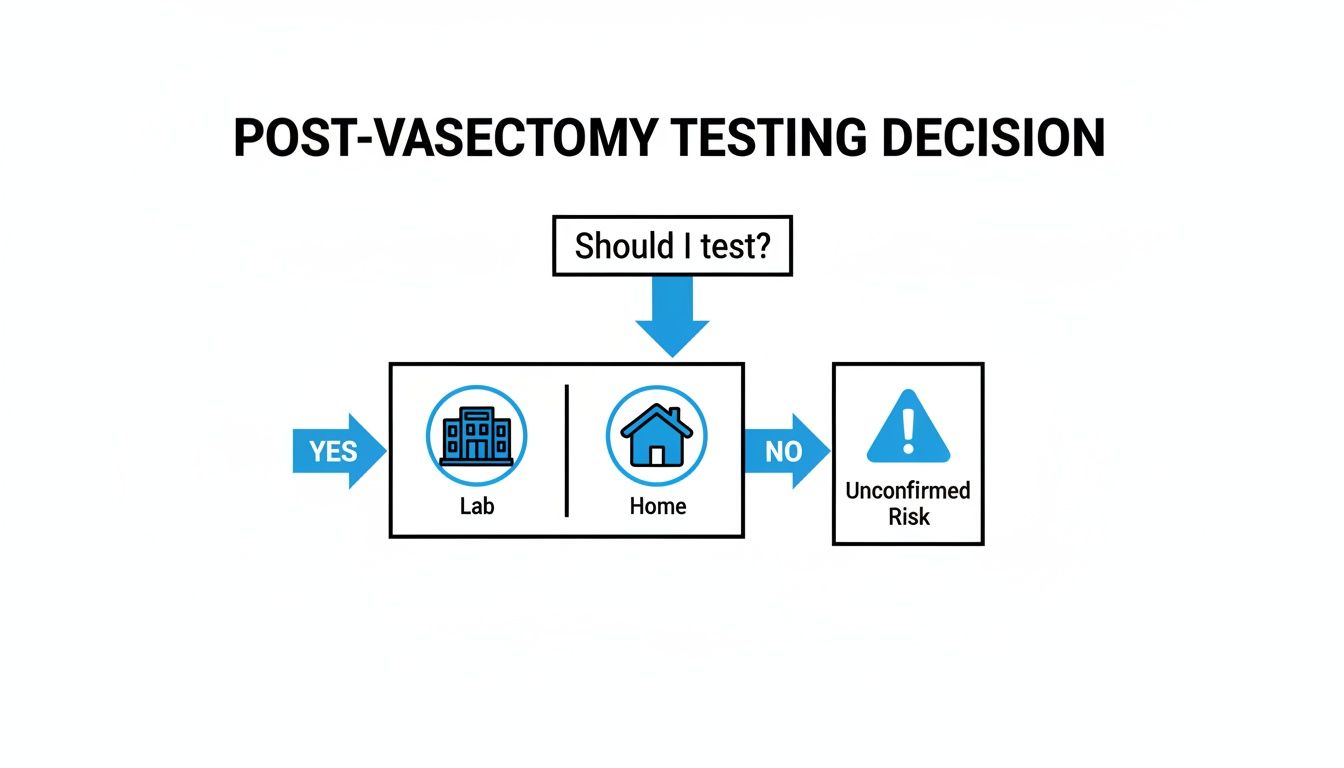
The main takeaway here is pretty clear: testing is the only real path to confirmed sterility. Skipping it just leaves you with unnecessary risk.
What If Sperm Are Still Present?
First off, don't panic if your report shows sperm. This is actually pretty common in the first few months. The two most important details to look for are the count (how many) and the motility (if they're moving).
You might see a result like Rare Non-Motile Sperm (RNMS). This means the lab found a very small number of sperm, but crucially, none of them were swimming. For most urologists, this is still considered a successful result.
The generally accepted threshold for a pass, even with some sperm hanging around, is a count of fewer than 100,000 non-motile sperm per milliliter. If your numbers are below this and nothing is moving, you're likely in the clear. The only real concern is motile (moving) sperm, because even one determined swimmer could theoretically be a problem.
For a deeper dive into the numbers and what they all mean, you can learn more about how to read semen analysis results in our detailed guide.
Decoding Your Post-Vasectomy Results
Sorting through the jargon on a lab report can be confusing. This table breaks down the common results you might see and what they actually mean for you.
| Result Term | What It Means | Is It the 'All Clear'? | Next Step |
|---|---|---|---|
| Azoospermia | Zero sperm were found in your sample. | Yes | You're sterile. Time to celebrate! |
| Rare Non-Motile Sperm (RNMS) | A very small number of non-moving sperm were found. | Usually, yes. | Your doctor will likely give you the all-clear. |
| <100k Non-Motile Sperm | Low count (<100,000/mL) of non-moving sperm. | Usually, yes. | This is a common passing result. |
| Motile Sperm Present | Any number of moving sperm were found. | No | You are not sterile yet. Continue to use protection and schedule a follow-up test. |
This table should help you quickly interpret your results. Azoospermia is the best-case scenario, but a very low count of non-moving sperm is often considered just as successful.
Reading Between The Lines
Think of it like this: your vasectomy blocked the assembly line, but there were still a few finished products left in the warehouse when the doors closed. A result of RNMS means those last few products are still on the shelves, but they're defective and can't go anywhere. As long as the warehouse isn't getting restocked with new, functional products (motile sperm), the job is considered done.
The bottom line is simple: no sperm is the best result, but a very low number of non-moving sperm is typically just as good. It’s the presence of any moving sperm that will require a follow-up conversation with your doctor and likely another test down the road.
Understanding these key terms empowers you to read your own report with confidence, turning a page of confusing medical jargon into a clear and simple answer.
What To Do If You Don’t Get The All-Clear
Getting your post-vasectomy test results back and seeing that sperm are still present can feel like a gut punch. It’s the one outcome you were hoping to avoid.
First thing’s first: do not panic. This is actually a pretty common scenario, and it very rarely means the vasectomy failed.
Actionable Next Step: The most important thing you can do right now is simple: keep using other forms of pregnancy prevention until your doctor gives you the official green light. An unclear result means you aren't confirmed sterile yet, so don't take any chances.
The Most Common Scenario: Lingering Sperm
More often than not, finding sperm on your first test just means your system hasn't fully cleared out yet. Your body needs time to flush all the residual sperm that were already past the blockage point when the procedure was done.
If your report shows a low count of non-motile sperm (sperm that can't swim), your doctor's advice will almost certainly be to just wait it out. They’ll likely tell you to keep ejaculating regularly and then re-test in another month or two. This gives your body more time to finish the job.
For the vast majority of men, this second test comes back with the all-clear.
The key takeaway here is that seeing non-moving sperm isn't a sign of failure. It's usually just a sign that your body's cleanup process is still underway. Patience and a follow-up test are typically all that's needed.
Understanding Recanalization: A Rare Complication
In very rare instances, an unclear test can point to a complication called recanalization. This is when the severed ends of the vas deferens manage to heal and reconnect, creating a new pathway for sperm to get through.
While this sounds alarming, it is extremely uncommon, happening in far less than 1% of cases. This is what your doctor is looking for if you have motile (moving) sperm on your test months after the procedure.
If this is suspected, your urologist will order repeat tests to confirm what's going on. If recanalization has occurred, a repeat vasectomy may be necessary. But remember, this is the exception, not the rule. For most men with an initial unclear result, the path forward is simply to wait, re-test, and get that final confirmation a bit later than expected.
Common Questions From Men After A Vasectomy
It’s completely normal to have questions swirling around after your vasectomy. The procedure itself is pretty quick, but the follow-up period is where the real uncertainty can creep in. A quick scan of Reddit shows that thousands of men have the exact same concerns, so let's tackle the big ones head-on.
Getting straight answers to these practical questions is the key to moving forward with confidence and getting the peace of mind you signed up for.
Can I Use a Regular Condom to Collect My Sample?
Let's make this crystal clear: absolutely not. This is probably the single most common mistake men make, and it will invalidate your test results.
Most condoms you buy off the shelf are loaded with lubricants and spermicides. Their entire purpose is to kill or stop sperm in their tracks. If you use one to collect your sample, the lab will likely report "no sperm" because the condom's chemicals did their job, not because your vasectomy worked. You'll end up having to re-test, wasting time and money.
Actionable Step: Always use the sterile, lab-provided collection cup. No exceptions.
I Am Past 12 Weeks and 20 Ejaculations, Am I Safe Without a Test?
Nope. It’s tempting to think you're in the clear, but you are not confirmed sterile. The "12 weeks and 20 ejaculations" rule is a solid guideline, but it's just an average. It’s not a guarantee that works for every single man.
Some men simply take longer to clear out all the residual sperm from their system. The only way to know for sure that the pipes are empty is to get a semen analysis. Skipping the test and relying on averages is a gamble you don't need to take.
My Test Showed Rare Non-Motile Sperm, Did My Vasectomy Fail?
This is highly unlikely to be a failure. In fact, seeing a result of Rare Non-Motile Sperm (RNMS) is incredibly common in the months after a vasectomy.
Think of these as old, straggler sperm that were already past the point of the procedure and are just now being flushed out. They're non-moving and completely non-viable. As long as the count is very low (usually under 100,000/mL) and they show zero motility, your urologist will almost certainly consider the vasectomy a success.
They might suggest one more follow-up test in a few weeks just to be 100% sure the number isn't going up, but this result is generally considered the all-clear.
Are At-Home Mail-In Sperm Tests Reliable?
Yes, for post-vasectomy confirmation, high-quality mail-in tests are very reliable. These aren't the same as basic male fertility screeners; they are designed specifically for this job.
The kits come with a special preservative that keeps your sample stable on its way to a CLIA-certified lab—the same type of lab your doctor’s office uses. The goal here is simple: confirm the absence of sperm or verify a very low count of non-motile swimmers. These tests do that accurately and conveniently.
And for any man just generally curious about his sperm numbers, there are great resources explaining how to check sperm count at home for broader male fertility purposes.
Key Insight: Let's be honest, the main reasons men skip their follow-up test are embarrassment and the sheer hassle of scheduling a lab visit. At-home testing completely removes those barriers, making it much easier for men to complete this crucial final step.
Sharing these experiences online helps a lot. For those talking about this on forums, understanding how to go about efficiently engaging with Reddit can help normalize the conversation. The more men talk openly, the more other men get accurate information and the peace of mind they're after.
At Hera Fertility, we've made post-vasectomy testing simple. You can order a physician-approved lab requisition online in minutes, choose a lab from our network of over 250 certified partners, and get the definitive results you need. Get it done and get on with your life. Find out more at https://herafertility.co.
Related Resource Articles
-
Clear Post Vasectomy Sperm Test Instructions for Men
Get clear post vasectomy sperm test instructions. Find out when to test, how to collect your sample, and what the results mean for your peace of mind.
15 min read
-
The Post Vasectomy Sperm Test: Your Ultimate Guide to Certainty
Get the facts on the post vasectomy sperm test. Learn when to test, what your results mean, and how to confirm your vasectomy was a success.
20 min read
-
Sperm Count After Vasectomy: The Complete 2026 Guide
Wondering about your sperm count after vasectomy? Learn the timeline for clearance, how to read your results, and when you're officially in the clear.
15 min read