Finding a Quest location is easy. Finding one that performs a complete fertility semen analysis is a different problem. Quest uses similar labels for a sperm-count screen, a post-vasectomy test, a third-party home kit, and a specialist affiliate. These options answer different questions. The right testing path depends on whether you need a fertility baseline or confirmation after a vasectomy.
Does Quest Diagnostics offer a complete semen analysis?
For a comprehensive fertility semen analysis at a regular Quest Diagnostics Patient Service Center, the answer is no. Quest does not offer it as a standard nationwide test that you can buy or book at a typical Quest location.
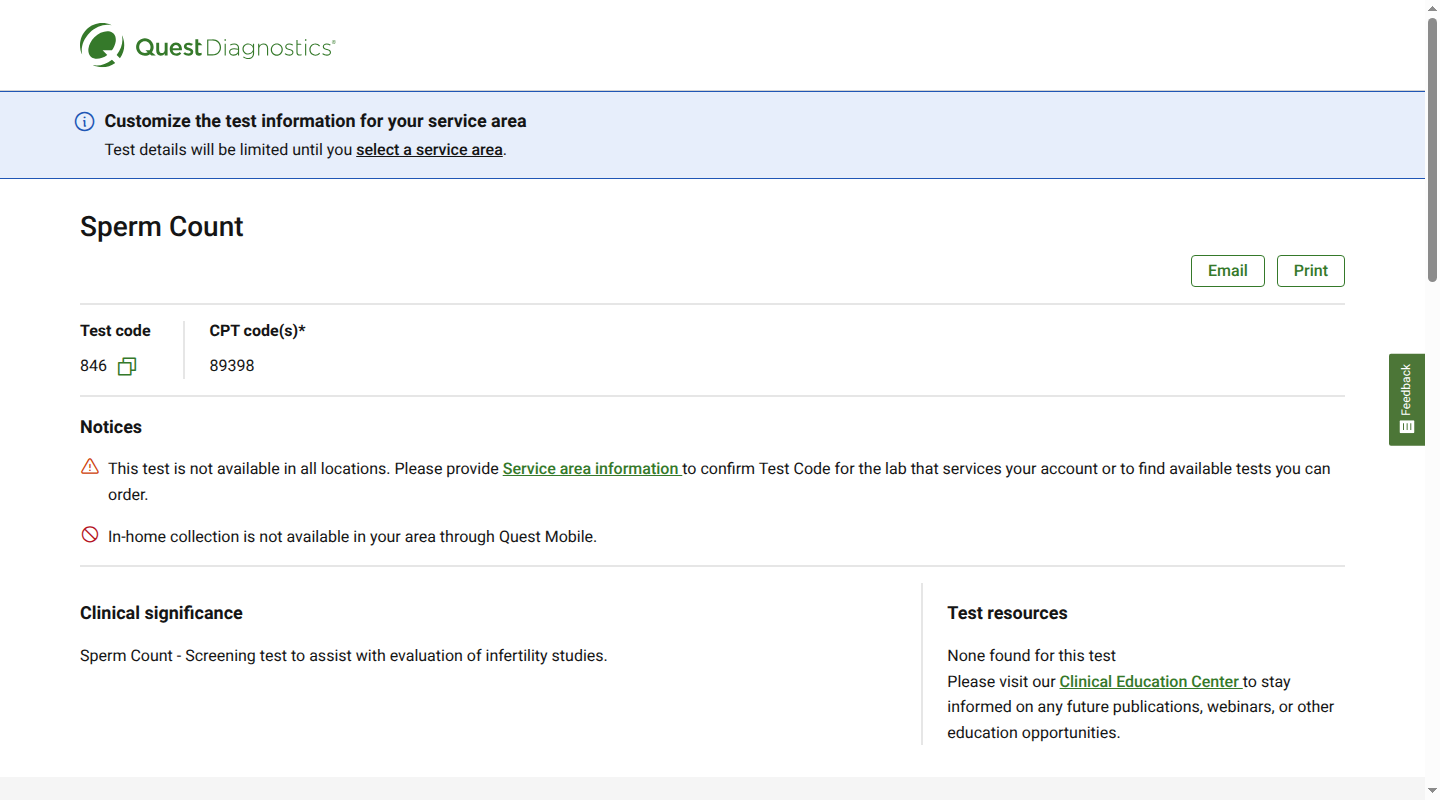
Quest's national Test Directory includes Sperm Count, test code 846. Quest describes it as a screening test, says it is unavailable in some locations, and lists sperm concentration as its reported measure. It does not list semen volume, total sperm count, motility, progressive motility, morphology, or pH. Code 846 is a sperm-count screen, rather than a complete fertility semen analysis.
Quest Health also sells a third-party smartphone sperm test. Quest states that Quest Diagnostics does not perform laboratory testing for that kit and does not receive its results. A separate Quest affiliate, ReproSource, offers a clinician-ordered mail-in semen analysis, but Quest describes ReproSource and Quest as separate companies with different ordering and billing processes. Neither route lets you book a complete local semen analysis at a regular Quest Patient Service Center.
If you need a comprehensive local test, our semen analysis lab finder shows participating fertility clinics and dedicated labs near you. We include a physician-signed lab requisition, coordinate scheduling with the selected lab, and give you plain-English results guidance. You do not need a separate doctor visit or referral.
What sperm tests does Quest list?
The word “semen” appears across several Quest offerings, which makes the service look broader than it is. The test purpose and result fields show the difference.
| Quest-related option | What it does | Why it is not a complete local fertility analysis |
|---|---|---|
| Sperm Count, code 846 | Screens sperm concentration in millions per milliliter | It does not list the other core fertility measures, and Quest says availability varies by service area |
| Post-Vasectomy, Spermatozoa, Qualitative, code 3187 | Checks whether sperm are seen after a vasectomy | It is a qualitative post-vasectomy test, not a fertility evaluation |
| YO at-home sperm kit sold by Quest Health | Measures several concentration and movement values through a smartphone-based home screen | It is a third-party over-the-counter product, and Quest Diagnostics does not perform the testing |
| ReproSource at-home collection | Sends a preserved sample to a specialty fertility laboratory for a multi-parameter analysis | ReproSource is a separate Quest affiliate, requires a clinician order, and uses its own ordering and billing route |
For someone trying to conceive who expects to drop off a sample at a nearby Quest, none of these options provides a routinely bookable, comprehensive fertility semen analysis at a standard Quest location.
Hormone blood panels do not fill that gap. Testosterone, follicle-stimulating hormone, and other blood markers can add context in selected cases, but they do not measure sperm concentration, movement, or shape. The AUA and ASRM male infertility guideline includes semen analysis in the initial male fertility evaluation.
What should a complete fertility semen analysis measure?
A complete analysis examines the semen and the sperm cells together. Its core measures give a much fuller baseline than sperm concentration alone.
| Measure | What it tells you |
|---|---|
| Semen volume | The amount of fluid in the complete sample |
| Sperm concentration | The number of sperm in each milliliter of semen |
| Total sperm count | The number of sperm across the full ejaculate |
| Total motility | The percentage of sperm showing any movement |
| Progressive motility | The percentage moving forward |
| Morphology | The percentage meeting the laboratory's strict shape criteria |
Depending on the laboratory and method, a report may also include pH, liquefaction, viscosity, vitality, agglutination, and round cells. The WHO semen laboratory manual provides standardized methods for collection, examination, and reporting.
These values work as a group. A concentration result cannot show whether sperm move forward, and a motility percentage cannot show how many sperm were present in the full sample. That is why Quest code 846 is too narrow for a useful fertility baseline.
WHO reference ranges are comparison points, rather than pass-or-fail fertility lines. A value above a lower reference limit does not guarantee pregnancy, and one value below it does not diagnose infertility. Collection details, medical history, both partners' reproductive health, and patterns across the report all matter.
How to get a full semen analysis through Hera
We built Hera for the access problem that sends people searching through general lab directories. The process is straightforward.
1. Choose a participating lab near you
Enter your city or ZIP code in our lab finder to compare more than 780 participating CLIA-certified locations by availability, location, and price. These include fertility clinics, andrology labs, urology practices, and other laboratories that handle semen samples.
2. Select the right testing purpose
A fertility semen analysis and a post-vasectomy semen analysis use different orders and result criteria. We coordinate the physician-signed lab requisition for the test you select. The requisition is a laboratory order. It is separate from a medical consultation, diagnosis, or specialist evaluation.
3. Receive the selected lab's collection instructions
Some locations provide a private collection room. Others accept a sample collected at home and delivered within a set period. We provide the selected lab's instructions for the container, abstinence period, collection method, timing, temperature, appointment, and handoff before you collect.
4. Get the report and clear next steps
Results typically arrive in 2 to 5 days, depending on the selected lab. We organize the measurements, explain them in plain language, and provide an action plan. If a result points to a need for specialist care, you have a clearer record to bring to that appointment.
Our standard physician-order fee is $60. Lab fees are separate and vary by location. In a July 2026 snapshot of 379 listed U.S. locations, the median listed lab fee was $185, and the 10th-to-90th-percentile listed range was $110 to $295. This historical snapshot does not establish a current or typical patient total. Your selected location shows its exact price before you place the order. Our semen analysis cost guide explains the fees and insurance considerations in more detail.
How to prepare for a laboratory semen analysis
Collection affects the usefulness of the report. The receiving lab's instructions take priority because delivery windows and collection arrangements vary by location. Common fertility-analysis instructions include:
- Avoid ejaculation for 2 to 7 days. Record the actual abstinence period for the laboratory.
- Use the supplied or approved sterile container. Saliva, regular lubricant, and standard condoms can interfere with the specimen.
- Collect the full ejaculate. Missing part of the sample can change semen volume, concentration, and total count.
- Record the collection time. Motility changes with time and temperature, so follow the selected lab's delivery and handling steps exactly.
- Report any collection problem. A missed portion, spill, delay, or temperature issue gives the laboratory and clinician important context.
The American Society for Reproductive Medicine's andrology laboratory guidance also emphasizes complete sample collection under specified conditions. We send the selected location's exact instructions before test day, so you do not have to piece them together from a generic lab page.
What happens after you get the result?
A semen analysis is a snapshot. Sperm and semen measures can vary from one sample to another, and collection issues, recent illness, and the abstinence interval can affect the report.
Read concentration, total count, motility, progressive motility, morphology, and volume together. One isolated flag rarely explains the whole fertility picture. The AUA and ASRM guideline says at least two semen analyses obtained about one month apart are important to consider, especially when the first analysis has abnormal parameters.
Persistent abnormalities, azoospermia, pain, swelling, a lump, ejaculation problems, or other concerning symptoms warrant evaluation by a reproductive urologist or another male fertility specialist. A semen analysis can guide that evaluation, but it does not replace a medical history and physical examination.
If you already have a Quest, ReproSource, fertility-clinic, or hospital report, you can upload the existing report for our plain-English interpretation. This interprets the report you already have. It does not run a new clinical test.
What if you need a post-vasectomy test?
Quest's national directory lists qualitative post-vasectomy test code 3187, but it is a separate, location-dependent service. It does not replace a comprehensive fertility analysis, and it may not provide the result format used by every surgeon.
A post-vasectomy semen analysis must follow the protocol used by the clinician managing the vasectomy. Keep using contraception until that clinician confirms clearance. If a regular Quest site cannot perform the ordered test, our lab finder also includes participating locations for post-vasectomy testing.
For a complete fertility semen analysis at a confirmed local lab, find a participating lab near you and start with the right test, order, price, and collection plan in one place.
Related Resource Articles
-
Labcorp Sperm Analysis: Tests, Locations, Cost, and What to Expect
Learn which Labcorp semen analysis fits fertility or post-vasectomy testing, how to confirm a location, prepare your sample, and understand the results.
9 min read
-
How Long Does It Take for Sperm to Build Back Up After Ejaculating?
How long does it take for sperm to build back up after ejaculating - Discover how long it takes for sperm to build back up after ejaculating. Get answers on
13 min read
-
Understanding Sperm Health: Decoding Semen Analysis Results | Hera Fertility
Learn how to decode semen analysis results and understand sperm health parameters. Expert guide to interpreting fertility tests and sperm quality assessments.
6 min read