Labcorp currently lists Semen Analysis, Basic (test 519114) for fertility evaluation, but it is available only through designated sperm-testing facilities. It is not offered at every Labcorp location and is not a routine walk-in service. Labcorp says the test must be scheduled with the laboratory that performs it, and most traditional Labcorp testing begins with an order from a healthcare provider.
Before collecting, confirm the exact test, performing location, appointment, and collection instructions. A fresh sample has a short delivery window, so sorting out those details first helps the lab accept and analyze it.
Which Labcorp sperm test do you need?
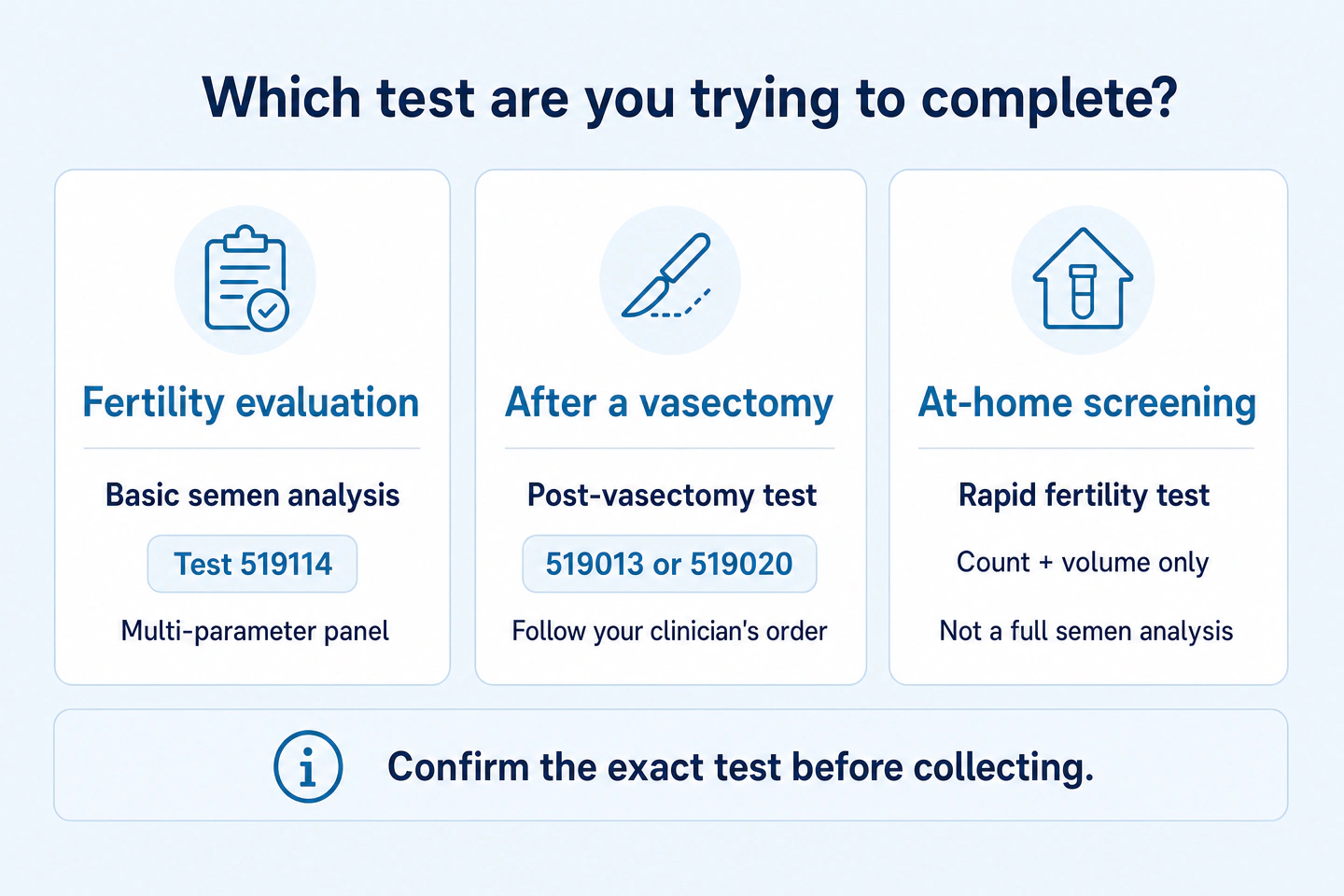
Labcorp lists several tests related to sperm, but they answer different questions.
| Testing path | What it is for | What to know |
|---|---|---|
| Basic fertility semen analysis (519114 / billing code (CPT) 89320) | Evaluating multiple sperm and semen characteristics as part of a male fertility assessment | Available only at designated sperm-testing facilities; confirm the performing site and appointment before collection. Labcorp lists a usual turnaround of 4–6 days |
| Post-vasectomy testing (519013 or 519020) | Checking whether sperm remain after a vasectomy | These are separate tests with different result fields and handling rules; Labcorp lists a usual turnaround within one day |
| Labcorp OnDemand Men's Rapid Fertility Test | At-home screening of sperm concentration bands and semen volume | It is not a full semen analysis and cannot confirm fertility, infertility, or vasectomy success |
If your question is about fertility, test 519114 is the relevant Labcorp laboratory panel. If you need confirmation after a vasectomy, use the specific post-vasectomy order chosen by your treating clinician. Do not use a fertility panel or home screen to decide that you can stop contraception after a vasectomy.
How to arrange a Labcorp basic semen analysis
Set up the order, location, and collection plan before you begin. A generic appointment at the nearest Labcorp does not necessarily reserve a semen analysis.
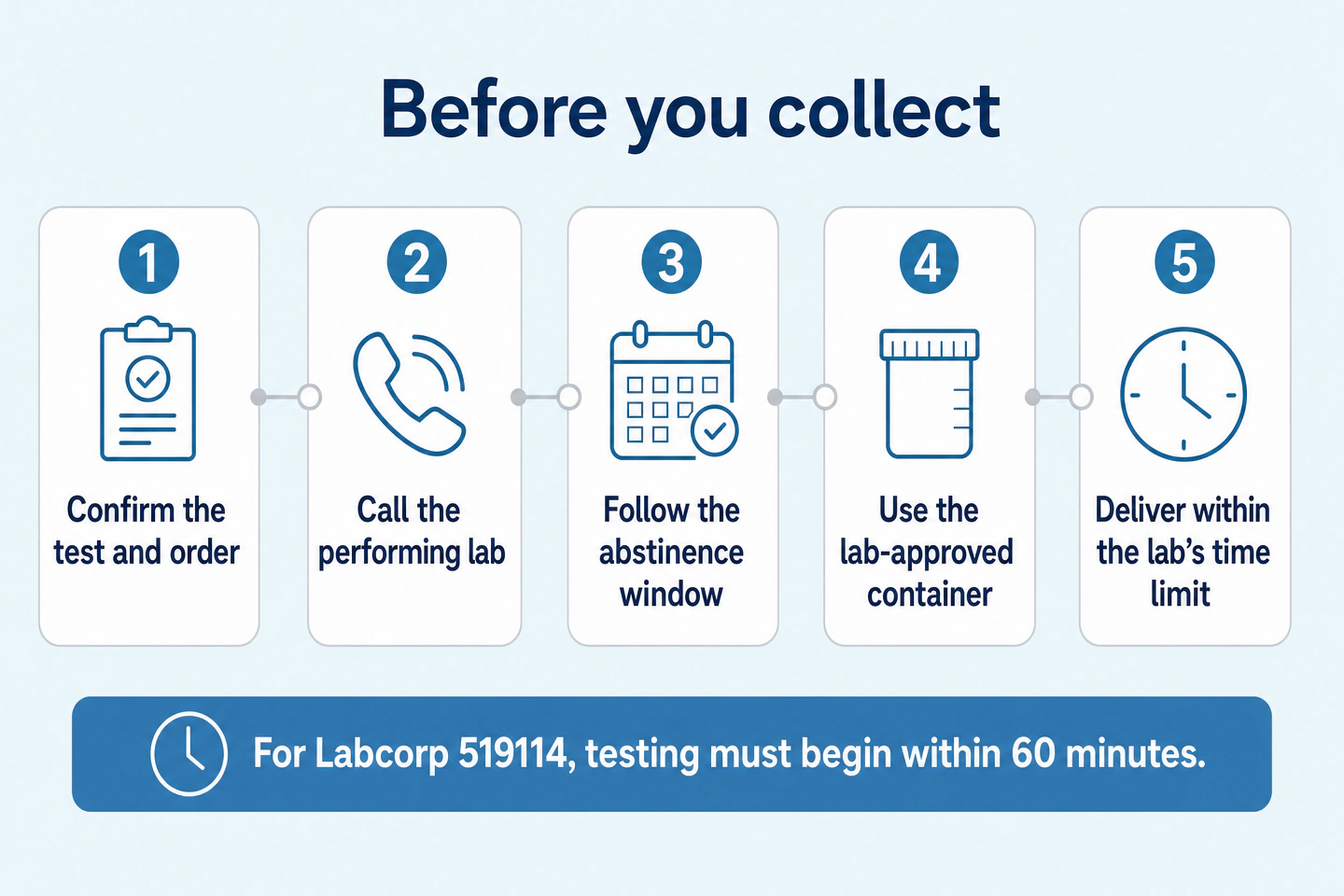
1. Confirm the order
Most traditional Labcorp tests require an order from a healthcare provider. The order may be sent electronically, so a paper form is not always required. If your clinician gave you a printed copy, bring it as a backup.
Ask the performing laboratory to confirm it has the order for Semen Analysis, Basic, test 519114. An order tells the laboratory which test to perform. It is not the same as a specialist referral, insurance authorization, or guarantee of coverage. Those may be separate requirements depending on your health plan. Labcorp explains its general order process in its patient help center.
2. Find the performing lab and schedule it
Labcorp states that test 519114 is available only at sperm-testing facilities and must be scheduled with the laboratory that performs it. A location appearing in the general Labcorp directory does not prove it offers semen analysis, and a standard appointment does not confirm that the site can accept a fresh semen specimen. Local booking methods and testing hours can also differ from ordinary lab work.
Use Labcorp's location details as a starting point, then call the specific site or the number your clinician provides. Ask:
- Does this location perform test 519114?
- Is an appointment required, and must it be booked by phone?
- Is collection done on site, at home, or either way?
- Which container should you use, and where can you get it?
- What is the exact delivery window and handoff location?
- What should you bring with the sample?
Labcorp requires scheduling so a qualified technologist is available when the fresh specimen arrives. Do not collect until the site and appointment are confirmed. Review Labcorp's current semen collection instructions before the visit, then follow the performing lab's instructions if they are more specific.
3. Check price and insurance before the visit
There is no single national price for Labcorp test 519114 on the public test page. Prices and coverage can vary by the performing laboratory, insurance plan, reason for testing, network status, deductible, and any referral or prior-authorization rules.
For a useful estimate, provide these identifiers:
- Labcorp test: 519114
- Billing code (CPT): 89320
- Performing facility: the location that confirmed it can run the test
If you have insurance, ask the plan whether the performing lab is in network, whether semen analysis is covered for your stated reason, whether authorization is needed, and what your estimated responsibility will be. Labcorp may be able to bill your carrier, but that does not mean every plan covers this test.
If you are uninsured or are not using insurance, ask Labcorp whether you are eligible for a self-pay estimate or Good Faith Estimate. Check whether separate clinician, collection, or facility fees could apply. Labcorp's billing and insurance page has current contact options.
4. Prepare and collect exactly as instructed
For the basic semen analysis, Labcorp currently instructs patients to avoid ejaculation for 2–7 days before collection. Record the actual number of days rather than trying to change the result. Do not stop medications or supplements unless your clinician specifically tells you to.
Use the sterile screw-cap container supplied or approved by the laboratory. Collect without lubricant or saliva. Do not use a standard condom unless the laboratory has specifically approved it for specimen collection, because lubricants and spermicides can affect the sample. Try to collect the entire ejaculate, since a missed portion can make semen volume and total sperm count appear lower than they are.
If anything spills or part of the sample is missed, tell the laboratory. Do not try to put spilled material back into the cup. The lab can decide whether the specimen is still useful or should be recollected.
Label the container and record the collection time as instructed. Labcorp's form asks for collection details, including the abstinence interval and whether the complete sample was captured.
5. Deliver the fresh sample on time
For a home-collected 519114 sample, Labcorp requires analysis to begin within 60 minutes of collection and lists specimens older than one hour as a reason for rejection. That means travel and handoff need to be planned before you produce the sample.
Keep the closed container near your body and protect it from hot or cold temperatures. Do not refrigerate or freeze a basic semen-analysis sample. Go directly to the agreed handoff point and tell the staff the collection time.
The one-hour rule applies to Labcorp's basic fertility analysis. A post-vasectomy order may use different handling instructions, which is one reason you should never switch test codes or specimen rules on your own.
6. Receive and review the report
Labcorp lists a usual turnaround of 4–6 days for test 519114, although actual timing and release processes can vary. Results are generally sent to the ordering provider and may also appear in your Labcorp patient account.
Plan to review the report with the clinician who ordered it. A flagged number is not a diagnosis, and an in-range result does not guarantee conception. Clinical context is what turns the measurements into a useful next step.
What does Labcorp's basic semen analysis measure?
Labcorp's basic semen analysis reports several semen and sperm measurements, not only concentration. Its test 519114 result map includes:
- Semen characteristics: Appearance, liquefaction, viscosity, volume, and pH describe the sample and the fluid carrying the sperm.
- Sperm quantity: Concentration is the number of sperm per milliliter. Total sperm count estimates the number in the whole ejaculate, so it reflects both concentration and volume.
- Movement: The report separates progressive movement, non-progressive movement, and immotile sperm. It also includes total motility and total motile sperm measures.
- Shape: Strict morphology reports the percentage of sperm that meet specific shape criteria.
- Other findings: The panel includes leukocyte (white blood cell) concentration. Labcorp may also add a viability check, which estimates the percentage of live sperm, when the motility findings call for it.
These measures are read together. For example, a concentration figure does not show whether sperm are moving forward, and morphology alone does not tell you whether pregnancy can happen.
The reference ranges on your report are comparisons, not pass/fail fertility lines. Use the current ranges provided by the reporting laboratory rather than a table copied from another website.
What your result can and cannot tell you
A semen analysis can identify patterns that help guide a male fertility evaluation. It may show lower sperm quantity, reduced movement, a higher proportion of unusually shaped sperm, or no sperm seen in the sample. The pattern can help a clinician decide whether repeat testing or a more targeted male fertility evaluation would be useful.
One result cannot prove that you are fertile or infertile. The World Health Organization's laboratory manual explains standardized semen examination, while the joint male infertility guideline from the American Urological Association and the American Society for Reproductive Medicine emphasizes that semen values vary and that individual parameters are not highly predictive by themselves. Several significant abnormalities together usually matter more than one isolated flag.
Semen also varies from one ejaculate to another. Recent illness, abstinence interval, incomplete collection, and delays or temperature changes during transport can affect the report. A clinician may repeat an unexpected result, but there is no single retest schedule that suits every situation. The right timing depends on the finding, recent health history, and the question being investigated.
Post-vasectomy testing requires an additional safety rule: keep using another contraceptive method until your treating clinician explicitly confirms that the vasectomy has met the applicable clearance criteria. Elapsed time, ejaculation count, a home test, or your own reading of a result is not enough. The CDC's permanent contraception guidance likewise treats post-vasectomy semen analysis as the confirmation step.
What if your nearby Labcorp does not offer the test?
If the nearest location does not perform test 519114, cannot confirm it, or makes the one-hour delivery window impractical, do not collect a sample or travel there hoping it can accept one. Use Hera's local clinic and lab finder to compare nearby facilities that handle semen analysis instead.
Choose a local clinic or dedicated andrology laboratory, then confirm its order, appointment, collection room or home-collection rules, container, price, and handoff window directly before collecting. Hera can help coordinate a physician-signed requisition for participating facilities, but it is not a Labcorp booking channel and does not make an unconfirmed Labcorp location available.
If you do not yet have an order, review how semen analysis without a doctor works through Hera's physician-review process. If you already have a Labcorp report and want help understanding its fields, Hera's free report analysis provides a separate plain-English interpretation. It does not run another clinical test.
Related Resource Articles
-
Does Quest Diagnostics do semen analysis?
Quest does not offer a full semen analysis at regular locations. See what its sperm tests cover and how Hera helps you find and book a local lab.
8 min read
-
Fertility After Vasectomy Reversal: What to Expect
Considering vasectomy reversal? Learn about fertility after vasectomy reversal: sperm return timelines, success rates, and understanding results.
15 min read
-
Sperm DNA Fragmentation: Causes, Tests and Fertility
Learn what sperm DNA fragmentation means, how DFI tests differ, when testing may help, and what an elevated result can and cannot tell you about fertility.
10 min read