A sperm concentration test kit is a straightforward tool: it’s an at-home test that gives you a first look into a key piece of your reproductive health. It measures how many sperm are in a semen sample, offering a private and convenient way to get some initial answers if you're curious about your fertility.
Why Proactive Male Fertility Testing Matters

Taking charge of your reproductive health is a powerful move. For a lot of men, the journey to understanding their fertility kicks off with a bunch of questions, and a sperm concentration test kit provides a private way to start finding some answers. Think of it as an initial checkpoint to gather baseline information right from the comfort of your own home.
But here’s the thing: it's crucial to understand what these kits actually measure—and what they don't. While sperm concentration (the number of sperm per milliliter) is a vital metric, it’s just one piece of the male fertility puzzle. A complete, accurate picture requires looking at other critical factors that these simple kits can't assess.
A Starting Point, Not a Final Answer
It's best to think of an at-home test as a simple screening tool. It can tell you if your sperm count is above or below a certain threshold, but it absolutely cannot provide a full diagnosis. True male fertility is a more complex story that also depends on:
- Sperm Motility: How well your sperm can actually move.
- Sperm Morphology: The size and shape of your sperm.
- Semen Volume: The total amount of fluid you produce.
The growing demand for these convenient options shows that more men are getting serious about their health. In fact, a recent market analysis projects significant growth, a boom driven by men seeking accessible and private ways to get started. You can dig into more insights about this growing market from Grand View Research.
This guide will walk you through exactly how a sperm concentration test kit works, how it stacks up against a comprehensive lab analysis, and give you the knowledge to make informed decisions. While at-home kits offer a great starting point, a clinical analysis is what provides the complete story for your reproductive health journey.
Decoding Sperm Concentration and Its Role in Male Fertility
So, what exactly is "sperm concentration"? Let's ditch the confusing medical jargon for a second. Think of it this way: imagine your semen sample is a swimming pool. Sperm concentration is simply the number of swimmers in that pool, measured in millions per milliliter (mL).
It makes sense that a pool packed with swimmers gives you a better chance of someone reaching the other side. Likewise, a healthy sperm concentration means there are plenty of sperm ready for the journey. It’s one of the first things we look at in male fertility, which is why a sperm concentration test kit zeroes in on this specific number.
But just having a crowded pool doesn't mean you'll win the race. The quality of the swimmers is just as important as the quantity. The same rule applies to your fertility.
Why Concentration Is Only Part of the Story
While a solid concentration number is a great start, it's just one piece of a much larger puzzle. At-home test kits are designed to measure only this single factor, but a complete picture of your reproductive health involves several other crucial details that these kits simply can't see.
Think about our swimming pool again. What if you have millions of swimmers, but none of them can actually swim forward? Or what if they're not in good enough shape to finish the race? That’s where the other key sperm health metrics come into play.
A "normal" sperm concentration is a positive sign, but it is not a complete fertility diagnosis. True male fertility depends on the quality and function of the sperm, not just the quantity.
The Teammates At-Home Kits Can't See
To really understand your fertility, you need to look at the whole team, not just how many players showed up. A comprehensive analysis goes way beyond just counting heads.
Here are the two other critical factors:
- Sperm Motility: This is all about movement. Motility measures how well your sperm can swim forward in a straight line. Think of it as the speed and endurance of your swimmers—they need to be strong and determined to reach their destination. High numbers don't mean much if the sperm are just floating around or swimming in circles.
- Sperm Morphology: This refers to the size and shape of the sperm. Healthy, properly formed sperm are better equipped for the journey. This is like checking the physical fitness of your swimmers—are they streamlined and built for performance?
Because at-home kits can't measure motility or morphology, they give you a very narrow snapshot. Getting familiar with the idea of a normal sperm count is a fantastic first step, but it’s vital to remember that a full evaluation provides deeper, more meaningful insights into your reproductive health.
At-Home Kits Versus Professional Lab Analysis
When it's time to test your sperm health, you're looking at two main paths: an at-home sperm concentration test kit or a professional semen analysis at a certified lab. Each has its place, and figuring out which is right for you means understanding what they can—and can't—do.
At-home kits have a big draw, and it's easy to see why. They offer total privacy and convenience. You can do the test in your own home, on your own time, with no appointments needed. But that convenience comes with a trade-off. These kits are designed to give you just one piece of the puzzle: your sperm concentration.
A professional lab analysis, on the other hand, is the gold standard for a reason. It does require a visit to a clinic, but the level of detail you get is in a completely different league. Think of it like this: the at-home kit checks the oil level in your car, while the lab analysis is the full diagnostic report from a master mechanic.
A Side-by-Side Comparison
To really grasp the difference, it helps to put them head-to-head. The choice often boils down to what you need right now: a quick, basic screening or a complete health report you can actually act on.
Let's break down what each option brings to the table. This comparison really shines a light on where each one excels and where it falls short, making it clear why one is a limited snapshot and the other is the full picture.
Key Takeaway: An at-home sperm concentration test kit can be a useful first step for a basic check, but only a lab analysis provides the complete, medically reliable data needed for a true understanding of your fertility.
The table below lays it all out, showing you exactly what to expect from each test.
Comparing Your Sperm Testing Options
Here's a side-by-side look at the features and limitations of at-home sperm concentration test kits versus a professional lab-based semen analysis.
| Feature | At-Home Sperm Concentration Test Kit | Professional Lab Semen Analysis |
|---|---|---|
| Metrics Measured | Primarily sperm concentration (count). | Concentration, motility, morphology, volume, and more. |
| Accuracy | Varies by brand; susceptible to user error. | Clinically validated and performed by trained andrologists. |
| Scope of Results | Provides a simple "low" vs. "normal" screening. | Delivers a detailed report with specific data and ranges. |
| Professional Oversight | None. You interpret the results on your own. | Results are analyzed and verified by medical professionals. |
| Actionable Insights | Limited. Does not explain why results are what they are. | Provides a foundation for targeted lifestyle changes or medical follow-up. |
As you can see, the difference is night and day, especially when it comes to getting results you can trust and use.
The Value of Clinical Precision
The comparison makes it clear: the biggest gap is in the scope and reliability of the results. An at-home kit might tell you if your sperm count is above a certain line. A lab analysis, however, tells you your exact count, how well your sperm are swimming, and if they're shaped correctly—the three core pillars of male fertility.
That's a level of detail an at-home kit just isn't built to provide. And when you're looking for real answers, that detail is everything. One practical thing to consider with a professional lab analysis is the turnaround time. Knowing how long lab work takes can help you set expectations and plan your next steps. Ultimately, a lab-based test is the only way to get a definitive, medically sound assessment that you and your doctor can use to make truly informed decisions about your health.
How to Use a Sperm Concentration Test Kit Correctly
So, you've decided an at-home sperm concentration test kit might be the right first move. Great. But to get a result you can actually trust, you need to know what you’re doing. Every kit is slightly different, but they all follow the same basic script—and getting the details right is what separates a useful screening from a waste of time.
It all starts with sample collection, and timing is everything. You'll need to abstain from ejaculation for a specific period, usually somewhere between 2 and 7 days. This isn't just a suggestion; it's a critical step. Too soon, and your concentration might look artificially low. Wait too long, and it could throw off other parameters. Either way, you get a skewed picture.
Once you’ve collected the sample, you can’t just test it right away. The sample needs to sit for a bit to liquefy. This is a natural process that's essential for the test to work correctly. After that, you'll use a little dropper or a similar tool to place a small amount onto the testing device.
Following the Steps for a Clearer Result
Precision matters here. A lot. Deviate from the instructions—even a little—and you could easily mess up the result. Sticking to the script for timing and sample handling gives you the best shot at getting an accurate reading.
To make sure you nail it, here’s a quick rundown of what to expect:
- Observe the Abstinence Period: Seriously, don't skip this. Follow the exact timeframe your kit recommends.
- Collect the Entire Sample: Make sure you get the whole sample into the sterile cup they provide. No spills, no partial collections.
- Prepare the Sample: Let the sample rest for the required waiting period before you touch it. Be patient.
- Apply and Wait: Carefully move the right amount of semen to the test cassette. Then, just wait for the lines or symbols to show up, which usually takes a few minutes.
This whole process is a perfect illustration of the trade-off you make: you get convenience, but you lose the comprehensive data a full lab analysis provides.
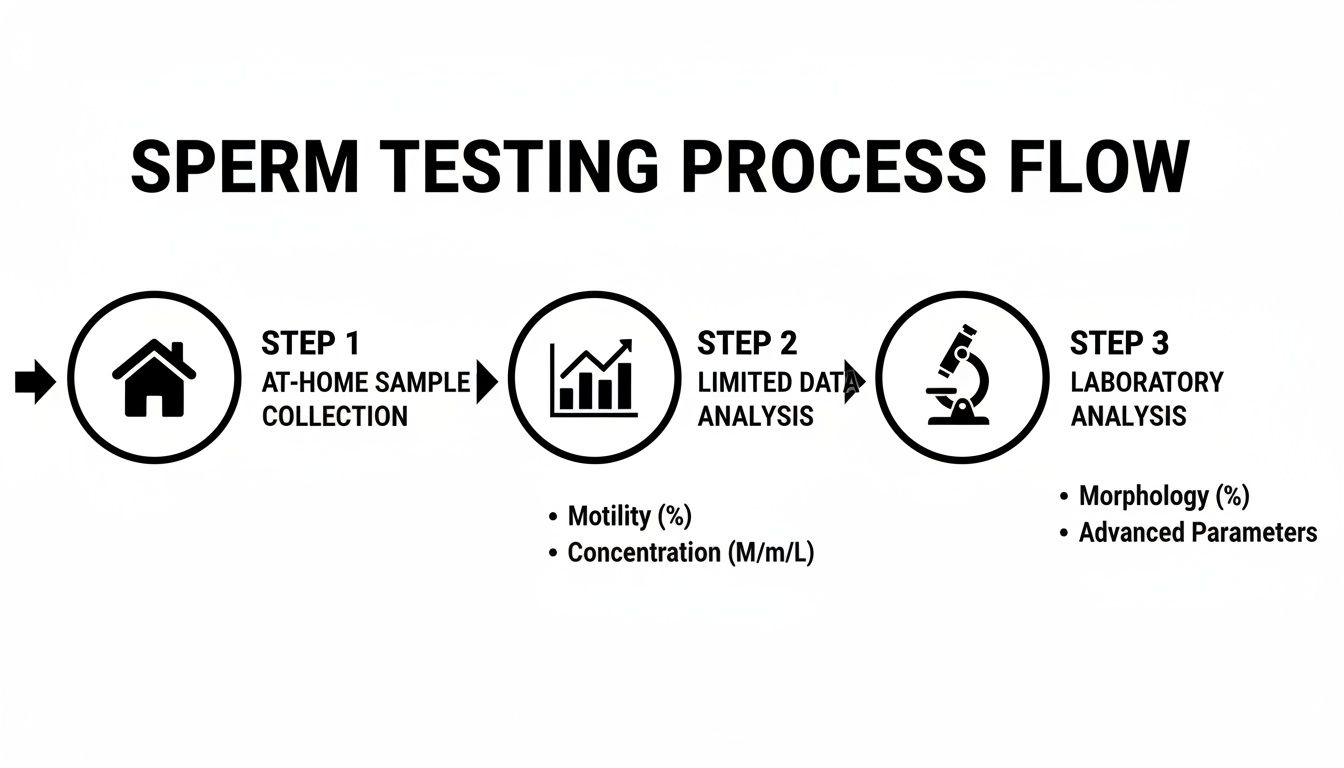
As the diagram shows, an at-home kit is a decent starting point. But for the full story—the kind of detailed evaluation that leads to real answers—nothing beats a professional lab analysis.
The simple fact that these kits exist shows a massive shift in how men are thinking about their reproductive health. It's a growing market, largely because more guys prefer the privacy and speed of testing at home, which is helping to finally chip away at the stigma around male fertility. You can discover more insights about this consumer preference from Mordor Intelligence.
But even if you follow every step perfectly, remember that you’re doing this in an uncontrolled environment. Things like the temperature of your room or how you time each step can subtly nudge the results. It’s a constant reminder of why the controlled, sterile setting of a lab remains the gold standard for accuracy.
What Your At-Home Test Results Really Mean
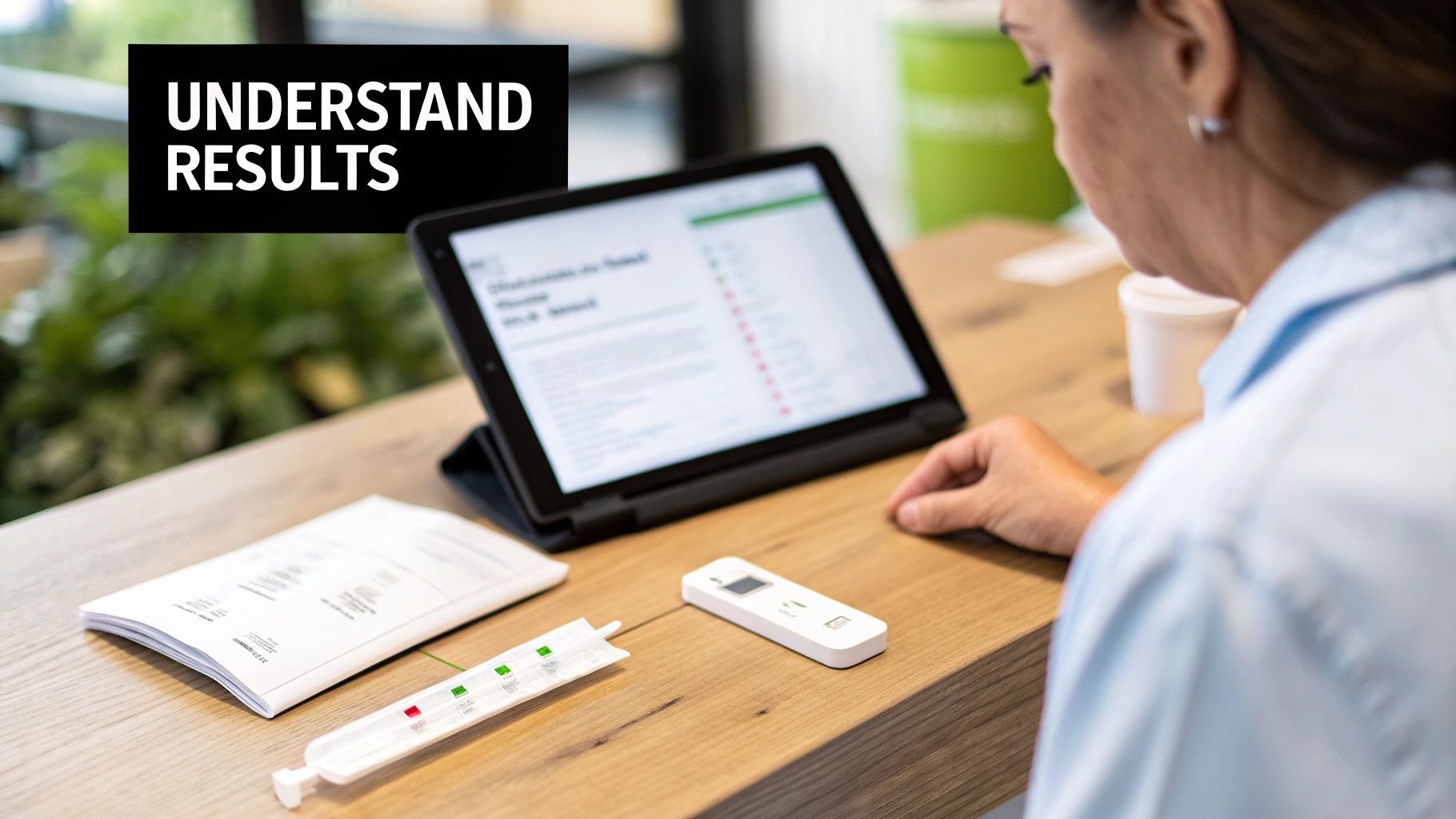
So, you’ve followed all the steps, waited for the result, and now you have an answer—usually a straightforward “low” or “normal.” It's tempting to take this as the final word on your fertility, but it's crucial to see it for what it is: just one piece of a much larger puzzle.
An at-home sperm concentration test kit is built to give you a simple yes-or-no answer based on a specific cutoff point. This threshold isn’t arbitrary; it’s typically based on guidelines from major health organizations like the World Health Organization (WHO), which establishes reference values for male fertility.
Think of it as a pass/fail screening. A "normal" result means your sperm concentration is most likely above that minimum line. A "low" result suggests it's probably below it. That's it. This isn't a diagnosis—it's a starting point for understanding your reproductive health.
Putting the Numbers in Context
To really understand your result, it helps to know what numbers fertility specialists are looking at. The WHO provides a baseline for what's considered a typical sperm concentration, and knowing these ranges helps clarify what your test is actually measuring against.
Sperm Concentration Reference Ranges (WHO Guidelines)
Here's a quick reference table to make sense of the general guidelines.
| Concentration Level | Sperm per Milliliter (mL) |
|---|---|
| Low | Below 15 million sperm/mL |
| Normal | 15 million to 200 million sperm/mL |
| High | Above 200 million sperm/mL |
Remember, this table gives you an idea of the clinical benchmarks, but your at-home kit is just an indicator. It can't tell you your exact number or provide the detailed context a full lab analysis can.
Seeing "normal" is definitely reassuring, but it doesn't automatically mean you're fertile. A man can have a perfectly healthy sperm count and still face fertility challenges because of factors the kit can't see, like poor sperm movement (motility) or abnormal shape (morphology).
When to Take the Next Step
No matter what your at-home test says, treat the result as a signal, not a destination. A "low" reading is a clear sign to get a professional opinion. But even a "normal" result should be followed up with a conversation if you have ongoing concerns about your reproductive health.
Here’s a simple, actionable plan:
- If your result is low: It’s time to book a consultation with a doctor or a male fertility specialist. They can order a complete semen analysis to get a precise, accurate picture of what’s happening.
- If your result is normal: This is good news, but it isn't the full story. If you still have questions or concerns about your reproductive health, a "normal" concentration shouldn't stop you from seeking expert guidance.
A comprehensive evaluation is the only way to get definitive answers. If you’re curious about what a detailed lab report includes, you can learn more about how to read semen analysis results to see just how much more information is involved. The goal is to move from a single data point to a complete understanding of your fertility, empowering you to make the best decisions for your future.
The Power of Clinically Accurate Semen Analysis
For any man wanting to move past a basic screening, a comprehensive, lab-based analysis is the gold standard. It offers a level of clarity and precision that an at-home sperm concentration test kit simply can't match. This modern approach gives you the best of both worlds—the convenience of starting the process from home, paired with the rock-solid reliability of a clinical lab.
The whole process is designed with privacy and ease in mind. It all starts by getting a physician-authorized lab order online, which means you can skip that initial, often awkward, doctor's visit. With your order in hand, you can head to a certified local lab for a private and professional collection. This ensures your sample is handled under perfect conditions right from the get-go.
From there, your sample is analyzed by trained andrologists who dig into all the critical parameters that tell the real story of your reproductive health.
Getting the Complete Picture of Your Health
Unlike a simple at-home test that only checks one box, a full semen analysis gives you the complete diagnostic overview. Lab professionals meticulously examine every key metric, giving you data that is both incredibly accurate and genuinely actionable for your fertility journey.
This comprehensive evaluation covers the big three:
- Sperm Concentration: An exact count of sperm per milliliter of semen.
- Sperm Motility: A precise measurement of how well your sperm are swimming.
- Sperm Morphology: An expert assessment of sperm shape and structure.
This detailed report gives you a complete and reliable baseline of your fertility status, empowering you to understand your health and plan your next steps with total confidence.
Your results are then delivered in a report that’s actually easy to understand, often using AI-powered tools to translate the complex medical data into clear, simple insights. This modern, direct-to-consumer approach is becoming increasingly popular, as men focus more on personal wellness and demand better health solutions. You can read the full research about these market trends from Grand View Research.
By bridging the gap between at-home convenience and clinical precision, you truly get the best of both worlds. You receive a full picture of your fertility and the personalized guidance you need to move forward. To learn more about what this process involves, you might be interested in our detailed guide on professional semen analysis.
Your Questions About Male Fertility Testing, Answered
When you start digging into male fertility, a lot of questions pop up. That’s completely normal. Getting clear, straightforward answers is the first step toward feeling confident and in control of your health. Let's tackle some of the most common things men ask when they start this journey.
One of the biggest questions we hear is about lifestyle. Can simple changes really make a difference? Absolutely. Things like your diet, how much you exercise, your stress levels, and even avoiding things like hot tubs can all add up to have a real, positive impact on sperm health over time.
Can a Low Sperm Count Be Improved?
Yes, in many cases, it absolutely can. Seeing a low number on a sperm concentration test kit or a lab report isn't a final verdict. Think of it more as a starting point. Depending on what’s causing the low count, there's often a lot you can do.
Here are some actionable next steps:
- Lifestyle Adjustments: Cleaning up your diet, getting more active, and kicking habits like smoking are powerful ways to support healthier sperm production.
- Medical Guidance: This is key. A specialist can help pinpoint underlying issues, like a hormonal imbalance or a varicocele (a common and often treatable condition), that could be affecting your numbers.
It's important to be patient, though. It takes about three months for new sperm to fully mature. That means any positive changes you start making today will need a little time to show up in your results.
Your fertility isn't set in stone. Think of a test result as a snapshot in time—a piece of information that empowers you to take proactive steps for your future health.
Another thing men often wonder is how often they should get tested. There’s no single right answer for everyone. If you are curious about your baseline reproductive health, getting a comprehensive analysis done is a crucial first step. From there, if you're making big lifestyle changes to improve your sperm health, re-testing after three to six months is a great way to see if your efforts are paying off.
Ready for clear answers and a complete picture of your fertility? Hera Fertility provides physician-backed, lab-grade semen analysis with AI-powered reports you can actually understand. Get started on your journey to confident reproductive health today.
Learn more about Hera Fertility's advanced testing
Related Resource Articles
-
Finding the Best Semen Analysis Lab Center in Frisco: A 2025 Guide for Men
Searching for the best semen analysis lab center in Frisco? Our guide reviews top local options to help you take the next step in your male fertility journey.
19 min read
-
Post Vasectomy Sperm Test Cost: A Clear Guide for Men
Understand the full post vasectomy sperm test cost with our clear guide. We break down lab fees, at-home kits, and insurance to help you plan.
16 min read
-
A Guide to the Sperm Count Test for Male Fertility
Understand the sperm count test and what it means for your fertility. This guide covers how the test works, what results mean, and your next steps.
21 min read