A sperm kit test is a simple, private way to get a solid look into your reproductive health. Think of it as a starting point—a way to gather crucial data about your fertility from the comfort of your home, giving you the power to make informed decisions.
Your First Step in Understanding Male Fertility
Deciding to learn about your fertility is a big deal, and it's a proactive step toward taking control of your health. Let’s be honest, male fertility can feel like a complicated and sensitive topic, but today’s testing options have made it easier than ever for men to get answers.
Maybe you're planning for a family, just curious about where you stand, or checking up after a vasectomy. Whatever your reason, a sperm analysis is the single most important first move for any man. Our goal is to cut through the medical jargon and turn confusing lab results into clear, practical knowledge you can actually use.
Why Male Fertility Matters
For a long time, fertility conversations have tended to focus on other factors. The reality is, a man's health plays a massive role. In fact, male factors are a consideration in a significant number of cases where a couple is seeking fertility support.
That number alone shows just how important it is for men to understand their own sperm health. It’s not just a footnote; it’s a central part of the story. Getting tested gives you a baseline—a clear picture of the key metrics that really matter for a man's reproductive health.
A sperm test is more than just numbers on a page; it's a powerful tool that provides a clear snapshot of your reproductive wellness, putting you in control of your health journey.
What a Sperm Kit Test Can Reveal
A good sperm kit test, especially one analyzed in a professional lab, gives you a detailed breakdown of your sperm health. It’s not just about how many sperm you have; it’s about their quality and overall fitness. The analysis focuses on a few core parameters that are absolutely essential for a man's fertility.
This table provides a quick overview of what a comprehensive test will typically measure.
What a Sperm Kit Test Tells You at a Glance
| Key Parameter | What It Measures | Why It Matters for You |
|---|---|---|
| Sperm Count (Concentration) | The number of sperm per milliliter of semen. | A higher count generally increases the odds of success. |
| Motility | The percentage of sperm that are moving. | Sperm need to be strong swimmers to complete their journey. |
| Morphology | The percentage of sperm with a normal shape. | A sperm's shape affects its ability to perform its function. |
This detailed insight is the foundation for any next steps you might take. For instance, knowing what's considered a normal sperm count is a great starting point for many men. You can learn more about what that means by checking out our guide on what constitutes a normal sperm count.
It’s also helpful to remember that sperm health is influenced by many factors, including nutrition. For example, understanding the role of zinc as an organizer mineral can offer another piece of the puzzle.
Choosing Between At-Home Kits and Lab Analysis

So, you're ready to get some answers about your fertility. You've got two main roads you can take: the discreet at-home sperm kit test or the thorough, physician-ordered lab analysis. Each has its place, and the best choice really boils down to your specific goals and what you need to know right now.
Think of it this way. An at-home kit is like checking the oil in your car with a dipstick. It’s a quick, easy way to see if you have enough oil—a crucial first check. A full lab analysis, on the other hand, is like taking your car to a mechanic for a complete diagnostic. They'll tell you about your oil level, engine performance, transmission fluid, and a dozen other things you didn't even know to ask about.
Both are useful, but they serve very different purposes. Let's break down what sets them apart so you can figure out which path makes the most sense for you.
At-Home Sperm Kit Tests
At-home kits are all about privacy and convenience. For a lot of men, the idea of going to a clinic is a non-starter, and these kits remove that barrier completely. They're perfect if you just want a preliminary screening to get a basic sense of where you stand before diving into a more formal process.
The biggest plus is just how discreet it is. You order it online, it shows up in a plain box, and you get your results in minutes, all from home. But you have to be realistic about what they can tell you. Most of these tests only look at one thing: sperm count.
- Pros: Total privacy, incredibly easy to use, and you get results fast. Great for a first look.
- Cons: Often limited to just sperm count, not as precise as a lab test, and won't give you info on motility or morphology.
This demand for private, simple solutions has totally changed the game. The global sperm test kit market is growing rapidly, driven by greater awareness of male fertility and the need for accessible testing. These home-use kits have carved out a huge piece of the market by combining convenience with smart tech that helps you understand the numbers.
An at-home sperm kit test can be a great first step, but a professional lab analysis is still the gold standard for a complete and definitive male fertility assessment.
Physician-Ordered Lab Analysis
When you need the full picture—the kind of detailed, clinically accurate data a doctor can work with—nothing beats a lab analysis. This isn't just a simple check; it’s a deep dive into every critical factor of your sperm health. The report you get back will cover the "big three" pillars of male fertility:
- Sperm Count (Concentration): How many sperm are in each milliliter of semen.
- Motility: What percentage of your sperm are actually moving and swimming forward correctly.
- Morphology: How many of your sperm have the normal, healthy shape required for fertilization.
This is the kind of detail that gives you a real, comprehensive understanding of your reproductive health. And while it does mean visiting a lab to provide a sample, the process today is far more private and efficient than it used to be. If you're looking for definitive answers or got a questionable result from an at-home kit, this is your most reliable next move. For a bit more context, you can learn about the basics of how to check your sperm count at home in our related guide.
At-Home Sperm Test vs Professional Lab Analysis
To make the choice even clearer, this table gives you a direct comparison. It’s designed to help you weigh the pros and cons based on what matters most to you, from privacy and cost to the level of detail you'll get in your results.
| Feature | At-Home Sperm Kit | Physician-Ordered Lab Test |
|---|---|---|
| Primary Goal | Initial screening, privacy, and convenience. | Comprehensive diagnostic, clinical accuracy for medical guidance. |
| Metrics Measured | Usually just sperm count. | Count, motility, morphology, volume, and more. |
| Accuracy | Varies by brand; good for a baseline but not clinical. | The "gold standard" for accuracy and reliability. |
| Process | Order online, test at home, get results in minutes. | Doctor's order, visit a lab, results in a few days. |
| Privacy | 100% private and discreet. | Handled by healthcare professionals under HIPAA regulations. |
| Best For | Men curious about their baseline fertility. | Men seeking definitive answers about their reproductive health. |
Ultimately, there's no single "best" option—only the best option for you. An at-home test can provide valuable peace of mind or be the nudge you need to seek a professional opinion, while a lab test gives you and your doctor the complete data set needed to make informed decisions about your health and family-building journey.
How Modern Sperm Testing Actually Works
Forget what you might have heard about awkward, confusing medical procedures. Getting a professional semen analysis today is all about convenience, privacy, and getting clear answers. The whole process is designed to put you in control, letting you get a clinically accurate sperm test on your own terms.
What used to be a complicated and often stressful experience is now broken down into a few simple steps. You don't even need to schedule a doctor's visit just to get the ball rolling—you can start right from home.
Step 1: Getting Your Physician-Signed Order
First things first, you need an official lab order, sometimes called a requisition. This is simply the doctor's note that tells a certified lab they're authorized to run your semen analysis. Thankfully, modern platforms have made this part incredibly easy.
You just go online, answer a few health questions on a secure portal, and a licensed physician reviews your request. If everything checks out, you'll get the official order sent to you digitally, often within a few hours. This completely skips the need for an in-person appointment just to get a referral.
Step 2: Finding a Convenient, Certified Lab
With your lab order in hand, it's time to find a location to provide your sample. The best services have a nationwide network of CLIA-certified laboratories. These are the exact same high-quality labs that hospitals and clinics trust for all kinds of medical testing, so you know you're in good hands.
Most platforms have an online map or locator tool to help you find a partner lab nearby. With hundreds of locations, it’s usually easy to find one that’s close to your home or office. You can then book an appointment online for a time that works for you.
The entire process is designed with your privacy in mind. From the initial online order to the final results, your personal health information is protected under strict HIPAA regulations, just like at any doctor's office.
Step 3: The Sample Collection Process
Let's be honest—this is the part most men feel a little anxious about. But labs are professionals and have made this experience as comfortable and private as possible. When you get to your appointment, they'll show you to a private collection room.
These rooms are built specifically for this purpose, giving you a sterile and totally discreet space. You’ll be given a sterile collection cup and simple instructions. Once you’re done, you just pass the sample to a lab technician through a small, secure window, so you never feel exposed.
To make sure your results are as accurate as possible, there are a few key things to remember:
- Abstinence Period: You'll need to abstain from ejaculation for 2 to 5 days before your appointment. This is important because it ensures your sperm count reflects its typical level.
- No Lubricants: This is a big one. It's critical to avoid using any lubricants, as many of them can damage sperm and throw off the analysis.
- Follow Instructions: The lab will give you very specific instructions. Following them to the letter is the best way to guarantee your test results are accurate and reliable.
By understanding how straightforward the process is, you can feel much more confident and prepared. The modern approach finally gives men a secure, efficient, and stress-free way to get real answers about their reproductive health.
Decoding Your Semen Analysis Results
Getting your sperm test results back can feel like you've been handed a sheet of engineering specs. It's a wall of numbers and clinical terms you've probably never seen before, and it’s easy to feel a little lost. But this is actually the most empowering part of the process—turning that data into real, actionable knowledge about your reproductive health.
Let's walk through the report and translate it into plain English. We'll focus on the "big three" metrics of male fertility, using some simple analogies to make it all click. Think of it like a coach going over game film: you need to know how many players are on the field, how well they move, and if they're in the right shape to score.
This whole process, from ordering the kit to getting your results, is designed to be straightforward and secure.
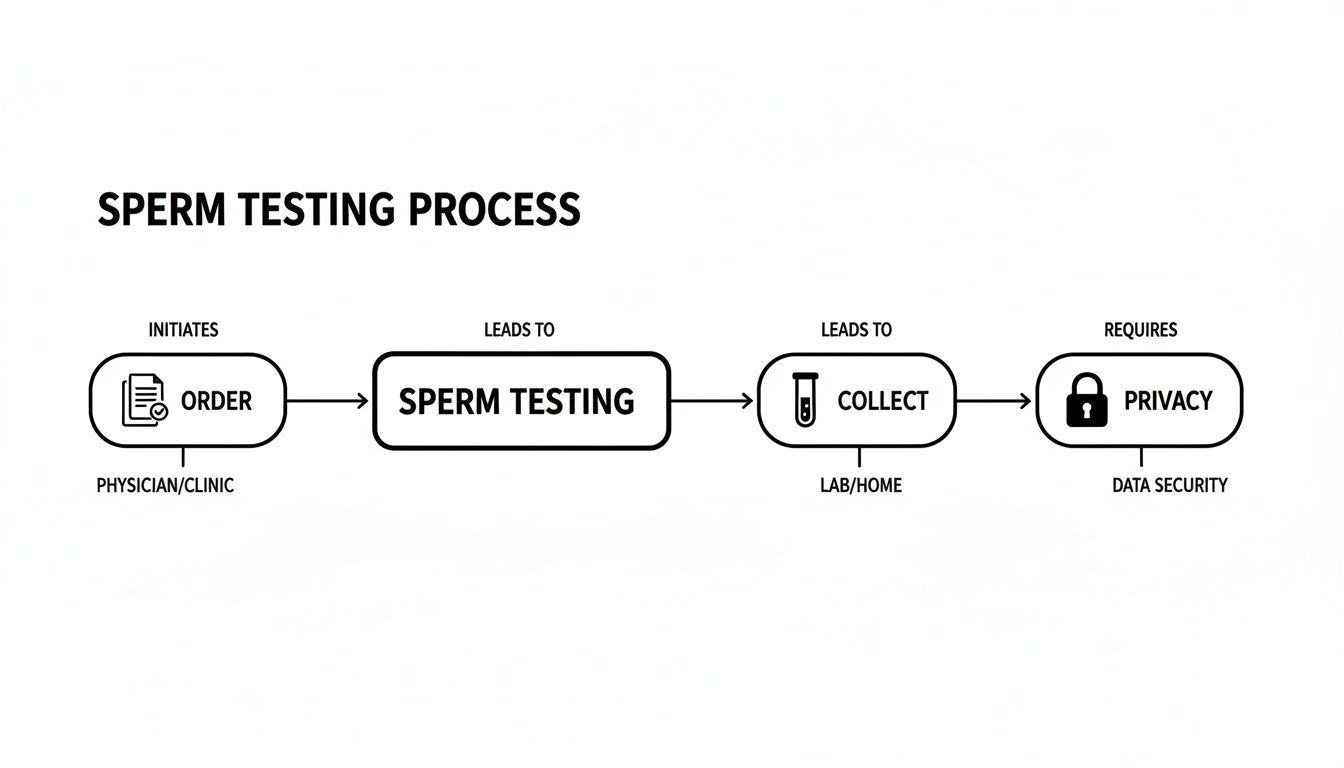
As you can see, modern testing puts privacy and simplicity first, making it easier than ever for men to get these crucial insights.
Sperm Count: The Size of Your Team
The first number that usually jumps out is sperm count, sometimes called sperm concentration. This is a straightforward measurement of how many sperm are packed into each milliliter (mL) of semen.
Think of it like trying to win a massive lottery. The more tickets you buy, the better your chances are. Sperm count operates on a similar idea. A higher number of sperm simply increases the odds of success.
So, what’s a good number? According to the World Health Organization (WHO), a count of 15 million sperm per milliliter or more is considered normal. If the number falls below that, it’s known as oligospermia, or low sperm count. It's a key metric, for sure, but it’s only one piece of the puzzle.
Sperm Motility: How Your Team Moves
Next up is sperm motility, and it’s arguably just as critical as the count. This metric tells you what percentage of your sperm are actually moving. Specifically, labs look for progressive motility—the sperm that are swimming forward with purpose, not just twitching or going in circles.
Imagine your sperm are a team of swimmers attempting to cross a vast ocean. It doesn't really matter if you have a million swimmers if none of them can actually move forward. Only the ones actively and efficiently pushing ahead have any shot at reaching the destination.
The target here is generally 40% or more of sperm showing total movement, with a healthy portion of that being the forward-charging, progressive kind. Low motility, called asthenospermia, can be a major hurdle for a man's fertility, even if his sperm count is sky-high. After all, sperm need to be powerful swimmers to succeed.
Your final report combines these individual metrics—count, motility, and morphology—into a single, easy-to-understand score, giving you a clear and complete picture of your overall sperm health.
Sperm Morphology: The Shape of Your Players
The last of the big three is sperm morphology, which is all about the size and shape of your sperm. Under a powerful microscope, technicians analyze what percentage of the sperm have a "normal" structure: an oval-shaped head and a long, single tail.
This might sound a bit nitpicky, but a sperm's shape is directly tied to its ability to do its job. An abnormally shaped head might have trouble performing its function, while a defective tail could make it a clumsy swimmer. It's like sending athletes onto the field with the wrong equipment—their form directly impacts their performance.
The bar for "normal" morphology is surprisingly strict. A result showing just 4% or more of normally shaped sperm is considered healthy. That number often catches men off guard, but it's a powerful reminder that when it comes to male fertility, quality is just as important as quantity.
Putting It All Together for a Clear Picture
While each of these metrics is important on its own, their real meaning comes from seeing how they interact. A man could have a massive sperm count, but if motility is poor, success is still a challenge. Likewise, another might have fantastic swimmers, but if very few are shaped correctly, that can also be a roadblock.
Modern testing platforms help simplify this by translating these separate numbers into a single, cohesive score. It cuts through the clinical jargon and gives you one clear indicator of your reproductive health. This is especially relevant in North America, which has become the largest market for sperm testing; the US market alone hit $785 million recently. For men using these services, understanding the benchmarks—like aiming for 15+ million/mL for count and 40%+ for progressive motility—is the first step in knowing where you stand. You can explore more data on the fertility testing market to see how these trends are shaping up.
Ultimately, your results aren't a final verdict. They're a valuable snapshot of your health right now. This information is your starting point for making informed decisions, whether that means celebrating a great result or taking proactive steps to improve your numbers.
You Have Your Results—Now What?
Getting your sperm test results back is a big moment. No matter what the report says, remember this: these numbers aren't a final verdict. They're a starting point—a powerful piece of information that helps you figure out what to do next.
Think of your results as a snapshot of your reproductive health right now. Whether they’re great, show some room for improvement, or confirm a successful vasectomy, there’s always a clear path forward. Let’s walk through what your results might mean and how to approach each scenario calmly and practically.
If Your Results Are Optimal
Seeing great numbers on your sperm analysis is a fantastic feeling. An optimal result means your key metrics—like sperm count, motility, and morphology—are right where they should be, which is a strong sign your reproductive health is on track. But this isn't the time to just coast; it's a perfect opportunity to keep that positive momentum going.
Sperm health isn't set in stone. It’s deeply connected to your daily habits, so maintaining those excellent results means continuing to invest in your overall well-being.
Here are a few simple, actionable next steps to keep your sperm health in peak condition:
- Eat Well: A balanced diet loaded with antioxidants, vitamins, and minerals makes a real difference. Think leafy greens, colorful fruits, nuts, and lean proteins—they all provide the building blocks for healthy sperm.
- Stay Active: You don't have to be a marathon runner. Regular, moderate exercise like jogging, swimming, or even brisk walking helps manage weight and lower stress, both of which are huge wins for male fertility.
- Keep Your Cool: Sperm production is sensitive to heat. Try to avoid long soaks in a hot tub, frequent sauna sessions, or wearing overly tight underwear.
- Manage Stress: Life gets stressful, but finding healthy ways to unwind is crucial. Chronic stress can throw your hormones out of whack. Whether it’s a hobby, mindfulness, or just getting outside, find what works for you.
An optimal result is more than just a passing grade. It's confirmation that your lifestyle is actively supporting your goals. The key now is simply consistency.
If Your Results Are Sub-Optimal
Getting a report that shows numbers below the normal range can feel like a gut punch. It's completely normal to feel disappointed, but it’s so important to see this for what it is: a health signal, not a definitive diagnosis of infertility. Plenty of men get sub-optimal results and go on to have healthy families. This report is your cue to be proactive.
Your very first actionable step should be to talk things over with a healthcare professional, like a urologist or a male fertility specialist. They can put your results into context, explain which areas need attention, and help map out a plan that’s tailored to you.
That plan might involve a few things:
- Further Testing: A specialist might want to dig a little deeper with a physical exam, hormone testing, or genetic screening to see if there's an underlying cause for the numbers.
- Lifestyle Adjustments: The good news is that many of the same habits that maintain good sperm health can also significantly improve it. Your doctor might recommend specific dietary changes, an exercise plan, or a strategy for quitting smoking and cutting back on alcohol.
- A Follow-Up Analysis: Sperm health fluctuates. Your doctor will likely suggest re-testing in a few months to track your progress. A full sperm production cycle takes about 74 days, so be patient—improvements take time.
For Post-Vasectomy Tests
If you're using a sperm kit to check on a vasectomy, you're looking for a very different kind of "optimal" result: a zero sperm count. Seeing the word "azoospermia" (which just means no sperm were detected) is the green light you’ve been waiting for. It confirms the procedure was a success.
On the other hand, if any sperm are detected, don't panic. Your next step is clear: follow up with the urologist who performed the procedure. They'll likely advise you to continue using another form of birth control for a bit longer and schedule a repeat test in a few weeks to make sure all the sperm have cleared out of your system.
Got Questions About Sperm Testing? We've Got Answers.
It's completely normal to have a ton of questions when you start looking into male fertility testing. Whether you're just curious, actively trying to build a family, or checking things out after a vasectomy, getting clear answers is the first step.
We'll walk through the most common concerns men have, from privacy and accuracy to what to do with your results. The goal here is to cut through the noise and give you the straightforward information you need to move forward with confidence.
Is My Health Information Actually Private?
Absolutely. It’s a major concern, and for good reason. Any reputable, professional testing service is legally bound by the Health Insurance Portability and Accountability Act (HIPAA)—the very same federal privacy law that protects your records at any doctor's office or hospital.
This isn't just a suggestion; it's a strict legal standard. From the moment you order a kit to the second you get your results, every piece of your information is encrypted and securely stored. It means your data is handled with total confidentiality, ensuring only you and authorized medical professionals can see it.
The entire process is built around discretion, so you can be sure that your personal health journey stays exactly that—personal.
How Accurate Is a Professional Lab Test, Really?
When you need a definitive answer about your fertility, a professional semen analysis from a CLIA-certified lab is the undisputed gold standard. Think of CLIA (Clinical Laboratory Improvement Amendments) as a seal of approval from the federal government, guaranteeing that a lab meets incredibly high standards for quality and precision.
Inside these labs, highly trained andrologists use powerful microscopes and sophisticated computer-assisted tools to examine your sample. They’re not just glancing at it; they're doing a deep dive into a full panel of crucial metrics, including sperm count, motility, morphology, and more. It's this comprehensive approach that delivers a level of accuracy that simpler screening tools just can't touch.
An at-home sperm kit test can be a great starting point for a quick check, but a professional lab analysis gives you the complete, clinically-sound data needed for real health decisions. It's the difference between a quick look under the hood and a full diagnostic from a master mechanic.
To put it another way, an at-home kit might tell you if your sperm count is "low" or "normal." A lab analysis, on the other hand, gives you the exact numbers—how many sperm you have, what percentage are swimming effectively, how many are shaped correctly, and other vital details that build a complete picture of your fertility.
I Got a Bad Result. Can I Actually Improve My Sperm Health?
Yes, in many cases, you definitely can. Getting a result that’s less than ideal can feel discouraging, but it's so important to see it as a health signal, not a final verdict. Sperm health is surprisingly dynamic; it can be influenced by a whole range of lifestyle and environmental factors, which means you have more power to make positive changes than you might think.
The sperm production cycle takes about 74 days, so you won’t see changes overnight. But by making consistent, healthy choices, you can see significant improvements in your numbers over a few months. It's a marathon, not a sprint.
Here are a few actionable next steps you can take:
- Diet and Nutrition: Your body needs the right building blocks. A diet rich in antioxidants (think fruits and veggies), healthy fats (nuts, avocados), and lean proteins can make a real difference.
- Get Moving: Regular, moderate exercise helps you maintain a healthy weight and lowers stress—both are directly linked to better sperm quality.
- Ditch Harmful Habits: Quitting smoking and cutting back on alcohol are two of the most powerful things you can do. Both have been clearly shown to hurt sperm count and motility.
- Keep Things Cool: Sperm production is very sensitive to heat. Limiting your time in hot tubs and saunas or even avoiding a hot laptop on your lap can help protect your team.
Your best first move after getting a concerning result is to talk it over with a doctor. They can help you build a personalized plan based on your specific results and health history.
What's a Professional Sperm Test Going to Cost Me?
The cost of a professional sperm test used to be a bit of a mystery, but modern platforms have made pricing much more accessible and transparent. When you see a price for a comprehensive lab analysis, it's typically an all-inclusive fee. That means the package covers everything you need, so you don’t get hit with surprise charges down the line.
A complete package usually includes:
- The Physician's Order: A licensed doctor reviews your info and provides the required lab requisition.
- All Lab Fees: This covers the cost of the actual analysis performed by skilled technicians.
- A Detailed Results Report: You get a full, easy-to-understand breakdown of all your key sperm health metrics.
This bundled approach takes the guesswork out of the process. It's also worth checking with your health insurance provider, as some plans may cover diagnostic fertility testing. A quick call to your insurer to ask about your policy is always a good next step—it will give you a clear picture of any out-of-pocket costs before you decide to get a sperm kit test.
Ready to take the next step in understanding your fertility? With Hera Fertility, you can get a physician-ordered, clinically accurate semen analysis on your terms. Find a lab near you, get your results interpreted into a clear SmartScore, and receive an actionable plan.
Related Resource Articles
-
A Man's Guide to the Sperm Check Test Kit
Thinking about a sperm check test kit? Our guide explains how at-home sperm tests work, their accuracy, and how to understand your male fertility results.
21 min read
-
What Is Semen Analysis? A Clear Guide for Men
Wondering what is semen analysis? Our clear guide explains the test, what results mean for your fertility, and your next steps. Get empowered with knowledge.
24 min read
-
A Complete Guide to the Male Fertility Test and Results
Understand every aspect of the male fertility test. This guide explains how to get tested, what your results mean, and your next steps for reproductive health.
17 min read