That nagging feeling that you’re just a bit… off? The one where your energy has taken a nosedive, your mood is unpredictable, or your sex drive isn't what it used to be? It's easy to brush off, but it's often your body's first quiet signal that something deeper is going on. These aren't just signs of a tough week; they could point to a hormonal imbalance, where your body's powerful chemical messengers have fallen out of sync.
Learning to recognize these symptoms is the first real step toward taking back control of your health and your ability to start a family.
Spotting the Early Signs of a Hormonal Imbalance
Think of your hormones as a finely-tuned orchestra. When every instrument plays its part correctly, the result is harmony—you feel strong, focused, and energetic. But if one instrument, say the testosterone trumpet, is out of tune, the whole performance suffers. That's what a hormonal imbalance feels like.
It's so easy for men to dismiss the early signs. We're conditioned to blame a demanding job for being constantly tired or chalk up a lagging libido to stress. And while life definitely throws curveballs, it's crucial to consider that these feelings might be rooted in your hormonal health.
The Clear Link Between Hormones and Male Fertility
Make no mistake, the connection between your hormones and your ability to have children is direct and powerful. A well-oiled hormonal system is the absolute bedrock of healthy sperm production. Hormones like testosterone don't just fuel your drive and build muscle; they are the essential foremen on the job site of creating and maturing sperm.
When those hormone levels are too low—or even too high—the entire delicate process gets thrown into chaos. This can directly impact your:
- Sperm Count: The total number of sperm you’re producing.
- Sperm Motility: How well your sperm can actually swim.
- Sperm Morphology: The proper size and shape of your sperm.
Simply put, you can't have optimal fertility without balanced hormones. Recognizing the symptoms of an imbalance is the first, most empowering step you can take to protect it.
"Ignoring persistent symptoms like low energy or a decreased sex drive can mean overlooking a key piece of your fertility puzzle. These signs are your body's way of communicating that it needs attention."
To help you connect the dots, here’s a quick rundown of what to look for.
Quick Guide to Common Symptoms of Hormonal Imbalance in Men
This table breaks down the most common signs to help you quickly identify what you might be experiencing.
| Symptom Category | Common Signs to Watch For |
|---|---|
| Sexual | Low libido, erectile dysfunction (ED), reduced testicle size, male infertility. |
| Physical | Loss of muscle mass, increased body fat (especially around the belly), fatigue, hair loss. |
| Emotional | Mood swings, irritability, depression, difficulty concentrating ("brain fog"). |
| Metabolic | Unexplained weight gain, high cholesterol, development of gynecomastia (breast tissue). |
Seeing one or two of these pop up might not be a major concern, but if you're ticking several boxes, it's a clear signal to dig a little deeper.
How Common Are These Imbalances in Men?
If any of this sounds familiar, you are far from alone. Hormonal imbalances, especially low testosterone, affect a huge number of men. Global estimates suggest that 10% to 40% of men are dealing with it. Here in the United States, studies show that somewhere between 24-39% of middle-aged to older men have a testosterone deficiency.
These aren't just abstract numbers; they highlight that how you feel is just as important as any lab result. This is a real, widespread issue. As a direct result, by 2021, male infertility cases—often tangled up with hormonal problems—hit a staggering 55 million worldwide. That's a sharp increase of nearly 75% since 1990. You can get more details on these global trends in male hormonal health on Frontiers in Endocrinology.
This reality makes it crystal clear: listening to your body isn't optional. When something feels off, seeking answers is the most important thing you can do for your reproductive health.
Understanding the Hormones That Drive Male Fertility
To really get a handle on the symptoms of hormonal imbalance in men, it helps to know the key players involved. Think of your body’s hormonal system like a finely tuned orchestra. For the orchestra to produce beautiful music—in this case, to maintain your energy, mood, and fertility—every instrument needs to be in perfect harmony.
If even one instrument is out of tune, the whole performance can sound off. Let's meet the main sections of the orchestra and see how each hormone contributes to your reproductive health.
Testosterone: The Lead Conductor
Testosterone is the hormone everyone knows, and for good reason. It’s the primary male sex hormone that directs everything we typically associate with masculinity—muscle mass, a deep voice, facial hair, and, critically, sex drive and sperm production.
When testosterone levels are where they should be, you feel driven, confident, and physically strong. But when those levels dip too low, it's like the conductor has walked off stage. This is when some of the most common symptoms of hormonal imbalance in males show up, like a dwindling interest in sex, trouble with erections, and a notable drop in sperm production that directly impacts fertility.
Estrogen: The Essential Harmonizer
This might come as a surprise, but men need estrogen, too. While it’s usually pegged as a "female" hormone, estrogen plays a crucial role in male health. It helps modulate libido, supports erectile function, and is essential for sperm to mature properly.
Think of estrogen as the harmonizing section that, while not always the loudest, ensures all the parts work together. If estrogen levels get too low, it can tank your sex drive. On the flip side, if they're too high compared to testosterone, it can cause issues like erectile dysfunction, more body fat, and even the development of breast tissue (gynecomastia). These are all clear signals of a deeper imbalance.
Thyroid Hormones: The Orchestra's Tempo
Your thyroid hormones, T3 and T4, set the tempo for your entire body. They control your metabolism—the speed at which your body uses energy. This directly influences everything from your heart rate and body temperature to your overall energy levels.
When it comes to male fertility, the thyroid's role is non-negotiable. An underactive thyroid (hypothyroidism) can slow the whole orchestra down, leading to fatigue, weight gain, and low libido. It can also directly put the brakes on sperm production. Conversely, an overactive thyroid (hyperthyroidism) sends your body into a frantic, chaotic pace, causing anxiety, weight loss, and potentially damaging sperm quality.
Prolactin: The Specialized Soloist
Prolactin is a hormone that often flies under the radar but has a major say in male reproductive health. In men, its primary job is to help keep sex drive and reproductive functions in check.
When prolactin levels are normal, it plays its part quietly in the background. But if levels climb too high—a condition called hyperprolactinemia—it can directly silence testosterone production. This creates a domino effect, leading to low libido, erectile dysfunction, and male infertility. High prolactin is a classic, though often overlooked, cause of hormonal imbalance symptoms in men.
Cortisol: The Disruptive Noise
Cortisol is your body’s main stress hormone, designed to give you a jolt of energy in a "fight or flight" scenario. While that’s great in a genuine emergency, chronic stress keeps cortisol levels cranked up high, which can disrupt the entire hormonal performance.
High cortisol acts like constant, disruptive noise from the audience, making it hard for the orchestra to play. It directly suppresses testosterone production and can interfere with the delicate signals that control sperm development.
This is why long-term stress doesn't just leave you feeling mentally exhausted; it physically impacts your fertility. These interconnected symptoms are classic signs of hormonal imbalance in men, often kicking off with the pressures of modern life.
This infographic visually maps out how these imbalances translate into sexual, physical, and emotional symptoms.
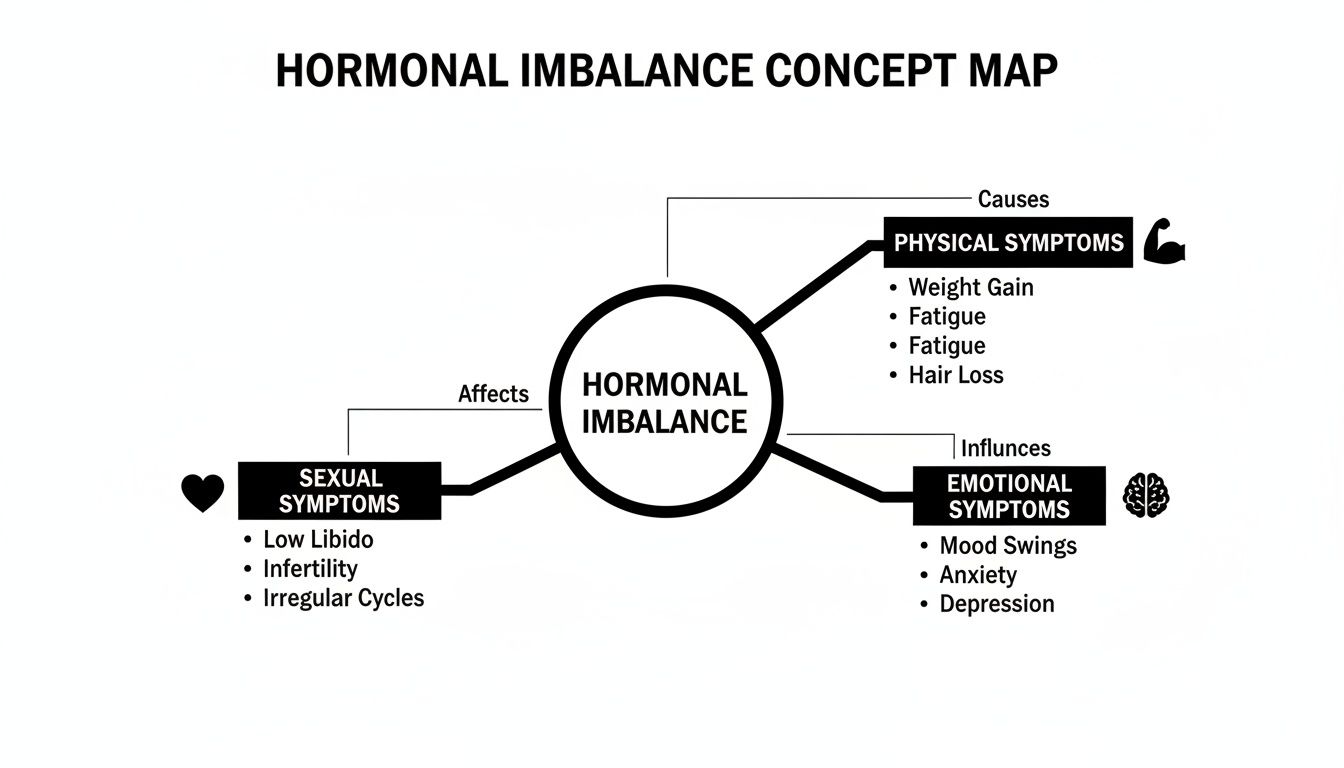
As you can see, a central hormonal issue can branch out to affect nearly every part of a man's well-being.
The symptoms of hormonal imbalance in men often show up as signs of hypogonadism (low testosterone), and their prevalence climbs steeply with age. Research shows that biochemical hypogonadism affects 12% of men in their 50s, a number that jumps to a startling 49% by age 80.
Male factors are involved in about half of all infertility cases, often stemming from untreated issues like a decreased sex drive. You can read the full research on hormonal trends and male health on NCBI.
A Detailed Breakdown of Hormonal Imbalance Symptoms in Men

It’s one thing to know which hormones might be involved, but it’s something else entirely to connect those names to what you’re actually feeling day after day. If you’ve been dealing with changes you can’t quite put your finger on, this is where we get into the specifics. The symptoms of hormonal imbalance in males aren’t just in your head—they are very real, physical signals from your body telling you something is off.
Let's break these signs down into categories that make sense in the real world. As you go through them, see what resonates. Think of this not as a checklist for self-diagnosis, but as a guide to help you understand your body better and feel more prepared to ask the right questions.
Sexual and Reproductive Symptoms
For many men, the first alarms go off in their sexual health. This makes sense, as hormones like testosterone are the main engine driving male reproductive function. While it can be a sensitive topic, it's an incredibly important one to address head-on.
Some of the most common signs here include:
- Low Libido: We're not talking about just not being "in the mood" once in a while. This is a persistent, noticeable drop in your desire for sex that doesn't seem to bounce back, even when life’s other stresses calm down.
- Erectile Dysfunction (ED): While a lot of things can contribute to ED, hormonal imbalances—especially low testosterone or even elevated estrogen—are a very common cause. It might show up as trouble getting an erection or keeping one firm enough for sex.
- Male Infertility: This is the most direct reproductive red flag. A hormone imbalance can throw a wrench in the whole sperm production system, leading to low sperm count, poor sperm movement (motility), or abnormally shaped sperm—all of which can make it very difficult to start a family.
These issues are deeply personal and can be tough to discuss, but they are legitimate medical symptoms. Acknowledging them as potential signs of a hormonal issue is the first and most critical step. If you're experiencing these, speaking with a healthcare professional is a positive next step.
Physical Symptoms
Beyond the bedroom, a hormonal imbalance can announce itself all over your body. These physical changes can be especially frustrating because it often feels like you’re losing control, even when you’re still putting in the work at the gym and in the kitchen.
You might be experiencing physical shifts like:
- Persistent Fatigue: This isn't just feeling tired. It's a deep, bone-weary exhaustion that a good night's sleep just doesn't seem to touch. It’s that feeling of constantly running on empty, a classic sign of low testosterone or a thyroid problem.
- Loss of Muscle Mass and Strength: Are you working out just as hard but seeing less definition, or struggling with weights that used to be manageable? Hormones are crucial for building and maintaining muscle. A dip in testosterone can make it much harder to hold onto your gains.
- Increased Body Fat: The accumulation of fat around the stomach and chest area is a particularly frustrating sign. This can happen even if your diet is on point and is often linked to a combination of low testosterone and high estrogen. The development of actual breast tissue, known as gynecomastia, is a very specific tell-tale sign.
- Hair Loss: Genetics obviously play a huge role here, but a sudden or unusual thinning of hair on your body or face can also point to a hormonal cause.
These symptoms can slowly chip away at your confidence. It's vital to see them not as personal failures but as clues pointing to an underlying imbalance. The right course of action is to investigate further with testing.
Emotional and Mental Symptoms
The impact of a hormonal imbalance goes far beyond the physical; it can profoundly affect your mental and emotional well-being. When your hormones are out of sync, it can feel like your own mind is working against you. This is often the most overlooked piece of the puzzle.
Think of your hormones as the chemical foundation for your mood and mental sharpness. When that foundation is shaky, everything you build on it—your focus, your motivation, your emotional stability—can start to feel unstable, too.
Mental and emotional signs to watch for include:
- Mood Swings or Irritability: Do you find yourself snapping over small things or feeling emotionally volatile? Fluctuating hormone levels can shorten your fuse and make it much harder to keep your emotions in check.
- Brain Fog or Difficulty Concentrating: This is that maddening feeling of just not being able to think clearly. You might struggle to focus at work, forget simple things, or just feel like your brain is wading through mud.
- Lack of Motivation: A serious drop in your drive and ambition is a hallmark of low testosterone. Hobbies you once loved can feel like a chore, and it can be a real struggle to muster the energy to go after your goals.
- Feelings of Depression or Sadness: While not a substitute for a mental health diagnosis, a persistent low mood can be directly tied to hormonal issues, particularly when it shows up alongside other physical symptoms on this list.
If these signs sound familiar, it’s important to know that your body's chemistry could be playing a major role. Getting to the root of the hormonal cause is often the key to starting to feel like yourself again. An actionable next step is to schedule a check-up to discuss these symptoms.
Exploring the Causes of Hormonal Imbalances in Men

To fix a problem, you have to understand where it’s coming from. A hormonal imbalance rarely just appears out of thin air; it’s usually the end result of one or more factors throwing your body’s natural rhythm out of whack. When you start connecting the dots back to the root causes, you can take meaningful, targeted action.
Think of your hormonal health like a finely tuned orchestra. So many things—from your age to your stress levels to what you had for dinner—have to work in harmony. If one instrument is out of tune, the whole performance can feel off.
The Natural Impact of Aging
It's no secret that our bodies change as we get older, and hormones are a big part of that story. For most men, testosterone levels hit their peak in the late teens and early twenties. After about age 30, they typically begin a slow, gradual decline.
This natural dip, sometimes called andropause, is a fact of life. But here’s the key: while aging itself is unavoidable, the speed of that decline isn't set in stone. The lifestyle choices you make can either hit the accelerator on that process or help you pump the brakes, maintaining healthier hormone levels for years to come.
The Power of Lifestyle Factors
Your daily habits have a huge say in your hormonal health. We often brush off things like sleep, diet, and stress as secondary, but when it comes to your hormones, they are front and center. They are the major levers that can either support your body or actively work against it.
Let's break down some of the biggest lifestyle culprits:
- Chronic Stress: When you’re constantly under pressure, your body pumps out the stress hormone, cortisol. High cortisol sends a direct signal to your system to suppress testosterone production. It's a physiological tug-of-war, and your energy, libido, and even fertility can end up on the losing side.
- Poor Nutrition: Your body can't just create hormones out of nothing. It needs the right raw materials, like zinc, vitamin D, and healthy fats. A diet filled with processed foods, sugar, and unhealthy fats is like trying to build a house with cardboard—it just doesn't work.
- Inadequate Sleep: Sleep is primetime for hormone production, especially testosterone. Consistently skimping on sleep and getting less than seven hours a night can crush your T-levels, with some studies showing a drop of as much as 10-15%.
These things don't happen in a bubble, either. They create a vicious cycle: stress ruins your sleep, exhaustion leads to poor food choices, and all of it keeps hammering your hormones.
The connection is clear: Your daily routine is a constant conversation with your hormones. The choices you make every day are either helping to create balance or contributing to the imbalance.
Underlying Medical Conditions and Influences
Sometimes, a hormonal imbalance isn't just a lifestyle issue—it can be a red flag for a deeper medical condition that needs attention. It’s crucial not to overlook these possibilities, because treating the underlying problem is often the only way to resolve the hormonal symptoms for good.
Certain health conditions are well-known for disrupting male hormones:
- Obesity: Fat cells aren't just for storage; they are metabolically active. Abdominal fat, in particular, produces an enzyme called aromatase, which converts your precious testosterone into estrogen. The more excess body fat you carry, the more this conversion happens, creating a damaging imbalance of low testosterone and high estrogen.
- Thyroid Disorders: Your thyroid acts like the conductor of your body's metabolic orchestra. Whether it’s underactive (hypothyroidism) or overactive (hyperthyroidism), it can throw your entire hormonal system into chaos, directly impacting testosterone levels and sperm health.
- Type 2 Diabetes: The link between diabetes and low testosterone is a two-way street. Men with diabetes are about twice as likely to have low testosterone. On the flip side, men with low testosterone have a higher risk of developing diabetes down the road.
Finally, we're constantly exposed to environmental chemicals, and some, known as endocrine disruptors, can mimic or block our natural hormones, creating serious interference. Getting a handle on all these potential causes gives you a much clearer map for navigating the path back to balance.
How to Get Tested and Finally Get Clear Answers
Recognizing the symptoms of a hormonal imbalance is a huge step forward, but it's only half the journey. The other half is getting definitive proof of what’s happening inside your body so you can take targeted, effective action.
If you’re tired of guessing and ready for clarity, this is your roadmap. Moving from suspicion to certainty involves a couple of key diagnostic tests. Think of it like a detective investigating a case—you need to gather all the evidence before you can solve the mystery. For male reproductive health, this means looking at both your hormone levels and your sperm health. They are two sides of the same coin.
Your Starting Point: The Hormone Panel Blood Test
The first piece of the puzzle is a straightforward blood test, often called a hormone panel. This test measures the levels of key hormones circulating in your bloodstream, giving you a clear snapshot of your endocrine function.
It’s a simple procedure, usually done in the morning when testosterone levels are naturally at their highest, and it provides a wealth of information. While a full panel can check many things, a few markers are especially important for a man's vitality and fertility:
- Total and Free Testosterone: This shows not just how much testosterone you have, but more importantly, how much is biologically active and available for your body to actually use.
- Luteinizing Hormone (LH): Produced by the pituitary gland, LH is the messenger that tells your testicles to produce testosterone. Think of it as the signal from the command center in your brain.
- Estradiol (Estrogen): As we've discussed, getting the balance right is critical. This test ensures your estrogen levels aren't out of whack compared to your testosterone.
- Thyroid-Stimulating Hormone (TSH): This gives a direct look at your thyroid health—the engine for your body's metabolism, which has a major impact on fertility.
Getting these levels checked provides the hard data needed to confirm if a hormonal imbalance is behind the symptoms you're experiencing.
The Second Critical Piece: The Semen Analysis
A hormone test tells you about the command system, but a semen analysis tells you about the results on the ground. Because hormones directly govern sperm production, you can't get a complete picture of your reproductive health without it. This is an absolutely critical step for any man concerned about fertility.
A semen analysis examines several key factors under a microscope:
- Sperm Count (Concentration): How many sperm are in your sample.
- Sperm Motility: How well your sperm can swim and move forward.
- Sperm Morphology: The size and shape of your sperm.
Think of it this way: Your hormones are the factory managers, and your sperm are the final product. A problem with management (a hormonal imbalance) will almost always show up as a problem in the final product (poor sperm health). Testing both is non-negotiable for getting the full story.
A Simpler Path to Clear Answers
Navigating doctor’s appointments and lab orders can feel overwhelming. That’s why Hera Fertility was created—to provide a more direct path to the answers you need. We help you get a physician-approved lab order for both a comprehensive hormone panel and a semen analysis in minutes. You can then get tested at one of over 250 certified labs near you, on your schedule.
Once your results are ready, the real challenge often begins: deciphering a complex lab report filled with medical terms and ranges. This is where the Hera SmartScore comes in. Our system analyzes those complex numbers for sperm count, motility, and more, translating them into a single, easy-to-understand score.
More importantly, it doesn't just give you a number; it gives you a personalized action plan. Based on your specific results, you'll receive clear, actionable steps you can take to support your hormonal health and improve your fertility. This approach removes the confusion, empowering you to move forward with confidence and a clear plan.
Taking Control: Your Action Plan for Hormonal Balance

Getting a diagnosis is the starting line, not the finish. The real journey begins now, and it’s all about taking proactive steps to regain control. Depending on what’s causing the imbalance, your doctor might recommend specific medical treatments. A common one you’ll hear about is Testosterone Replacement Therapy (TRT), designed to bring your levels back into a healthy range and tackle symptoms like fatigue and a lagging libido.
But TRT is a big step, and it’s certainly not for everyone—especially if you're trying to start a family. The good news is that alongside any medical treatment, you have a powerful set of lifestyle tools at your disposal. These are changes you can make today to naturally support your hormones and fertility, and they can make a world of difference.
Fuel Your Body for Hormonal Success
What you eat directly becomes the building blocks for your hormones. It's that simple. Don't think of it as a diet; think of it as strategically fueling your body's internal hormone factory.
You'll want to focus on a few key players:
- Zinc-Rich Foods: This mineral is non-negotiable for testosterone production. Load up on oysters, beef, and pumpkin seeds.
- Healthy Fats: Your body actually needs cholesterol to make testosterone. Get the good stuff from avocados, olive oil, and nuts.
- Vitamin D: Often called the "sunshine vitamin," it acts more like a hormone in your body. You can get it from sun exposure, fatty fish like salmon, or fortified milk.
When you prioritize whole, nutrient-packed foods, you’re giving your body exactly what it needs to find its balance again.
Move with Purpose to Boost Testosterone
Exercise is one of the most potent signals you can send your body to ramp up testosterone. But not all workouts are created equal.
Strength training is the king here. Lifting heavy weights forces your muscles to repair and grow, a process that screams for testosterone. Your endocrine system gets the message loud and clear: it’s time to get to work.
Focus on big, compound movements that use multiple muscle groups—think squats, deadlifts, and bench presses. They give you the most bang for your buck hormonally. High-intensity interval training (HIIT) is another fantastic option for a powerful boost. The secret sauce is consistency.
Master Your Stress and Prioritize Sleep
If testosterone has an arch-nemesis, it’s chronic stress. When you’re constantly on edge, your body is flooded with the stress hormone cortisol, which actively suppresses testosterone.
This isn’t about eliminating all stress—that's impossible. It's about managing it. Simple techniques like deep breathing, meditation, or just carving out time for a short walk can dial down cortisol and give your testosterone a fighting chance.
Finally, sleep is non-negotiable. Aim for 7-9 hours of quality sleep every single night. Your body does the crucial work of producing and regulating hormones while you’re asleep. Cutting corners on sleep is one of the fastest ways to tank your levels. Think of rest as your body's reset button.
Burning Questions About Male Hormonal Imbalance
We get it—navigating hormonal health can feel like a maze. Here are some of the most common questions we hear from men, answered simply.
Is It Possible to Fix a Hormonal Imbalance Naturally?
Sometimes, yes. If your hormones are slightly out of whack due to things like a poor diet, not enough sleep, or chronic stress, making meaningful lifestyle changes can absolutely move the needle. You'd be surprised how much better you can feel just by cleaning up your habits.
However, if the root cause is something more complex, like a genetic issue or another underlying medical condition, lifestyle tweaks alone probably won't cut it. That's where professional treatment comes in. The only way to know for sure what's going on and how to fix it is to get tested and pinpoint the source of the symptoms of hormonal imbalance in males.
How Long Does It Take to Feel a Difference After Starting Treatment?
This is the million-dollar question, and honestly, it's different for every man. If you're making lifestyle changes, you might start feeling more energetic within a few weeks. When it comes to medical treatments like TRT, some men notice their libido picking up in about a month, but seeing real changes in things like muscle mass can take six months or more.
The key takeaway? Be patient and consistent.
The single biggest piece of the puzzle is correctly identifying what's causing the imbalance in the first place. For instance, if you're under constant stress, your cortisol levels will stay sky-high. High cortisol actively suppresses testosterone production and can be a major roadblock to fertility. Getting a handle on stress isn't just a "nice-to-have"; it's essential for getting your hormones back on track.
Tired of guessing what's going on with your health? Hera Fertility offers a clear, physician-backed way to get both a comprehensive hormone panel and a semen analysis. We help you understand your results with our easy-to-read SmartScore and give you a personalized action plan to take back control.
Start your journey to clear answers today.
Related Resource Articles
-
Understanding Male Hormone Imbalance Symptoms and Their Impact on Fertility
Discover male hormone imbalance symptoms and how they affect energy, mood, and fertility. Learn practical steps to restore balance today.
25 min read
-
Vasectomy and Erectile Dysfunction A Guide for Men
Worried about the link between vasectomy and erectile dysfunction? We explore the evidence, debunk common myths, and explain what to expect. Get clarity now.
17 min read
-
What Does Watery Sperm Mean for Male Fertility?
Concerned about what does watery sperm mean? Learn the common causes, how it impacts male fertility, and what actionable steps you can take for your health.
18 min read