When you're trying to grow your family, feeling constantly tired, moody, or just not interested in sex can be confusing and disheartening. More often than not, these are tell-tale male hormone imbalance symptoms that have a very real impact on your reproductive health. Getting to know these signs is the first real step toward taking back control of your fertility journey.
Recognizing the Signs of Male Hormone Imbalance
If you've been struggling to conceive, it's easy to overlook a huge piece of the puzzle. We tend to write off low energy, weight gain, or a short temper as just byproducts of a stressful, modern life. But these can be critical signals from your body that your hormones are out of balance—and that imbalance can directly affect your ability to have a baby.
Think of your endocrine system as a finely tuned orchestra, with each hormone playing a crucial part in creating healthy sperm. When a key instrument like testosterone is out of tune, the whole performance—your fertility—falters.
The Connection Between Symptoms and Male Fertility
These signs aren't just inconvenient; they're the external clues to an internal problem that's likely interfering with sperm production. Recognizing them isn't about placing blame—it's about understanding your biology so you can take action.
The World Health Organization points to hormonal disorders as a major driver of male infertility because they can directly disrupt sperm count, motility, and morphology. It’s a widespread issue. Testosterone deficiency, for example, affects a huge portion of the male population—some studies show it impacts as many as 10-40% of men. While it’s more common with age, it can hit men at any point in their reproductive lives. You can discover more insights about the global impact of testosterone deficiency from this research.
The takeaway is simple: How you feel on the outside is often a direct reflection of your fertility health on the inside. Persistent symptoms are your body's way of telling you it's time to dig deeper.
To help you connect the dots, we’ve broken down the most common signs of a male hormone imbalance into three key areas. This gives you a clear framework for figuring out what you’re experiencing. For an even more comprehensive look, check out our guide on male infertility signs.
Quick Guide to Male Hormone Imbalance Symptoms
It can be tough to connect something like "brain fog" to your fertility, but it's all linked. This quick guide breaks down the physical, sexual, and emotional signs for men to watch for and shows you exactly how they tie back to reproductive health.
| Symptom Category | Specific Signs You Might Notice | How It Directly Affects Male Fertility |
|---|---|---|
| Physical | Unexplained weight gain (especially belly fat), fatigue, decreased muscle mass, and hair loss. | These signs often point to low testosterone or high estrogen, which can disrupt the delicate signals needed for healthy sperm production. |
| Sexual | Low libido (sex drive), erectile dysfunction (ED), and reduced testicular size. | A healthy sex drive and function are closely linked to optimal hormone levels—the same hormones essential for sperm development and maturation. |
| Emotional | Mood swings, irritability, depression, anxiety, and "brain fog" or difficulty concentrating. | Hormones like testosterone play a key role in regulating a man's mood and cognitive function; imbalances here can signal systemic issues that also affect fertility. |
Seeing your own experience reflected in this table can be the first step toward getting the right diagnosis and treatment. Once you identify what’s going on, you can start taking meaningful steps to improve both your overall health and your fertility.
The Hormonal Team Driving Male Fertility
When we talk about male fertility, it's easy to zero in on testosterone. But that's only part of the picture. To really understand how hormonal imbalances can throw a wrench in the works, it helps to think of a man's reproductive system as a high-tech factory dedicated to one thing: producing healthy sperm.
This whole operation is run by a tight-knit team of hormones, and each one has a very specific job. When they're all in sync, the factory runs like a well-oiled machine. But if just one team member starts slacking off or causing trouble, the entire production line can grind to a halt. This team isn't just testosterone; it includes crucial hormones from the brain that act as the managers and supervisors. Getting to know their roles is the first step toward figuring out where a problem might be coming from.
Meet the Key Players
A man's fertility is really a constant conversation between his brain and his testes. This back-and-forth happens through a handful of key hormones, each carrying critical messages to keep that sperm production line on schedule.
Here are the four main players on your hormonal team:
- Luteinizing Hormone (LH): Think of this as the "Line Supervisor." It travels from your brain to your testes and gives the direct order to produce testosterone.
- Follicle-Stimulating Hormone (FSH): This is the "Factory Manager." Its job is to tell the testes to actually start making sperm.
- Testosterone: This hormone is your "Quality Control Expert." It’s responsible for making sure sperm mature correctly and are fully functional.
- Estrogen: Men need small, necessary amounts of this hormone to help with sperm maturation, but it can cause major problems if levels get too high.
This group works in a delicate feedback loop. A signal from the brain (LH and FSH) triggers action in the testes (testosterone and sperm production), and the testes send signals back to the brain to let it know everything is on track. Any breakdown in this communication can lead to noticeable symptoms and, of course, impact a man's fertility.
The chart below shows just how interconnected things are—how an imbalance can trigger physical, sexual, and emotional symptoms all at once.
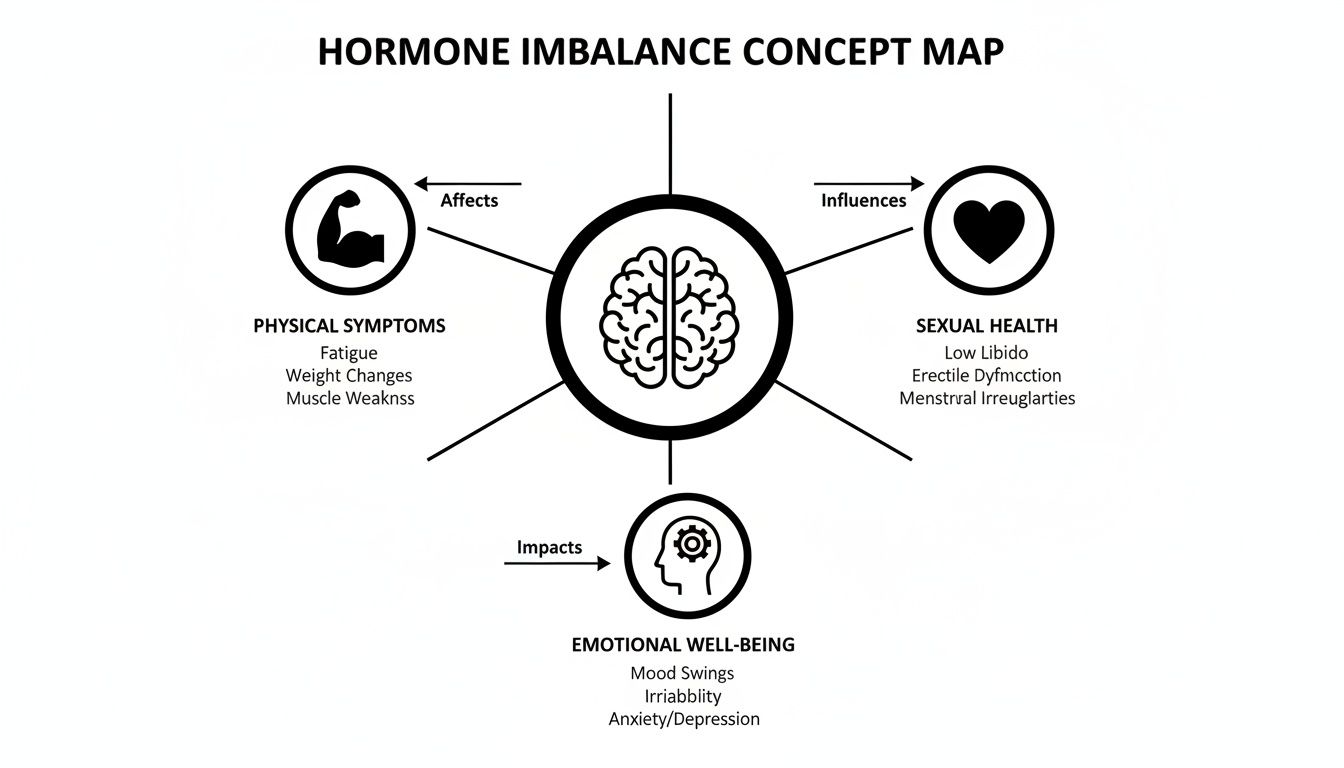
As you can see, a central issue originating from a man's hormonal control center can branch out, affecting everything from muscle mass and mood to libido.
How the Hormonal Assembly Line Works
Let’s go back to our factory analogy to see how this team actually works together. It’s a process that demands precision, timing, and clear communication from the top down.
The whole thing starts in the brain. The pituitary gland, which is basically the master controller, sends out two key messengers into the bloodstream: LH and FSH.
When LH (the Line Supervisor) arrives at the testes, it gives a direct order to specialized cells to get to work producing testosterone. Without that signal, testosterone production slows to a crawl, gumming up every other stage of the process.
At the same time, FSH (the Factory Manager) also arrives at the testes. Its job is to kickstart the machinery of spermatogenesis—the literal process of creating new sperm. You can think of FSH as the one who turns on the lights and powers up all the equipment in the factory.
The core idea is simple but incredibly powerful: A man's brain has to give the right orders for his testes to do their job. If the signals are weak, confused, or ignored, the entire system falters, and sperm health pays the price.
Once the factory is up and running, Testosterone (the Quality Control Expert) steps in. It's not enough to just make sperm; they need to be matured properly. Testosterone is absolutely essential for this final, critical stage, making sure each sperm develops the right shape and the ability to swim effectively.
When a Saboteur Enters the System
Even with a great team, things can get disrupted. In the male hormonal system, the most common saboteur is an excess of estrogen. While men need a small amount of estrogen for things like bone health and even sperm maturation, too much of it can wreak havoc.
High estrogen levels essentially send confusing signals back to the brain, telling it to slow down or even stop sending out LH and FSH. It’s like a troublemaker telling the factory managers that production targets have already been met, so they might as well shut everything down for the day.
This disruption kicks off a chain reaction:
- The brain dials back the LH and FSH signals.
- With fewer signals, the testes produce less testosterone.
- Lower testosterone levels mess with sperm maturation and quality control.
- Ultimately, the factory’s output of healthy, functional sperm plummets.
This is a classic example of a male hormone imbalance. It’s not just about one hormone being "low"—it’s about the entire team being out of sync, with one bad actor disrupting the whole system. The symptoms you feel, like low energy or a lagging libido, are really just the outward signs of this internal breakdown.
How Hormonal Imbalances Impact Your Sperm Health
The physical and emotional symptoms of a hormone imbalance are often just the tip of the iceberg. Underneath the surface, these same hormonal disruptions can have a direct, and often significant, impact on your sperm health—the very foundation of male fertility. This is where we connect the dots between how you feel day-to-day and your long-term goal of starting or growing your family.

A semen analysis report boils down to three core pillars of sperm health: count, motility, and morphology. Think of them as the three most important stats for your team’s success. A hormonal imbalance can weaken one, two, or all three of these pillars, making the path to conception much more challenging.
Low Power at the Sperm Factory: Low Testosterone and Sperm Count
Low testosterone is one of the most common issues for men, and its effect on sperm count is direct. Imagine your body’s sperm production system is a high-tech factory. Testosterone is the main power source that keeps the entire assembly line humming at full capacity.
When testosterone levels drop, it's like trying to run that factory on a low-power setting. The machinery slows, production becomes inefficient, and fewer units—in this case, sperm—roll off the line. This often leads to a condition called oligospermia, or low sperm count.
Globally, conditions like late-onset hypogonadism (LOH) affect a huge number of men, driven by factors like aging, obesity, and diabetes. These hormonal issues are a primary cause of male infertility, with imbalances from testicular or pituitary problems slashing sperm quality. In fact, these disruptions can lead to conditions like oligospermia in up to 40% of men with testosterone deficiency. You can read the full research about hormonal disruptions and male fertility here.
Navigation Errors: High Estrogen and Sperm Shape
While low testosterone can dial down the quantity of sperm, elevated estrogen often messes with their quality. Specifically, it can lead to poor morphology, which is just a technical term for the shape and structure of the sperm. For a sperm to successfully fertilize an egg, it needs a very specific build: an oval head and a long tail.
Think of a healthy sperm as a perfectly engineered vehicle designed for one mission. High estrogen levels act like a saboteur in the factory, causing defects during assembly. This results in sperm with misshapen heads, bent tails, or other structural flaws that render them ineffective.
These defective sperm simply can't swim properly or penetrate an egg’s outer layer. It doesn't matter how many sperm a man produces; if their shape is compromised, their mission is destined to fail.
The key takeaway is simple but vital for any man trying to conceive: Healthy hormones build healthy sperm. You cannot have optimal sperm health without a balanced hormonal foundation.
Compromised Fuel for the Journey: Thyroid Issues and Motility
Hormonal issues aren't limited to just testosterone and estrogen. A man's thyroid, the gland that controls the body's entire metabolism, also plays a critical role in male fertility. An underactive or overactive thyroid can directly impact sperm motility—their ability to swim forward effectively.
Think of sperm as swimmers in a long-distance race. Proper thyroid function provides them with the right energy and metabolic support to complete their journey. When the thyroid is out of balance, it’s like giving those swimmers a poor-quality energy drink. They might start the race, but they’ll quickly run out of steam and lack the forward momentum needed to reach the finish line. This condition, known as asthenospermia (poor motility), is another common finding in men with hormonal imbalances.
By understanding how specific hormones affect sperm count, shape, and movement, you can begin to see why getting your levels checked is such a crucial step. It helps you and your doctor understand the "why" behind your semen analysis numbers and create a targeted plan to restore your hormonal balance and, in turn, your fertility.
Uncovering the Root Causes of Hormonal Disruption
Once you discover a male hormone imbalance is part of your fertility picture, the next question is always, "Okay, but why is this happening?" It's natural to feel frustrated, but the good news is that these disruptions usually have clear, identifiable causes—many of which are well within your control.
This isn’t about personal failure; it’s about biology. By digging into the common culprits, from daily habits to underlying health issues, we can turn a confusing problem into a manageable one with a clear path forward.
Lifestyle Factors You Can Influence
A man's daily habits are like the conductor of his body's hormonal orchestra. Think of it like a high-performance engine: the fuel you use, the rest it gets, and the stress it's under all dictate how well it runs.
Three key lifestyle areas can throw male hormones out of whack:
- Poor Diet and Excess Body Fat: A diet heavy on processed foods, sugar, and unhealthy fats can directly interfere with hormone production. Even more impactful, excess body fat—especially around the midsection—is home to an enzyme called aromatase. This enzyme actively converts your precious testosterone into estrogen, creating a double-whammy of low T and high estrogen that can be brutal for sperm production.
- Chronic Stress: When a man is constantly under pressure, his body is flooded with the stress hormone cortisol. Here's the catch: the body uses the same biological building blocks to make cortisol that it does to make testosterone. When stress is always high, testosterone production gets pushed to the back of the line.
- Lack of Quality Sleep: Your body does some of its most important work while you're asleep, including producing a huge chunk of your daily testosterone. Consistently skimping on 7-8 hours of quality sleep can cause T levels to plummet, affecting everything from energy to sperm count.
Underlying Medical Conditions
Sometimes, a hormone imbalance is actually a symptom of a deeper medical issue that needs a closer look. These are physiological conditions that can throw a man's entire endocrine system off balance.
For men on a fertility journey, stubborn symptoms like low mood and poor sperm parameters are often driven by testosterone deficiency. This is especially true for late-onset hypogonadism (LOH), a condition that affects about 2.1% of men aged 40-79. The risk gets much worse with factors like weight gain and other diseases. In fact, obesity can double a man's risk of testosterone deficiency, and men with low T have a 2-3 times higher chance of developing insulin resistance and diabetes, which adds another layer of complication to fertility. You can dive into the research on how weight and disease impact male hormones in this detailed study on human reproduction.
Beyond issues directly related to male hormones, other endocrine problems can be at play. For example, the well-established link between thyroid disorders and overall wellness shows how systemic hormonal imbalances can be the root cause of many different health concerns.
The Natural Process of Aging
Finally, it’s a simple biological fact: testosterone levels naturally decline as men get older. This slow and steady decrease usually starts around age 30 and continues for the rest of a man’s life.
While aging is inevitable, a steep or premature drop in hormones isn't. Lifestyle and medical factors can hit the accelerator on this process, turning it into a much bigger hurdle for fertility.
This is exactly why it’s so important to look at all the pieces of the puzzle. By identifying the root causes—whether it's getting a handle on stress, cleaning up your diet, addressing a thyroid issue, or simply understanding the effects of aging—you and your doctor can build a targeted plan to restore balance and get you closer to your fertility goals.
Your Action Plan for Getting Diagnosed
Figuring out if you have a hormone imbalance can feel pretty overwhelming. It's totally normal to feel that way. But getting answers doesn't have to be a complicated or intimidating ordeal. Think of this as your roadmap to taking back control.
Here’s a straightforward plan to move from uncertainty to clarity, turning the whole diagnostic process from a roadblock into an empowering first step.
The journey always starts with a simple conversation. First things first: book an appointment with your doctor or a fertility specialist to talk about the symptoms you've been noticing. Be completely open about everything, whether it's low energy, mood swings, or changes in your sex drive. This initial chat is what sets the stage for a targeted investigation into what's going on with your hormones.
Based on that conversation, your doctor will likely order two key tests. These are the cornerstones of any male fertility evaluation, and they work together to paint a full picture of your reproductive health.
The Two Pillars of Male Fertility Testing
To really understand what’s happening, you need to look at both the "factory" (your testes) and the "product" (your sperm). This means two different, but equally important, tests.
- Hormone Panel Blood Test: This test measures the levels of key hormones circulating in your blood. It’s like checking the signals being sent from your brain and how your testes are responding.
- Semen Analysis: This one directly examines your sperm, assessing critical factors like count, motility (how they swim), and morphology (their shape). Think of it as the ultimate quality control check on your factory's output.
These tests aren't an either/or situation; they provide different pieces of the same puzzle. Very often, your hormone levels can explain the results of your semen analysis, creating a clear link between cause and effect.
Demystifying Your Blood Test Results
When you get your hormone panel back, you’ll probably see terms like "total" and "free" testosterone, and it's crucial to know the difference. Total testosterone measures every bit of testosterone in your blood, but a lot of it is attached to proteins, making it unavailable for your body to actually use.
Free testosterone is the good stuff—the active, unbound hormone that's actually doing the work. It powers your energy levels, libido, and sperm production. A man can have a normal total testosterone level but low free testosterone, which can absolutely cause symptoms. This is exactly why getting a comprehensive panel that checks both is so important for an accurate diagnosis.
Simplifying Your Semen Analysis with Hera Fertility
While a blood test is pretty straightforward, getting a semen analysis has traditionally been a clunky, and let's be honest, sometimes awkward process. This is where modern solutions can make a world of difference.
Hera Fertility was designed to remove that friction, making testing private and accessible. We wanted to get rid of the common barriers that stop men from getting the answers they need.
The platform lets you order a physician-signed lab requisition online in just a few minutes. From there, you can visit one of over 250 CLIA-certified labs across the USA and Canada whenever it works for you. No more awkward handoffs or complicated scheduling.
Once your results are in, they’re analyzed and delivered as an easy-to-understand Hera SmartScore. This score translates all that complex data about your sperm count, motility, and morphology into clear insights. Instead of a confusing lab report, you get actionable information that actually makes sense.
This step-by-step table breaks down how the entire diagnostic journey works and how Hera streamlines the key parts.
Your Fertility Testing Roadmap
| Diagnostic Step | What It Involves | How Hera Fertility Simplifies the Process |
|---|---|---|
| 1. Initial Consultation | Discussing your symptoms, health history, and concerns with a doctor or fertility specialist to determine the next steps. | While we recommend seeing a specialist, our educational resources can help you prepare for a more productive conversation with your doctor. |
| 2. Hormone Blood Panel | A simple blood draw at a lab to measure key male hormones like testosterone (total and free), LH, FSH, and others. | You can easily get the necessary requisition through your primary care physician or a specialist. |
| 3. Semen Analysis | Providing a semen sample at a clinic or lab for microscopic evaluation of sperm count, motility, and morphology. | Order a lab requisition online, visit a local certified lab discreetly, and avoid the awkwardness of a traditional clinic visit. |
| 4. Results Interpretation | Receiving and trying to understand complex lab reports filled with medical jargon and reference ranges. | Your results are translated into a simple Hera SmartScore, giving you a clear, easy-to-understand overview of your sperm health. |
| 5. Follow-Up & Action Plan | Reviewing all test results with your doctor to discuss a diagnosis and create a personalized treatment or lifestyle plan. | Armed with your clear Hera SmartScore report, you can have a more informed and effective discussion with your doctor about next steps. |
By breaking it down this way, the path to getting answers becomes much clearer and less intimidating. This whole approach puts you in the driver's seat, armed with the information you need to have a truly productive conversation with your doctor about what comes next.
Pathways to Restoring Your Hormonal Balance
Getting a diagnosis of a male hormone imbalance isn't the end of the road; it's the start of your action plan. This is your guide to getting back on track, covering both the powerful lifestyle strategies you can start today and the medical treatments that can help restore your body’s natural rhythm. The whole point is to build a plan that supports your overall health and your fertility goals.

For many men, significant improvements come from dedicated lifestyle changes alone. These habits are the absolute foundation of hormonal health. Think of your body as a high-performance engine—it needs the right fuel, proper maintenance, and good operating conditions to run smoothly.
Lifestyle Strategies for Natural Hormone Support
You have more power than you think to influence your hormonal health through your daily habits. Making these changes can create an internal environment that’s primed for testosterone production and better sperm health. They’re immediate steps you can take to feel more in control.
Nutrition as a Foundation
- Focus on Key Nutrients: Zinc is absolutely vital for testosterone production—you can find it in lean meats, nuts, and seeds. Vitamin D, often called the "sunshine vitamin," actually functions like a hormone and is crucial for male reproductive health.
- Balance Your Plate: Make sure every meal has a good mix of quality protein, healthy fats (like avocados and olive oil), and complex carbs from vegetables. This simple move helps keep your blood sugar and insulin stable, preventing hormonal dips.
Smart and Targeted Exercise
- Prioritize Strength Training: Hitting the weights has been shown to give testosterone levels a significant boost. It’s one of the most effective things a man can do.
- Avoid Overtraining: While exercise is great, too much prolonged cardio can jack up your cortisol levels, which actively works against testosterone. The sweet spot is a balanced routine of strength work and moderate cardio.
The most effective approach combines consistency with balance. Drastic diets or extreme workout regimens often backfire by creating more stress on the body, disrupting the very balance you're trying to restore.
Mastering Stress and Sleep
- Manage Cortisol: Chronic stress floods your system with cortisol, the stress hormone that directly competes with testosterone. Find ways to wind down that work for you, whether it’s mindfulness, short walks, or a few deep-breathing exercises during the day.
- Optimize Your Sleep: Your body produces a huge chunk of its testosterone while you’re in a deep sleep. Aim for 7-9 hours of quality, uninterrupted sleep every night to give your body the best shot at its natural hormone production cycle.
As you start down this path, it's also smart to think about the practical side of things. Taking the time to understand how your pre-existing conditions health insurance works is a key part of planning for your long-term health journey.
Medical Treatments for Male Fertility
Sometimes lifestyle changes aren't enough on their own, or you're dealing with a more significant imbalance. In those cases, medical intervention can be incredibly effective. For men who are trying to conceive, the focus is usually on treatments that kick-start the body's own hormone production, rather than just replacing them.
One common approach uses medications like Clomid or HCG. These work by sending a signal to your brain to produce more LH and FSH—the two key hormones that tell your testes to get to work making more testosterone and sperm. It’s like a jumpstart for your body’s internal "hormone factory."
Testosterone Replacement Therapy (TRT) is another well-known option, but it comes with a huge warning for men who are actively trying to have a baby. TRT can sometimes shut down your body's natural sperm production, essentially acting like male birth control. This is a critical point to discuss with your doctor to weigh the pros and cons for your specific fertility goals. For more ways to support your journey, you might be interested in our guide on how to increase sperm count.
Frequently Asked Questions About Male Hormones and Fertility
Diving into the world of male fertility and hormones can feel overwhelming, and it's natural to have a lot of questions. We’ve compiled answers to some of the most common concerns we hear from men, hoping to give you clarity and confidence as you move forward.
Can a Man Improve His Hormone Levels Naturally Without Medication?
Absolutely. For many men, making targeted changes to lifestyle can have a huge impact on hormonal health. This isn't about a magic pill; it's about getting back to basics.
Think of it as creating the right internal environment for your body to thrive. Focusing on a diet packed with nutrients, getting to a healthy weight, exercising regularly, and making 7-9 hours of quality sleep a non-negotiable are all incredibly powerful. Stress is a big one, too—high cortisol levels from chronic stress can directly suppress testosterone.
The crucial first step is to know your starting point. Getting tested first provides a baseline, a clear picture of what’s going on. That way, you and your doctor can figure out if lifestyle changes alone will be enough to get you where you need to be.
If a Man Has Low Testosterone, Does That Automatically Mean He Is Infertile?
No, not at all. While low testosterone is definitely a significant hurdle for sperm production and often leads to a lower sperm count, it doesn't shut the door on fatherhood. Many men with low T are still able to conceive.
The key is to avoid jumping to conclusions. What you need is the full story, which you get by combining hormone blood tests with a comprehensive semen analysis. This combination gives you a complete diagnosis, showing exactly how hormones are (or aren't) impacting sperm. From there, you and your doctor can build a treatment plan that's actually designed for your specific situation.
How Long Does It Take to See Sperm Health Improve After Treatment?
This is where patience really comes into play. The entire process of creating mature sperm—from the very beginning to the final product—is a long game. Biologically, it takes about 74 days.
Because of this timeline, you really need to give it at least two to three months after starting a treatment or making big lifestyle changes before you can expect to see real improvements in your semen analysis. Sticking with your plan consistently is everything. Follow-up testing is the only way to know for sure if your strategy is working and to track your progress over time.
Take the first step toward clarity and control over your reproductive health. With Hera Fertility, you can easily order a lab requisition, get tested at a nearby lab, and receive a simple, AI-powered analysis of your sperm health. Understand your numbers and get on the path to improvement today at https://herafertility.co.
Related Resource Articles
-
Symptoms of Hormonal Imbalance in Men and What They Mean for Fertility
Are you experiencing symptoms of hormonal imbalance in males? Learn how low T, fatigue, and mood changes can affect your fertility and what you can do about it.
24 min read
-
Semen Retention and Ejaculation Frequency: What the Science Actually Says
Does semen retention raise testosterone or improve fertility? Here's what studies show about ejaculation frequency, sperm quality, and DNA damage.
10 min read
-
High FSH & Low T: Fertility Options Explored
High FSH and low testosterone can impact male fertility. Learn about causes, treatment options, and lifestyle changes to improve your chances of conceiving.
6 min read