Receiving a lab report full of medical terms can feel like trying to read a foreign language. But understanding your sperm test results is really about turning that complex data into clear, actionable information about your health.
Think of it less like a final grade and more like a detailed check-up—one designed to give you the knowledge you need to move forward.
Why Your Sperm Test Results Matter
Getting a handle on your semen analysis is a critical first step for any man thinking about his fertility. Whether you're actively trying to start a family, confirming the success of a vasectomy, or just getting a baseline of your health, this report provides a vital snapshot.
It's the tool that moves you from uncertainty to clarity, giving you a solid foundation to build on.
This guide will cut through the medical jargon and explain what each number on your report actually means for you. Our goal is to help you feel confident and informed, turning a confusing document into a clear plan. We'll walk through every key metric, what it means for your personal journey, and what to do next.
A Starting Point, Not an Endpoint
It’s crucial to see your semen analysis as a starting point. Male fertility isn’t set in stone; it can change with your lifestyle, overall health, and even your stress levels. A single test is just a picture of your health at one specific moment.
A sperm test result is a data point that helps you understand where you stand right now. It's not a final verdict on your ability to become a father, but a guide for taking proactive control of your health.
Because of these natural fluctuations, a result outside the typical range is often just a signal to look a little closer. It’s a prompt to talk with a doctor and consider making some positive changes.
What This Guide Will Cover
To help you get a firm grasp on your report, we’re breaking down everything you need to know. Here’s what we’ll explore together:
- Decoding Key Metrics: We'll translate terms like sperm count, motility, and morphology into simple, understandable concepts.
- Understanding Abnormal Results: We’ll explain what common findings mean without causing alarm, focusing on context and next steps.
- Identifying Common Causes: You'll learn about the lifestyle and medical factors that can influence your sperm health.
- Creating an Action Plan: We will provide a clear roadmap for what to do after you get your results.
Decoding the Key Numbers on Your Semen Analysis
Getting your semen analysis report back can feel like being handed a complex scorecard for a game you don’t know the rules to. But once you understand the key players, those numbers start to make a lot more sense. Think of it as a scouting report for your sperm—assessing the team's size, speed, and overall fitness.
Your fertility is a team effort, and your sperm are the players. The analysis simply tells you the strengths and weaknesses of your team on any given day.
The Three Core Metrics of Male Fertility
Your report will list several parameters, but three stand out as the most critical for understanding your reproductive health: sperm concentration, motility, and morphology.
Sperm Concentration (The Team Roster): This is the number of sperm packed into each milliliter of semen. Think of it as the total number of players you have available. A bigger roster means more players on the field, which statistically raises the odds of success.
Motility (The Players' Speed and Agility): This metric measures how many of your sperm are moving—and just as importantly, how they're moving. It’s not enough to have players; you need players who can actually run, swim, and push forward. Progressive motility, which counts the sperm moving purposefully forward, is especially important.
Morphology (The Players' Physical Condition): This refers to the size and shape of your sperm. Just like an athlete needs to be in proper physical form to perform well, sperm need a specific structure—an oval head and a long tail—to do their job correctly.
This visual guide shows how the knowledge from your report connects to your broader health and fertility journey.
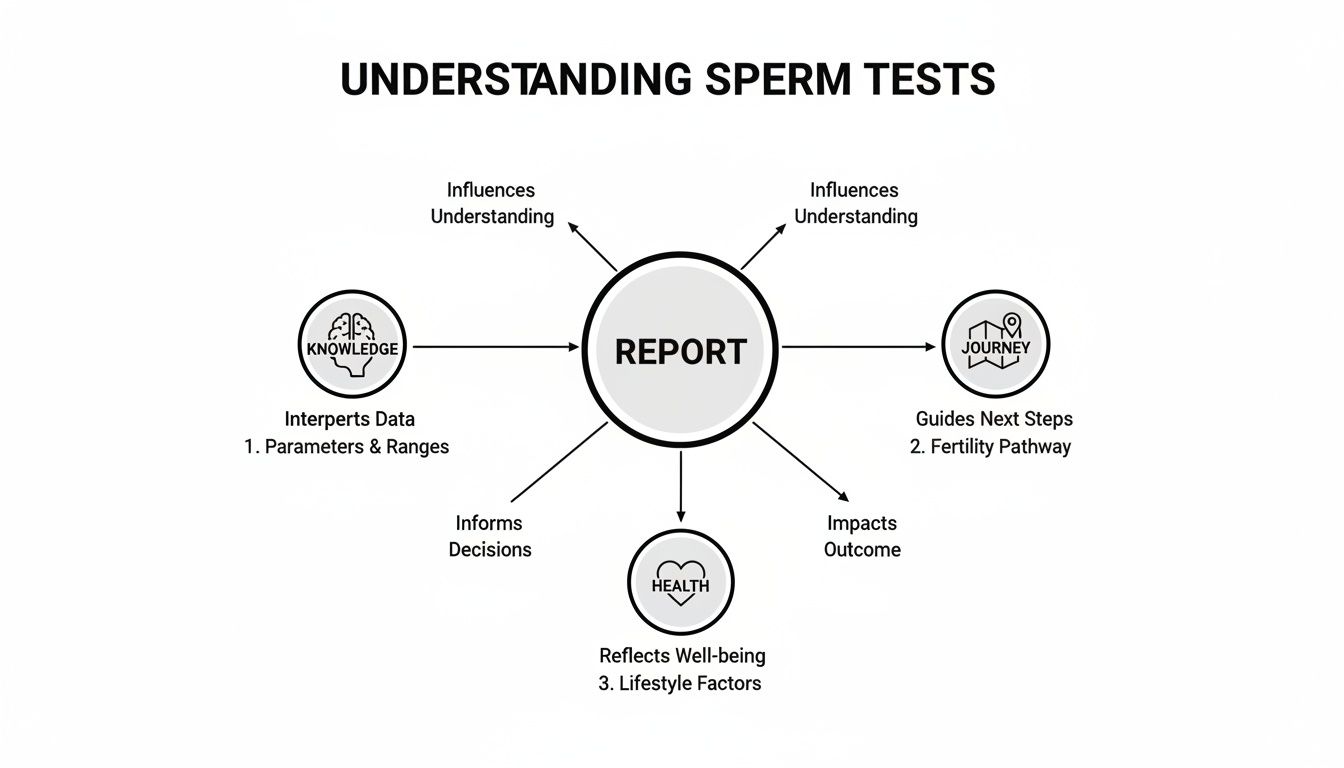
Interpreting your results is the first step. That knowledge empowers you to take control of your health and figure out the best path forward.
Benchmarks, Not Final Judgments
The World Health Organization (WHO) provides reference ranges that help labs and doctors interpret results consistently. It's vital to see these as benchmarks or reference points—not as strict pass/fail grades.
Falling below a certain value doesn't automatically mean you can't have a child. It just highlights an area that deserves a closer look and a conversation with a specialist.
The numbers on your report are a snapshot in time. Your sperm health can and does fluctuate. A single result is a starting point for a conversation, not a final verdict on your fertility.
For example, your report might show 40% motility but only 3% normal morphology. Numbers like these can be confusing. While WHO guidelines consider progressive motility over 30% and morphology above 4% as within the reference range, global data shows a broader trend of declining sperm quality.
In some countries, where male-factor issues contribute significantly to couples' fertility challenges, having a motility below 32% has been shown to double the time it takes to conceive.
To give you a clearer picture, here’s a breakdown of the key parameters and their WHO lower reference limits.
Key Semen Analysis Parameters and WHO Reference Ranges
This table breaks down the most important metrics from your sperm test report and shows the lower reference limits according to the World Health Organization (WHO) 6th edition manual.
| Parameter | What It Measures | WHO Lower Reference Limit |
|---|---|---|
| Semen Volume | The total amount of fluid in your sample. | 1.4 milliliters (mL) |
| Sperm Concentration | The number of sperm per milliliter of semen. | 16 million per mL |
| Total Sperm Count | The total number of sperm in the entire sample. | 39 million per ejaculate |
| Total Motility | The percentage of sperm that are moving. | 42% |
| Progressive Motility | The percentage of sperm moving forward. | 30% |
| Morphology | The percentage of sperm with normal shape. | 4% |
Remember, these are just the lower limits of what is considered typical. Many men with numbers below these ranges go on to become fathers naturally.
The key is to look at the complete picture. These results work together, and a strong showing in one area can sometimes compensate for a weaker result in another. For a deeper dive into what each of these metrics means, check out our comprehensive guide on semen analysis.
What an Abnormal Sperm Test Result Really Means
Seeing the word 'abnormal' on a lab report is enough to make any man's heart sink. It’s easy to let your mind race, but it's crucial to take a breath and understand what these results actually mean in the real world. An abnormal finding on your sperm test isn't a final verdict—it's the starting point for a deeper conversation about your reproductive health.
Think of it like a check engine light in your car. It doesn't mean the engine is shot; it just signals that a specific area needs a closer look. In the same way, an abnormal result simply points to a particular aspect of your sperm health that might need some attention.
Understanding Common Abnormal Findings
When a lab report flags a result, it uses specific medical terms to describe the issue. They might sound intimidating, but they just categorize which metric has fallen below the standard WHO reference range. A huge part of understanding your sperm test results is learning what these terms mean.
Let’s break down the most common ones you'll see:
- Oligozoospermia: This simply means your sperm count is lower than the typical reference range. Think of it as having fewer players on your team than expected.
- Asthenozoospermia: This points to poor sperm motility, meaning not enough of your sperm are swimming effectively. Your team might be large, but if the players aren't fast or agile, it’s harder to succeed.
- Teratozoospermia: This indicates that a high percentage of your sperm have an unusual shape (morphology). This is like having players who aren't in the right physical shape to do their job on the field.
It's also pretty common to have a combination of these issues. A diagnosis of Oligoasthenoteratozoospermia (OATS), for example, just means that count, motility, and morphology are all below the reference values.
A Single Test Is Just a Snapshot
Your sperm health isn't set in stone; it's a dynamic process that changes over time. Things like stress, a recent fever, a few bad nights of sleep, or even what you ate last week can influence your numbers. It takes roughly two to three months to produce a new batch of sperm from start to finish.
A single semen analysis captures your sperm health on one particular day. It’s a snapshot in time, not the full story of your fertility potential. Because of these natural ups and downs, a follow-up test is almost always recommended to confirm any findings.
This is exactly why one abnormal result rarely leads to an immediate diagnosis of infertility. Instead, it serves as an important signal. It’s your body’s way of telling you that it’s time to pay closer attention and maybe make some positive changes.
Turning Information into Positive Action
An abnormal result is your cue to take the driver's seat in your reproductive health journey. It moves you from a place of wondering to a place of knowing, giving you specific areas to focus on. Rather than being a source of stress, try to see it as a powerful opportunity to investigate further and make informed decisions.
This is the perfect moment to start looking at lifestyle factors you have control over. Your diet, exercise habits, stress management, and cutting out things like smoking or heavy drinking can all have a significant impact on sperm quality over the next few months.
Your result is not an endpoint. It’s the beginning of a journey where you're now armed with the knowledge to improve your health. The next step is to figure out the potential causes behind these numbers and create a plan to address them, often with the guidance of a specialist.
Common Causes Behind Poor Sperm Health
So you have your semen analysis results, and the numbers aren't quite what you expected. The first step is to understand why. An abnormal result isn't a final verdict; think of it as a signpost, pointing you toward specific areas of your health and lifestyle that might be impacting your sperm quality. The great news is that many of these factors are well within your control.
Sperm production is a delicate biological process. Any disruption—whether it's from your diet, your environment, or your overall health—can throw a wrench in the works and affect the final product. Pinpointing these potential disruptions is the first real step toward making a difference.

This link between modern life and male reproductive health is more critical than ever. Researchers have confirmed a worrying global trend: sperm counts have been falling for decades. A landmark 2023 study revealed a staggering 51.6% drop in average sperm concentration in men across the globe between 1973 and 2018.
Even more concerning, this decline is speeding up, hitting 2.64% per year since 2000. Experts strongly believe this is tied to the environmental and lifestyle shifts of the last half-century.
Lifestyle Factors You Can Control
Many of the most common things that drag down sperm health are tied directly to your daily habits. This puts the power to make positive changes right back in your hands.
- Diet and Nutrition: What you eat literally provides the building blocks for sperm. A diet low in antioxidants, key vitamins, and minerals can seriously hamper production. On the flip side, loading up on fruits, vegetables, lean proteins, and healthy fats can give your body what it needs to create high-quality sperm.
- Weight Management: Being significantly overweight or underweight can mess with the delicate hormonal symphony required for sperm production. Excess body fat, in particular, often leads to lower testosterone and higher estrogen, a combination that directly harms sperm count and quality.
- Smoking and Alcohol: There’s no ambiguity here—both tobacco and excessive alcohol are proven enemies of sperm. Smoking introduces toxins that can damage sperm DNA, while heavy drinking can tank testosterone levels and reduce sperm count, motility, and normal shapes.
- Exercise (The Goldilocks Principle): Regular, moderate physical activity is fantastic. It boosts your body's natural antioxidant defenses and supports healthy hormone levels. But going too hard, too often, can create physical stress that backfires, negatively affecting your sperm. It's all about finding that just-right balance.
Medical and Environmental Influences
Beyond your daily choices, certain medical issues and environmental exposures can also play a huge role in your semen analysis results. It's crucial to know about these, as they often warrant a conversation with your doctor.
One of the most frequent medical causes is a varicocele, which is just an enlargement of the veins inside the scrotum. Think of it like a varicose vein in your leg. This condition can raise the temperature around the testicles, creating a hostile environment for sperm production.
An estimated 15% of all men have a varicocele, and that number jumps to 40% for men being evaluated for infertility. It's often treatable and is one of the most common reversible causes of poor sperm quality.
Other important factors to consider include:
- Hormonal Imbalances: Conditions that throw off key hormones like testosterone, LH, and FSH can disrupt the signals your body needs to make sperm.
- Excessive Heat: There's a reason the testicles are outside the body—they need to stay a few degrees cooler than your core temperature. Frequent hot tub or sauna use, or even just resting a laptop on your lap for hours, can temporarily lower your sperm count.
- Environmental Toxins: Everyday exposure to certain chemicals, pesticides, heavy metals, and endocrine disruptors (often found in plastics) can interfere with male reproductive function.
Furthermore, underlying health issues like diabetes can have a big impact on sperm quality. This makes it vital to manage related conditions, such as learning how to lose weight with diabetes, for your overall reproductive health. By figuring out which of these factors might be at play for you, you can start building a targeted action plan. For a deeper dive into improving sperm movement, read our guide on how to boost sperm motility.
Your Action Plan After Getting the Results
Receiving your semen analysis report is a huge step. Now, let’s turn those numbers into a clear, forward-looking plan. Think of your results not as a final grade, but as a roadmap—a guide to help you take control of your reproductive health.
Whether your numbers are exactly where you want them to be or some fall below the reference values, there's always a clear path forward.

If All Your Results Are Within the Normal Range
Getting a report where all your key parameters—count, motility, and morphology—fall within the World Health Organization (WHO) reference ranges is excellent news. From a sperm health perspective, this means you have a solid foundation for fertility.
However, if you've been trying to start a family for a year or more without success despite a normal report, it might be time to look deeper. A standard semen analysis is a crucial first step, but it doesn't tell the whole story. A fertility specialist can advise on advanced testing, like a sperm DNA fragmentation test, which looks at the genetic integrity of your sperm.
If One or More Parameters Are Low
Seeing one or more of your results flagged as low can feel disheartening, but it's important to see this as an opportunity for action, not a final judgment. An abnormal result is simply a signal to investigate further and focus on making positive changes.
Here are your immediate next steps:
- Don't Panic: Seriously. A single test is just a snapshot in time. Sperm quality fluctuates daily, and one suboptimal result is not a diagnosis of infertility.
- Schedule a Follow-Up Test: Your doctor will almost always recommend a repeat analysis. This helps confirm the initial findings and rules out temporary factors—like a recent fever or a stressful week at work—that could have skewed the results.
- Review Your Lifestyle: This is where you can be proactive. Take an honest look at your daily habits: diet, exercise, sleep, stress levels, and alcohol or tobacco use. Small, consistent improvements here can lead to significant gains in sperm health. For a detailed guide, you can learn more about how to increase sperm count and quality.
The Three-Month Rule for Seeing Change
It's critical to understand the timeline for sperm health. The entire process of creating new sperm, from start to finish, is called spermatogenesis, and it takes about 74 days. That's roughly two and a half months.
This means any positive changes you make today—improving your diet, quitting smoking, hitting the gym—won't fully show up in your semen analysis for about three months. Patience and consistency are your greatest allies on this journey.
This is exactly why doctors schedule a follow-up test three months after the initial one. It gives your body enough time to produce a whole new generation of sperm that reflects the impact of your healthier habits.
When to Consult a Specialist
While lifestyle changes are powerful, some situations call for the expertise of a medical specialist. Getting a professional involved can provide deeper insights and a more targeted treatment plan.
It’s time to see a urologist or a male fertility specialist if:
- Your follow-up test confirms abnormal results. Consistent low numbers in count, motility, or morphology need a professional evaluation.
- You have a known medical condition. Things like a varicocele, hormonal imbalances, or a history of testicular surgery require specialized care.
- You suspect a physical issue. If you experience any pain, swelling, or notice other physical changes, a urologist can perform an exam to find the cause.
A specialist can conduct a thorough physical examination, order hormonal blood tests, or use an ultrasound to get a complete picture of what's going on and recommend the best course of action.
Simplify Your Journey with Clear Interpretation
Let's be honest—navigating lab reports and medical jargon can feel overwhelming. This is where modern tools can make understanding sperm test results much simpler. Solutions like Hera Fertility are designed to cut through the confusion.
By uploading your existing report, an AI-powered platform can instantly analyze all the complex data for you. Instead of trying to piece together what different parameters mean, you get a single, easy-to-understand Hera SmartScore.
This score gives you a holistic view of your sperm health. More importantly, it generates a personalized, jargon-free action plan with clear next steps tailored specifically to your results. It turns a confusing document into your personal guide for moving forward.
Questions We Hear All the Time
Even after getting your results, it's totally normal to have a few more questions pop up. The world of male fertility can feel a little complicated at first, and asking questions is the smartest thing you can do.
To help cut through the noise, we've put together answers to some of the most common questions we get from men about their sperm tests and what the results really mean.
How Long Until Lifestyle Changes Actually Improve My Sperm?
This is probably the number one question men ask, and the answer is rooted in biology. The entire journey of creating a new sperm cell, from start to finish, is called spermatogenesis. That whole process takes about 74 days.
This means any positive changes you make—like cleaning up your diet, quitting smoking, or hitting the gym—need about two to three months to show up in your sperm quality. It’s a marathon, not a sprint, and consistency is key.
That's also why your doctor will usually suggest re-testing after three months. It gives your body enough time to produce a whole new batch of sperm, so you can see the real impact of all your hard work.
Is It Possible to Have a Low Sperm Count and Still Become a Father?
Yes, absolutely. Fertility isn't a simple pass/fail test; it’s more like a game of odds. A lower sperm count, what doctors call Oligozoospermia, just lowers the statistical chances of conception each month. It definitely doesn't make it impossible.
Plenty of men with sperm counts below the standard WHO reference ranges go on to father children without any medical help.
Think of it this way: your overall fertility is a team effort. Strong performance in other areas, like motility or morphology, can often pick up the slack for a lower count. It’s the complete picture that matters, not just one number.
Looking at all your parameters together gives you a much more realistic view of your reproductive health than obsessing over a single metric.
My Sperm Test Came Back "Normal," So Why Haven't We Conceived?
This is an incredibly common and frustrating situation. A standard semen analysis is a crucial first step, but it’s important to know that it doesn’t tell the whole story of male fertility.
Even when your count, motility, and morphology all look great on paper, other hidden factors could be at play.
For example, a basic report doesn’t look at the genetic health of your sperm. More advanced tests can check for things like sperm DNA fragmentation, which is damage to the precious genetic cargo inside the sperm. This kind of damage can prevent a successful pregnancy even when all the other numbers seem perfect.
If you’ve been trying for over a year with a normal semen analysis, it’s a good idea to see a fertility specialist or a urologist. They can dig deeper with more advanced testing to find out what’s really going on.
What Is a Hera SmartScore and How Does It Help?
We created the Hera SmartScore to get rid of the confusion and anxiety that comes with trying to read a standard lab report. Instead of leaving you with a page full of medical jargon, our platform gives you a clear, simple way to understand your sperm test results.
Here’s how it works to put you back in control:
- Instant Analysis: Just upload your existing lab report. Our system immediately analyzes all the key parameters and how they interact.
- One Simple Score: It boils down all that complex data into a single, easy-to-understand score. This gives you a quick, holistic snapshot of your reproductive health—no medical degree required.
- Personalized Action Plan: The score comes with a clear, evidence-based action plan tailored to your specific results. It turns a confusing document into a straightforward roadmap for improving your health.
It’s all about transforming a moment of uncertainty into an opportunity for clear, proactive steps forward.
Ready to finally understand your sperm health without the confusion? Hera Fertility can analyze your existing lab report for free, giving you a clear Hera SmartScore and a personalized action plan in minutes. Get the clarity you deserve today.
Related Resource Articles
-
TTC Means Pregnancy: A Man's Guide to the Journey to Fatherhood
What does ttc means pregnancy for men? This guide explains the male role in trying to conceive with practical steps, timelines, and health tips for 2026.
14 min read
-
Urologist for Infertility: When to Seek Help for Male Fertility
Discover when to see a urologist for infertility, what tests to expect, and practical steps toward understanding your reproductive health.
22 min read
-
How to Choose a Fertility Clinic: A Guide for Men
Your guide: how to choose fertility clinic for men to evaluate services, costs, semen analysis, and urology access.
23 min read