A post-vasectomy sperm count test is the only way for a man to know for sure that his procedure worked. It’s a simple check that verifies his semen is completely free of sperm, giving him the definitive all-clear.
Think of it as the final, non-negotiable step for a man's peace of mind.
Why Your Post-Vasectomy Test Is So Important
You’ve gone through the procedure, but the journey isn’t quite over yet. The vasectomy sperm count test is the final confirmation—the step that officially closes the chapter. Without it, a man is just assuming it worked, and that's a risky bet.
The ultimate goal is to achieve azoospermia, which is the clinical term for a zero sperm count. This result means the vasectomy was a complete success. While a vasectomy is one of the most effective forms of permanent male contraception, there's still a very small but real chance of failure.
Securing Your Peace of Mind
In some rare cases, the vas deferens tubes can actually heal and reconnect on their own. This is a process known as recanalization, and it could happen weeks or even months after your procedure, potentially creating a path for sperm to travel again.
A single post-vasectomy semen analysis (PVSA) gets rid of all doubt. It transforms a man's confidence from "it probably worked" to "I know for a fact it worked," securing his reproductive decisions.
A clean test result is the green light a man needs. It confirms he can move forward with confidence.
What the Test Looks For
The focus of a post-vasectomy sperm count test is straightforward: are there any sperm present? The primary goal is to see a sperm count of zero.
While a zero count is the ideal result, some men may want more definitive proof. A full semen analysis provides a more comprehensive look by evaluating not just the sperm count, but also motility (movement) and morphology (shape). This extensive analysis ensures there are absolutely no functional sperm left, providing the highest level of certainty.
Medical guidelines have evolved, making this process much simpler for men. It used to be that two consecutive tests showing zero sperm were needed to get the all-clear. However, organizations like the American Urological Association updated their guidelines, now allowing for clearance if a test shows a very low number of non-motile sperm (typically under 100,000 per mL). These changes were based on a mountain of data showing the extremely low risk associated with these findings. You can learn more by exploring the research on modern PVSA protocols.
If you're curious about what a typical sperm count looks like before a vasectomy, check out our guide on understanding normal sperm count ranges. It's a small step that provides a lifetime of assurance.
When to Schedule Your Test for Accurate Results
Timing is everything when it comes to your post-vasectomy sperm count test. Testing too early will likely show sperm that were simply left over in the male reproductive tract, leading to unnecessary stress and follow-up testing.

To get it right the first time, urologists have a clear, two-part guideline. Think of it as a combination of letting time pass and actively flushing the system. Nailing this timeline gives you the best possible shot at getting a conclusive, one-and-done "all clear" result.
The Two Critical Milestones
For your test to be accurate, you need to hit two key milestones before providing a sample. Both are equally important for making sure the results truly reflect the success of your procedure.
Your doctor will almost certainly advise you to wait for:
- Time Passed: At least 8 to 12 weeks should go by after your vasectomy. This gives the vast majority of sperm that were already past the vasectomy site a chance to clear out naturally.
- Number of Ejaculations: You’ll want to have at least 20 ejaculations during that time. Each one helps to actively flush any lingering sperm from your reproductive tract.
The combination of waiting a sufficient amount of time and hitting the ejaculation count is the gold standard. Meeting both milestones is your best strategy for seeing that ideal "zero sperm" result on your first test.
If you lose track of the exact number of ejaculations, don't worry. The number is more of a guideline to ensure the pipes are cleared. As long as you've waited the full 12 weeks and have been reasonably active, you’re almost certainly ready for your test.
Is It a Problem to Wait Longer?
Not at all. In fact, it's completely fine—and often recommended—to wait longer than the minimum timeframe. There’s absolutely no harm in scheduling your test at 14, 16, or even 20 weeks post-procedure.
Waiting longer provides more time and opportunity for your system to clear out any residual sperm. This can increase your odds of getting a definitive azoospermia (zero sperm) result on your very first try.
The main takeaway is not to test too soon. Give your body the time it needs, follow your doctor’s advice, and you can schedule your test with confidence.
Navigating Your Testing Options Today
Long gone are the days when the only path to getting the all-clear was an awkward, sterile room at a lab. Today, men have far more convenient and private ways to confirm a vasectomy was successful. The choice really boils down to two main routes: the traditional in-clinic sample drop-off or a modern at-home kit that you mail to a certified lab.
Each path has its trade-offs when it comes to convenience, privacy, and cost. Understanding these differences will help you pick the method that fits your life and comfort level. The most important thing to remember is that both options end with your sample being analyzed by professionals in a clinical lab, so you can trust the results are accurate.
The Traditional Clinic Visit
The classic approach involves getting a lab order from your urologist, booking an appointment, and producing a sample in a collection room at the clinic. It’s been the standard for years, but for most men, the whole experience feels clinical, public, and uncomfortable.
But it does have one key advantage: immediacy. You hand the sample directly to the technicians, which completely removes any worry about shipping times or temperature changes affecting the specimen. It’s a straightforward process that gets the job done, but it often means taking time off work and dealing with logistics that many men would rather skip.
Modern Convenience with At-Home Mail-In Kits
For a more private and flexible alternative, the at-home, mail-in vasectomy test is a game-changer. This option perfectly bridges the gap between at-home comfort and clinical-grade accuracy. You collect your sample in your own space, on your own time, and use a specialized, prepaid kit to mail it to a certified laboratory.
This approach cuts out the clinic visit entirely, offering a level of privacy that most men appreciate. In fact, this convenience has proven to be a huge factor in getting men to complete their follow-up testing. One of the biggest reasons men face uncertainty after a vasectomy is simply skipping that final test.
A UK study drove this point home, showing that when men were offered postal testing kits, compliance jumped from 59.1% to 79.5%. That’s a massive 20.4% increase, proving that easier logistics lead to better follow-through. You can read the full BMJ study findings for a deeper dive.
At-home mail-in testing isn't about cutting corners; it's about combining the privacy of your own space with the unquestionable accuracy of a professional lab analysis.
Services like Hera Fertility make the process even simpler. A man can get a physician-approved lab order online in just a few minutes and then decide what works best. Whether you want to use an at-home kit or just find a local lab for a quick drop-off, you're in control. You can easily find a certified lab near you to see how simple it can be to get that crucial all-clear without the hassle.
Decoding Your Vasectomy Test Results
Getting a lab report can feel like trying to crack a code. But when it comes to your post-vasectomy sperm count test, it’s actually quite straightforward. The entire analysis boils down to a few key findings that tell you everything you need to know about the success of your procedure.
This decision tree helps visualize the simple choice between at-home and in-clinic testing.
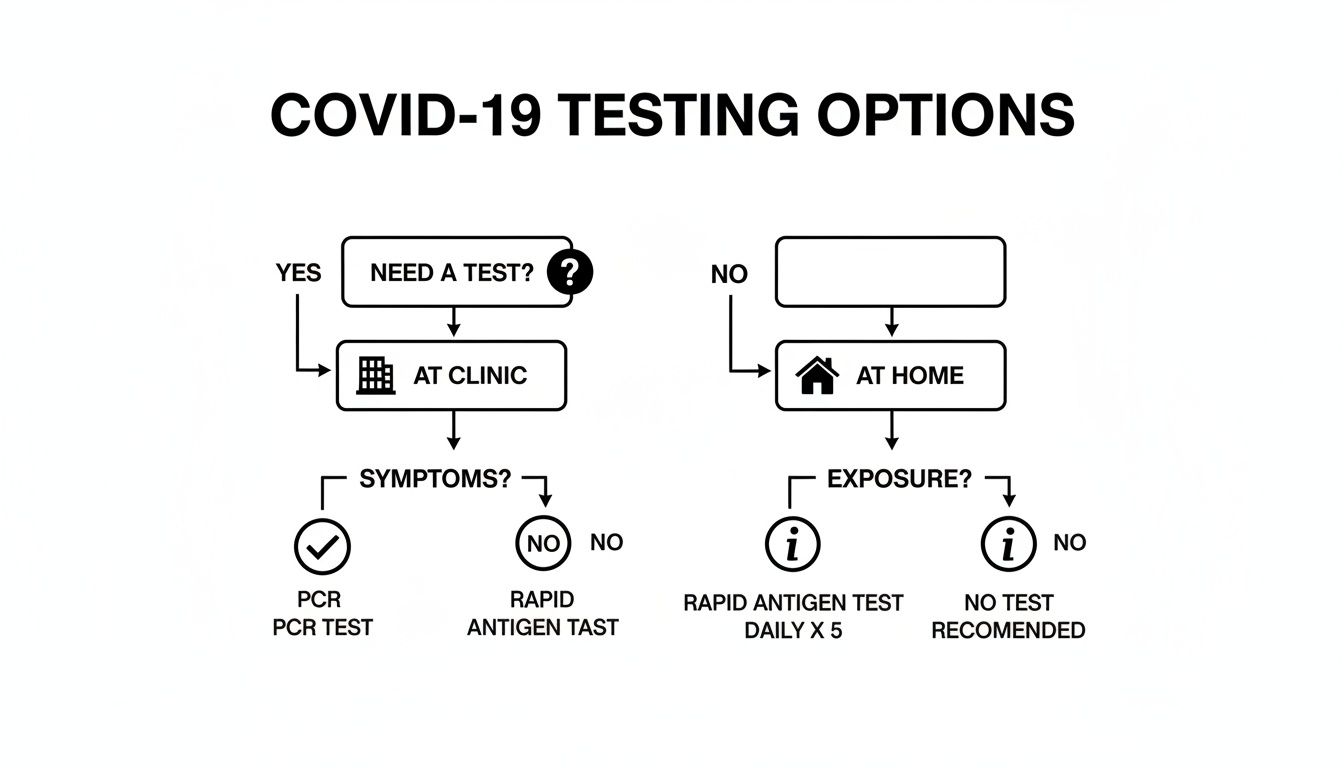
The key takeaway is that both paths lead to a professional lab analysis, so you can choose based on what works best for your privacy and convenience.
The Gold Standard: Azoospermia
This is the result you're hoping for. Azoospermia is the clinical term for zero sperm found in your sample. Simple as that.
Seeing "azoospermia" on your report is the definitive all-clear. It means your vasectomy was a complete success, and once your doctor gives the final sign-off, you can be fully confident in your procedure.
What "Rare Non-Motile Sperm" Actually Means
Don't be surprised if your report comes back with a note about Rare Non-Motile Sperm (RNMS). This just means the lab spotted a very small number of sperm, but crucially, none of them were moving.
So, is this a problem? Almost always, no. Current medical guidelines consider this a successful outcome. The thinking is that these are just leftover remnants from before your procedure, hanging out in the male reproductive tract. Since they can't swim or function, they pose virtually no risk, and your urologist will almost certainly give you the green light.
The most important factor in your vasectomy test result is motility. A finding of zero moving sperm is the critical indicator of a successful procedure, even if a few non-motile ones are still present.
Sperm Count vs. Motility: What Really Matters Now
After a vasectomy, the focus shifts entirely away from typical sperm count metrics and zeroes in on sperm motility. While some men opt for a full semen analysis for complete peace of mind, the single most critical red flag is the presence of even one motile (moving) sperm.
A post-vasectomy semen analysis is the final, essential step to confirm the procedure's high success rate. Unfortunately, many men skip it. We've seen real-world cases where men still had motile sperm at 12 and even 16 weeks post-procedure, highlighting just how vital proper follow-up is.
If your report does show any motile sperm, don't panic—but your journey isn't over yet. This result means you'll need a clear plan for follow-up testing. For a deeper dive into lab reports, check out our complete guide on how to read your full semen analysis results.
What to Do If Sperm Are Still Present
Seeing any sperm on your post-vasectomy test result can be concerning, but don't panic. It’s not an automatic sign that the procedure failed. Think of it as a signal to work with your doctor to figure out exactly what’s going on.
The first actionable step is to review the details of your lab report. The most important piece of the puzzle isn't just that sperm are there, but what condition they’re in. Are they moving (motile) or just sitting there (non-motile)? That single detail changes everything.
Non-Motile vs. Motile Sperm
If your report shows a few non-motile sperm, take a deep breath. This is actually quite common and, by most modern medical standards, is often considered a successful outcome. These are likely leftover, non-viable sperm that are just taking their sweet time leaving the system. They pose virtually no risk. In this scenario, your urologist will very likely give you the all-clear.
On the other hand, finding any motile sperm is a different story. Sperm that are still swimming suggest there might be an open pathway, and that definitely requires a closer look. This is the result that tells you and your doctor the job isn't quite done yet.
The most critical takeaway here is simple: you must continue using another form of contraception until your doctor gives you the official green light. This is non-negotiable the moment you see any moving sperm on your report.
Are You a Slow Clearer, or Did the Vasectomy Fail?
Finding motile sperm usually points to one of two things. By far the most common reason is that you’re simply a "slow clearer." It just means your body needs more time than the average man to flush out all the residual sperm. It’s not a failure; it’s just your body's unique timeline.
If you’re a slow clearer, the game plan is straightforward:
- Wait a bit longer. Your doctor will probably suggest waiting another four to eight weeks.
- Keep clearing the pipes. More ejaculations will help flush out any remaining sperm.
- Test again. You'll need to do another sperm count test after this extended waiting period.
The much rarer, but more serious, possibility is a true vasectomy failure. This happens when the vas deferens tubes reconnect on their own, a process called recanalization. If your follow-up tests still show motile sperm several months down the line, this becomes the more likely explanation. At that point, your doctor will talk you through the next steps, which could mean repeating the procedure.
Remember, this outcome is very uncommon, but it’s the exact reason why follow-up testing is so vital for every single man who gets a vasectomy.
Answering Your Post-Vasectomy Testing Questions
Getting to the finish line after a vasectomy often brings up a few final questions. That's completely normal. Having clear answers makes this last step feel a lot more straightforward. Let’s walk through some of the most common things men ask about their post-vasectomy sperm count test.
Is a Simple Sperm Count Enough, or Do I Need a Full Semen Analysis?
This is a great question because it gets right to the point: what does it really take to confirm success? For a post-vasectomy check, the number one goal is confirming your sperm count is zero. So, is a simple count enough? Maybe, but a full semen analysis is the gold standard for a reason—it leaves no room for doubt.
A complete analysis goes beyond just the count. It also looks at motility (how sperm move) and morphology (their shape). This is actually the most critical piece of the puzzle after a vasectomy.
Think about it this way: a urologist is far less concerned about finding a few non-motile (non-moving) sperm than finding even a single motile sperm swimming around. A full analysis gives the complete picture, ensuring total certainty.
How Long Should I Abstain Before Collecting My Sample?
You've probably heard that for male fertility testing, men are told to abstain from ejaculation for 2-5 days. The goal in that scenario is to see sperm at peak concentration.
But for a post-vasectomy test, we're doing the exact opposite—we're looking for the absence of sperm. Because of this, the rules are a bit more relaxed. Still, most labs will suggest a 2-3 day period of abstinence. This just makes sure the sample volume is good enough for them to do a thorough and accurate check.
When in doubt, always follow the specific instructions that come with your test kit or from the lab staff.
What Happens If I Never Get the All-Clear After Several Tests?
It's rare, but it does happen. If your tests consistently show motile sperm several months after your procedure, it usually points to a vasectomy failure. This happens in about 1 in 2,000 cases, typically when the vas deferens tubes manage to reconnect on their own (a process called recanalization).
If you’re in this situation, your urologist will go over the next steps with you. The most common solution is a repeat vasectomy. It’s absolutely critical to continue using another form of contraception until you have a clear plan and your doctor confirms the second procedure was a success.
Can I Just Use an At-Home Sperm Check Kit From the Pharmacy?
You might see those over-the-counter sperm check kits and wonder if they’re a shortcut. The short answer is no—they are not a substitute for a clinical Post-Vasectomy Semen Analysis (PVSA).
Those simple kits are designed to check if sperm levels are above a general fertility threshold. They can’t confirm absolute zero.
A professional lab test is the medical standard because it uses high-powered microscopes and is performed by trained technicians. They can spot not just the presence of sperm but their exact count and, most importantly, their motility. Using a service that combines at-home convenience with a CLIA-certified lab analysis gives you the best of both worlds—privacy and accuracy.
Ready to get your definitive all-clear with confidence and privacy? Hera Fertility makes it simple. Order a physician-approved lab requisition online in minutes and get your vasectomy sperm count test done at one of our 250+ certified labs. Get your results as a clear, easy-to-understand Hera SmartScore and move forward with total peace of mind. Learn more at Hera Fertility.
Related Resource Articles
-
Post Vasectomy Sperm Test Near Me: Your 2026 Clear Guide
Searching for a post vasectomy sperm test near me? Get clear steps on timing, finding a lab, getting a requisition, and understanding your results.
11 min read
-
Post Vasectomy Sperm Test Cost: A Clear Guide for Men
Understand the full post vasectomy sperm test cost with our clear guide. We break down lab fees, at-home kits, and insurance to help you plan.
16 min read
-
The Post Vasectomy Sperm Test: Your Ultimate Guide to Certainty
Get the facts on the post vasectomy sperm test. Learn when to test, what your results mean, and how to confirm your vasectomy was a success.
20 min read