When you start looking for answers about male fertility, one of the first questions is usually the simplest: what is a good sperm count?
It’s a fundamental question, and thankfully, there’s a clear starting point. According to the World Health Organization (WHO), a count of at least 15 million sperm per milliliter (mL) of semen is the accepted baseline for male fertility. Getting this number moves the conversation from guesswork to hard facts, giving you a tangible piece of data to understand your reproductive health.
What a Good Sperm Count Actually Means

Think of it like building a sports team. You might be able to compete with just a few players, but having a full, healthy roster on the field dramatically increases your odds of winning. A higher sperm count works the same way—it boosts the chances of conception simply by having more "players in the game."
But it's crucial to understand that a "good" sperm count isn't a simple pass/fail grade. It’s a spectrum. The WHO sets the minimum threshold, but higher numbers often correlate with better fertility outcomes.
The Numbers That Matter
The official guidelines from the World Health Organization give us clear reference points. A count is considered normal if it’s at least 15 million sperm per milliliter.
Because the total volume of an ejaculate can vary, experts also look at the total sperm count, which should be over 39 million sperm per ejaculate to be in the normal range.
While these numbers provide a standardized measure, they don't tell the whole story. Here’s how to put them in context:
- More is Often Better: A count above 15 million/mL is good, but many fertility specialists feel more comfortable with numbers above 40 million/mL, as they are often linked to better chances of conception.
- It’s a Team Effort: Sperm count is just one key player. Other factors like motility (how well sperm swim) and morphology (their shape and structure) are just as vital for success.
- Knowledge is Power: Getting your number isn't about judgment; it’s about empowerment. It gives you the information you need to make proactive decisions about your health and your path to fatherhood.
To make this easier to understand, here's a quick breakdown of what different sperm concentration levels generally mean for a man's fertility.
Sperm Count Ranges and Fertility Potential
| Sperm Count (per mL) | Classification | What This Means for Male Fertility |
|---|---|---|
| > 40 million | High-Normal | Excellent fertility potential. Conception is less likely to be hindered by sperm count. |
| 15–40 million | Normal | Considered sufficient for conception, falling within the standard WHO reference range. |
| 5–14 million | Mild Oligozoospermia | Conception is possible but may take longer. This is a common finding. |
| < 5 million | Moderate to Severe Oligozoospermia | Natural conception is difficult. Fertility treatments are often recommended. |
| 0 million | Azoospermia | No sperm found in the ejaculate. Requires specialist intervention to explore causes and options. |
This table is a guide, not a final diagnosis. Every man's situation is unique, and a lower-than-average count doesn't automatically mean you can't have children.
Understanding your baseline is the first proactive step. You can learn more about what goes into a typical analysis in our detailed guide to the average sperm count.
Why Your Sperm Count Is a Key Fertility Factor
Knowing your sperm count gives you a critical piece of information. But why does this one number matter so much? It really comes down to a game of probability against a very, very tough journey.
Think of conception as a lottery. It only takes one sperm to succeed, but the path to get there is incredibly difficult. Having a higher sperm count is like buying more lottery tickets—it dramatically increases your odds of winning.
A healthy sperm count ensures that enough strong swimmers are even present to start the race. Millions will be lost along the way, which is exactly why a man needs to start with a massive team.
More Than Just a Numbers Game
While a high count gives you a powerful advantage, it's not the only thing that matters. Sperm count is just one player on a team, and every player needs to be in top form for the team to win. The other two critical players are:
- Sperm Motility: This is all about movement. Can your sperm actually swim forward effectively? A huge army of sperm that can't move properly won't get you any closer to your goal.
- Sperm Morphology: This refers to the shape and structure of the sperm. Properly formed sperm are built for the journey and have the right tools to succeed.
Simply put, a good count provides the numbers, but motility gives them direction, and morphology gives them the right tools for the job.
The ultimate goal is to have a large team of healthy, fast, and well-formed sperm working together. Each of these three key factors—count, motility, and morphology—plays an indispensable role in a man’s reproductive health.
How These Factors Work Together
Let's use an analogy. Imagine you're trying to send thousands of tiny messengers on a long and treacherous journey to deliver a vital package.
Your sperm count is the number of messengers you send out. Motility is their speed and endurance. And morphology is whether they have the right equipment to complete the mission once they arrive.
You need all three elements firing on all cylinders for that package to be delivered successfully. A low count means you sent too few messengers. Poor motility means they got tired or lost. And poor morphology means they arrived but couldn't complete their task. Grasping how these factors interact is the first step toward building a complete picture of your fertility and taking control of your future.
The Global Decline in Sperm Counts You Should Know About

Before we even get into your personal numbers, there’s a bigger picture every man should be aware of. For decades, researchers have been tracking a startling trend in male reproductive health. This isn't about fear-mongering; it's about giving you the full context so you can take control of your own health.
Studies have confirmed a major drop in average sperm counts all over the world. This means the idea of a "normal" sperm count isn't what it used to be. You can no longer assume you’re in the clear just because your father or grandfather had no issues. The world has changed, and it seems our biology is changing with it.
A Modern Wake-Up Call for Male Health
This isn’t a minor dip—it’s a massive shift that serves as a serious wake-up call for men’s health. The data is clear and compelling.
Back in 1973, the average sperm count worldwide was a healthy 101.2 million sperm per milliliter. Fast forward to 2018, and that number had crashed to just 49 million per milliliter. That's a staggering 51.6% decline in just 45 years.
This isn't some fringe study. This conclusion comes from a huge meta-analysis of 223 studies that included nearly 57,000 men. You can dig into the specifics of this global sperm count research on abc3340.com if you want to see the raw data.
What this trend really highlights is that you can’t afford to be passive about your reproductive health anymore. The environmental and lifestyle pressures on men today are vastly different than they were a generation ago, and it's having a real, measurable impact.
This trend is more than a statistic—it’s a clear signal that proactively monitoring male reproductive health is no longer optional, but a fundamental part of a man's overall wellness plan.
Why Proactive Testing Is Now a Smart Move
Knowing about this global decline should empower you, not scare you. The logical next step is simple: find out where you stand. Instead of guessing or worrying about a worldwide trend, getting tested gives you a concrete, personal baseline.
A semen analysis is the only way to know your numbers in today's landscape, not yesterday's. It shifts you from being a passive observer of a scary statistic to an active participant in your own health journey. By understanding your own count, motility, and morphology, you get the critical information needed to make smart decisions—whether that means tweaking your lifestyle or talking to a specialist. It’s simply the smartest move any man thinking about his future can make.
Key Lifestyle Factors That Influence Your Sperm Count

Knowing your numbers is the first step. Now, let’s shift from information to action. Many of the factors that shape your sperm production are tied directly to your daily habits and environment, which puts a surprising amount of control right back in your hands.
The male body is constantly producing new sperm in a cycle that takes about two to three months. This is great news. It means positive changes you make today can lead to real, measurable improvements in your sperm count just a few months down the road.
Daily Habits That Directly Impact Sperm Production
Your day-to-day routine has a profound effect on your body's ability to produce healthy sperm. Small, consistent adjustments can create a much better internal environment for sperm development.
Diet and Nutrition: Think of food as the raw material for building sperm. Foods rich in antioxidants (like berries and leafy greens), zinc (found in beef and pumpkin seeds), and omega-3s (from fish like salmon) are fertility all-stars. On the flip side, a diet heavy in processed foods can work against you.
Exercise and Weight Management: Regular, moderate exercise is fantastic for testosterone levels and overall sperm health. The key here is balance—overly intense workouts can sometimes have the opposite effect. Maintaining a healthy weight is also critical, as obesity is clearly linked to lower testosterone and reduced sperm counts.
Smoking and Alcohol: These two habits can be particularly damaging. Smoking is known to harm sperm DNA, while excessive alcohol can tank testosterone levels and interfere with sperm production. Cutting back or quitting can be one of the single most effective changes you make.
Environmental Exposures and Your Health
It’s not just about what you put in your body; the world around you plays a role, too. Certain environmental factors can create stress on your system, and being mindful of them can help protect your fertility.
One of the biggest culprits is heat. There’s a reason the testicles are located outside the body—they need to stay cooler than your core temperature.
Sperm production is highly sensitive to temperature. Regularly exposing your scrotum to high heat from hot tubs, saunas, or even a laptop resting on your lap for long stretches can temporarily lower your sperm count.
Making simple swaps, like choosing showers over hot baths and wearing looser-fitting underwear, can help maintain the optimal cool-down your body needs.
It’s also wise to be mindful of exposure to environmental toxins like pesticides and industrial chemicals (such as BPA), which have been linked to negative effects on male reproductive health. While you can't avoid everything, you can take simple steps to minimize your exposure where possible.
Managing Stress and Sleep for Better Health
Your overall wellness is the foundation of your reproductive health. Chronic stress and poor sleep can throw your hormones completely out of whack, directly impacting the systems responsible for making sperm.
Prioritizing 7-9 hours of quality sleep each night and finding effective ways to manage stress—whether it's through exercise, meditation, or just making time for hobbies—aren't just "nice-to-haves." They are essential for your physical and reproductive health.
If you want more practical, actionable steps, you can explore our in-depth guide on how to increase sperm count. By focusing on these lifestyle areas, you can move from just worrying about the numbers to actively improving them.
How to Test Your Sperm Count and Understand the Results
Reading about sperm count is one thing, but the only way to know where you truly stand is to get tested. Fortunately, finding out your numbers is more straightforward and private than ever before.
The gold standard for evaluating male fertility is a semen analysis. This is a clinical lab test that looks at a fresh semen sample to measure the big three factors: sperm count, motility (how they swim), and morphology (their shape).
The Old Way vs. The New Way
Traditionally, getting a semen analysis felt like a bit of an ordeal. It usually meant a doctor's visit for a referral, a trip to a sterile lab or fertility clinic, and producing a sample in a less-than-comfortable, impersonal room. It worked, but for many men, the process was awkward and inconvenient.
Thankfully, that’s not the only option anymore. Modern approaches give you a much more direct and private path, letting you order physician-approved tests online and provide a sample at a local lab on your own schedule. This removes a ton of the friction and anxiety from the equation.
A Simpler Path with Hera Fertility
We designed Hera Fertility to make this essential first step as simple and stress-free as possible. Our goal is to give you direct access to a clinical-grade semen analysis without all the traditional hurdles.
The process is broken down into a few easy steps:
- Order Online: Get a physician-signed lab order directly through our platform in just a few minutes. No doctor's visit required.
- Test Locally: We've partnered with over 250 CLIA-certified labs across the country. Just pick the location that’s most convenient for you and provide your sample when it fits your schedule.
- Get Clear Results: Here’s where we really make a difference. The raw lab data is sent securely back to us, and we translate it for you.
Instead of just handing you a confusing report full of medical jargon, we turn it into something you can actually use.
We translate your complex lab results—sperm count, motility, and morphology—into a single, easy-to-understand Hera SmartScore. This score gives you an immediate snapshot of your overall sperm health, no medical degree required.
Making Sense of Your Results
Getting a lab report can be overwhelming. It's often just a list of numbers and percentages with zero context, leaving you wondering, "So... is this good or bad?" The Hera SmartScore is designed to cut right through that confusion.
Your score comes with personalized insights and clear, actionable next steps tailored to your specific results. It tells you where you are and what you can do about it, turning what could be an anxious moment into an empowering one. This gives you a solid foundation to either make meaningful lifestyle adjustments or have a much more informed conversation with a specialist.
If you’re ready to stop guessing, getting tested is the definitive next step. For men who already have a lab report and need help deciphering it, you can also learn more about how to read semen analysis results in our detailed guide.
Your Next Steps After Getting Your Sperm Count Results
Getting your sperm count results is a big deal, but the numbers themselves are just the starting line. The real value is turning that data into an actionable plan. No matter what your results show, there’s always a clear path forward that puts you back in the driver's seat.
The whole point of testing, from the initial order to the final analysis, is to give you clarity, not confusion.
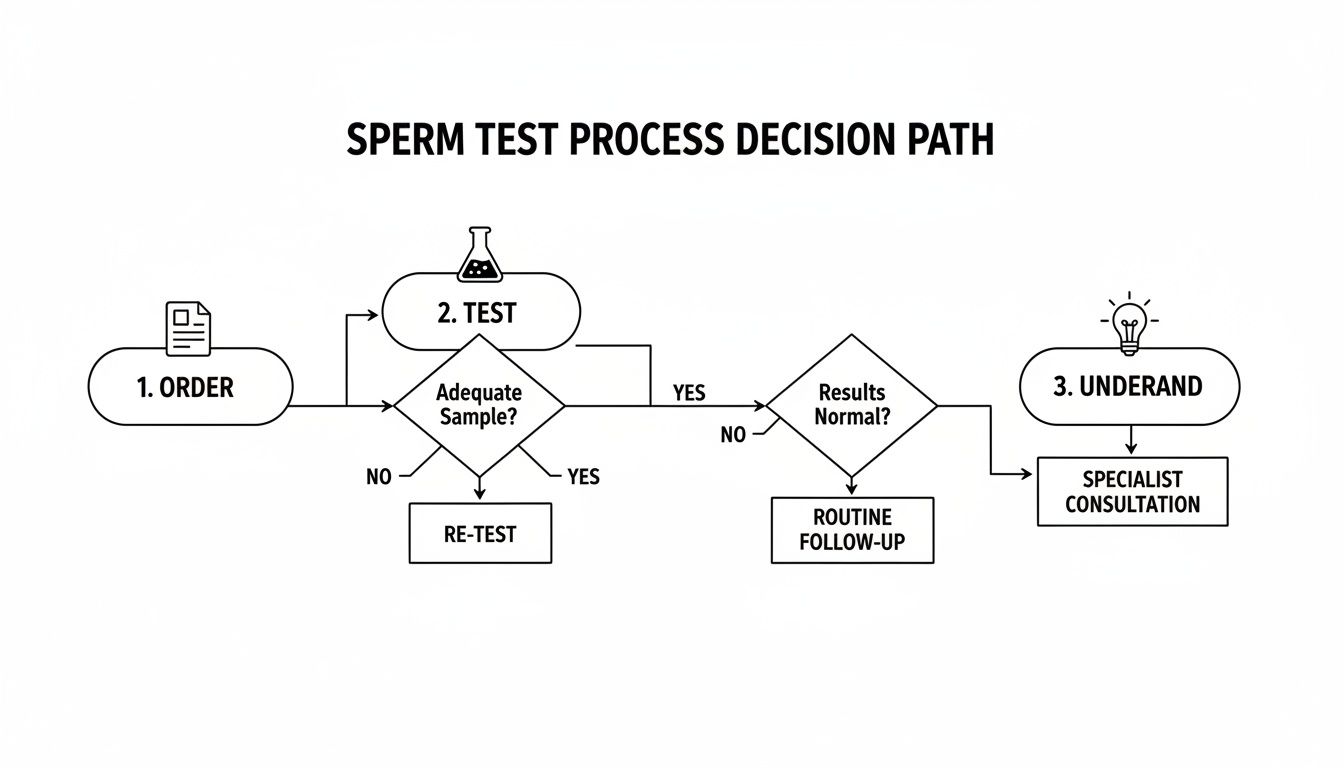
This flowchart breaks down the key stages, guiding you from that first click to your final follow-up actions. The goal is to demystify the journey and give you a simple roadmap. Let's walk through the three most common scenarios and what to do for each.
Scenario 1: Your Count Is in the Normal Range
If your sperm count is above 15 million per mL, that’s fantastic news. You’ve got a solid baseline to work with. The goal now shifts from active improvement to smart maintenance. Think of it like running a great time in a race; now you just need to keep up your training to stay in shape.
Your action plan should be all about protecting your health with positive habits. This means sticking to a balanced diet, getting regular exercise, and steering clear of things known to hurt sperm production, like smoking or excessive heat. For preserving your fertility, consistency is king.
Scenario 2: Your Count Is Borderline or Slightly Low
Seeing a number that’s hovering on the lower end of normal, or just below it, can feel a bit unsettling. But this is often the most actionable scenario. The first thing to remember is that sperm counts can and do fluctuate.
A single test is just a snapshot, not the full movie. Your body is constantly making new sperm in a cycle that takes over two months, so the number you see today isn't set in stone.
Because of this natural variation, the standard recommendation is to re-test in 2-3 months. This gives your body enough time to run through a full sperm production cycle. In the meantime, you can get to work on the lifestyle factors that impact sperm health, giving yourself a real chance to see a measurable improvement on your next test. This is an excellent opportunity to take proactive steps.
Scenario 3: Your Count Is Significantly Low
If your results come back well below the normal range, that's a clear signal to bring in an expert. This isn't a reason to panic, but it does mean that lifestyle tweaks alone might not be enough to move the needle.
Your most important next step is to schedule a consultation with a urologist, especially one who specializes in male fertility. They can run a more thorough evaluation to see if any underlying medical issues are affecting your sperm production. This professional guidance is crucial for getting a complete diagnosis and exploring every option available to you.
Your Questions, Answered
Navigating the world of male fertility can bring up a lot of questions. Here are some quick, clear answers to the most common concerns we hear from men after they first learn about sperm count.
Can I Improve My Sperm Count?
Absolutely. In most cases, a man’s sperm count isn’t a fixed number and can definitely be improved.
Your body is constantly producing new sperm in a cycle that takes about two to three months to complete. This is great news because it means positive lifestyle changes you make today can lead to better numbers in the very near future. Things like a balanced diet, regular exercise, quitting smoking, cutting back on alcohol, and managing stress can all have a significant impact.
Does a Low Sperm Count Mean I Can't Have Children?
Not at all. A low sperm count, known clinically as oligospermia, simply means you have fewer sperm than the average man. While this can make conceiving naturally more of a challenge, it certainly doesn't make it impossible.
Remember, male fertility is a team effort. Sperm count is just one key player on the field, working alongside:
- Motility: How well your sperm can actually swim.
- Morphology: The shape and structure of your sperm.
A specialist looks at all these factors together to give you the full picture of your fertility and walk you through all your options.
How Often Should I Test My Sperm Count?
For a solid baseline understanding of your reproductive health, one test is a great place to start. If your results come back outside the normal range, a doctor will likely recommend a second test 2-3 months later just to confirm the findings, since sperm counts can fluctuate quite a bit.
If you're actively making lifestyle changes to boost your numbers, re-testing after 3-6 months is a fantastic way to track your progress and see the real-world impact of your efforts.
Ready to move from questions to answers? Hera Fertility makes it simple for men to get a clinical-grade semen analysis with clear, actionable results. Take control of your reproductive health by ordering your physician-approved test today at HeraFertility.co.