The old "one-year rule" for men—try for a year, then see a doctor—is common advice. But frankly, it’s outdated. For many men, waiting a full 12 months isn’t the most proactive or efficient path forward. Your personal health history can dramatically shorten that timeline.
Knowing When It’s Time to See a Fertility Specialist
Thinking about your fertility can feel a bit abstract, but figuring out when to get professional advice shouldn't be. While that one-year guideline exists, it's definitely not a one-size-fits-all answer. Certain health factors and personal timelines are clear signals to get checked out much sooner.
Being proactive is the single most powerful step you can take on this journey. It’s not about jumping to conclusions or assuming there’s a problem. It’s about taking responsible control of your health and gathering information early on so you can make informed decisions and move forward with a clear, actionable plan.
Key Timelines for Men to Consider
Your age and health history are the two biggest factors in deciding when to see a fertility doctor. While every man's situation is unique, some scenarios really do call for a more immediate consultation. If any of the situations below sound familiar, it’s smart to schedule an appointment without waiting.
This flowchart gives you a quick visual guide to help you pinpoint the right timeline for your situation.
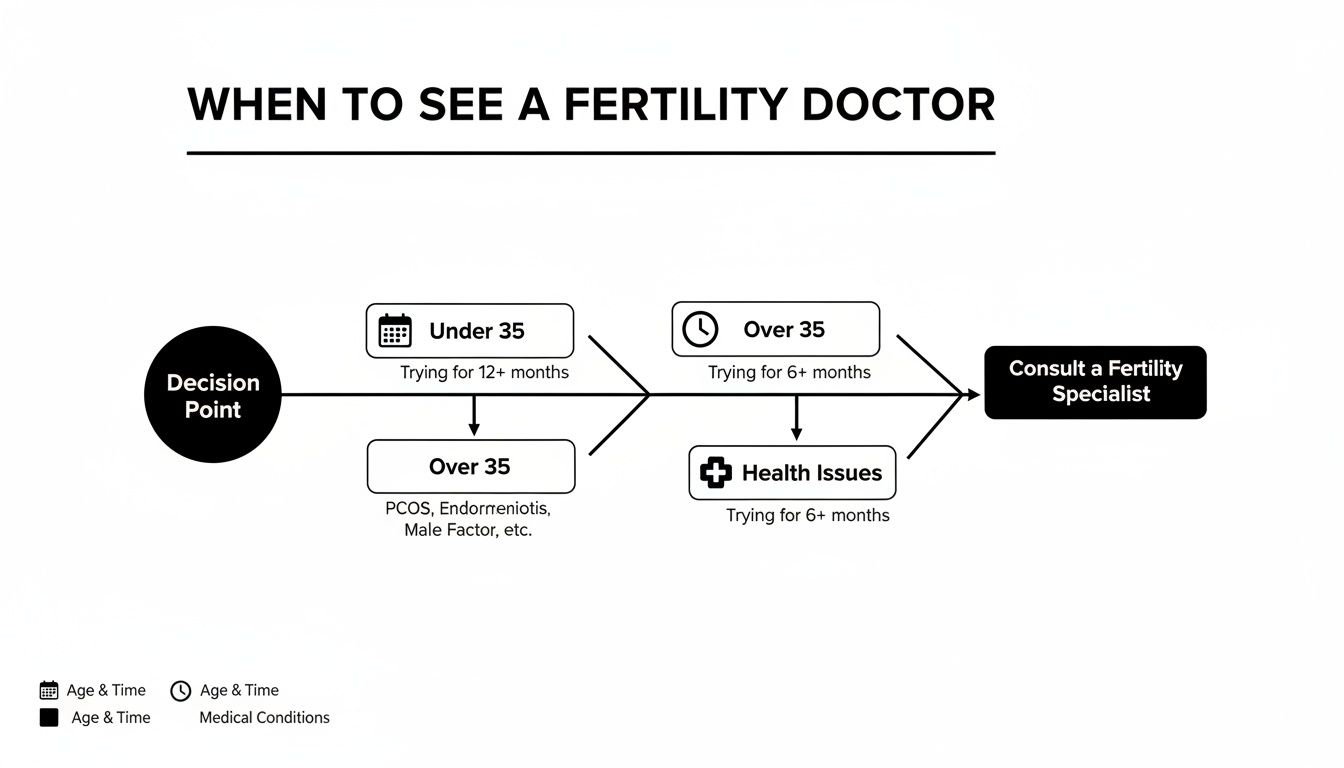
The main takeaway here? Factors like being over 35 or having a history of relevant health issues mean you should shorten the recommended waiting period.
Signs You Should Act Sooner
Certain scenarios are red flags that should prompt you to seek an evaluation well before that one-year mark. If you have known risk factors, waiting is not the best strategy.
Consider booking a consultation right away if you:
- Are over the age of 35. Male fertility does decline with age, so time becomes more critical.
- Have a known medical condition that could impact fertility, like a varicocele or a history of testicular cancer.
- Previously had surgery on your testicles or in the groin area, such as a hernia repair.
- Are experiencing any issues with sexual function.
For men, being proactive about fertility is crucial. Recognizing the subtle signals and understanding your medical history can save valuable time and provide peace of mind. Learning more about the common male infertility signs can empower you to take the next step.
Research shows that the 35-39 age group is often the most affected by infertility, making this a critical period for men to seek an evaluation if fatherhood isn't happening on their desired timeline.
The table below provides a quick reference to help you decide if it’s time to talk to a specialist.
Quick Guide for When Men Should See a Fertility Doctor
Use this table to quickly identify if your situation warrants a proactive consultation with a fertility specialist.
| Your Situation or Timeline | Recommended Action |
|---|---|
| Under 35 with no known health issues | See a specialist after 1 year of trying to conceive. |
| 35 or older | See a specialist after 6 months of trying to conceive. |
| Have a known varicocele or had testicular cancer | See a specialist immediately, before you start trying. |
| Had past groin/testicular surgery (e.g., hernia repair) | See a specialist after 6 months or even right away. |
| Experiencing issues with sexual function | See a specialist right away to address underlying issues. |
| History of STIs, chemo, or radiation | See a specialist immediately for an evaluation. |
Ultimately, if you have any reason to be concerned about your fertility, there is no harm in seeking a consultation early. It’s always better to have the information and not need it than to wait and wish you had acted sooner.
Why Your Fertility Is a Critical Part of the Equation
For way too long, the conversation around building a family has been a bit one-sided. The focus has often landed elsewhere, leaving men on the sidelines until much later in the game. It's time to change that script. Understanding your own reproductive health is the first step toward taking control of the process.

Let's be clear: this isn't about blame. It’s about empowerment. Acknowledging that your reproductive health is a vital piece of the puzzle equips you to be proactive. Waiting around to consider male factors can lead to months, even years, of unnecessary frustration and dead ends.
The Numbers Don't Lie
When a couple struggles to conceive, the underlying cause is very often shared. In fact, male factor infertility plays a role in roughly 50% of all cases. Think about that for a second. With 1 in 8 couples in the United States facing fertility challenges, that means male factors are a significant part of the story in millions of homes. You can dive deeper into these trends in male reproductive health if you want to see the research.
These stats hammer home a simple truth: if you're trying to become a father, your health is fundamentally important.
Understanding your own reproductive health isn't a sign of a problem; it's a sign of strength and responsibility. It's about being an active, informed participant in one of life’s most important goals.
When you recognize this responsibility, the entire dynamic shifts. It moves the journey from a place of stress and quiet worry to one of empowered action and clear next steps.
Shifting the Mindset on Male Fertility Testing
Given how common male factor issues are, getting a semen analysis shouldn't be a last resort. It should be a standard, proactive first step for any man who's serious about building a family. It’s just smart.
Here’s why it makes so much sense:
- It provides a clear baseline. A simple test gives you a powerful snapshot of your reproductive health right from the get-go. No guessing.
- It saves valuable time. Identifying potential issues early means you can tackle them head-on, avoiding months of stressful uncertainty.
- It empowers you with data. Knowing your numbers gives you and your doctor the information you need to create a real plan, not just a shot in the dark.
Ultimately, addressing your fertility proactively reframes the entire process. It’s no longer about reacting to a problem—it’s about taking charge of your health to build the future you want. And figuring out when to see a fertility doctor is a key part of that playbook.
Using Your Medical History to Spot Fertility Red Flags
Your health history is far more than just a list of old doctor's visits and procedures. Think of it as a roadmap that can reveal some incredibly powerful clues about your fertility right now. Certain events from your past can directly mess with sperm production or block the pathways sperm need to travel.
This is a huge reason why the answer to "when should I see a fertility doctor?" might be immediately, rather than after months of trying. By taking a proactive look at your own history, you can spot potential issues and get ahead of the game.
Testicular Health and Past Surgeries
The testicles are the factory floor for sperm, so any past injuries, issues, or surgeries in that neighborhood are a pretty big deal. A procedure in the groin area, even if it seemed minor at the time, can sometimes interfere with the delicate network of tubes that transport sperm.
You should consider getting an evaluation right away if any of these sound familiar:
- Undescended Testicle: Even if it was surgically corrected as a baby, being born with one or both testicles not in the right spot can impact sperm production down the line.
- Testicular Torsion: This is a serious medical emergency where the spermatic cord gets twisted, cutting off blood flow. Even with quick treatment, it can sometimes leave a lasting mark on testicular function.
- Hernia Repair: That common surgery to fix an inguinal hernia (in the groin) can occasionally lead to scarring or accidental damage to the vas deferens—the all-important tube that carries sperm from the testicle.
Think of your reproductive system like a finely tuned plumbing network. Any past twists, blockages, or surgical repairs near the main pipes are worth investigating to ensure everything is still flowing smoothly.
Previous Illnesses and Treatments
Some common illnesses and major medical treatments can have a profound—and sometimes permanent—effect on male fertility. The problem is, the impact isn't always obvious at the time, which is why connecting these past events to your current goals is so important.
For any men whose medical records are in another language, or who might be seeing a specialist abroad, professional medical document translation services can be a huge help in making sure nothing gets lost in translation.
It's a good idea to book a consultation without delay if you have a history of:
- Mumps After Puberty: Getting the mumps as a teen or adult can sometimes lead to orchitis, which is a nasty inflammation of the testicles that can damage the very cells responsible for making sperm.
- Cancer Treatments: This is a major one. Chemotherapy and radiation, especially when aimed at the pelvic area, can dramatically reduce or even completely stop sperm production.
- Significant Infections: A history of sexually transmitted infections (STIs) like chlamydia or gonorrhea can cause inflammation and scarring that may block the tubes sperm use to get out.
If any of these points from your health history ring a bell, you have a solid, concrete reason to schedule a fertility evaluation now instead of waiting and wondering.
How Lifestyle Choices Can Signal a Need for Early Testing
Your daily habits have a much bigger impact on your reproductive health than you might think. For many men, lifestyle is the single biggest reason to get a baseline fertility check—even before you officially start trying for a family.
Think of it this way: your body is a finely tuned system, and things like diet, stress, alcohol, and even heat exposure can throw a wrench in the delicate process of sperm production.
Recognizing Modifiable Risk Factors
The good news is that most of these factors are within your control. Just identifying them is the first step toward making positive changes that can have a real, measurable impact on your sperm health.
Take a hard look and see if any of these are part of your regular routine:
- High Stress Levels: Chronic stress is notorious for messing with the hormonal signals required for healthy sperm production.
- Smoking or Vaping: The toxins in tobacco and vape products are known to damage sperm DNA, tanking both sperm count and their ability to swim.
- Heavy Alcohol Use: More than a few drinks per week can lower testosterone levels and directly impair sperm quality.
- Poor Diet: A diet heavy on processed foods essentially starves your body of the essential building blocks it needs for optimal sperm health.
- Heat Exposure: Regularly using hot tubs, saunas, or even resting a hot laptop on your lap for long stretches can raise scrotal temperature to levels that are toxic for sperm.
If you nodded along to a few of these, it’s a strong sign that getting a baseline fertility assessment is a smart, proactive move. It can save you a ton of time, money, and stress down the road.
Why Proactive Testing Matters
If you're already working through significant lifestyle challenges—like addressing binge eating patterns or navigating a high-pressure job—it just makes sense to know your baseline. Waiting a full year to get tested when you already have known risk factors on the table isn't the most efficient path forward.
Decades of research have shown a steady decline in sperm quality in Western countries, and a lot of that points back to our modern environment, sedentary habits, and poor diets. These are exactly the kinds of modifiable risks that make an early evaluation so valuable.
Getting tested early empowers you to make changes now. For practical, effective advice on improving your numbers, check out our guide on how to increase sperm count. Knowing where you stand gives you the information you need to take control of your fertility journey from day one.
Your First Actionable Step: The Semen Analysis
If you're starting to wonder about your fertility, the single most powerful and direct first step you can take is getting a semen analysis. This simple diagnostic test is the bedrock of any male fertility evaluation.
Forget the guesswork and anxiety. A semen analysis gives you a clear, objective snapshot of your reproductive health, replacing uncertainty with hard data. Think of it like checking the engine diagnostics on a car—it tells you exactly what’s going on under the hood.
What Does the Test Actually Measure?
A semen analysis isn't just one number; it’s a detailed report card on several critical factors. Each one plays a crucial role in the journey to fatherhood.
Here are the big three metrics the lab will check:
- Sperm Count (Concentration): This is the total number of sperm in your sample. A higher count generally improves the odds of success.
- Sperm Motility (Movement): This measures what percentage of your sperm are active swimmers and how well they move forward. They have a long journey ahead, so strong swimming is essential.
- Sperm Morphology (Shape): This looks at the physical structure of the sperm. A normal, well-formed shape is crucial for a sperm's ability to do its job.
Together, these numbers paint a comprehensive picture of your sperm health. An issue in any one of these areas can make becoming a father more challenging, which is why getting this baseline information is so important.
How to Get a Semen Analysis—the Modern Way
In the past, getting this test often felt like a complicated and intimidating process that required multiple doctor visits just to get a referral. Not anymore.
Today, the process is far more straightforward and private. Modern platforms have put the power back in your hands. At Hera Fertility, for example, you can take control right from the start.

You can order your own physician-backed lab requisition online in minutes and find a convenient, certified lab from a huge network. This lets you skip the delays and get straight to the answers.
Taking this first step is a sign of proactive health management. It’s the single most effective way to get concrete answers and move forward with a clear, informed plan.
Preparing for the test itself is simple. You’ll typically be asked to abstain from ejaculation for 2-5 days beforehand to make sure the sample is optimal for analysis. The lab will provide a private room and clear instructions. It's a routine medical test, and getting it done is a responsible, empowering move for any man planning his family's future.
Understanding Your Results and Planning Your Next Move
Getting a lab report back that’s filled with medical jargon and a bunch of numbers can feel like trying to read a foreign language. The key is turning that data into clear, actionable insights so you know exactly what your next move should be.
This is simpler than ever with modern tools. For example, platforms like Hera Fertility use an AI-powered SmartScore that translates your results into an easy-to-understand format. It takes the guesswork out of the equation and gives you immediate clarity on your sperm health.
Turning Insights into Action
Once you understand what your results are telling you, the focus shifts to action. Your personal roadmap forward will depend entirely on what the analysis reveals. The goal is to match the next step to your specific situation, putting you on the most efficient path.
Different results point toward different strategies. For some men, the path forward might involve simple but powerful lifestyle adjustments. For others, the data might be a clear signal that it’s time to consult a specialist.
No matter what your semen analysis shows, there is always a logical next step. Think of the report not as a final verdict, but as a guide that empowers you to take control of your reproductive health.
Your Personalized Path Forward
Consider your results the starting point. From here, you can explore targeted options that make the most sense for you.
- Lifestyle Adjustments: If your results show only minor issues, the next steps might focus on improving your diet, finding ways to reduce stress, or getting more exercise. These kinds of changes can have a surprisingly significant impact on sperm quality over time.
- Specialist Consultation: For more complex results, the best move is to consult with a urologist who specializes in male fertility. They can run further tests to pinpoint any underlying causes and recommend specific treatments.
Knowing the details is crucial. For a full breakdown, you can learn how to read semen analysis results in our detailed guide. This will help you feel confident and prepared for any conversation with your doctor.
Common Questions About Male Fertility Consultations
Even after deciding to see a doctor, it’s normal to have a few last-minute questions. Getting clear answers helps you walk into that first appointment feeling prepared and confident, ready to take the next step on your path to fatherhood.
Should I Get a Semen Analysis Before We Start Trying?
Absolutely. Getting a baseline semen analysis before you even start trying to become a father is one of the most proactive steps you can take. Think of it as getting a clear snapshot of your reproductive health right from the get-go.
This simple test can save you months of stress and uncertainty down the line. If there is an issue, you can start addressing it immediately instead of discovering it a year into your journey. Modern platforms make ordering a test easier than ever, putting crucial information in your hands as you begin planning your family.
What Kind of Doctor Specializes in Male Fertility?
When it comes to male fertility, you’ll want to see a urologist with specialized training in male reproduction. These experts are often called a reproductive urologist or an andrologist. They have dedicated their careers to diagnosing and treating the specific conditions that impact a man's ability to conceive.
Your semen analysis results are the key piece of information this specialist needs for your first consultation. Walking into that appointment with your results already in hand makes the entire visit far more productive and focused.
Taking the step to see a specialist is about being informed and in control. A reproductive urologist is your expert partner in understanding your health and planning the best path forward.
Does Insurance Cover Male Fertility Testing?
This is a big one, and the answer is: it depends. Insurance coverage for male fertility services varies dramatically from one plan to another. The good news is that diagnostic testing, like a semen analysis, is often covered. Specific treatments, however, might not be.
Your best bet is to call your insurance provider directly to get the specifics on your benefits. Make sure to ask about coverage for both “male fertility diagnosis” and “male fertility treatment” so there are no surprises. This will give you a complete picture of what your plan includes.
Ready to take the first, most important step? With Hera Fertility, you can order a physician-backed semen analysis requisition online and get tested at a lab near you. Get the clear answers you need to move forward with confidence. Start your journey today at herafertility.co.