So, you're ready to get a sperm test. That's a great first step for understanding your reproductive health. But the immediate question is... where do you actually go? You've got a few solid options, and the right one for you really depends on your situation.
Generally, you can choose from a fertility clinic for the most detailed analysis, a urologist's office if you want a specialist's guidance from the start, or an at-home test kit for a quick, private screening. Each route offers a different mix of convenience, cost, and in-depth information.
Navigating Your Sperm Test Options
Trying to figure out where to start can feel overwhelming, but it doesn't need to be. Finding the right place for a semen analysis is simply about matching the test to your needs, whether you're just curious about your baseline health or want to get a clearer picture of your fertility.
This decision tree can help you visualize the best path forward based on where you're at in your journey.
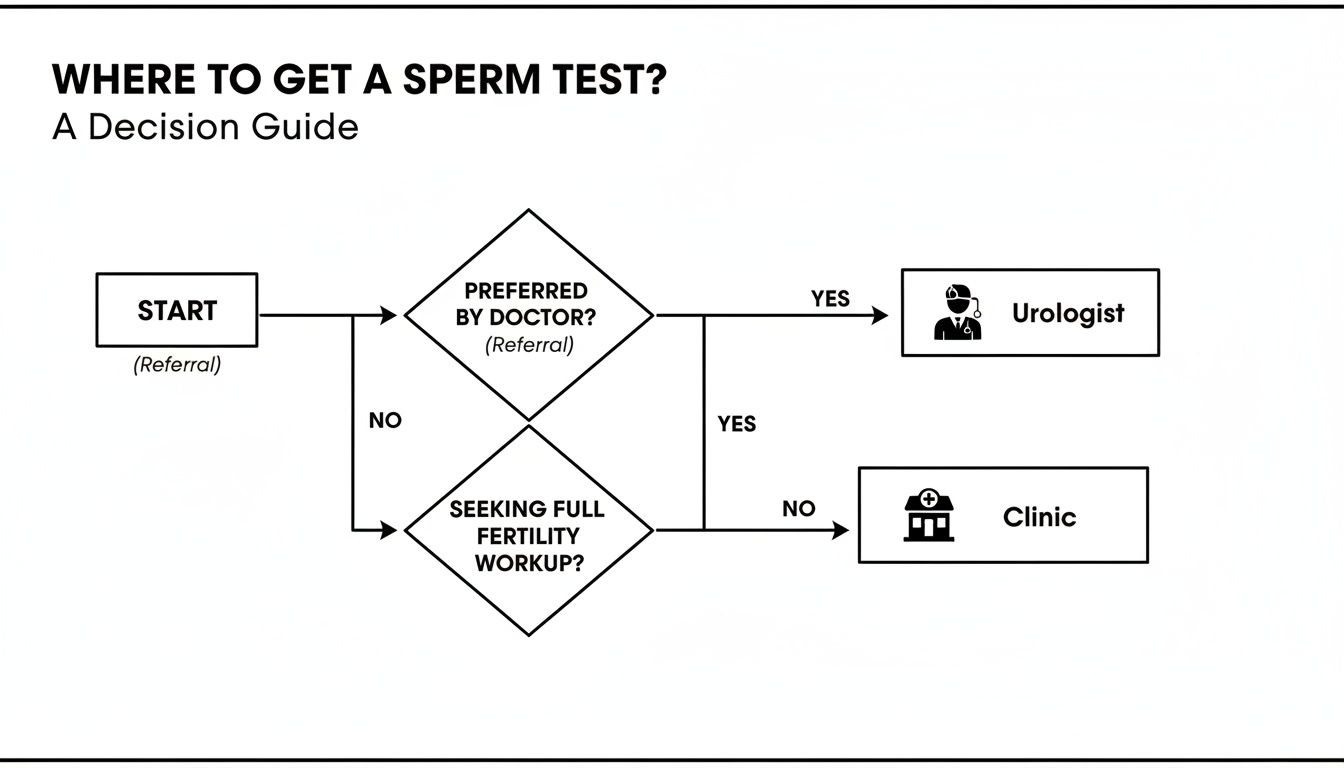
As you can see, the best starting point often hinges on whether you already have a doctor involved or if you'd prefer to take a more direct, private approach first. Think of this as your roadmap—it helps you weigh the important stuff like accuracy, cost, and convenience.
The Three Main Paths for Male Fertility Testing
Your primary choices boil down to these three main avenues. Each one has its own distinct advantages depending on what you're looking for.
- Fertility Clinics and Labs: This is the gold standard. These facilities provide the most comprehensive and accurate lab test you can get—a clinical-grade semen analysis. This is the right choice if you need a complete picture of sperm count, motility (how sperm move), and morphology (their shape).
- A Urologist's Office: Seeing a specialist in male reproductive health is a smart move if you suspect an underlying medical issue or just prefer a more guided process. The urologist will conduct a full evaluation first and then refer you to a trusted lab for the actual analysis.
- At-Home Test Kits: For sheer convenience and privacy, these kits are hard to beat. They offer a basic screening of your sperm count or concentration right from home. While they don't provide the detailed insights of a lab test, they serve as a useful first step if you just want some preliminary information.
A Quick Comparison of Sperm Testing Options
Here's a side-by-side look at the most common places for a semen analysis, highlighting the key differences in convenience, cost, detail, and privacy.
| Testing Option | Best For | Typical Cost Range | Key Feature |
|---|---|---|---|
| Fertility Clinic / Lab | Men who need comprehensive, accurate results for health and family-planning decisions. | $100 - $300 | Gold-standard analysis of all key sperm parameters. |
| Urologist's Office | Men with symptoms or suspected medical conditions affecting fertility. | $200 - $500 (consult + lab fee) | Specialist evaluation and diagnosis combined with testing. |
| Sperm Bank | Men planning to freeze sperm for future use. | $150 - $250 | Analysis is part of the cryopreservation process. |
| At-Home Test Kit | A private, preliminary check of sperm count or concentration. | $50 - $200 | Maximum convenience and privacy for initial screening. |
This table should give you a clearer idea of which option might be the best fit for your budget, goals, and personal preferences.
For a lot of men, the biggest hurdle isn't the test itself. It’s the logistics of finding a qualified lab and getting the required doctor’s order to even schedule an appointment. Making that first step easier is a crucial next step.
Services that help you find a certified lab near you and get a valid lab order online can completely remove that initial barrier.
If you're looking for broader health information, the Edmonton Health and Wellness Guide is a great resource for exploring other local services.
Why Fertility Clinics Are the Gold Standard
When you absolutely need the most accurate, reliable answers about your male fertility, nothing beats a formal semen analysis at a specialized fertility clinic or lab. This is the definitive path for any man who needs conclusive data to make important health and family-planning decisions.

These facilities provide a clinical-grade test that goes lightyears beyond a simple sperm count. They dig deep into every critical aspect of your semen, giving you a complete and, most importantly, actionable picture of your reproductive health.
The Power of CLIA Certification
So, what makes these labs the gold standard? It all comes down to CLIA certification.
CLIA stands for Clinical Laboratory Improvement Amendments, a federal standard that governs quality, accuracy, and reliability in lab testing. When you see a lab is CLIA-certified, you can trust that it meets the most rigorous scientific benchmarks.
This certification means the lab's equipment is meticulously calibrated, its technicians are highly trained specialists, and its procedures are validated for clinical use. It’s the same level of quality control you'd demand for any other critical medical test.
Choosing a CLIA-certified lab is non-negotiable if you need a semen analysis that a physician can use for a diagnosis or to create a treatment plan. It’s the benchmark for clinical-grade testing in both the USA and Canada.
What a Comprehensive Analysis Actually Includes
Unlike a basic at-home kit that might just give you a "yes" or "no" on sperm presence, a true lab analysis provides a detailed breakdown of multiple factors. These are the metrics that tell the full story of your sperm health.
- Sperm Count (Concentration): The total number of sperm per milliliter of semen.
- Motility: The percentage of sperm that are moving—and just as importantly, how well they move forward.
- Morphology: The percentage of sperm that have a normal shape, which is critical for their function.
- Volume and pH: Other key measurements of the seminal fluid that provide essential context for your overall male reproductive health.
This in-depth analysis is crucial. For instance, a man might have a great sperm count, but if motility is low, it still presents a significant fertility challenge. Only a full workup can reveal these critical details. A clear next step would be to discuss these detailed results with a specialist.
Getting It Done: From Lab Order to Collection
The main hurdle for many men is getting the required physician's lab order. Traditionally, this meant scheduling a whole doctor's appointment just to get that piece of paper.
Thankfully, modern platforms have simplified this process. You can now get a physician-signed lab requisition online, which lets you book an appointment at a certified lab directly. Once you have your order, you'll schedule a time to provide the sample on-site in a private room, ensuring it’s analyzed under optimal conditions right away.
The demand for this level of precision is growing fast. The global sperm count test market is valued at around USD 2,473.8 million in 2025 and is projected to jump to USD 3,844.3 million by 2032. With North America's advanced healthcare infrastructure, men have excellent access to top-tier options like CLIA-certified labs. You can explore more about these market trends and what they mean for the future of male reproductive health.
Starting the Conversation with a Urologist
While fertility clinics have some of the most advanced labs, a lot of men feel more comfortable kicking things off with a urologist. And honestly, that's an excellent choice. This is especially true if you have a gut feeling that an underlying health issue might be involved, or if you just prefer having one specialist manage your care from the get-go.
Seeing a urologist is about more than just getting a lab slip for a sperm test. It’s a complete, expert-led evaluation of your male reproductive health. These specialists are trained to see the whole picture, connecting the dots between your overall health and your fertility in a way that other doctors might not.
What to Expect During a Urologist Visit
Think of your first visit as a comprehensive health deep-dive, not just a quick chat. The urologist’s goal is to build a full medical profile that gives crucial context to any lab results that come back.
Your appointment will usually cover a few key areas:
- Detailed Medical History: The doctor will ask about your entire health history—any past surgeries, medications you're on, and lifestyle stuff like diet, exercise, and habits. Be as open as you can; this information is vital for an accurate picture.
- Physical Examination: This is a standard and important part of the process. The exam lets the specialist check for physical conditions known to impact male fertility, like a varicocele (which is essentially swollen veins in the scrotum).
- Open Discussion: This is your time. You can ask any questions you have and bring up concerns. The urologist can explain how different factors might be affecting your reproductive system and what certain symptoms could mean.
It’s More Than Just a Lab Order
The real value of seeing a urologist is the expert interpretation that comes after the test. A semen analysis report is just a page of complex data and numbers. A urologist translates that data into a meaningful diagnosis and, most importantly, a clear, actionable plan.
Your lab results are just one piece of the puzzle. A urologist helps put all the pieces together—your history, physical exam, and lab data—to give you a complete and accurate understanding of your fertility status.
This holistic approach is a game-changer, particularly if you have a condition that needs direct medical attention. For instance, if low testosterone or a physical blockage is the root cause of the problem, the urologist can diagnose and treat it directly. This specialist-led care ensures you’re getting a clear path forward, not just a set of confusing numbers. The next step here is to follow the urologist's treatment plan.
After the initial evaluation, the urologist will give you an order for a semen analysis at a trusted, high-quality lab. They coordinate directly with the lab, making sure the test is done right and that they get the detailed report back for your follow-up discussion. This coordinated approach provides confidence and clarity every step of the way.
The Reality of At-Home Sperm Test Kits
At-home sperm tests have really taken off, offering a private, convenient first look at your reproductive health without needing to step into a doctor's office. Think of them as a discreet starting point to gather some initial data from the comfort of home.
But it’s absolutely critical to understand what these kits can—and more importantly, cannot—tell you. The world of at-home testing isn’t one-size-fits-all, and the kit you choose drastically changes the quality of information you’ll get back.
Different Kits Deliver Different Results
Generally, at-home sperm tests fall into two buckets. Knowing the difference is key to setting the right expectations.
Simple 'Pass/Fail' Kits: These are the most basic options you'll find. They usually just measure sperm concentration, telling you if your count is above or below a certain cutoff (often the World Health Organization's minimum threshold). It's essentially a "yes" or "no" answer to the question, "Do I have enough sperm?" They're quick, but the insight you get is extremely limited.
Advanced Mail-In Kits: These kits are a step up. You collect your sample at home and mail it to a lab for analysis. The report is more detailed than a simple pass/fail test, often including sperm count and sometimes motility.
But even these more advanced kits have major drawbacks. That journey from your bathroom to the lab can expose the sample to temperature swings and delays, which can wreck the accuracy of motility results—one of the most important factors for male fertility.
The biggest blind spot with almost all at-home tests is their inability to give you the full picture. They might check your sperm count, but a man's fertility is just as dependent on motility (how sperm swim) and morphology (their shape). Making big health decisions based on just one piece of the puzzle is a risky game.
When to Use an At-Home Test
So, where do these kits fit in? They're best used as a preliminary screening tool.
If you're just starting to think about your fertility and want a quick, private check-in, an at-home test can provide a useful, albeit incomplete, starting point. You can check your sperm count at home to get some initial data.
However, any concerning result from an at-home test—or even a "normal" one if you are proactively managing your reproductive health—should be considered a signal. The clear next step is to follow up with a comprehensive semen analysis at a CLIA-certified lab. Only a formal, clinical-grade test provides the accurate, detailed results needed for a real diagnosis.
As male fertility becomes a more openly discussed topic, the demand for semen analysis is rising worldwide. Markets in Asia-Pacific are seeing a boom in low-cost, smartphone-based kits. Still, the gold standard in North America remains proper lab testing, which gives you the most reliable results possible. You can read more about these global market dynamics and see why accurate testing is so important.
How to Prepare for Your Semen Analysis
Getting an accurate sperm test result starts long before you ever see a collection cup. To get a sample that truly reflects your reproductive health, a little prep work is non-negotiable. Whether you're heading to a clinic or using an at-home kit, following a few key steps can make all the difference.

The single most important rule? The abstinence window. You need to avoid any kind of ejaculation for 2 to 5 days before your test.
Why is this so specific? Any less than two days, and your sperm count might be artificially low. Any more than five, and you risk having a higher number of sperm that can't swim well (non-motile sperm). Timing is everything here.
Your Pre-Test Checklist
Think of the week leading up to your test as a crucial window. Consistency during this time helps ensure the lab gets the best possible sample to analyze.
Here’s what you need to do:
- No Lubricants. Period. When you collect your sample, do not use any lubricants, saliva, or lotions. It's a common mistake, but most of these products contain chemicals that are spermicidal—they can kill sperm or stop them in their tracks, which will tank your motility results.
- Keep Your Cool. Sperm production is incredibly sensitive to heat. For a few days before your test, steer clear of hot tubs, saunas, and even resting a warm laptop directly on your lap for long periods. Keeping the testicles cool is a simple way to protect sperm quality.
- Disclose All Medications. Make sure your doctor knows about every single medication, herb, or supplement you're taking. Certain substances can mess with sperm production, and your physician needs the full picture to interpret your results correctly.
Following the clinic's instructions to the letter is your top priority. Even small slip-ups, like using the wrong collection cup or taking too long to deliver the sample, can compromise the entire test and force you to start all over again.
The Collection Process Itself
Let’s be honest, collecting the sample can be a source of stress. Knowing what to expect makes it a lot easier. If you're providing the sample at a clinic, they'll give you a sterile container and show you to a private room.
It’s absolutely vital to collect the entire ejaculate in the cup. The first portion of the fluid usually has the highest concentration of sperm. If you happen to spill any of the sample, don't just ignore it—let the lab staff know right away.
Making Sense of Your Sperm Test Results
Once the test is done, you’ll get a report that can look pretty intimidating. It’s usually filled with clinical terms like concentration, motility, and morphology. Let's translate that medical jargon into clear, straightforward information about your male reproductive health.

This isn't just about the numbers; it’s about seeing the bigger story they tell. The first step is getting a handle on the difference between sperm quantity and sperm quality.
Key Metrics in Your Semen Analysis
Your report will zero in on a few core parameters. Each one provides a unique piece of the male fertility puzzle, and they all work together to give you a complete picture of your sperm health.
- Concentration (Sperm Count): This is the total number of sperm you have per milliliter of semen. While a higher number is generally a good thing, it's definitely not the only metric that matters.
- Motility (Movement): This measures what percentage of your sperm are moving. More importantly, it looks at how well they are moving forward, a key factor known as progressive motility. Sperm need to be strong, determined swimmers.
- Morphology (Shape): This is the percentage of your sperm that have a normal size and shape. A properly formed head, midpiece, and tail are crucial for a sperm to function correctly.
Think about it this way: a massive sperm count means very little if most of those sperm are swimming in circles or have structural defects. That’s why a comprehensive lab test that evaluates all these factors together is so valuable.
The goal isn't just to get a sheet of numbers, but to get actionable insights. Modern services are great at this, turning complex lab data into simple, easy-to-understand scores that take the guesswork out of what to do next.
The Technology Behind Accurate Results
Today’s top labs aren’t just relying on a person peering through a microscope anymore. Modern testing uses advanced analyzers and computer-assisted sperm analysis (CASA) technology—which holds a 39.56% market share—to objectively measure these key parameters.
This level of automation dramatically cuts down on the human error common in older, manual methods. The result? The numbers you receive are far more precise and reproducible.
Ultimately, getting your results is just the beginning. The real power comes from understanding what they mean for you and your health goals. For a deeper dive into decoding every line of your report, check out our complete guide on how to read semen analysis results for clear, actionable advice. Your next step is to use this information to have an informed discussion with your doctor.
Common Questions About Sperm Testing
Navigating the logistics of a sperm test often brings up a few practical questions. Getting clear, direct answers can help you move forward with confidence and make the whole process feel much less intimidating.
We’ve gathered some of the most common queries men have when figuring out where and how to get tested. Think of this as your quick-reference guide to the practical side of things, covering costs, doctor's orders, and timelines.
How Much Does a Semen Analysis Usually Cost?
The price tag for a sperm test can really vary, depending on where you go and your insurance situation.
For a comprehensive analysis at a fertility clinic or a CLIA-certified lab, you can generally expect the out-of-pocket cost to range from $100 to $300. Some insurance plans will cover this if it’s deemed medically necessary, so it's always a good next step to call your provider beforehand to check.
At-home kits also have a wide price range. A simple "pass/fail" screening kit might only set you back around $50, while more detailed mail-in kits can be $200 or more. Just make sure you understand exactly what parameters the kit is testing for before you buy.
Do I Need a Doctor's Referral for a Sperm Test?
Whether you need a doctor's order depends entirely on the route you choose.
Clinics and Labs: Yes, you will almost always need a physician-signed lab requisition to get tested at a clinical facility. If you're already seeing a urologist, they'll provide this as part of your workup.
Online Services: Some modern platforms can connect you with a physician remotely to issue a valid lab order, letting you bypass a separate in-person visit just for the referral. This is a great next step to save time.
At-Home Kits: Nope. Direct-to-consumer test kits don't require a doctor’s referral, which is a major part of their convenience.
How Long Will It Take to Get My Results?
The wait time for your report really depends on the type of test you take.
For an in-person test at a lab or clinic, the turnaround is generally quick. You can typically expect to see your results within a few business days to a week. The lab just needs time to perform the detailed analysis before the report is finalized.
Mail-in at-home kits naturally take a bit longer. When you factor in shipping time to the lab and the processing period, you're usually looking at a timeline of one to two weeks from the day you send your sample.
The most important thing isn't just getting results fast—it's getting results you can actually understand and act on. Look for services that not only provide the data but also help translate it into clear, meaningful insights about your male reproductive health.
This clarity can make all the difference in knowing what your next steps should be.
At Hera Fertility, we make understanding your sperm health simple. Order a physician-signed lab requisition in minutes, find a top-tier lab near you, and get AI-powered results that provide clear insights and an actionable plan. Take control of your male fertility journey by visiting Hera Fertility.