Insurance sometimes covers a sperm analysis, clinically called a semen analysis. Coverage is more likely when a clinician orders an in-network laboratory test to investigate infertility or another medical concern. A fertility exclusion, an elective test, an out-of-network lab, or unmet plan requirements can still leave you paying the bill. And even when the service is covered, your deductible, copay, or coinsurance may apply.
The best pre-service estimate comes from matching your reason for testing, the exact billing codes, and the performing laboratory to your specific plan before you collect a sample. Even then, the estimate does not guarantee how the final claim will be processed.
Which sperm tests may be covered?
Insurance treats tests differently based on why they are performed. The name on the appointment is not enough to predict coverage.
| Reason for testing | How a plan may treat it | Main coverage issue |
|---|---|---|
| Fertility evaluation | Diagnostic infertility testing or diagnostic laboratory work | The plan may cover infertility diagnosis, exclude all infertility services, or apply medical-necessity rules |
| Evaluation of a medical concern | Diagnostic testing tied to the documented condition | The order, diagnosis, and plan criteria must support the reason for the test |
| Post-vasectomy confirmation | Follow-up to sterilization or a limited sperm-detection test | It is a different test from a comprehensive fertility semen analysis and may be bundled or billed separately |
| Proactive fertility baseline | Elective screening or diagnostic testing, depending on the plan and clinical history | Tests requested without a documented medical reason are less likely to meet medical-necessity rules |
| Over-the-counter home sperm screen | Consumer health product | It usually does not run through the clinical laboratory benefit |
| Sperm preparation for IUI or IVF | Fertility treatment service | A plan can cover diagnostic semen analysis while excluding treatment-related preparation |
A comprehensive fertility semen analysis commonly reports sperm concentration, total sperm count, motility, progressive motility, morphology, semen volume, and other lab-specific measures. A post-vasectomy analysis may only determine whether sperm are present and moving. Sperm washing or preparation for treatment is another service again. Ask for the exact test, rather than using “sperm test” as a catch-all.
If you need a local laboratory test, we arrange the physician-signed lab requisition, coordinate with the selected participating CLIA-certified lab, and provide a Hera SmartScore with plain-English guidance. We do not submit insurance claims. The selected performing lab sets its own insurance and payment arrangements, which appear in that location's insurance badge and billing terms. No separate doctor visit or referral is needed for the order. The requisition is separate from a physician consultation or diagnosis.
Five factors decide what you will pay
Coverage becomes easier to predict when you line up the test's purpose, provider order, billing codes, performing lab, and your plan's cost sharing.
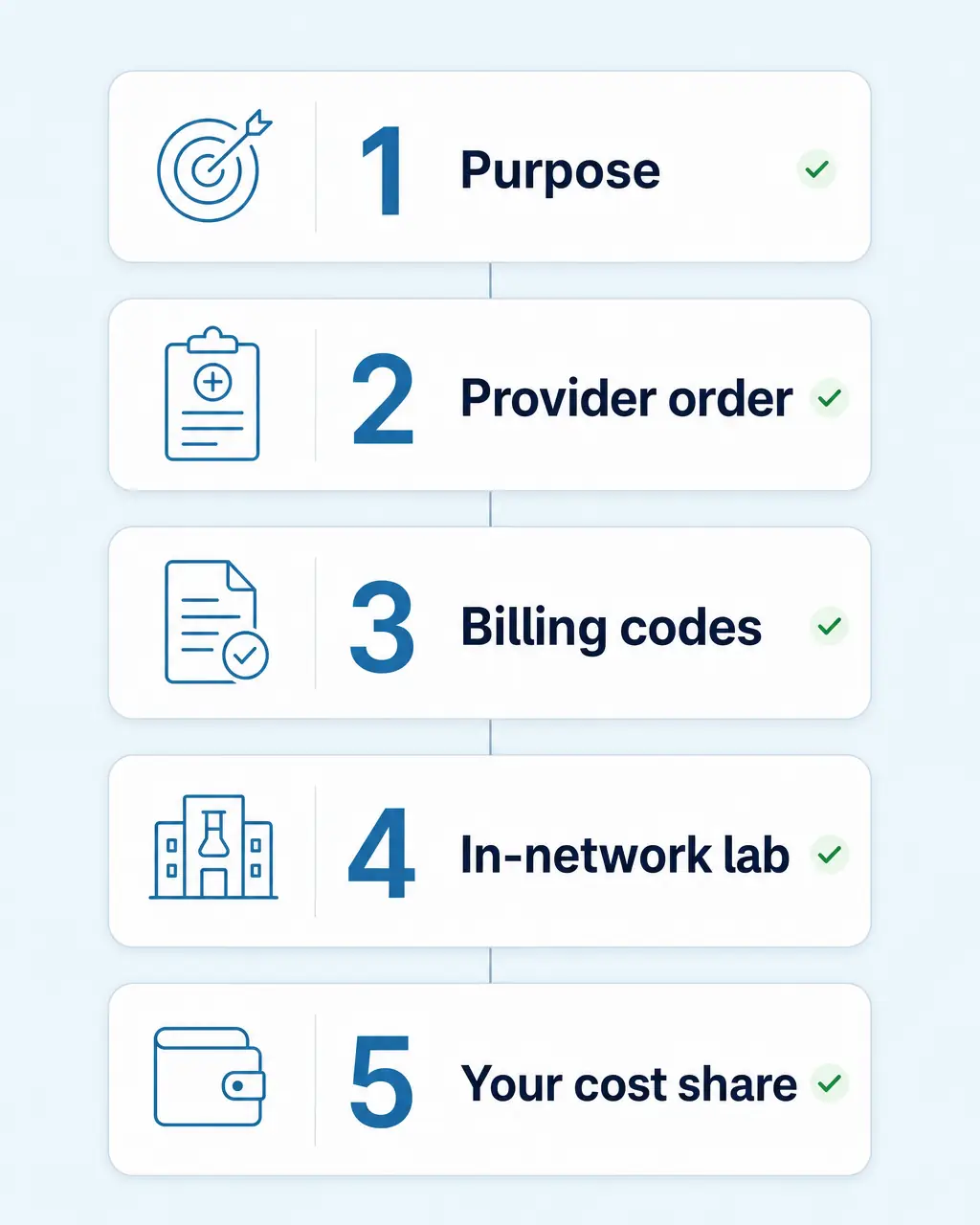
1. Your plan's infertility language
Read both the laboratory benefit and the infertility section in the Evidence of Coverage, member certificate, or Summary Plan Description. “Lab work covered” does not automatically include every lab test. Likewise, an exclusion for infertility treatment does not always exclude diagnostic testing.
An insurer's general medical policy may describe a test as medically necessary while your plan document still excludes the benefit. Coverage requires both the clinical policy and your individual benefits to line up.
Marketplace plans include laboratory services as a broad essential health benefit, but the specific services within that category vary by state and plan. Cost sharing can still apply, according to federal Marketplace guidance.
Look for separate language about:
- infertility diagnosis and testing
- infertility treatment and assisted reproductive technology
- sterilization and post-sterilization follow-up
- medical necessity
- exclusions for screening or over-the-counter products
- limits on repeat tests
2. Why the test was ordered
The clinical reason and diagnosis sent with the claim matter. A plan may approve a clinician-ordered test during an infertility evaluation and deny the same laboratory service when it is elective screening.
The diagnosis on the claim must accurately reflect your medical record. If a claim contains an error, the provider can correct it. Asking a provider to substitute a diagnosis simply to obtain coverage can create an inaccurate record and does not make the service eligible.
3. The exact procedure and diagnosis codes
The laboratory or ordering office can provide the procedure code it expects to bill and the diagnosis code attached to the order. A complete fertility analysis, a sperm-presence check after vasectomy, strict morphology, and treatment-related sperm preparation can use different codes. Do not rely on a code found in a generic price list because the actual panel may differ.
4. The people and facilities in the claim
Confirm network status for every party that may bill:
- the ordering clinician
- the performing laboratory
- the clinic or hospital facility
- any clinician who interprets the result
An in-network clinic can send a specimen to an out-of-network laboratory. A hospital can also add a facility charge to the laboratory claim. Ask where the sample will actually be analyzed and whether you should expect more than one bill.
5. Your plan's utilization and cost-sharing rules
A covered test may require an order, referral, prior authorization, or use of a designated laboratory. Then your remaining deductible, copay, and coinsurance determine your share.
For example, assume the plan's allowed amount is $200. If you still have $800 left on your deductible, you could owe the full $200 even though the service is covered. If your deductible is met and the plan applies 20% coinsurance, your share could be $40, plus any separately billed visit or facility charge. These examples illustrate the math, rather than predict your plan's price.
How to confirm coverage before the test
1. Get the billing details from the provider
Ask the laboratory or clinic for:
- the test name and purpose
- each expected procedure code
- the diagnosis code on the order
- the performing lab's name, address, and National Provider Identifier
- the ordering clinician's details
- any separate order, visit, collection, interpretation, or facility fee
- the cash price for the same service
2. Call the member-services number on your insurance card
Use the exact information from the provider. This script keeps the conversation focused:
I am calling about a semen analysis ordered for [reason]. The provider expects to bill procedure code [code] with diagnosis code [code], and the performing lab is [name and NPI]. Is this a covered benefit under my plan? Is it processed under diagnostic laboratory services, infertility diagnosis, post-vasectomy care, or another benefit? Do I need prior authorization, a referral, or a specific in-network lab? What are my remaining deductible, copay, coinsurance, and estimated responsibility for the allowed amount? Are repeat analyses handled differently?
Also ask whether the provider and performing lab are in network on the date of service. Record the representative's name, call-reference number, date, and answers. A phone response is useful documentation, although it is not a guarantee that a claim will be paid. The final claim still depends on the services and codes submitted.
3. Compare the available payment estimates
Compare the same test and all required services. An insurance estimate should include your share of the allowed amount, any required office visit, and possible facility charges. If you choose not to use insurance, CMS self-pay rules generally let you request a written good faith estimate for scheduled non-emergency care.
Do state fertility mandates guarantee coverage?
No. State laws can require certain insurance policies to cover infertility diagnosis or treatment, but their scope, definitions, eligibility rules, and exemptions vary.
Plan funding is as important as the state on your insurance card. The CMS plan-type guide explains that a private employer plan can be fully insured or self-funded and that the employer's human resources team can identify which type you have. A fully insured plan purchases coverage from an insurance issuer, and that policy is regulated by the state's insurance department. For private-sector employment plans, DOL ERISA guidance states that self-funded plans generally are not subject to state health-insurance coverage laws. An insurance company may still administer a self-funded plan, so its logo on the card does not identify who carries the claims risk.
Government, church, and other non-ERISA plans can follow different rules. For current state-specific requirements, use your state insurance department's official guidance or the applicable enacted statute, then compare it with your plan document. A state mandate does not promise that every semen analysis is covered without cost sharing.
What to do if insurance denies the claim
Start with the Explanation of Benefits and denial letter. The EOB is the insurer's claim decision, not necessarily a bill from the provider. Match the denial reason to the right response.
| Denial reason | Useful next step |
|---|---|
| Benefit exclusion | Compare the cited exclusion with language for diagnostic testing, post-vasectomy care, and any state rule that applies to your plan |
| Not medically necessary | Ask the ordering clinician for the order, relevant history, and a letter explaining the clinical reason for testing |
| No prior authorization or referral | Ask whether the plan permits a retrospective review and submit the order and call records |
| Out of network | Compare the claim with the plan directory and your recorded confirmation; document if no in-network lab could perform the exact test |
| Coding or patient-data error | Ask the billing provider to correct and resubmit the claim |
| Duplicate, bundled, or treatment-related service | Request an itemized claim and have the provider explain how each billed service differs |
File an internal appeal by the deadline printed on the denial. For plans subject to the federal process, appeal guidance says the deadline is generally 180 days from the denial notice and recommends keeping the EOB, medical documentation, appeal copies, and notes from every call. If the internal appeal fails, the decision letter explains whether external review is available. A clear benefit exclusion is harder to overturn than a coding mistake or a disputed medical-necessity decision.
What if the test is not covered?
Compare complete local laboratory analyses and all required charges. Our semen analysis cost guide provides national price context, while our self-pay guide explains written estimates, required fees, and follow-up costs.
HSA or FSA funds may be available for eligible charges. IRS Publication 502 includes diagnostic tests and laboratory fees that are part of medical care, while Publication 969 explains HSA and health FSA rules. Eligibility still depends on the expense, account terms, timing, reimbursement from other sources, and required documentation.
Budget for the possibility of a repeat. Semen parameters vary between samples, and the amended 2024 AUA/ASRM guideline says at least two analyses, ideally at least a month apart, are important when the first result is abnormal. A plan that covers the first test may apply separate medical-necessity or frequency rules to another.
Insurance coverage FAQ
Does Blue Cross Blue Shield cover sperm analysis?
There is no single Blue Cross Blue Shield answer because coverage is set by the local company, employer plan, state rules, and individual benefit design. Use the exact test code, diagnosis code, performing lab, and reason for testing when asking about your plan.
Is sperm analysis covered as preventive care?
Usually, a semen analysis is processed as diagnostic testing, infertility testing, or post-procedure follow-up, rather than a no-cost preventive screening. That means ordinary deductible, copay, and coinsurance rules can apply.
Does insurance cover a repeat semen analysis?
Sometimes. Plans may limit the number or timing of tests or require another medical-necessity review. Ask about repeat-testing rules during the first coverage call so you can budget for follow-up if the initial result is abnormal or affected by a collection problem.
Do you bill insurance directly?
We do not submit insurance claims. The selected performing lab's insurance and payment arrangements vary by location. Review that location's insurance badge and billing terms before ordering. If the lab accepts insurance, its claim and payment process is separate from our order and coordination service.
If you are ready to compare local options, find a semen analysis lab and review the selected location's insurance badge, billing terms, and price before you order.
Related Resource Articles
-
Direct Access Semen Analysis: No Doctor Referral Needed
Direct access semen analysis: No doctor referral needed. Get accurate, private, and fast male fertility testing at home. Take control today!
9 min read
-
What Does Clear Semen Mean for Your Fertility?
Wondering what does clear semen mean? Learn the common causes, from harmless factors to potential fertility signals, and discover your next steps.
15 min read
-
How Long Does It Take to Get Pregnant? A Clear Timeline
Learn what is typical over months of trying, what happens after sex, when to test, and when both partners should consider a fertility evaluation.
11 min read