You’ve probably heard that a vasectomy is one of the most effective forms of male contraception out there—and it is. But like any medical procedure, it’s not 100% foolproof.
It's extremely rare, but failures can happen in a couple of different ways. An early failure can occur if the tubes manage to reconnect shortly after your procedure, while an even rarer late failure might happen months or even years down the road. Understanding these tiny risks is a big part of making a confident, informed decision about your reproductive health.
Understanding Why Vasectomies Occasionally Fail
A vasectomy is a rock-solid choice for permanent male contraception, boasting a success rate of over 99%. But "almost perfect" still leaves a tiny sliver of a chance for failure. To get why, you first need to know how the procedure works.
Think of the vas deferens—the tubes that transport sperm—as a simple garden hose. A vasectomy is like cutting that hose in two and sealing both ends to stop the flow. This keeps sperm from ever reaching the semen, which is what makes a man sterile. A failure, then, is when the body somehow manages to bridge that gap and reconnect the hose against all odds.
The Two Types of Vasectomy Failure
So how does this reconnection actually happen? There are really two distinct scenarios, each with its own timeline and probability.
Here’s a quick breakdown of how vasectomy failures can occur:
| Failure Type | When It Occurs | Primary Cause |
|---|---|---|
| Early Failure | Within the first few months | The body's healing process creates a new channel between the severed tube ends (recanalization). |
| Late Failure | Months or years after being confirmed sterile | An extremely rare, spontaneous reconnection of the vas deferens. |
Let's dig a little deeper into what these mean for you.
Early Failure (Recanalization)
This is the one we see more often, though it's still quite uncommon. Recanalization happens when your body’s powerful healing instincts go a little overboard. In the first few months after surgery, the body can sometimes form a microscopic new channel between the two severed ends of the vas deferens, allowing sperm to sneak through.
Late Failure
This one is the real unicorn of vasectomy failures. It’s an incredibly rare event where the tubes find a way to reconnect long after you’ve already been given the all-clear with a sterile semen analysis. We’re talking months or even years later.
The most important thing to remember is this: you are not sterile the moment you walk out of the clinic. It takes time and a number of ejaculations to clear out all the remaining sperm from your system. A follow-up test is the only way to know for sure that the pipes are clear.
The numbers back this up. Studies show that early failure, or recanalization, happens in about 0.3% to 0.6% of vasectomies when checked a few months after the procedure. Late failure is far, far rarer—a large study in the UK found it occurred in just 0.04% of cases. You can find more details on vasectomy statistics from the European Association of Urology.
Because you can’t see or feel a failure happening, that post-vasectomy semen analysis isn’t just a friendly suggestion—it’s the critical final step. It's the only way to confirm the job is done and give you the peace of mind you're looking for.
Early Failure: The Most Common Scenario
When a man asks how a vasectomy can fail, the answer almost always points to something called early recanalization. It sounds complicated, but the idea is actually pretty simple. This is by far the most common reason a vasectomy doesn't work out, though it's important to remember it's still a very rare event overall.
This type of failure happens in the first few months after your procedure. It has nothing to do with something you did or didn't do during recovery. It’s simply the body’s incredible, and in this case, inconvenient, ability to heal itself. Sometimes, that healing process manages to create a tiny, microscopic tunnel between the two sealed ends of the vas deferens.
Think of it like building two dams to block a tiny stream. In the vast majority of cases, those dams hold perfectly. But every once in a while, a little trickle of water manages to forge a new path around or through the blockage, reconnecting the flow. That’s essentially what recanalization is—sperm find a new way to get across the gap.
Why You Wouldn't Know It's Happening
Here’s the most critical part to understand about early failure: there are no physical signs or symptoms. You won't feel any pain, notice anything different, or have any clue that the tubes have reconnected. Everything will feel completely normal.
This is exactly why the follow-up semen analysis is non-negotiable. It's not just a box to check off; it is the only way to know for sure that your vasectomy was successful. Without that lab test, you're just guessing about your fertility, which can lead to a very unexpected outcome.
An early vasectomy failure isn't a sign of a botched surgery or a mistake you made recovering. It's a known, though uncommon, biological possibility that highlights why post-procedure testing is an essential part of the process for every single man.
Skipping this final step is the biggest risk you can take after getting a vasectomy. It is absolutely vital to use other contraception until you get the official all-clear from your doctor based on your semen analysis.
Turning Confirmation Into Confidence
It helps to think about the post-vasectomy semen test in a different light. Instead of seeing it as a chore, view it as the final, empowering step in the process. This test gives you the concrete proof you need to have total confidence in your vasectomy and secure your long-term peace of mind.
The confirmation process is straightforward but does require a bit of patience. Your doctor will give you specific instructions, but the general plan is to wait a set amount of time and ejaculate a number of times before submitting your sample. This is to make sure any sperm left in the pipes before the procedure have been cleared out.
- Wait for the Go-Ahead: Your doctor will typically recommend waiting 8-12 weeks after your vasectomy before you get tested.
- Clear the System: You'll also need to have ejaculated a certain number of times (usually 20-30 times) to flush out any sperm that were already past the point of the surgical snip.
- Get Tested: Follow the instructions for providing a sample. It's a small step that delivers huge reassurance.
By sticking to this simple plan, you move from hoping the vasectomy worked to knowing it did. That confirmation is what truly marks the end of the procedure and the start of a new chapter of your life.
Late Failure: An Extremely Rare Possibility
After getting the all-clear from your doctor, it’s natural to consider your vasectomy a done deal. For the overwhelming majority of men, it absolutely is. However, to get the full picture, it's worth understanding an incredibly rare phenomenon called late recanalization.
This is exactly what it sounds like: a failure that happens months or even years after a man has already been confirmed sterile by a post-vasectomy semen analysis. While early failure is uncommon, late failure is exceptionally rare.
How Does Late Recanalization Happen?
Late recanalization occurs when the sealed ends of the vas deferens manage to grow back together and form a new channel, long after the procedure has healed. Think of it like two cut vines in a dense garden that, over a great deal of time, slowly find their way back to each other and fuse, reopening the path.
This isn't caused by anything you do or don't do. It’s simply a rare, unpredictable biological event where the body’s powerful healing mechanisms create a microscopic new tunnel for sperm to pass through. The key thing to remember is that this happens after you’ve already proven the vasectomy was initially a success.
Late failure is an incredibly rare event, occurring in roughly 1 out of every 2,000 vasectomies. While the odds are overwhelmingly in your favor, it shows that a vasectomy's effectiveness, while extremely high, is not an absolute lifetime guarantee.
Knowing this isn't meant to cause worry, but to provide a complete, realistic view of your long-term male reproductive health. It reinforces that while a vasectomy is one of the most reliable forms of contraception available, no method is 100% perfect forever.
What This Means for You Long-Term
The main takeaway here is that a surprise pregnancy, while highly improbable, isn't completely impossible years down the road. Since there are no physical symptoms that a reconnection has occurred, a man would have no way of knowing his fertility has been restored.
This reality just underscores the importance of being aware and proactive. Here’s how to frame it:
- Trust the Statistics: First and foremost, remember how exceedingly uncommon this is. The vast majority of men will never experience it.
- Acknowledge the Possibility: Simply knowing this rare event can happen allows for more informed discussions about long-term goals.
- Consider Re-testing if You Need Peace of Mind: If your life circumstances change or you just want to be certain years later, you can always get another semen analysis to re-verify your status. It’s a simple step for complete assurance.
Ultimately, being fully informed about how a vasectomy can fail—both in the short term and the very long term—is empowering. It gives you the complete picture, allowing you to move forward with confidence and clarity for the rest of your life.
How Your Surgeon's Choice Impacts Vasectomy Success
When a vasectomy doesn't work out, it's natural to think about the biological reasons, like recanalization. But there's another piece of the puzzle that has a huge impact on the outcome: the experience and specialty of the surgeon. While a vasectomy is a common procedure, the skill of the man performing it is directly linked to its long-term success.
Choosing a surgeon is one of the most important decisions you'll make. It’s a bit like hiring someone to fix a critical pipe in your house. You could go with a general handyman who does a little of everything, or you could call a master plumber who has spent a decade perfecting one specific trade. Both might stop the leak, but the specialist brings a level of expertise that almost always leads to a more reliable, long-lasting fix.
Why a Urologist Is Your Best Bet
A urologist is a doctor who specializes in the male reproductive system. This is their turf. They perform vasectomies day in and day out, so they're intimately familiar with the anatomy and the subtle techniques that cut down the risk of failure. A surgeon with a high volume of these procedures has seen it all—every anatomical variation you can imagine—and has honed their technique over thousands of cases.
This experience isn't just theoretical; it translates into real benefits for you. A seasoned urologist is generally faster, uses the most effective methods for sealing the vas deferens, and is better prepared to handle any curveballs that might pop up during the procedure. This specialized focus is key to setting you up for success from day one.
The decision of who performs your vasectomy is one of the most important you'll make in this process. Opting for a board-certified urologist with extensive experience is a proactive step toward minimizing the already low risk of failure and ensuring your peace of mind.
The data backs this up. A major US study found that men whose vasectomies were done by non-urologists had a 56% higher chance of needing a repeat procedure compared to those treated by urologists. This statistic really drives home how much expertise matters for a one-and-done outcome. You can dive deeper into these findings on the importance of procedure expertise in vasectomy outcomes.
Actionable Steps for Choosing Your Surgeon
Making an informed choice isn't about stressing yourself out; it's about giving yourself the power of information. Here are a few practical things you can do when picking a provider:
- Ask About Experience: Don't be shy. Ask how many vasectomies the surgeon performs each year. A high-volume surgeon has likely seen and done more, which refines their skills.
- Confirm Their Specialty: Check if the provider is a board-certified urologist. This certification is a guarantee they've met the highest standards in their field.
- Read Patient Reviews: See what other men are saying. Real-world feedback about their experience with a specific doctor can be incredibly insightful.
- Schedule a Consultation: This is your chance to ask questions and get a feel for the doctor’s approach. A good surgeon will be happy to walk you through their technique and address all your concerns.
Taking these steps helps ensure you’re not just getting a procedure, but that you’re getting expert care designed for the best possible result. Finding a trusted specialist is a simple but powerful way to take control of your male reproductive health. If you're looking for post-vasectomy testing options, you might be interested in our guide on finding a lab for your semen analysis.
Your Post-Vasectomy Plan for Confirming Success
Getting a vasectomy is a huge step, but the procedure itself isn’t the finish line. Think of the weeks that follow as the final, crucial phase—this is where you confirm the job was a success. Your active role here is what truly locks in the long-term peace of mind you were looking for.
This isn’t just about following a checklist; it's about understanding why each step is so important. After the vas deferens are sealed, there are still live sperm hanging out in the upper parts of your reproductive tract. It takes time and a certain number of ejaculations to completely flush them out, which is why you are not considered sterile right away.
Why the Waiting Period Is Non-Negotiable
Your doctor will give you a specific timeline for follow-up testing, which is usually 8 to 12 weeks after your procedure. They'll also recommend a minimum number of ejaculations—often around 20 to 30—to help clear out any lingering sperm from the pipes.
This waiting period is absolutely essential. Having sex without other contraception before getting the all-clear is one of the most common reasons for an unplanned pregnancy after a vasectomy. It's a simple case of bad timing—the system just hasn't been fully cleared out yet.
The image below shows why picking the right surgeon from the start is so important. A specialist urologist can significantly improve your odds of success and reduce the risk of complications.
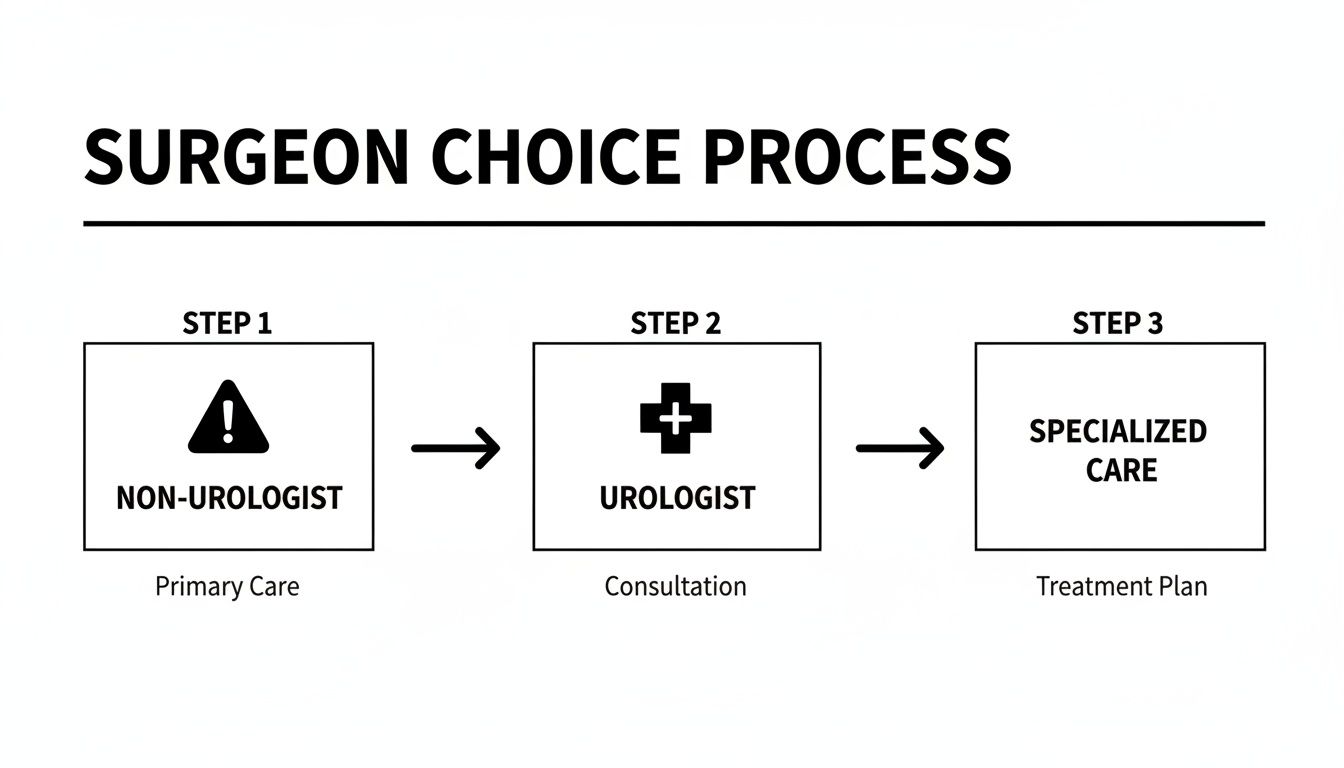
This just goes to show that while you have options, heading straight to a urologist is the recommended route for specialized care and a higher chance of a successful outcome.
Your Action Plan for Vasectomy Confirmation
Navigating the post-vasectomy period is pretty straightforward once you know what to do. Here’s a simple checklist to make sure you cover all the bases and can move forward with total confidence.
- Stick to the Timeline: Follow the waiting period and ejaculation count your urologist gave you. Circle the date on your calendar for when you need to schedule that first semen analysis.
- Keep Using Other Contraception: This is critical. You absolutely must continue using another reliable form of contraception until your doctor officially confirms your vasectomy was successful based on your lab results.
- Schedule and Complete Your Semen Analysis: Do not skip this test. It is the only way to know for sure if your vasectomy worked. This is the proof that puts any lingering questions about failure to rest.
A vasectomy is only considered a success once a semen analysis shows azoospermia (a complete absence of sperm). Until you get that official all-clear, you have to assume you are still fertile.
Unfortunately, far too many men drop the ball on this last step. The procedure's ultimate success hinges on this final verification, yet compliance with follow-up testing can be shockingly low. Some reports show noncompliance rates as high as 73%. This shows that vasectomy failure isn't just about the surgery—it's also about a man's commitment to seeing the process through.
Understanding Your Semen Analysis Results
Once you get your results, your doctor will walk you through them. The perfect outcome is azoospermia, which means zero sperm were found in your sample. This is the official green light confirming your procedure was a complete success.
Sometimes, a test might show a very low number of non-motile (non-moving) sperm. In these situations, your doctor will likely recommend waiting a few more weeks and re-testing to give the remaining sperm more time to clear out. However, if motile (moving) sperm are present, it could signal an early failure, and your urologist will discuss the next steps.
If you're looking for a convenient way to get this crucial test done, you can easily find labs for post-vasectomy semen analysis through our network.
What to Do If Your Vasectomy Fails
Getting the news that your vasectomy didn't work can be incredibly disheartening. You took a definitive step for permanent contraception, so learning that sperm are still present in your semen is the last thing you want to hear.
But the first thing to know is this: it’s a manageable situation. A failed vasectomy isn’t a dead end—it’s just a detour, and your urologist knows the map well. Take a breath. The fact that you found out through a semen analysis means the safety net worked. You caught the problem before an unplanned pregnancy could happen.
This proactive discovery puts you right back in the driver's seat. Your next move is a simple, productive chat with your urologist to go over the game plan.
Your Primary Option: A Repeat Vasectomy
For the vast majority of men facing a vasectomy failure, the solution is refreshingly straightforward: a repeat vasectomy.
I know, the thought of going through the procedure again probably isn’t thrilling. But there’s a major silver lining—repeat vasectomies have an extremely high success rate. Your surgeon now has the advantage of knowing a failure occurred and can take extra precautions to ensure the second time is the charm.
This might mean removing a slightly larger segment of the vas deferens or using more robust techniques to seal the ends and keep them separated. Think of it like this: your body's unique healing process presented a challenge the first time. Now, your doctor can tailor a new approach specifically to overcome that challenge, dramatically increasing the odds of success.
Discussing the Next Steps With Your Doctor
When you meet with your urologist, the conversation will be focused on getting you a definitive result and restoring your peace of mind. This is your chance to ask every question you have and make sure you're comfortable with the plan.
Here’s what your urologist will likely cover:
- Confirming the Failure: Before jumping to another procedure, they may recommend a second semen analysis just to be 100% certain the first result wasn't a lab error or a fluke.
- Reviewing the Surgical Technique: Your doctor can explain what might have caused the initial failure and, more importantly, what they’ll do differently this time to lock in success.
- Scheduling the Procedure: You'll get the repeat vasectomy on the books, following the same simple prep and recovery instructions you did the first time around.
A failed vasectomy is a known, albeit rare, possibility. Having a clear plan and an experienced urologist to guide you through a repeat procedure is the most reliable path to achieving permanent sterility and regaining your confidence.
Remember, it is absolutely critical to continue using another form of contraception until your repeat vasectomy is complete and you get the all-clear from a follow-up semen analysis. Taking these calm, measured steps will resolve the issue and get you back to the worry-free outcome you wanted from the start.
Frequently Asked Questions About Vasectomy Failure
We’ve covered the technical side of how and why vasectomies can fail, but it's completely normal for a man to have a few more questions rattling around. Let's tackle some of the most common concerns men have after getting the snip, reinforcing the key things you need to know.
How Long After a Vasectomy Can It Fail?
Vasectomy failure generally falls into two distinct timelines. The one we see most often is early failure, which is when the vas deferens tubes find a way to grow back together shortly after the procedure. This process, called recanalization, usually happens within the first three to four months. This is exactly why your urologist insists on follow-up semen tests during that window—to catch this before it leads to an unintended pregnancy.
Then there's late failure. This is when the tubes reconnect years after you’ve already been given the all-clear. It's incredibly rare, but it can technically happen at any point down the road. It serves as a stark reminder that testing is the only surefire way to know your status.
Are There Physical Signs of a Failed Vasectomy?
No, and this is a critical point for men to understand. There are absolutely no physical symptoms that will tip you off to a vasectomy failure. You won't feel different, notice any changes in sensation, or experience pain if the tubes reconnect—whether it happens early or late.
The only way to know for sure if your vasectomy was successful—and remains so—is through a semen analysis. This lab test is the one and only definitive method to confirm whether motile sperm are present.
Does Finding Any Sperm Mean the Vasectomy Failed?
Not necessarily. It's perfectly normal for a man to find sperm in his ejaculate for several weeks, or even a few months, after his procedure. Your body simply needs time to clear out all the sperm that were already "in the pipeline" beyond the point where the snip occurred.
The crucial detail isn't just the presence of sperm, but whether they are motile (moving). This is what your doctor will be looking for on the lab report. If you want to get a better handle on what your results mean, check out our guide on how to read a semen analysis report.
Here's how a urologist typically interprets the findings:
- Non-motile sperm: These are usually just dead or dying sperm being flushed out of the system. Your doctor will likely recommend waiting a bit longer and then re-testing to ensure they eventually disappear.
- Motile sperm: Finding moving sperm is a potential sign of early failure. This will prompt a conversation with your doctor about what to do next, which might include a repeat vasectomy.
Ultimately, your urologist will put the results into context. A few dead sperm early on is expected; any moving sperm a few months later is a red flag. It all comes down to giving your system enough time to fully clear out.
At Hera Fertility, we believe understanding your male reproductive health should be simple and straightforward. Whether you're confirming a vasectomy's success or exploring your fertility for other reasons, our platform gives you the tools you need: physician-signed lab requisitions, access to over 250 certified labs, and clear, AI-powered analysis of your results. Take the next step in your health journey with confidence at https://herafertility.co.
Related Resource Articles
-
Understanding the Odds of Causing a Pregnancy After a Vasectomy
Get clear, reassuring answers on the odds of getting pregnant with a vasectomy. Learn about failure rates, semen analysis, and what men need to know.
22 min read
-
How to Prepare for a Vasectomy: A Man's Complete Guide
A definitive guide on how to prepare for vasectomy. Get checklists, pre-procedure medical steps, recovery tips, and info on confirming your success.
21 min read
-
How Long After Vasectomy: Your 2026 Recovery Timeline
Wondering how long after vasectomy until sterile? Our 2026 guide covers typical timelines, required testing, and when to safely stop contraception.
11 min read