Figuring out how to get your husband to do a sperm test often comes down to one key approach: frame it as a proactive, information-gathering step you can take together as a team. This isn't about assigning blame or pointing fingers. It’s simply about getting a complete picture of his health so you can move forward with clarity.
Starting the Male Fertility Conversation

Let's be honest, initiating this conversation can feel challenging. The topic is deeply personal and can easily trigger feelings of pressure or inadequacy for a man. Your goal is to create a safe space where he feels supported, not scrutinized.
The most effective strategy is to normalize male fertility testing. Present it as a routine health check-up, a simple way to rule things out and collect valuable data. This approach shifts the focus from a pass/fail exam to a logical step in a larger process. It’s just about being thorough.
The key is to emphasize partnership. Use "we" and "us" to reinforce that you're in this together. A sperm test isn't a reflection of his masculinity; it’s a smart, responsible step toward a shared goal.
Finding the Right Words for Him
Every man is different, so a one-size-fits-all script rarely works. You know your partner best. Take a moment to consider what motivates him and what might make him feel defensive.
Is he data-driven and logical? Does he respond best to emotional connection and teamwork? Thinking about his communication style beforehand allows you to choose an approach that will actually resonate with him.
It can also help to mention that this is a common health topic. Male factors contribute significantly to fertility challenges. Sharing facts like this can help him see this isn't a personal failing. You can explore more data on male fertility trends to understand the bigger picture.
Conversation Starter Approaches
To help you get started, here’s a breakdown of different ways you can frame the conversation based on his personality. Think about which one sounds most like him.
| Approach | Best For A Husband Who Is... | Example Opening Line |
|---|---|---|
| The Team Player | Collaborative and values partnership. | "Hey, as we're figuring out our next steps, I was thinking we could tackle this together. Getting a complete picture of your health feels like the best way for us to move forward as a team." |
| The Data-Driven Analyst | Logical, analytical, and appreciates facts. | "I've been looking into things, and a sperm analysis is a really straightforward way to gather some key data. It would give us a clear baseline and help us make informed decisions without guessing." |
| The Health-Conscious Planner | Proactive about his health and wellness. | "You're so on top of your health, and I was thinking this is just another part of that. A simple check-in on your reproductive health seems like a smart, proactive thing to do, just like any other check-up." |
Finding the right opener can make all the difference in setting a supportive tone for the entire conversation. The goal isn't to corner him, but to invite him into a joint effort.
Understanding Why Men Hesitate About Sperm Tests
To actually have a productive conversation about a sperm test, it helps to first understand the real reason he’s putting it off. For many men, this isn’t about just being difficult or avoiding a simple task.
When you bring up a semen analysis, he might hear something completely different—a loaded question that triggers a whole cascade of complex emotions. It's almost never just about the inconvenience of the appointment.
Often, the real roadblock is a deep, quiet anxiety about the results. He's likely wrestling with the question, "What if something is wrong with me?" That fear of getting bad news can be paralyzing, making it feel much easier to just avoid the test than to face a reality that might be tough to hear.
This isn't some niche worry, either. Male reproductive health is a massive and growing field of medicine. The global male infertility market was valued at around USD 4.0 billion in 2022 and is projected to climb significantly. That shows just how seriously the medical community is taking men's health. You can find more on the latest science on male reproductive health at mensreproductivehealth.com to get a sense of the landscape.
The Pressure to Perform and Masculinity
Beyond the fear of a bad diagnosis, many men tie their fertility directly to their sense of masculinity and virility. A sperm test can feel like a direct challenge to that core part of his identity.
Then there’s the whole issue of producing a sample on command, in a sterile clinic. The thought alone can create serious performance anxiety. It’s an unnatural, high-pressure situation that can be a major psychological hurdle. He might be fixated on the awkwardness of it all, feeling exposed and vulnerable.
A man's hesitation often isn't a sign of selfishness or a lack of commitment. More often, it's a quiet signal of his own internal fears—about his health, his identity, and what the results might mean for your shared future.
Privacy and Control
Men also tend to be very private about their health, especially something this personal. The idea of discussing such an intimate topic with doctors or lab techs can be deeply uncomfortable. He might be worried about who will see his results and how that information is going to be handled.
To help him feel more in control of the situation, it’s useful to see things from his perspective. Here are some of the common feelings that could be driving his reluctance:
- Fear of Judgment: He may worry that an abnormal result will be seen as a personal failure or a reflection on him as a man.
- Aversion to Medical Settings: Let’s be honest, some men just avoid doctors and clinics at all costs. A sperm test is definitely no exception.
- Loss of Control: The whole process can feel like something that is happening to him, rather than a proactive choice he's making for his health.
- Misinformation: He might believe outdated myths about male fertility or not realize that many issues affecting sperm health are temporary and can often be improved.
When you can recognize these potential underlying concerns, you can move past the surface-level excuses. This lets you start the conversation from a place of genuine empathy, addressing his specific fears with compassion and reassurance—and that's the real first step to getting him on board.
Actionable Scripts for a Supportive Discussion
Knowing what to say can make all the difference, turning a potentially tense chat into a productive and loving conversation. The words you choose here really matter. The goal is to frame this as a team effort, using "we" and "us" to show you're in this together.
Timing is everything. Pick a calm, private moment when neither of you is stressed, tired, or rushing out the door. Think a quiet evening on the couch, not a frantic Tuesday morning.
For the Analytical, Data-Driven Partner
If your husband is a logical guy who thrives on facts and efficiency, he’ll respond best to a straightforward, data-focused approach. Frame the sperm test as the quickest way to gather information so you can make smart decisions.
Here’s a way you could phrase it:
"I've been thinking about our next steps, and it feels like we need more information. To be as efficient as possible, it just seems logical for us to get a complete picture of your health. A semen analysis is a simple way to get a key piece of data, so we can make informed choices together instead of just guessing. It’s just about getting all the facts on the table."
This approach taps into his problem-solving mindset. It positions the test not as an emotional challenge, but as a necessary diagnostic step to build a clear plan.
For the Sensitive, Emotionally-Tuned-In Partner
For a man who is more in touch with his emotions, leading with reassurance and partnership is key. He needs to feel safe and supported, not judged or backed into a corner. The focus should be on your connection as a couple.
You could try an approach like this:
"Can we talk about something? I want to make sure we're facing everything together. I was thinking that looking into your health is something we could do for each other. This isn't about finding a 'problem'—it's about being proactive and supportive partners through all of this. What do you think?"
This script validates his feelings and centers the conversation on your relationship. It underscores your commitment to navigating this side-by-side, which can help ease any underlying anxieties he might have about performance or masculinity. Building a foundation of strong communication is critical. If you find it hard to express your feelings or understand each other's point of view, exploring effective communication strategies can give you both some helpful tools.
Listen and Validate Whatever Comes Up
After you’ve opened the door, the most important thing you can do is just listen. Seriously. Give him the space to share his thoughts and fears without jumping in to correct or solve anything.
He might bring up worries you hadn't even considered. Whatever he says, your first job is to validate his feelings.
If he says: "I'm worried about what the results might say."
You could respond: "That makes total sense. It’s a lot of pressure, and feeling anxious about the unknown is completely normal. We’ll look at the results together, no matter what they are."
If he says: "The whole process just seems really awkward and clinical."
You could respond: "I hear you. It definitely sounds uncomfortable, and I appreciate you even considering it. We can look into options that make it as private and straightforward as possible."
By truly listening and validating, you're showing him his feelings are legitimate and that you're on his side. This builds the trust that will make him see the sperm test as a collaborative step forward. For more perspectives from medical experts on handling these conversations, you might find some great insights in these expert interviews on male fertility.
Making The Sperm Test Process Simple And Private
Even after you've had a good, supportive conversation, the actual logistics of getting a sperm test can feel like a huge hurdle. For a lot of men, the thought of scheduling an appointment, taking time off work, and sitting in an awkward clinic waiting room is enough to put it off indefinitely. The whole process can feel clunky and uncomfortably public.
But here’s the good news: getting a sperm test is much easier and way more private than it used to be. You can now present him with options that put him in the driver's seat, which honestly, can make all the difference.
This graphic really breaks down the key parts of a successful conversation, focusing on finding the right time, truly listening, and approaching it as a team.
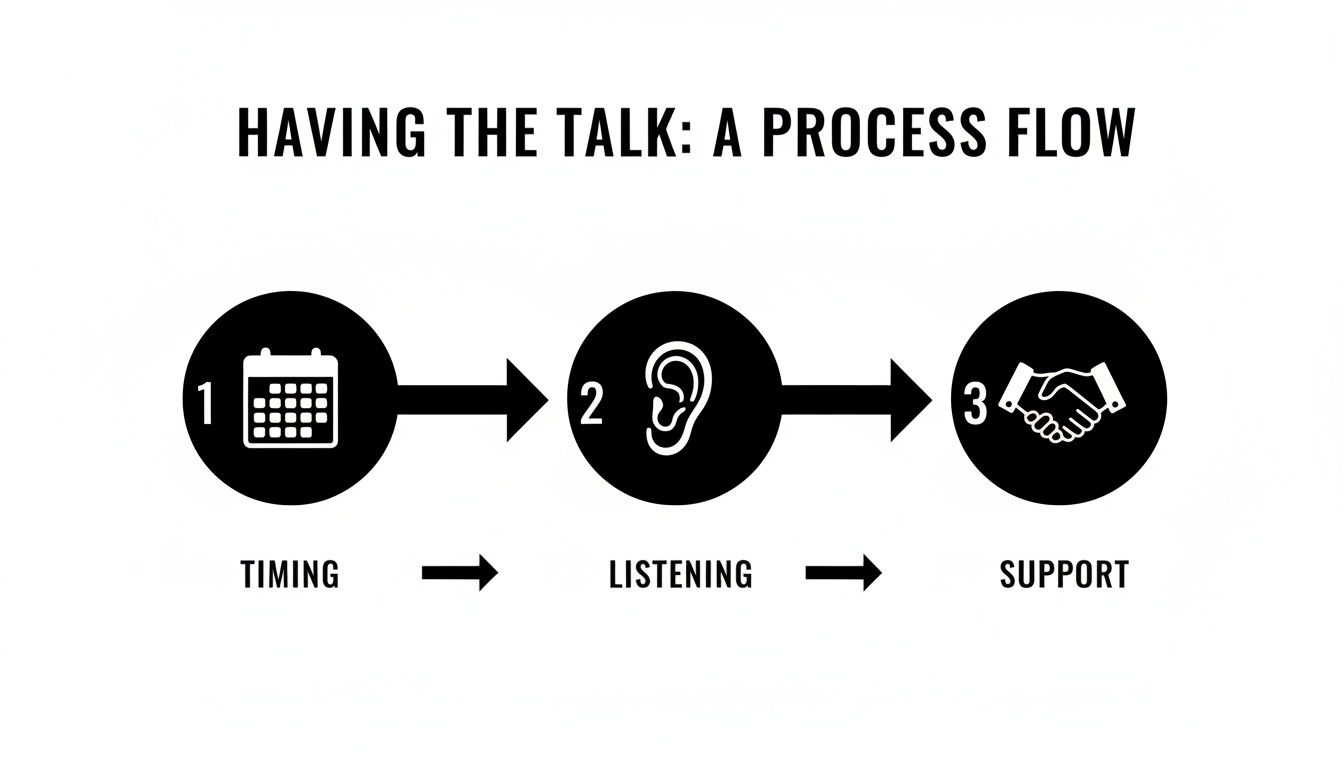
When you build on that foundation of trust, figuring out the "how" and "where" becomes so much easier.
Low-Friction Testing Options
Let's quickly compare the old way with the new way.
The traditional route usually involves getting a doctor's referral, booking an appointment at a fertility clinic or hospital, and then producing a sample on-site in a sterile, impersonal room. It works, but it's not exactly a comfortable or convenient experience for most men.
A much more private and flexible alternative is using a service like Hera Fertility. This approach sidesteps many of the common barriers by separating the ordering of the test from the taking of the test.
Here’s how simple it is:
- Order Online From Home: He can get a physician-authorized lab order in just a few minutes, completely skipping that initial doctor's visit.
- Choose a Convenient Lab: Instead of being stuck with one specific clinic, he can pick from a huge network of professional, CLIA-certified labs nearby. You can even scope out the network of labs near you to see just how convenient it is.
- Schedule On His Terms: He chooses the date and time that fits his schedule. No one else’s. This gives him complete control.
This method directly tackles the biggest hang-ups: privacy and convenience. He interacts with a professional lab tech for just a moment, and the entire thing is handled with the same discretion as any other routine medical test.
Comparing Sperm Test Options
To make it even clearer, here’s a side-by-side look at the two main options. This can help you both decide which path feels less stressful and more manageable.
| Feature | Traditional Clinic Visit | At-Home Lab Requisition (e.g., Hera) |
|---|---|---|
| Initial Step | Requires a doctor's visit for a referral. | Order a physician-authorized requisition online. |
| Location | Must go to a specific fertility clinic. | Choose from a wide network of local labs. |
| Scheduling | Limited to clinic hours and availability. | Flexible scheduling based on his calendar. |
| Privacy | Produces sample on-site in a designated room. | Collects sample at home, drops off at lab. |
| Comfort Level | Can feel clinical, public, and awkward. | Private, controlled, and far less intimidating. |
| Turnaround | May take a week or more for results. | Often faster results, delivered securely online. |
Choosing an option that minimizes discomfort and maximizes his sense of control is often the key to moving forward without friction.
Emphasizing Privacy And Control
Presenting a low-friction option like this can be a total game-changer. It shows him you’ve really thought about his comfort and are trying to make things as stress-free as possible. The awkwardness he might be picturing pretty much disappears.
This modern approach also ensures his sensitive health information is protected under HIPAA regulations, just like any other medical record. He gets the accuracy of a professional lab without the discomfort of a traditional clinic.
For anyone curious about what these places are like, understanding how medical testing laboratories are set up can offer a peek behind the curtain.
By framing the test as a simple, private health check that he can manage himself, you remove the biggest roadblocks before they can even become excuses.
What to Expect From the Semen Analysis Results
 For a lot of men, the biggest thing holding them back is a fear of the unknown. "What are the results going to say?" "Will I even understand the report?" That anxiety is a huge hurdle, but you can help turn that fear into a feeling of empowerment by just demystifying what the results actually look like.
When he knows what comes after he provides the sample, the whole test feels less like a vague, scary verdict and more like a manageable first step. It’s not some final judgment on his manhood or health; it's just information.
The results aren't just a simple "pass" or "fail." A semen analysis is a detailed snapshot of his reproductive health at one specific moment in time. Several key factors are measured to get the full picture.
Breaking Down the Key Metrics
A typical lab report looks at a few different aspects of sperm health. The technical terms might sound complicated, but the ideas behind them are actually pretty simple.
- Sperm Count (Concentration): This is just what it sounds like—the number of sperm found per milliliter of semen. It’s all about quantity.
- Motility: This measures the percentage of sperm that are actually moving. More importantly, it looks at progressive motility—how well they swim forward in a straight line.
- Morphology: This refers to the shape and structure of the sperm. A lab technician literally looks at the percentage of sperm that have a "normal" shape, meaning a well-formed head and tail.
An important takeaway for your husband is that these numbers can and do fluctuate. Factors like a recent flu, high stress levels, or even a few nights of bad sleep can temporarily impact results. A single test is just a starting point, not the final word.
Turning Complex Data into Actionable Insights
Let’s be honest, traditional lab reports can be a nightmare to read. They're often dense, full of medical jargon, and leave you both guessing what it all means. This is where modern services have a massive advantage.
Platforms like Hera Fertility, for instance, don't just dump raw numbers on you. They translate all that complex data into a clear, easy-to-understand Hera SmartScore.
This score combines all the critical parameters—count, motility, and morphology—into one simple metric that tells him exactly where his reproductive health stands. No medical degree required. If you want to dive deeper into the specifics, you can learn more about how to read semen analysis results and what each number really means.
Even better, he’ll receive a personalized action plan. This is the most crucial part. The results become a roadmap, offering concrete, evidence-based suggestions for lifestyle changes or next steps. This reframes the entire test as a constructive tool for improvement, reassuring him that no matter the outcome, there are always clear, proactive things he can do.
Common Questions About Male Fertility Testing
Even after you've had a great conversation, he might still have a few worries rattling around in his head that he's not quite ready to voice. Getting out ahead of these common questions can dissolve any last-minute hesitation and help him feel much more comfortable moving forward.
Is an Abnormal Sperm Test a Final Verdict?
Not even close. This is probably the biggest misconception out there, and it’s critical he understands that a semen analysis is just a snapshot in time. It's not a permanent label or some final judgment on his fertility.
So many things can temporarily throw the numbers off—a recent fever, a stressful month at work, a few bad nights of sleep, or even certain medications. An abnormal result isn’t a dead end; it’s actually really valuable information. Think of it as the starting line for a proactive plan, which could involve simple lifestyle tweaks, targeted supplements, or getting more specific medical guidance.
An abnormal test result is simply data. It's the beginning of a proactive plan, not the end of the story. Many men see significant improvements in their sperm parameters with a focused approach.
How Private Is the Sperm Testing Process?
Privacy is a huge deal, and modern testing services are built around it. You can reassure him that his personal health information is locked down by strict federal laws like HIPAA, which exist solely to protect patient confidentiality. The whole process is designed to be discreet.
For instance, with an at-home lab requisition service, the order is placed privately online. From there, he can pick a certified, professional lab from a network and book an appointment that fits his schedule. This completely bypasses the awkwardness of discussing personal details in a crowded clinic waiting room, giving him a level of privacy and control he probably wasn't expecting.
What If He Still Says No?
If you’ve tried these supportive approaches and he’s still digging his heels in, pushing the issue will only build a wall between you. This is the point where it might be smart to change the strategy.
Instead of focusing on him getting a test, suggest a joint appointment with a urologist or a male fertility specialist. You can frame it as a chance for you both to "gather information" as a team. Hearing about the importance of male factor testing from a neutral medical expert often lands differently than hearing it from a partner. It takes the personal pressure off him and puts the recommendation in the hands of a professional, making it feel less like an accusation and more like a standard part of a health check-up.
Ready to take the next step with a simple, private, and clear approach to male fertility testing? At Hera Fertility, we translate complex lab results into an easy-to-understand Hera SmartScore and a personalized action plan. Order your physician-authorized lab requisition today.
Related Resource Articles
-
How to Get Sperm Tested: A Man's Complete Guide (2026)
Learn how to get sperm tested with our clear, step-by-step guide for men. Explore test types, prep, costs, and how to understand your results for better health.
21 min read
-
Pyospermia Treatment: Your Complete Guide
Confused by pyospermia? Explore pyospermia treatment options, from diagnosis to fertility impact. Get guidance on your next steps.
17 min read
-
Do You Need a Doctor Order for Semen Analysis?
Unsure if you need a doctor order for semen analysis? This guide explains the process, why it's required, and how to easily get tested for male fertility.
17 min read