If your semen analysis says oligo-astheno-teratozoospermia (OAT), three measures were below the lab's reference range: sperm concentration, motility and morphology. The term looks intimidating. It describes a pattern on a report and cannot, by itself, tell you whether you can have a child. The useful questions are whether the pattern persists, what may be causing it and which path fits you and your partner. Here is how to interpret the numbers and decide what to do next.
What is oligo-astheno-teratozoospermia?
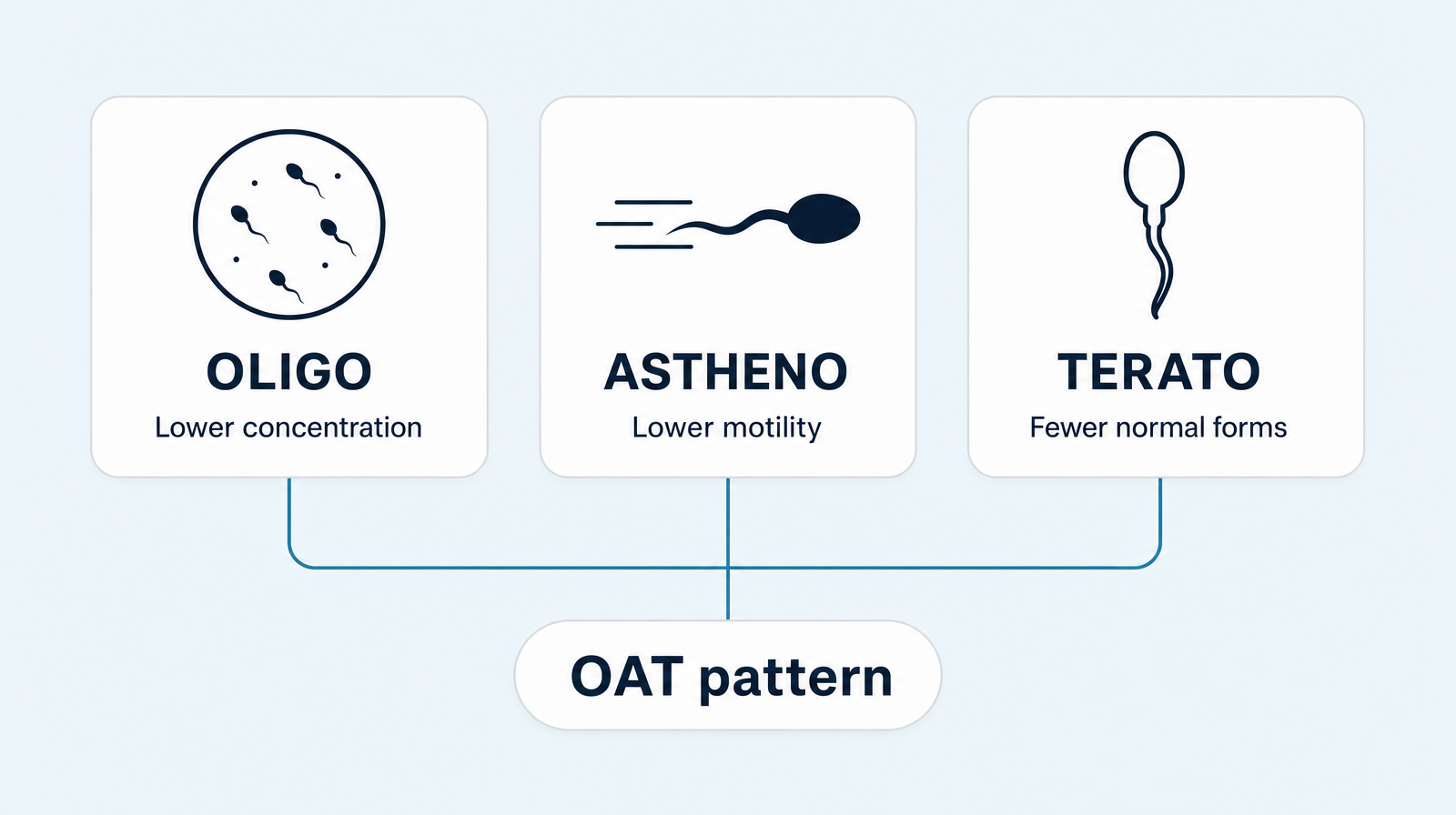
Oligo-astheno-teratozoospermia combines three semen-analysis findings:
- Oligo means a low sperm concentration or number.
- Astheno means low sperm motility, especially movement that progresses forward.
- Terato means a low percentage of sperm that meet strict criteria for typical shape.
You may also see the term written as oligo astheno teratozoospermia, oligoasthenoteratozoospermia, OAT syndrome or OATS. These names refer to the same three-part pattern.
Two similar terms describe only two affected measures. Oligoasthenozoospermia means low count plus low motility, while oligoteratozoospermia means low count plus low morphology. Neither term confirms that all three OAT components are present.
OAT is a descriptive semen phenotype. The direct OAT clinical guideline uses the term when the three abnormalities occur together. It is not one disease with one cause, and it is not proof of sterility. The WHO sixth-edition manual moved away from using labels such as oligozoospermia, asthenozoospermia and teratozoospermia as formal diagnostic categories. Clinicians and laboratories still use the terms as useful shorthand.
Only a full semen analysis that measures all three parameters can identify the pattern. A home screen that reports concentration alone cannot show whether you have OAT.
How OAT appears on a semen analysis
Reports commonly compare your results with the WHO 2021 lower reference values:
| Parameter | What it measures | WHO 2021 lower reference value | What an OAT report may show |
|---|---|---|---|
| Sperm concentration | Sperm in each milliliter of semen | 16 million/mL | Below the reference value |
| Total motility | Sperm moving in any direction | 42% | Below the reference value |
| Progressive motility | Sperm moving forward | 30% | Below the reference value |
| Morphology | Sperm meeting strict criteria for normal forms | 4% | Below the reference value |
The reference value for total sperm number is 39 million per ejaculate. Some reports use total number as part of the oligo finding, while others emphasize concentration. Read both when they are available.
These values are lower fifth percentiles from about 3,500 men in 12 countries whose partners conceived naturally within 12 months. They are reference points, not a fertile-versus-infertile border. The current European urology guideline makes that limitation explicit and recommends interpreting the couple's full reproductive picture.
Morphology deserves special care. A result of 3% normal forms does not mean the other 97% are useless. Strict morphology scoring asks whether each sperm matches a narrow set of features under the microscope. It does not measure fertilizing ability on its own.
Can you get pregnant naturally with OAT?
Yes. Natural conception is possible with OAT. Persistent abnormalities across count, motility and morphology carry more weight than one mildly low parameter. Even so, a semen analysis cannot calculate your individual chance of natural pregnancy.
The likelihood and time required depend on details the acronym leaves out:
- how far each value is below its reference range
- total sperm number and total motile sperm count
- whether similar results appear on a repeat test
- how long you have been trying
- the cause, if one can be found
- intercourse timing and sexual function
- your partner's age, ovarian reserve, ovulation and tubal health
There is no trustworthy universal “OAT pregnancy rate.” Studies mix different degrees of impairment, causes, partner factors and treatments. A percentage without that context can be more misleading than useful.
You may also see severe OAT on a report. There is no universally accepted grading system that combines all three parameters. Clinicians often pay close attention when sperm concentration is below 5 million/mL because genetic abnormalities and impaired sperm production become more likely. That threshold is a prompt for a closer workup, not a complete severity score or an automatic IVF decision.
Confirm the result before planning treatment
Semen parameters vary between samples. An incomplete collection can lower the apparent count because the first portion of the ejaculate is often sperm-rich. Recent fever, the abstinence interval, transport time and temperature, medication changes and ordinary biological variation can also affect the result.
For men in couples with infertility, the WHO infertility guideline suggests repeating an analysis after a minimum of 11 weeks when one or more parameters are outside its reference ranges. That interval covers roughly one sperm-development cycle and allows some temporary influences to pass. The recommendation is conditional, and its evidence certainty is very low. A clinician may repeat sooner when sperm are absent or extremely low, or when collection problems could have changed the first sample.
For a useful confirmation:
- Use a laboratory analysis. The repeat needs concentration, motility and morphology, not a count-only screen.
- Follow the receiving lab's abstinence window. The WHO standardized range is 2-7 days. Your selected lab may give a narrower range.
- Collect the full sample into the approved container. Tell the lab if any portion was lost.
- Follow the exact handoff rules. Delays and temperature changes can affect motility, so do not assume that home collection is permitted.
- Record recent illness and medications. Do not stop a prescription on your own.
If you already have a report, you can upload your semen analysis to get a plain-English parameter breakdown. That interpretation helps you prepare questions, while a clinician evaluates causes and makes a diagnosis.
What can cause an OAT pattern?
OAT has several possible explanations, and more than one can apply at the same time.
OAT itself usually has no outward symptoms. Trouble conceiving may be the first clue. Pain, swelling, low sex drive or problems with erections or ejaculation can point to an underlying condition and deserve medical evaluation.
| Cause group | Examples | Why the distinction matters |
|---|---|---|
| Collection or temporary factors | Incomplete sample, nonstandard abstinence, transport delay, recent fever or illness | A properly collected repeat may look different after the temporary factor passes |
| Testicular or developmental factors | Undescended testicle, prior torsion or trauma, orchitis, testicular surgery, cancer treatment | History and examination guide further testing and prognosis |
| Hormonal factors | Pituitary or testicular hormone disorders, high prolactin | Blood tests can identify specific conditions that need specialist treatment |
| Medication or substance effects | Exogenous testosterone, anabolic steroids, chemotherapy and some other medicines | The prescribing clinician may need to change or supervise withdrawal from the exposure |
| Structural factors | A palpable varicocele, partial obstruction or ejaculatory dysfunction | Examination, semen volume, pH and directed imaging help separate these possibilities |
| Genetic factors | Chromosome differences or Y-chromosome microdeletions | Results can affect treatment, sperm-retrieval planning and genetic counseling |
Sometimes no cause is found after a standard evaluation. The European Association of Urology reports that this happens in about 30-40% of men with impaired sperm parameters. You may hear this called idiopathic male infertility. “Idiopathic” means the available workup did not identify the cause. It does not mean the result is imaginary or that you caused it.
What the medical workup usually includes
After persistent OAT, a reproductive urologist or clinical andrologist usually looks beyond the three numbers. The evaluation may include:
- reproductive, sexual, medical and family history
- past pregnancies and how long the couple has been trying
- childhood undescended testicle, torsion, infections, surgery, cancer treatment or trauma
- current prescriptions, testosterone, anabolic steroids, tobacco, alcohol, recreational drugs and relevant exposures
- examination of the testes, epididymides, vas deferens and possible palpable varicocele
- hormone tests, commonly FSH and total testosterone, with LH or prolactin added when the history or first results indicate them
- genetic counseling or testing when the concentration is very low and impaired production is suspected
The AUA/ASRM male infertility guideline recommends specialist evaluation when one or more semen parameters are abnormal. It also advises evaluating both partners at the same time. Waiting to finish one partner's workup before starting the other's can waste valuable time.
Extra tests should answer a specific question. Sperm DNA fragmentation, antisperm antibodies and scrotal ultrasound are not routine first tests for every man with OAT. A specialist may consider selected testing after recurrent pregnancy loss, failed fertility treatment, a concerning examination or another clear indication.
Can OAT be treated or cured?
There is no single medicine or procedure for the OAT label. Treatment targets a confirmed cause or helps the couple reach pregnancy when the cause cannot be reversed.
Some cases improve after a reversible cause is treated. Genetic and idiopathic patterns may persist. The practical questions are whether a treatable cause exists and which pregnancy plan gives the couple a reasonable chance without wasting time.
Treat a cause when one is found
- Clinical varicocele: Repair or embolization may be discussed when a palpable varicocele, infertility and abnormal semen parameters occur together. The WHO treatment guideline gives this a conditional recommendation based on low-certainty evidence and notes that the effect on live birth is unknown.
- Hormonal disorder: Gonadotropins are an established treatment for hypogonadotropic hypogonadism. Other hormone medicines belong in specialist care after blood-test confirmation.
- Confirmed infection: Antibiotics treat an identified infection. White blood cells alone do not prove infection and are not a reason for automatic antibiotics.
- Testosterone or anabolic-steroid suppression: Exogenous testosterone can reduce or stop sperm production. A fertility specialist should coordinate any change with the prescriber. Testosterone is not a treatment for low sperm count.
- Obstruction or ejaculatory dysfunction: Surgery, medication or sperm-retrieval methods may be appropriate for a defined structural or functional problem.
Use lifestyle changes for health, without expecting a guaranteed cure
Stopping smoking, avoiding anabolic steroids, moderating high alcohol intake, staying active and managing weight can support overall and reproductive health. A clinician can also review occupational exposures and medicines. These steps do not guarantee that all three OAT parameters will reach the reference range after one sperm-development cycle. Our guide to support sperm health explains the evidence behind common habit changes.
Supplements deserve the same caution. Trials use different antioxidants, doses, combinations and patient groups. WHO concluded that the evidence was insufficient to recommend for or against antioxidant supplements for male-factor infertility. No specific supplement stack has been shown reliably to reverse OAT or improve live birth. Discuss supplements with a clinician, especially if you take other medicines.
Natural conception, IUI or IVF with ICSI?
The treatment path is a couple-level decision. Repeat results, total motile sperm count, the time already spent trying, the cause, partner age and other reproductive findings all matter.
Continuing to try naturally
This may be reasonable when abnormalities are mild, the repeat result is more favorable, there is no urgent partner factor and the couple has not tried for long. A specialist can help set a time limit so that open-ended waiting does not delay useful care.
Intrauterine insemination (IUI)
IUI places processed sperm in the uterus near ovulation. Repeatedly low total motile sperm counts reduce its chance of success. The AUA/ASRM treatment guideline notes that fewer than 5 million motile sperm after processing is associated with limited IUI chances. This is a counseling threshold, not an absolute rule.
IVF with intracytoplasmic sperm injection (ICSI)
With ICSI, an embryologist injects one viable sperm into each mature egg. It can largely bypass problems with concentration, motility and morphology when enough viable sperm are available. It does not correct the cause of OAT, guarantee fertilization or ensure a live birth. IVF and ICSI outcomes also depend heavily on egg number and quality, embryo development and other couple factors.
When to move quickly
Arrange specialist care without waiting for the usual 12-month infertility mark if the report shows extremely low or no sperm, or if you have a history of undescended testicle, torsion, testicular surgery, cancer treatment, testosterone or anabolic-steroid use, sexual or ejaculatory problems, or a known genetic concern.
Couples commonly start an infertility evaluation after 12 months of regular unprotected intercourse. Start after 6 months when the partner who provides the eggs is 35 or older, and sooner when they are over 40 or either partner has a known fertility risk.
Sudden severe testicular pain is an emergency. A new testicular lump or swelling needs prompt medical assessment. OAT itself does not typically cause these symptoms. They should never wait on a fertility appointment.
Frequently asked questions
Is OAT the same as azoospermia?
No. With OAT, sperm are present, while three measured features are below reference values. Azoospermia means no sperm are found in the ejaculate after the laboratory follows the required examination process.
Does OAT cause birth defects?
The OAT pattern alone cannot predict a birth defect. A genetic condition that causes severe sperm-production impairment may have implications for offspring. That is why very low concentration and certain histories can lead to genetic testing and counseling before treatment.
Is sperm DNA fragmentation the next test after OAT?
Usually, no. It is not part of the routine initial evaluation. A specialist may discuss it in selected cases, such as recurrent pregnancy loss or failed assisted-reproduction cycles, and professional guidelines differ on when it adds value.
Get a clear repeat result
If you need to confirm an OAT result, we can arrange a physician-signed lab requisition and a local semen analysis at a participating CLIA-certified lab. No separate doctor visit or referral is needed for the order. Results typically arrive in 2-5 days, depending on the selected lab.
Related Resource Articles
-
Fertility Pills for Men: What Works and Who They Help
No pill works for every cause of male infertility. Compare supplements, Clomid, hormone injections, evidence, monitoring, and when treatment may help.
12 min read
-
Expert Guide to Male Disorders of the Reproductive System
Understand male disorders of the reproductive system. Get practical info on causes, symptoms, diagnosis, & steps for better reproductive health.
22 min read
-
A Man's Guide to Abnormal Sperm Morphology
Struggling to understand abnormal sperm morphology? This guide explains what it means for male fertility, its causes, and clear, actionable steps you can take.
22 min read