When you’re starting your fertility journey, hearing a term like "male factor infertility" can sound heavy and clinical. But let's break it down. It’s simply a medical term for when a health issue related to sperm makes it harder to conceive.
This has nothing to do with masculinity or virility. It's a common medical condition that affects millions of men, and this guide is here to give you clear, supportive information to help you understand what it all means.
Understanding Male Fertility Basics
If you're just starting out, that phrase might feel intimidating. The reality is, it's far more common than most men realize. This isn't a rare problem—it's a shared challenge for countless men trying to build a family.
Many men are surprised to learn that male factor infertility is a key component in 30-40% of infertility cases. This means fertility struggles are just as likely to be related to a male factor as any other cause.
To make things easier to grasp, let's look at the core concepts in a simple table.
Male Factor Infertility At A Glance
| Concept | Simple Explanation |
|---|---|
| What is it? | A medical condition where issues with sperm make conception difficult. |
| How common? | It plays a role in roughly one-third of all infertility struggles. |
| Is it just one thing? | No, it's a broad term covering issues with sperm count, movement, or shape. |
| Is it permanent? | Often, no. Many causes are treatable or can be improved with lifestyle changes. |
Understanding these basics is the first step toward feeling more in control of your health journey.
A Simple Analogy for Sperm Health
Thinking about sperm health can get technical fast, so let's use an analogy. Imagine your sperm are a fleet of delivery trucks trying to get a very important package to its destination. For the delivery to be successful, three things need to go right:
- Sperm Count (The Number of Trucks): You need enough trucks on the road to ensure a delivery can be made. If you have too few trucks, the chances of one making it to the final destination drop significantly.
- Sperm Motility (The Engine and Driver): Each truck needs a good engine and a driver who knows where they're going. Sperm need to be able to swim forward purposefully. If they're slow or just move in circles, they'll never reach their destination.
- Sperm Morphology (The Truck's Condition): The trucks themselves have to be well-built. A properly shaped sperm is essential for successful conception. If a truck is misshapen, it might not be able to carry its package or complete the final step of the delivery.
When one or more of these factors aren't optimal, that's what we call male factor infertility. It doesn't mean the delivery is impossible—just that there are some roadblocks that need to be addressed.
Facing a potential fertility issue isn't a final verdict. It’s the first step toward taking control, getting answers, and making a plan.
This guide is designed to demystify the process and give you actionable next steps. Knowledge is your most powerful tool, and you can learn even more by checking out our guide on the early https://herafertility.co/male-infertility-signs.
Uncovering the Causes of Male Infertility
So, you understand what male factor infertility is. The next logical question is why does it happen? The answer is rarely a single thing. Instead, think of it as a complex puzzle where medical history, environmental exposures, and daily lifestyle choices all fit together.
Pinpointing the root cause is the critical first step toward finding the right solution. Some factors are well within your control, while others might need a doctor's help. By breaking down the potential causes, you can start to see where your own health story fits and what you can do about it.
Medical Conditions Affecting Sperm Health
Certain medical issues can directly interfere with your body's ability to produce healthy, strong sperm. These are often the first things a specialist will investigate because their impact can be significant.
One of the most common culprits is a varicocele. This is essentially a varicose vein, but located in the scrotum. These swollen veins can raise the temperature inside the testicles, creating a hostile environment for sperm production. It's like trying to run a high-performance computer in a hot, stuffy room—it’s just not going to function at its best.
Other key medical factors include:
- Infections: Some infections, past or present, can cause inflammation and scarring that either block the pipes or damage the sperm-making cells themselves.
- Hormone Imbalances: The male reproductive system runs on a precise cocktail of hormones. When these levels are out of whack, the entire sperm production line can grind to a halt.
- Genetic Conditions: In some cases, genetic issues can affect how sperm develop or how the reproductive tract is built.
Many causes of male factor infertility stem from hormonal imbalances, making a deep understanding of the endocrine system crucial for both diagnosis and treatment. For a comprehensive overview, consult an essential endocrine system study guide.
The Impact of Environmental Factors
Your surroundings can play a surprisingly big role in your fertility. Exposure to certain elements can act as disruptors, subtly undermining the intricate process of making healthy sperm. It’s not always about obvious, hazardous waste; sometimes, everyday exposures are the problem.
We’ve known for a long time that heat is bad for sperm. The scrotum hangs outside the body for a reason—to keep the testicles slightly cooler than your core temperature. Frequent hot tub sessions, saunas, or even just resting a warm laptop on your lap for hours can raise that temperature enough to temporarily slam the brakes on sperm production.
Beyond heat, certain chemicals in our environment can mess with hormone function. These can be found in industrial settings, pesticides, and even some common household products. Doing what you can to minimize exposure is a smart, proactive step.
How Lifestyle Choices Shape Your Fertility
Finally, we get to the area where you have the most direct control: your daily habits. This is often the most empowering part of the puzzle because the choices you make every single day can either support or sabotage your body's ability to produce strong, healthy sperm.
Take diet, for instance. A diet loaded with processed foods and lacking key nutrients essentially starves your body of the raw materials it needs to build good sperm. On the flip side, a diet packed with fruits, vegetables, and lean proteins provides the perfect fuel for your reproductive engine.
Here are some of the most impactful lifestyle habits:
- Smoking: This is a big one. Smoking is consistently linked to lower sperm counts, sluggish motility, and more abnormally shaped sperm. Quitting is one of the single most effective changes you can make.
- Excessive Alcohol: Heavy drinking can tank your testosterone levels and torpedo sperm production. Moderation is absolutely essential for keeping your hormones in balance.
- Chronic Stress: High, unrelenting stress can interfere with the hormones needed to produce sperm. Finding ways to manage it, whether through exercise, meditation, or hobbies, is good for your whole body—including your fertility.
- Weight Management: Being significantly overweight or underweight can throw your hormones out of balance and hurt sperm quality. Maintaining a healthy weight through a good diet and regular exercise is a cornerstone of male fertility.
By looking closely at these three key areas—medical, environmental, and lifestyle—you can get a much clearer picture of what might be influencing your fertility and start taking action on your path to fatherhood.
How Doctors Diagnose Male Fertility Issues
When you're trying to figure out what’s going on with your reproductive health, the whole diagnostic process can feel a bit mysterious. For male fertility, though, the path to clear answers is often more straightforward than you might think. It usually starts with one foundational test that gives doctors a powerful snapshot of your sperm health.
This first step is all about gathering intel. It's not a final verdict or a judgment—it’s just a crucial look under the hood to see how your body is functioning. From there, a specialist can piece together the full picture and point you toward the right next steps on your journey to fatherhood.
The Cornerstone Test: A Semen Analysis
The single most important tool for understanding male factor infertility is the semen analysis. This test takes a close look at a semen sample under a high-powered microscope to check out the health and viability of your sperm. It’s a completely non-invasive and highly effective way to get real, hard data about your fertility potential.
Think of it like a tryout for a sports team. A coach wouldn’t just count how many players show up; they’d also see how fast they are and if they have the right skills for the game. A semen analysis does the same for your sperm, zeroing in on a few key metrics that determine your team's strength.
The infographic below highlights the main categories of factors—medical, environmental, and lifestyle—that can ultimately influence your test results.
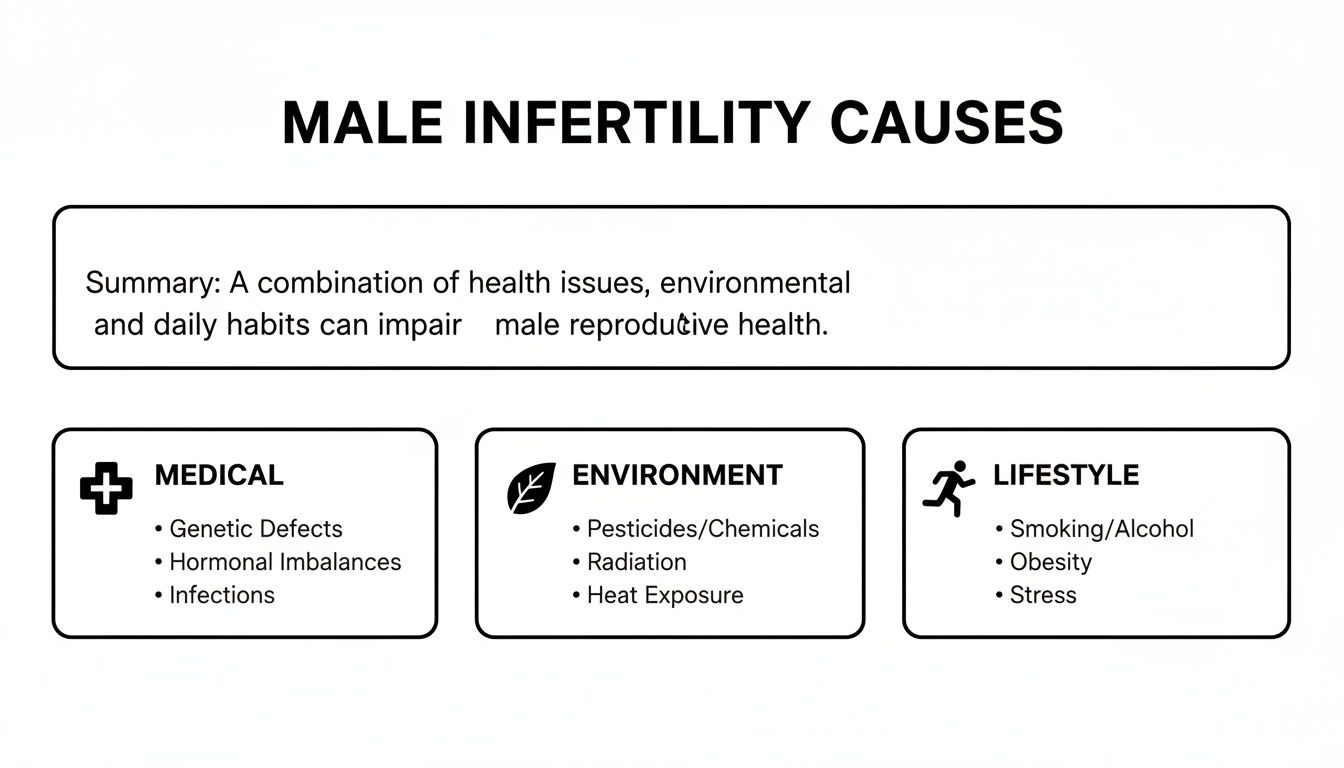
This just goes to show how connected your reproductive health is to your overall well-being, since any of these areas can have a real impact on your semen analysis.
What Your Semen Analysis Results Mean
Getting a lab report full of medical jargon can be overwhelming. Let's break down the three most critical parameters:
- Sperm Count (or Concentration): This is the number of players you have on the team. You need enough sperm on the roster to have a solid chance at success. A low count, known as oligospermia, means you have fewer players on the field.
- Sperm Motility (Movement): This is all about the speed and agility of your players. It's not enough just to have a lot of them; they need to be able to swim forward with purpose to achieve conception. Poor motility means your sperm are sluggish or aren't swimming in a straight line.
- Sperm Morphology (Shape): This looks at the physical form of your players. A sperm needs a specific shape—an oval head and a long tail—to do its job right. Abnormally shaped sperm might struggle to succeed.
These three core metrics give you a powerful baseline. If you're ready for a more detailed breakdown, you can check out our guide on how to read semen analysis results for a deeper dive.
To give you a clearer picture, here’s a quick reference table with the key parameters and their normal ranges based on the latest World Health Organization (WHO) guidelines.
Understanding Your Semen Analysis Results
| Sperm Parameter | What It Measures | WHO Lower Reference Limit |
|---|---|---|
| Semen Volume | The total amount of fluid in one ejaculate. | ≥ 1.4 milliliters (mL) |
| Sperm Concentration | The number of sperm per milliliter of semen. | ≥ 16 million sperm/mL |
| Total Sperm Count | The total number of sperm in the entire ejaculate. | ≥ 39 million sperm |
| Total Motility | The percentage of sperm that are moving. | ≥ 42% |
| Progressive Motility | The percentage of sperm swimming forward. | ≥ 30% |
| Morphology | The percentage of sperm with a normal shape. | ≥ 4% |
Remember, these are just reference points. A result below the lower limit doesn't automatically mean you can't conceive; it just gives your doctor a starting point for discussion.
When Doctors Need to Dig Deeper
Sometimes, the semen analysis flags a more complex issue, or the initial results aren't totally clear. In these cases, your doctor might suggest a few more tests to get the full story. These aren't always needed but can be key for pinpointing specific causes.
These extra tests could include:
- Hormone Testing: A simple blood test can check levels of testosterone and other hormones that run the show for sperm production. An imbalance here can often be fixed with medication.
- Genetic Screening: If a very low sperm count shows up, genetic tests can look for specific conditions that might be affecting your fertility.
- Physical Examination: A urologist might do a physical exam to check for structural problems like a varicocele (enlarged veins in the scrotum), which is a common and often correctable cause of male infertility.
These additional steps help your doctor connect the dots between your semen analysis and the why behind the numbers. This thorough approach makes sure any treatment plan is built on solid information, moving you from uncertainty to a clear, actionable path forward.
Exploring Treatment Options for Male Infertility
Getting a diagnosis can feel like a lot to take in, but it’s also the first real step toward a solution. The good news? For most men, male factor infertility is a very manageable condition with several clear paths forward. Treatment can range from simple lifestyle adjustments you can start making today to advanced medical care guided by a fertility specialist.

This journey is all about taking proactive steps. Let's walk through the options available to support your goal of becoming a father, starting with the changes that put the power right back in your hands.
Building a Foundation with Lifestyle Changes
Before diving into more complex treatments, specialists almost always recommend starting with lifestyle. These changes are low-risk, boost your overall health, and help create the best possible environment for sperm production. Think of it as preparing fertile ground before you plant the seeds.
Small, consistent habits can make a huge difference in sperm quality.
- Optimize Your Diet: A balanced diet packed with antioxidants, vitamins, and minerals gives your body the raw materials it needs to build healthy sperm. Load up on fruits, vegetables, lean proteins, and healthy fats.
- Manage Stress Levels: Chronic stress throws the hormones that regulate sperm production out of whack. Bringing activities like exercise, meditation, or just a relaxing hobby into your routine can help keep your system balanced.
- Quit Smoking and Reduce Alcohol: Both smoking and drinking too much have been directly linked to lower sperm count, poor movement, and abnormal shape. Cutting back or quitting is one of the most powerful moves you can make.
Medical and Surgical Interventions
When lifestyle changes aren't quite enough, or if a specific medical issue is found, your doctor might suggest more targeted treatments. These are designed to address the root cause of the problem, whether it's a hormone imbalance or a physical blockage.
For instance, if blood tests show a hormone deficiency, medication can often restore the right levels to kickstart healthy sperm production. For many men with specific endocrine issues, this is a straightforward and very effective fix.
Another common route is surgical correction.
A varicocelectomy is a minor surgery to repair enlarged veins in the scrotum (varicoceles) and is one of the most common and successful treatments for male infertility. By fixing the "overheating" issue these veins create, sperm production often bounces back.
These treatments are tailored specifically to your diagnosis, which is why a thorough workup is so important. They offer a direct way to fix an underlying problem and improve your chances of conceiving naturally.
Assisted Reproductive Technologies (ART)
For some men, especially those dealing with very low sperm counts or major motility problems, assisted reproductive technologies (ART) offer a powerful way forward. These advanced techniques help overcome biological hurdles by giving sperm a direct shortcut to conception.
The main ART methods for male factor infertility include:
- Intrauterine Insemination (IUI): This process involves taking a semen sample, concentrating the healthiest sperm, and placing them in a position that shortens their journey, boosting the odds of success.
- In Vitro Fertilization (IVF): With IVF, sperm and eggs are combined in a lab to create embryos. This method is often the go-to when sperm quality is a significant barrier.
- Intracytoplasmic Sperm Injection (ICSI): Often done as part of an IVF cycle, ICSI is a true game-changer for severe male infertility. A single, healthy-looking sperm is selected and injected directly into an egg, bypassing any issues with swimming or shape.
The global need for these services is huge. For example, in Africa, male factor infertility drives 58% of medically assisted reproduction cycles, but the demand is far greater than the available resources. This worldwide gap highlights the growing challenge men face in getting the care they need. You can read the full research about these global fertility trends.
From lifestyle tweaks to advanced medical support, understanding all your options is the key to moving forward on your path to fatherhood with confidence.
Taking Control of Your Fertility Journey
Understanding the ins and outs of male factor infertility is a huge step. But knowledge is only powerful when it leads to action. Now is the time to shift from learning to doing—taking a clear, tangible step toward getting the answers you need about your reproductive health.
The journey really begins with establishing a baseline, which is just a clear snapshot of your sperm health right now. This single action cuts through the uncertainty and gives you a solid foundation for every decision that follows, whether you're just starting to think about family or have been on this path for a while.
Your First Step: A Proactive Semen Analysis
Waiting for answers can be one of the most stressful parts of this process. The good news is that getting a semen analysis is more straightforward and private than ever before. It's the definitive first step in understanding your fertility, giving you hard data on the key metrics that truly matter—sperm count, motility, and morphology.
You don't have to navigate this alone. Services like Hera Fertility are designed to put the power back in your hands, making the entire process discreet and convenient. From ordering a physician-backed lab requisition online to getting tested at a certified lab near you, you can take control of your health on your own terms.
The whole point is to remove the barriers and give you direct access to crucial health insights.
Getting a baseline semen analysis isn't about looking for a problem; it's about gaining information. This proactive step is the key to taking charge of your reproductive health, no matter what the results show.
From Complex Data To Clear Answers
One of the biggest hurdles men face is trying to make sense of a confusing lab report filled with medical jargon. What does a morphology of 3% actually mean for you? How does a motility of 35% impact your chances of conception? Getting results without any context can leave you with more questions than answers.
This is where simplified reporting makes all the difference. With Hera Fertility, your results are translated into a clear, easy-to-understand Hera SmartScore. This score breaks down what each parameter means for your fertility in plain English, turning complex numbers into actionable insights.
Instead of a dense medical document, you get a clear interpretation of your sperm health and personalized recommendations for what to do next. For instance, your report might suggest specific dietary changes, or it might highlight the need to consult with a specialist. If you already have results from another lab, you can upload them for an instant analysis and get the same level of clarity.
Turning Your Results Into An Action Plan
Once you have a clear picture of your sperm health, you can start making informed decisions. A good report won't just throw data at you; it will guide you on what to do with it. Your action plan might include a few different strategies.
- Lifestyle Adjustments: If your results show some room for improvement, the plan might focus on targeted changes to your diet, exercise, or stress management. For more ideas, check out our guide on how to increase sperm count.
- Medical Follow-Up: For results that point to a potential underlying medical issue, the clear next step is to share your report with a urologist or fertility specialist.
- Peace of Mind: If your results come back strong, you gain valuable reassurance. That confidence can make all the difference as you move forward.
Ultimately, taking this first step transforms you from a passive observer into the active driver of your own fertility journey. It’s about replacing uncertainty with clarity and building a proactive plan for your future.
Your Next Steps and When to See a Specialist
Okay, you've taken in a lot of information. Navigating the world of male reproductive health can feel like learning a new language, but every piece of information you gather is a step toward clarity and control. You now have a solid understanding of what male factor infertility is and what it isn't.
This final part is all about turning that knowledge into action. Knowing when to keep digging on your own and when to bring in a professional is key to making real progress without wasting time or energy.
Making the Call to a Specialist
Deciding to see a doctor might feel like a huge step, but honestly, it’s one of the most empowering things you can do. A urologist who specializes in male fertility isn't just a doctor; they're a strategist who can interpret complex results, conduct a thorough evaluation, and map out a plan that’s built specifically for you. It's about replacing guesswork with an expert-led strategy.
You should seriously consider booking a consultation if you find yourself in any of these situations:
- You've received abnormal semen analysis results. Any parameter flagged outside the normal range—whether it's count, motility, or morphology—is a clear signal to get a professional opinion.
- You have a relevant medical history. If you've had testicular surgery, a known varicocele, hormonal issues, or genetic conditions in your past, a specialist can connect the dots in a way you can't.
- You’ve made lifestyle changes without seeing results. If you've spent several months cleaning up your diet, exercising, and cutting back on bad habits but aren't seeing the desired changes, it's time for a deeper look.
Remember, consulting a specialist isn't admitting defeat. It’s a strategic move. You're bringing an expert ally onto your team to find the most direct route to your goals.
The Power of Simply Understanding
If there's one theme running through this guide, it's this: understanding your fertility is a critical part of managing your overall health. For far too long, conversations about fertility have focused disproportionately on other factors.
Taking proactive steps to get tested and learn about what is male factor infertility completely changes that dynamic. It puts you in the driver's seat. Whether your results bring a sigh of relief or point toward a need for treatment, you'll have concrete information to work with. This knowledge transforms vague uncertainty into a clear, actionable plan for the future.
You Are Not Alone in This
Finally, it’s incredibly important to remember that you are not walking this path by yourself. Millions of men face these same questions and challenges every single day. The stress, frustration, or anxiety that can bubble up during this process is completely valid and, believe me, it's widely shared.
The most important takeaway is that there are clear answers and effective solutions out there. From advanced diagnostics and supportive online communities to dedicated medical professionals, a whole network of resources is ready to help guide you. By taking these next steps, you are joining a community of men who are proactively taking charge of their health and their future families.
Frequently Asked Questions About Male Fertility
Diving into male reproductive health can bring up a lot of questions. Let's tackle some of the most common concerns men have, cutting through the noise to give you clear, straightforward answers.
Can Lifestyle Changes Really Improve My Sperm Quality?
Yes, absolutely. While lifestyle tweaks can't solve every single cause of male infertility, they can have a surprisingly big impact. Simple, consistent changes create a much better internal environment for your body to produce healthy sperm.
Think about things like eating a balanced diet full of antioxidants, getting regular (but not extreme) exercise, and keeping your weight in a healthy range. On top of that, quitting smoking and cutting back on alcohol are two of the most powerful moves you can make—not just for your fertility, but for your overall health, too.
Think of it this way: your body uses the fuel you give it to build everything, including sperm. Better fuel almost always leads to a better-running engine and a higher-quality final product. These are often the very first things a specialist will recommend.
Is Male Infertility A Sign of A More Serious Health Problem?
Sometimes, yes. In certain situations, fertility issues can be the first clue that there's an underlying health condition that needs attention. This could be anything from a hormonal imbalance or a genetic condition to, in very rare cases, testicular cancer.
This is exactly why a thorough check-up with a specialist is so important. A semen analysis is a critical piece of the puzzle, but a good doctor will also look at your complete health picture to make sure nothing bigger is being missed. Getting tested isn't just about fertility; it's a proactive step for your long-term well-being.
How Long Does It Take to See Improvements in Sperm Health?
This is where patience really is a virtue. The entire lifecycle of a sperm—from its creation as a tiny cell to a fully mature swimmer—takes about 74 days.
Because of this biological timeline, specialists typically recommend waiting at least two to three months after you've made significant lifestyle changes or started a treatment before getting re-tested. This gives your body enough time for a whole new, hopefully healthier, generation of sperm to be produced and show up in your results.
If I Have a Low Sperm Count, Can I Still Have Children?
Definitely. Getting a diagnosis of low sperm count (oligospermia) just means the statistical odds might be a bit lower, but it is far from a dead end. Plenty of men with low counts go on to conceive naturally.
And if natural conception is proving difficult, modern medicine is incredible. Treatments and assisted reproductive technologies like IUI or IVF can be highly effective, helping men with even very low sperm counts become biological fathers. A diagnosis isn't the end of the road—it's just the starting point for a conversation with your doctor about the best path forward for you.
Take the first step toward clear answers. With Hera Fertility, you can order a physician-backed semen analysis, get tested at a lab near you, and receive a simple, easy-to-understand Hera SmartScore that explains what your results mean. Get your fertility baseline today at Hera Fertility.
Related Resource Articles
-
Understanding Secondary Male Infertility: A Clear Guide
Struggling to conceive again? Our guide to secondary male infertility explains the causes, diagnostic tests, and clear next steps to take for your health.
15 min read
-
CoQ10 Male Fertility Supplement: 2026 Science and Guide
Improve sperm health with a CoQ10 male fertility supplement. Our 2026 guide covers clinical benefits and how to create an action plan for your journey.
17 min read
-
Fertility Pills for Men: What Works and Who They Help
No pill works for every cause of male infertility. Compare supplements, Clomid, hormone injections, evidence, monitoring, and when treatment may help.
12 min read