A sperm test kit is essentially a first-look at your sperm health, all from the privacy of your own home. Think of it as a quick check-in. These kits usually measure one or two key metrics, like sperm count, to give you a baseline understanding of where you stand. It's a simple, initial step for any man thinking about starting a family or just wanting to get a handle on his reproductive health.
Your First Step in Understanding Male Fertility
Taking control of your reproductive health starts with getting clear, straightforward information. For many men, the whole topic of fertility can feel complicated, maybe even a little intimidating. But figuring out your starting point is a huge, empowering first move. It all begins with testing, and thankfully, men have more accessible options today than ever before.
Being proactive about your sperm health is always a smart move. It doesn't matter if you're actively trying to start a family right now or just planning for down the road. It takes the guesswork out of the equation and gives you real data to work with.
Why Male Fertility Testing Matters
For the longest time, the conversation around fertility pretty much ignored the male side of things. Getting tested gives you an essential baseline, helping you understand your own body and spot any potential areas for improvement early on.
This proactive approach lets you make informed choices about your health and lifestyle. And with different testing methods available, you can pick the path that feels right for you. The two main options are:
- At-home sperm test kits: These are all about convenience and privacy for an initial screen.
- Clinical semen analysis: This is the full-service, comprehensive lab test that gives you a much more detailed picture of your sperm health.
The growing demand for these options signals a big shift. More men are looking for convenient, private ways to check their fertility, without the old-school stigma or awkwardness of a clinic visit. This trend is shaking up the market, too. The sperm count test market is projected to hit USD 559.89 million by 2033, and at-home testing is a huge driver of that growth. You can dive deeper into these market trends and insights at Grand View Research.
Think of this guide as your roadmap to navigating these choices with confidence.
Comparing At-Home Kits and Clinical Lab Tests
When you decide to check your sperm health, you’ll find two main paths: the quick at-home sperm test kit and the more thorough clinical lab test. Knowing the key differences is the first step toward choosing the right option for you and getting the answers you’re looking for.
Think of it this way: an at-home kit is like checking the tire pressure on your car. It gives you a quick, important reading on a single metric—usually sperm count—to let you know if there might be an issue. It’s fast, totally private, and a great first step for many men.
A clinical semen analysis, on the other hand, is like taking your car to a mechanic for a full diagnostic service. It goes much deeper, looking not just at the number of sperm but also how they move (motility) and their shape (morphology). These factors are just as crucial for male fertility, and only a lab test provides this complete picture.
What At-Home Sperm Test Kits Measure
Most at-home kits are designed to do one thing: screen for sperm concentration. They give you a simple "yes" or "no" answer, telling you if your sperm count is above or below a certain threshold—often the one set by the World Health Organization as a baseline for normal male fertility.
While that's a useful piece of the puzzle, it’s only a small part of the story. A man can have a perfectly normal sperm count but still face fertility challenges if his sperm have poor motility or morphology. This is where most rapid at-home tests fall short. You can dive deeper into how to check your sperm count at home in our detailed guide.
The popularity of these kits is undeniable. The market for at-home sperm count tests is booming, with these kits holding 41.3% of the market share in 2024. This growth is driven by men seeking private, convenient ways to get initial answers, especially since male factors are a significant consideration in a couple's ability to conceive.
The Power of a Clinical Semen Analysis
A clinical semen analysis is the gold standard for a reason. It gives you a comprehensive evaluation that at-home rapid tests simply can't match. Here’s a look at what it covers:
- Sperm Count (Concentration): The total number of sperm in your sample.
- Motility: What percentage of your sperm are actually moving forward.
- Morphology: The percentage of sperm that have a normal, healthy shape.
- Semen Volume: The total amount of fluid produced.
- And more: Other important factors like pH and vitality are also checked.
To give you a clearer idea, here’s a direct comparison of what you get with each option.
At-Home Rapid Test vs. Clinical Lab Analysis
| Feature | At-Home Rapid Sperm Test Kit | Clinical Semen Analysis (via Hera Fertility) |
|---|---|---|
| Parameters Measured | Primarily sperm count (concentration). | Sperm count, motility, morphology, volume, and more. |
| Results | A simple "positive/negative" or "above/below threshold" result. | A detailed report with precise numbers and percentages for all key metrics. |
| Accuracy & Detail | Good for a basic screening, but limited in scope. | The gold standard for accuracy, providing a complete male fertility profile. |
| Privacy & Convenience | Very high. Can be done entirely from home. | High. Sample collection is done at home with mail-in convenience. |
| Expert Interpretation | None. You are left to interpret the basic result yourself. | Full clinical review and a personalized Hera SmartScore to explain what your results mean. |
| Best For | Getting a quick, preliminary check on sperm count out of curiosity. | Gaining a comprehensive understanding of your fertility, investigating conception challenges, or post-vasectomy confirmation. |
While a rapid test can be a good starting point, a clinical analysis gives you the full story.
This decision tree can also help you visualize which path might be right for your specific situation.
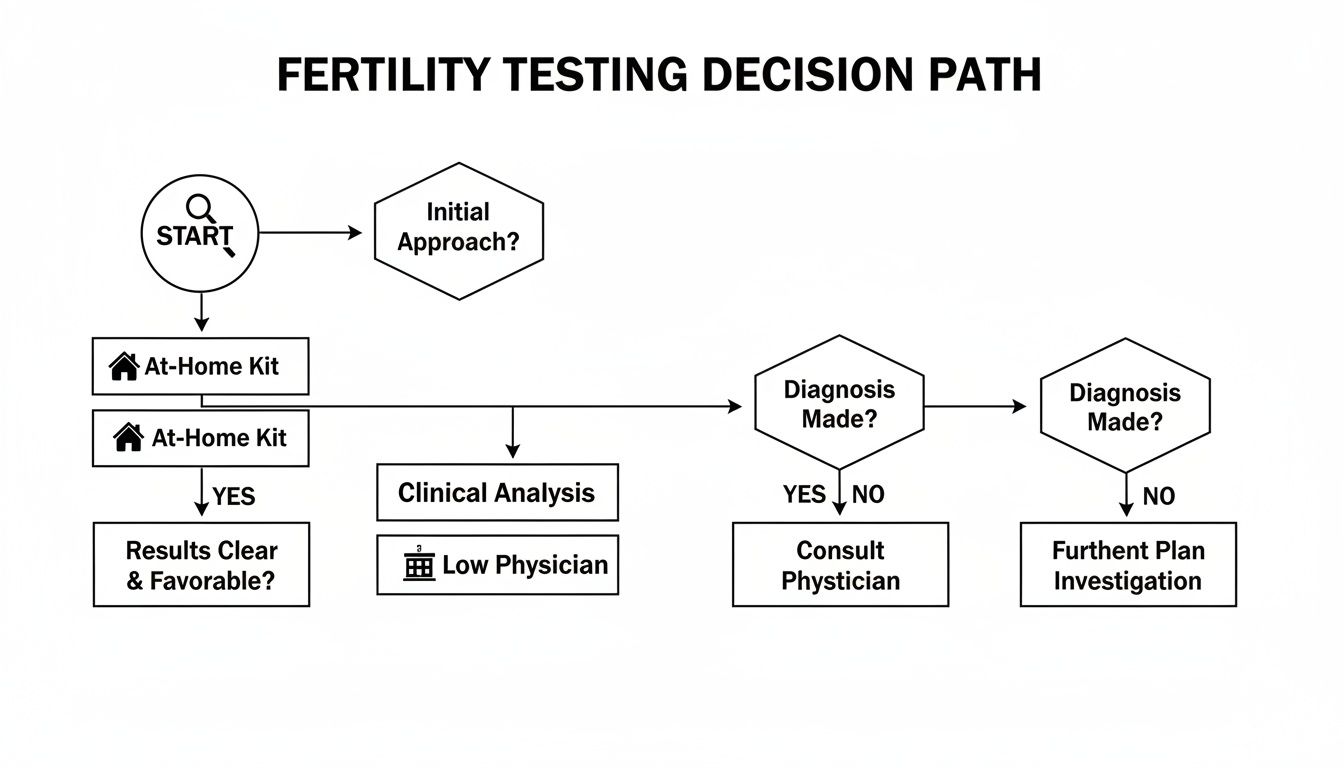
As the flowchart shows, while at-home kits are a solid entry point for a basic check, a clinical analysis delivers the detailed data you need for a complete fertility picture. Choosing a clinical test means getting actionable insights backed by professional analysis, taking all the guesswork out of understanding your reproductive health.
How to Get a Professional Semen Analysis with Ease
If a detailed, clinical-grade test feels like the right move, you'll be happy to hear the process isn't the awkward, inconvenient experience it used to be. Modern services have made getting a professional semen analysis simple, private, and totally on your terms. This guide will walk you through just how easy it can be.
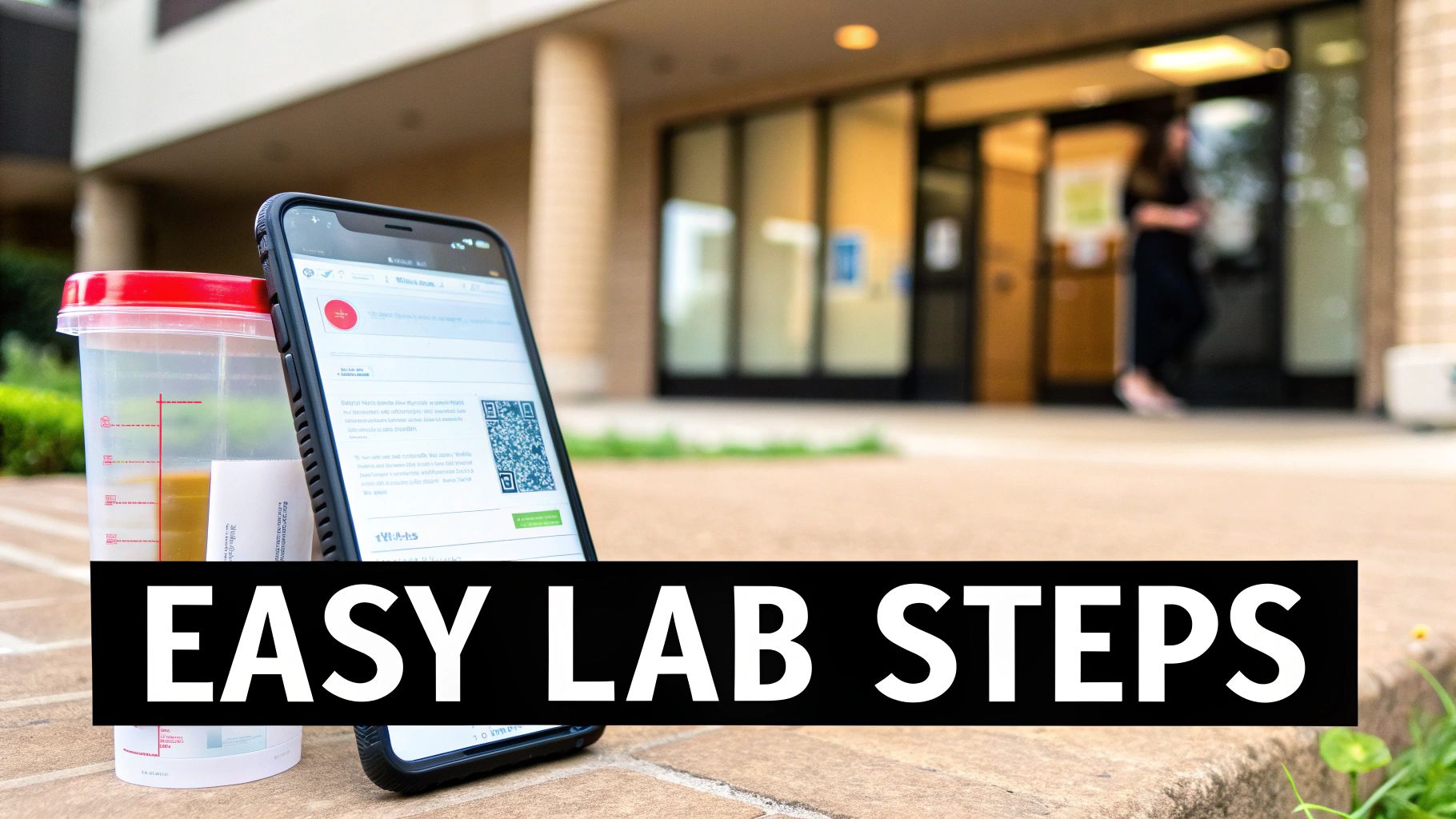
It all starts with getting a physician-approved lab order, which you can now do online in just a few minutes. This completely sidesteps the need for an initial doctor's visit, saving you time and getting the ball rolling right away. It’s a huge step forward in making male fertility testing more accessible for every man.
Once that order is in your hands, a few simple prep steps will make sure your results are as accurate as they can possibly be.
Preparing for Your Test
Getting ready for the test is straightforward, but it's absolutely essential for a reliable analysis. The main thing to focus on is timing your abstinence from ejaculation.
Here’s what you need to know:
- Abstinence Period: Plan to abstain from any ejaculatory activity for 2 to 5 days before collecting your sample.
- Why It Matters: Testing too soon can lead to a lower sperm count, but waiting too long can affect sperm motility (how they swim). Sticking to this sweet spot gives the lab the most accurate snapshot of your sperm health.
- Consistency is Key: If you ever need to retest down the road, try to use the same abstinence period. This ensures you can compare your results accurately over time.
This small bit of planning makes a massive difference in the quality of your test results, giving you a clear and dependable baseline to work from.
Taking control of your fertility journey starts with getting accurate data. Following these simple prep guidelines is the best way to arm yourself with information you can trust, setting the stage for clear next steps.
Collection and Lab Visit
The sample collection process is designed for total privacy and comfort. You'll collect your sample at home, in a familiar environment, which gets rid of the stress and pressure of trying to produce a sample in some sterile clinic room.
After collection, you just need to find a convenient lab to drop off your sample. With modern platforms, this is easier than ever. You can instantly find a certified lab near you from a huge network of locations, picking one that fits right into your schedule.
These places are staffed by pros who handle your sample discreetly and efficiently. For anyone wanting a professional semen analysis, understanding the ins and outs of equipping medical testing labs can give you some real insight into their quality standards. This streamlined approach—from the doctor's order to a quick lab visit—puts you firmly in control of your health journey.
Making Sense of Your Semen Analysis Results
Getting your lab results back is a huge step, but it can feel like you've been handed a document in a foreign language. A typical semen analysis report is packed with terms and numbers that aren't exactly self-explanatory. Let's break down the most important parts of your results into plain English, so you can see exactly what’s going on with your sperm health.

Think of your semen analysis as a scouting report for your sperm team. It doesn't just look at one stat; it evaluates the whole team's performance. The three star players we need to watch are sperm count, motility, and morphology.
Decoding the Three Key Sperm Metrics
To get a real handle on male fertility, you have to look beyond just the number of sperm. How they move and what they look like are just as vital.
Let's dive into each one:
- Sperm Count (Concentration): This is the total number of sperm in your sample—basically, the size of your team. Having enough sperm is obviously important, but it's only the first piece of the puzzle.
- Sperm Motility: This measures the percentage of your sperm that are actively moving forward, or "swimming." This is all about your sperm's hustle and drive. They have a long journey ahead, and they need to be strong swimmers to make it.
- Sperm Morphology: This one looks at the percentage of sperm with a normal, healthy shape. Think of this as your sperm having the right structure. An ideal shape is crucial for a sperm's potential to fertilize.
A low number in any of these areas can create challenges, which is exactly why a complete lab analysis is so much more insightful than a basic at-home sperm test kit that might only check for count.
From Complex Data to a Clear Score
Staring at all these different percentages and numbers can feel overwhelming. How do you know what it all means when you put it together? This is where a simplified scoring system can be a game-changer, boiling all that complex data down into a single, easy-to-understand number.
The Hera SmartScore translates all your detailed lab metrics—count, motility, morphology, and more—into one clear score. This number gives you an immediate, at-a-glance understanding of your overall sperm health without needing a medical dictionary.
This approach helps you grasp the big picture in an instant. It’s a bit like understanding how data analytics drives better clinical decisions in the wider world of healthcare—turning raw data into a clear, actionable insight.
Get a Free Analysis of Your Existing Report
What if you already have a semen analysis report from another clinic or lab? If you're struggling to make sense of it, you're definitely not alone. Many men get these reports with very little explanation of what the numbers actually mean for their goals.
You can upload your existing report for a free, instant analysis. Our tool provides the same clear scoring and interpretation, giving you the clarity you might be missing. It's a powerful way to turn confusing data into real knowledge about your reproductive health. You can learn more about how to read semen analysis results in our complete guide.
This push for clarity is part of a much bigger movement. As awareness around male fertility grows, the sperm test kit market has exploded and is projected to hit $7.09 billion by 2025. These new tools and services are finally giving men the nuanced insights they need to take control of their health.
Creating Your Action Plan After Getting Results
Getting your sperm test results is a major step, but it’s important to see it as a starting point, not the final word. Think of your report as a powerful piece of information—a guide for your next moves, whether you’re actively trying for a family or just checking in on your health. The key is to turn these numbers into a clear, positive action plan.
Regardless of what the report says, this is your opportunity to be proactive. You now have data that can help you make informed decisions about your health and lifestyle. Let’s walk through the different scenarios and outline some practical, supportive next steps for each one.
If Your Results Are in the Optimal Range
Seeing results that fall within the normal or optimal range is fantastic news. It's a huge confidence booster and provides some welcome reassurance. If you are trying to conceive, this information confirms that your sperm health is on the right track.
But even with great results, you can keep supporting your male fertility. Here’s what you can do:
- Maintain a Healthy Lifestyle: Keep focusing on a balanced diet, regular exercise, and good stress management. These healthy habits are the bedrock of solid reproductive health.
- Avoid Environmental Risks: Stay mindful of things that can harm sperm, like excessive heat from hot tubs or placing a laptop directly on your lap. Also, try to limit exposure to chemicals known to affect sperm production.
- Plan for the Future: If you’re not trying to conceive right now, your results give you a solid baseline. You can always re-test down the road to monitor your health over time.
This positive outcome gives you the green light to move forward with your family-planning goals with confidence.
If Your Results Show Areas for Improvement
Seeing results that are below the optimal range can feel disappointing, but try not to get discouraged. This is exactly why you got tested in the first place—to get clear information so you can take action. Many of the factors that impact sperm health are temporary and can be improved with the right changes.
An "abnormal" result from a single sperm test is not a final diagnosis. It's a signal to look deeper and start making positive adjustments. Sperm production is a continuous cycle, and your health today can directly influence the quality of your sperm in about three months.
Your first step is to focus on what you can control. Simple lifestyle modifications can have a significant impact on sperm count, motility, and morphology.
Here are some immediate, actionable steps to consider:
- Review Your Diet and Nutrition: Focus on a diet rich in antioxidants, vitamins (like C and E), and minerals (like zinc and selenium). Think leafy greens, fruits, nuts, and lean proteins.
- Evaluate Your Exercise Routine: Moderate, consistent exercise is great for your circulation and overall health. Just be careful to avoid overly intense workouts, which can sometimes have a negative effect on sperm parameters.
- Prioritize Sleep and Stress Management: Chronic stress and poor sleep can interfere with the hormones essential for sperm production. Aim for 7-9 hours of quality sleep a night and find healthy ways to unwind.
- Cut Back on Harmful Habits: Reducing or eliminating alcohol, tobacco, and recreational drugs can lead to measurable improvements in sperm health.
Making these changes can set the stage for better results down the line. After you’ve stuck with them for a few months, consider re-testing to track your progress. If your numbers haven't improved or you have specific concerns, it's a good time to consult with a specialist, like a urologist or a male fertility expert, who can offer more personalized guidance.
Common Questions About Male Fertility Testing
Stepping into the world of fertility testing can feel a little daunting, and it's totally normal to have questions. You’re taking a big step, and you deserve clear, direct answers. Let's tackle some of the most common questions men have, so you can feel confident and informed.
Think of this as a final check-in to clear up any lingering uncertainties before you move forward.
Are At-Home Sperm Test Kits Accurate?
This is a great question, and the answer is: it depends on what you're trying to learn. The rapid, over-the-counter tests you see online are pretty good at one thing: checking your sperm count. They can reliably tell you if your concentration is above or below a certain threshold.
But that’s just one piece of the puzzle. True male fertility is about much more than just the number of sperm. A complete semen analysis from a certified lab is the gold standard because it looks at the bigger picture: count, motility (how well they swim), and morphology (their shape). This comprehensive view is what gives you a truly accurate assessment of your male fertility.
How Should a Man Prepare for a Sperm Test?
Preparation is straightforward but super important for getting reliable results. The main thing to focus on is timing your abstinence from any ejaculation before collecting your sample.
- Abstinence Period: You'll want to aim for 2 to 5 days of no ejaculatory activity.
- Why It's Important: This window gives you the most representative snapshot of your sperm health. Too short a period, and your count might be lower than it actually is. Too long, and it can affect how well the sperm move.
Here's a pro tip: if you ever need to do a follow-up test, try to stick to the same abstinence period. That way, you’re comparing apples to apples and can track any real changes over time.
What Does the Collection Process Feel Like?
Let's be honest, this is often the biggest source of anxiety for men. The good news? The process has come a long way from the awkward, sterile clinic rooms of the past.
You no longer have to produce a sample on-demand in an unfamiliar setting. With modern mail-in lab kits, you can collect your sample in the comfort and privacy of your own home, completely on your own schedule.
This change alone removes so much of the pressure and stress. After collection, you just send the sample off to a certified lab in a special, temperature-controlled transport container that keeps it perfectly preserved. It’s the best of both worlds: the discretion of doing it at home combined with the clinical precision of a professional lab analysis.
Ready to get clear, actionable insights into your reproductive health? With Hera Fertility, you can order a physician-approved semen analysis, collect your sample at home, and get a detailed report with a simple SmartScore. Take the first step with confidence. Learn more and get started today.
Related Resource Articles
-
What Is a Good Sperm Count: A Guide to Understanding Male Fertility
Understand what is a good sperm count and how it affects fertility. Learn factors that influence it and practical steps to improve male health.
18 min read
-
Sperm Color Meaning: What Every Man Should Know
Unlock the sperm color meaning for your health. Our guide explains what different semen colors reveal about male fertility and when to see a doctor.
22 min read
-
A Man's Guide to the Sperm Count Test Kit
Explore your options with a sperm count test kit. This guide compares at-home vs. lab tests and explains what your results really mean for male fertility.
21 min read