So, you're ready to get some real data on your reproductive health. The first question on your mind is probably, "where can I get a sperm test?"
The most reliable and thorough answers will come from specialized andrology labs. These are expert facilities designed specifically for male fertility testing. You'll usually find them inside fertility clinics, and your doctor or urologist can refer you to one. Going to a professional setting like this is the best way to get a truly accurate picture of your male reproductive health.
Your First Step in Understanding Male Fertility

Whether you’re planning for a family, making sure a vasectomy was successful, or just want a baseline for your own health records, a sperm test is the definitive first move. The official term for this test is a semen analysis, and it's the gold standard for evaluating all the key factors that contribute to male fertility.
Think of it as the roadmap for your reproductive journey. This guide will walk you through all the practical options for getting tested, breaking everything down in a supportive way without confusing medical jargon. Our goal is to give you the confidence to choose the path that makes the most sense for you. As an actionable next step, here's a simple comparison of the main options available.
Sperm Testing Options at a Glance
| Testing Location | Best For | Typical Process | Key Feature |
|---|---|---|---|
| Fertility Clinic Lab | Men actively trying to start a family or seeking a comprehensive fertility evaluation. | Obtain a requisition from a physician, schedule an appointment, and provide a sample on-site in a private room. | The most comprehensive analysis, directly integrated with male fertility specialists for immediate next steps. |
| Independent Lab | Men who have a requisition from their GP or urologist and want a convenient, local option. | Your doctor sends a referral, you book a time at a lab like Quest or Labcorp, and provide a sample. | Wide network of locations, often covered by insurance for diagnostic purposes. |
| At-Home Test Kit | Getting a quick, private baseline of sperm count and/or motility without a doctor's visit. | Order a kit online, produce a sample at home, and either mail it to a lab or use a device to analyze it instantly. | Unmatched convenience and privacy, though less comprehensive than a clinical analysis. |
| Urologist's Office | Men experiencing specific symptoms (like pain or lumps) or needing a post-vasectomy check. | A urologist will assess your overall reproductive health and can order a semen analysis as part of the workup. | Combines the sperm test with a full physical examination by a specialist. |
Each route has its pros and cons, but they all lead to valuable information. The key is picking the one that aligns with your specific situation and goals right now.
Finding a Lab and Getting Started
For many men, the first hurdle is just figuring out where to go. A quick search for "semen analysis near me" will give you plenty of results, but it’s important to know that not all labs are the same. You really want to find a facility that specializes in this kind of testing.
A proper semen analysis is so much more than a simple sperm count. It's a detailed look at your sperm's ability to actually do their job. Choosing a specialized lab ensures you get precise, meaningful data to guide your next steps.
This is more important than ever. Male factors now play a role in 40-50% of cases where couples have difficulty conceiving. Getting clear, accurate information about your own reproductive health early on can make all the difference.
Thankfully, modern platforms are making this whole process much easier. For instance, Hera Fertility lets you get a physician-signed lab requisition online in minutes, connecting you with a network of over 250 CLIA-certified labs. You can get tested at a location near you and get results decoded into a clear SmartScore that covers count, motility, and morphology, complete with personalized action plans. You can learn more about how the growing sperm count test market is making care more accessible for men.
Why a Specialized Andrology Lab Matters
When your search for "semen analysis near me" pulls up a list of options, you'll see a mix of general diagnostic labs and specialized clinics. It’s tempting to think they’re all the same, but knowing the difference is critical. While a standard lab can perform the test, an Andrology lab—usually found within a fertility clinic—is the undisputed gold standard for male reproductive health.
Think of it like this: a general auto shop can change your oil, but you wouldn't trust them with a complex engine rebuild on a high-performance car. For that, you need a specialist who lives and breathes that specific engine. A general lab runs a semen analysis just like any other test, following a basic checklist. An Andrology lab, on the other hand, is built from the ground up for one purpose: analyzing sperm.
This specialization means their entire team consists of experts—called andrologists—who spend their days doing nothing but evaluating sperm. They are rigorously trained to spot the subtle details that have a massive impact on male fertility.
The Specialist Advantage in Sperm Testing
An Andrology lab delivers a level of detail that a general lab simply isn't equipped to provide. Their analysis goes far beyond a simple sperm count. They're doing a deep dive into the critical metrics that truly define your fertility potential.
These labs use highly advanced equipment and follow strict, standardized protocols, almost always adhering to the latest World Health Organization (WHO) criteria. This ensures your sample is being measured against the most current global benchmarks for what’s considered fertile.
Their expert focus covers key areas like:
- Sperm Count and Concentration: Not just a ballpark figure, but a precise measurement of the total number of sperm in your sample—a cornerstone of male fertility.
- Motility Analysis: This is more than just seeing if sperm are moving. They assess the quality of that movement. Are they swimming with purpose (progressive motility), or just twitching in circles? This distinction is huge.
- Morphology Assessment: A highly skilled andrologist examines the shape and structure of individual sperm. An abnormally shaped head, midpiece, or tail can make it impossible for a sperm to do its job, and only a trained eye can accurately identify these subtle flaws.
In a general lab, the technician running your sample might have looked at a few hundred sperm samples in their entire career. The andrologist looks at that many in a single day. This lack of specialized experience can easily lead to less reliable or incomplete results, giving you a fuzzy picture of your reproductive health. When you're making major life decisions, you need sharp focus, not a fuzzy picture.
Choosing a specialized Andrology lab is the single best way to ensure your results are more than just numbers on a page. They become meaningful data you can act on with real confidence.
Ultimately, the goal is to get a clear, accurate assessment of where you stand. An Andrology lab is staffed and equipped to give you exactly that. It removes the guesswork and provides the solid foundation you need to understand your fertility and map out your next steps.
Comparing Your Main Sperm Testing Options
So, you need a sperm test. The good news is you have options. But figuring out which path to take can feel a bit overwhelming. Are you just curious and want a convenient starting point, or do you need the most detailed workup possible?
Your answer will guide you to one of four main avenues: a fertility clinic, a urologist's office, an at-home test kit, or a sperm bank. Let’s break down what to expect from each.
Fertility Clinics and Andrology Labs
Think of this as the gold standard. For a complete, medically sound semen analysis, a fertility clinic is your best bet. These clinics have specialized Andrology labs on-site, staffed by experts whose entire job is to analyze sperm. They provide the most detailed report you can get on count, motility, and morphology.
This is the right move for any man who wants a thorough fertility evaluation. It gives you the highest level of accuracy and the best possible foundation for any future conversations with a men's health specialist. Your actionable next step would be to get a referral from your doctor or use a service to connect directly with a clinic.
Urologist Offices
A urologist is a specialist in the male reproductive system, which makes their office a fantastic place to start your journey. A good urologist will assess your overall reproductive health, perform a physical exam, and then write you a requisition for a semen analysis at a trusted lab.
This route is ideal if you're experiencing other symptoms or simply want a doctor's guidance from day one. It’s a holistic approach, combining a medical consultation with the testing process to give you the full picture.
So, when is a specialized lab non-negotiable? This decision tree makes it simple.
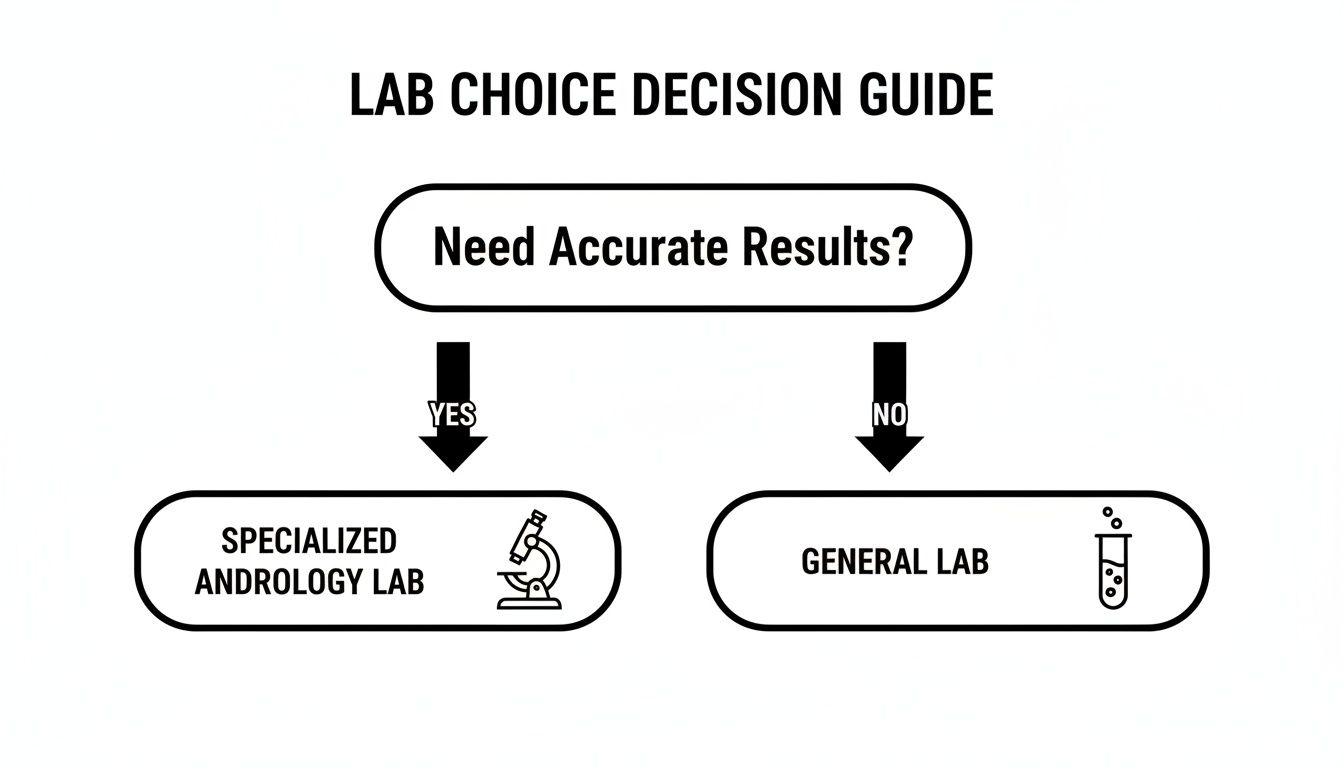
If you're making important health decisions, you need precise, reliable data. And for that, a specialized Andrology lab is the only way to go.
At-Home Sperm Test Kits
For men who value privacy and convenience above all else, at-home kits offer a quick, preliminary screening. These tests generally measure sperm count and, in some cases, a very basic form of motility. They're a decent first step if you just want a baseline without stepping into a clinic.
But—and this is a big but—they have major limitations. At-home tests cannot analyze sperm morphology (the shape of your sperm) or provide the detailed motility data a clinical analysis offers. They’re a screening tool, not a diagnostic one.
Think of it this way: an at-home kit is like checking your car's oil dipstick. It tells you one important thing. A full semen analysis at a lab is like getting a complete diagnostic from a master mechanic.
Sperm Banks
This option is in a category of its own. If you’re considering becoming a sperm donor, you'll undergo an incredibly rigorous semen analysis at a sperm bank. This process is far more detailed than a standard fertility test, often including extensive genetic screening and other health checks.
This path is specifically for men pursuing donation and isn't a typical route for a personal fertility assessment.
The great news is that awareness around male reproductive health is growing, and with it, the number of accessible testing options. The sperm count test market was valued at USD 2,473.8 million in 2025 and is on track to hit USD 3,844.3 million by 2032. This boom is fueled by more CLIA-certified labs and platforms that connect men directly with testing facilities. You can discover more insights about this market trend and see how it's changing men's healthcare.
Services like Hera Fertility are making it easier than ever to find labs near you and get a physician-approved test without all the usual hassle.
How to Prepare for Your Semen Analysis
 To get the most accurate snapshot of your sperm health, what you do before the test is just as important as the test itself. Think of it like prepping for a big presentation—a little groundwork ensures you get the clearest, most reliable results.
The single most important instruction is the abstinence period. Your doctor or the lab will be very specific about this, asking you to avoid any sexual activity that leads to ejaculation for 2 to 5 days before your appointment.
This isn't an arbitrary window. It's a carefully calculated balance. Abstaining for less than two days can mean a lower sperm count in your sample. On the other hand, waiting longer than five days can actually hurt sperm motility, as older, less active sperm start to build up.
Key Preparation Steps
Beyond timing your abstinence, a few other simple guidelines can make a big difference in the quality of your sample and the accuracy of your results.
- Avoid Harmful Lubricants: This is a big one. Many common sexual lubricants can damage or kill sperm. If you absolutely need to use one, ask the clinic for a sperm-safe alternative.
- Steer Clear of Excessive Heat: High temperatures are a known enemy of sperm production. In the days leading up to your test, skip the hot tubs, saunas, and long, steaming hot baths.
- Limit Alcohol and Substance Use: It’s wise to avoid alcohol and recreational drugs before your analysis. These substances can throw off your sperm parameters, and you want the test to reflect your baseline health.
Following these steps isn't just about checking off boxes on a list. It's about giving yourself the best shot at a clear, accurate result that truly reflects your reproductive health. A good sample is the foundation for everything that follows.
What to Expect on Test Day
Walking into a clinic for a semen analysis can feel a bit awkward, but rest assured, the process is designed to be professional, private, and surprisingly straightforward.
Once you check in, you'll be shown to a private collection room. These rooms are designed specifically for this purpose to be both comfortable and sterile. A staff member will provide a sterile collection cup and give you clear, simple instructions.
After you've produced the sample, you'll pass it to a lab technician, often through a small, secure window that ensures your privacy is respected the entire time.
While a clinical test provides the most detailed and accurate results, some men prefer to start with a more private first step. If you're curious about an initial screening before heading to a full lab analysis, our guide on how to check sperm count at home is a great place to start.
Making Sense of Your Semen Analysis Results
 Getting a lab report back can feel like trying to decipher a secret code. It’s packed with technical terms and numbers that don't mean much on their own. But learning to read your semen analysis is one of the most powerful steps you can take for your reproductive health. This report gives you a clear, data-driven snapshot of the key factors influencing your fertility.
Think of it like a scouting report for a sports team. To have a winning season, you need enough players on the field, they have to be fast and agile, and they need to be in the right shape to do their job. A semen analysis is doing exactly that for your sperm, focusing on a few core metrics established by the World Health Organization (WHO).
The Three Pillars of Sperm Health
Your report will zero in on three essential parameters. Each one tells a crucial part of your fertility story, and understanding them is the first step toward taking action.
- Sperm Concentration (The Players): This is simply the number of sperm you have per milliliter of semen. A high number of players on the field is the first step toward increasing the odds of success.
- Sperm Motility (Their Movement): This metric is all about how well your sperm can swim. Specifically, the lab looks for progressive motility—the ability to swim forward with purpose, not just wiggle around in one spot.
- Sperm Morphology (Their Shape): This refers to the physical structure of your sperm. A "normal" sperm has a smooth, oval head and a long, single tail, a design that's essential for its function.
Each of these numbers is just one piece of a larger puzzle. When you see how they all fit together, you start to get a much clearer picture of your overall fertility potential. For a much deeper dive into what each number means for you, check out our complete guide on how to read semen analysis results.
Key Semen Analysis Parameters Explained
To make it even clearer, here’s a quick breakdown of the main metrics you’ll see on your report and what they mean, based on the latest WHO guidelines.
| Parameter | What It Measures | Normal Range (WHO 6th Edition) | Why It Matters For Male Fertility |
|---|---|---|---|
| Semen Volume | Total amount of fluid in one ejaculation | ≥ 1.4 mL | Sufficient fluid is needed to transport sperm. |
| Sperm Concentration | Number of sperm per milliliter of semen | ≥ 16 million/mL | A higher density of sperm increases the chances of success. |
| Total Sperm Count | Total number of sperm in the entire sample | ≥ 39 million | The overall number of "players" available. |
| Progressive Motility | Percentage of sperm swimming forward | ≥ 30% | Sperm need to be strong swimmers to complete their journey. |
| Total Motility | Percentage of all moving sperm | ≥ 42% | Overall movement, including those not swimming progressively. |
| Sperm Morphology | Percentage of sperm with normal shape | ≥ 4% | The correct shape is vital for the sperm to function properly. |
Understanding these individual numbers is a great start, but seeing how they interact is what truly matters.
Beyond the Numbers: A Comprehensive Score
While these individual metrics are important, trying to weigh them against each other can be confusing. Is high concentration enough to make up for low motility? That’s where a simplified, all-in-one score can make a world of difference.
A semen analysis is more than just a test; it's a tool that translates complex biological data into a clear starting point for your health journey. It empowers you with the knowledge to make informed decisions.
Modern platforms are now designed to take the guesswork out of this process. For instance, Hera Fertility's SmartScore combines all of these complex parameters into a single, easy-to-understand rating. It translates the raw lab data into a straightforward assessment, helping you instantly grasp where you stand without needing a medical degree.
Semen analysis is rapidly becoming a mainstream tool for proactive male health. The global market hit US$962.86 million in 2024, with North America leading the way. For men asking "where can I get sperm tested," platforms like Hera Fertility are the answer—connecting you to over 250 CLIA-certified labs, providing a physician-signed requisition, and delivering that powerful SmartScore that turns confusing results into a personalized plan. You can learn more about the growing semen analysis market and how it's changing men's health.
What to Do After You Get Your Results
Getting your semen analysis report back is a big moment, but it’s just the beginning. Think of these results less like a final grade and more like a detailed map. It shows you exactly where you stand and gives you the power to chart a course for your reproductive health. What comes next depends entirely on what that map reveals.
If your numbers all fall within the normal range, that’s fantastic news. Your next step is simply to maintain that good health. Simple, consistent habits—like eating a balanced diet full of antioxidants, getting regular exercise, and keeping stress in check—can go a long way in preserving your sperm quality for the future.
When Results Show Room for Improvement
If your report highlights a few areas that could be better, don't get discouraged. This is precisely why you got tested in the first place: to get real, actionable data. The single most important next step is to book a follow-up appointment with a men's health specialist, like a urologist or a male fertility expert, to walk through the results and build a plan.
Your specialist will probably recommend a mix of strategies tailored to your specific results. These often include:
- Lifestyle Adjustments: You’d be surprised how much impact small changes can have. Improving your diet, cutting back on alcohol, quitting smoking for good, and finding healthy ways to manage stress are always the first line of defense.
- Further Investigation: Sometimes, the report points to an underlying issue. Your doctor might suggest more tests to check for things like a hormonal imbalance or a varicocele (a common condition involving enlarged veins in the scrotum).
- Follow-Up Testing: It takes about 72 days for your body to produce a new batch of sperm. Because of this cycle, your doctor will likely want you to do another semen analysis in a few months to see if the changes you've made are having a positive effect.
A semen analysis is your personal health roadmap. It points out where you are right now and helps a specialist guide you toward where you want to go. It’s the starting point for a proactive conversation about your health.
As you move through this process, it's good to know that labs and clinics are bound by strict privacy rules to protect your sensitive health information. If you're curious about the specifics of how healthcare providers keep communication secure, this HIPAA compliant healthcare communication guide is a helpful resource. Ultimately, your results are the key to unlocking the next phase of your health journey.
Common Questions About Sperm Testing, Answered
Getting a handle on male fertility testing can feel a bit overwhelming at first. Let's clear up some of the most common questions men have when they're thinking about getting a semen analysis.
Do I Need a Doctor's Referral for a Sperm Test?
For the most part, yes. Clinical labs and fertility centers will almost always ask for a requisition form from a doctor before they run the test. This is actually a good thing—it ensures the results become part of your official medical record and get interpreted correctly by a professional who knows your health history.
But here’s the modern twist: getting that referral doesn’t necessarily mean you have to book a separate, in-person doctor's appointment. Newer platforms can get you a physician-signed lab order entirely online, connecting you directly to a certified lab without all the extra hassle. This approach makes the whole process way faster and more straightforward.
How Much Does a Semen Analysis Cost?
The price tag for a semen analysis can bounce around quite a bit, but you can generally expect it to be somewhere between $100 and $300. The final cost really depends on the lab you choose, where you live, and just how deep the analysis goes.
Insurance coverage is another variable. Whether or not your plan covers it often comes down to why you're getting the test. A test ordered to diagnose a potential male fertility issue is much more likely to be covered than one done for simple curiosity. The best actionable step is always to give your insurance provider a quick call to see where you stand.
How Long Does It Take to Get My Results Back?
You're usually looking at a wait time of a few days up to a week. The exact turnaround time often depends on the type of facility you go to. Specialized Andrology labs—the ones that handle these kinds of tests all day, every day—are typically quicker than general-purpose labs.
This is another area where digital health platforms can really speed things up. They can deliver your professionally interpreted results straight to a secure online portal the moment they're ready, so you’re not left waiting for a follow-up call or another appointment.
Ready to take control of your reproductive health with clarity and confidence? Hera Fertility makes it simple. Get your physician-approved lab order online, test at a certified lab near you, and receive a clear, easy-to-understand Hera SmartScore that breaks down your results into actionable insights.
Related Resource Articles
-
Do You Need a Doctor Order for Semen Analysis?
Unsure if you need a doctor order for semen analysis? This guide explains the process, why it's required, and how to easily get tested for male fertility.
17 min read
-
Sperm Analysis Cost Near Me: A Man's 2026 Guide to Frisco, TX Options
Searching for sperm analysis cost near me in Frisco, TX? Our guide covers pricing, lab options, and actionable steps for men's reproductive health.
15 min read
-
Where to Get a Sperm Test: A Practical Guide for Men
Wondering where to get sperm test? Discover your options—from clinics and urologists to at-home kits—with clear, actionable guidance.
19 min read